Tuesday Testlab Sketching - 03-18-25
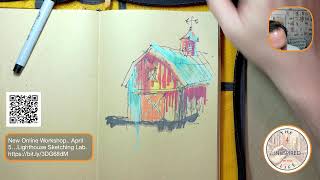
Jason Nicholas tests sketching materials on kraft paper, including watercolor sticks, graphite pencils, and markers. He sketches a wonky barn with a gambrel roof, showing how each tool behaves wet and dry, and notes the paper handles moisture well with minimal bleed-through.
Chapters
Hello, happy Tuesday! Hope you're having a great day today. Welcome to Tuesday Test Lab sketching. You can see I have a bunch of different items here, um, that I haven't used yet on this kraft paper, so I thought it'd be fun just to spend a few minutes playing around, experimenting, and seeing how these materials, um, work on the paper. So it's about having fun, being playful, and experimenting. So if you're having a great, great day, I'm Jason Nicholas Nicholas with The Inkspired Life, where sketching architecture and urban sketching are my passions in life. I love doing this stuff, it's so fun, and just gotta have a playful attitude. So let's go for it, let's create something. Feel free to say hello or leave a question or comment for me. I'll be checking the chat, and this is going to be really quick. Let's see, about 10 minutes I'll be on. All right, so I've been really liking this, um, Soho craft paper. It's fairly thin. It does bleed through if you, you know, add watercolor or you add a lot of like, uh wet ink or even Sharpies will show through. You can kind of see it coming through on the other side there. But what I love about this paper so far is the intensity and the, the way the colors are just coming out on here. So it's been a lot of fun to use. So let's, uh, play around tonight. Let's see, I think one of my favorite sketches so far has been this. I really love this lighthouse. Zoom in even closer. Cool. Alrighty, let's do it. No particular order. I have an Aqua Brush here. Aqua Brushes are great if you want to do some watercoloring or use watercolor pencils or anything you need like to add water on, especially while you're out and about. These are really convenient. You can store water right inside here. So I really love the Aqua brushes. Of course I have a Sharpie. Always, always have a Sharpie. Uh, tonight I'm going to play around with this Art Graph water-soluble graphite stick. There is, there is some in here. I think it broke, but we'll see if we can get some of that out. Yeah, there you go. So we're going to play around this on the kraft paper, see what it looks like. And I also have a— what is this, a Daniel Smith, I think— Graphite Gray watercolor stick. So let's throw that on here as well. And I have some water, and I think we'll even break out maybe, uh, one or two of these watercolor pencils. Of course, I gotta get this color, my favorite color, here. And we'll see, we'll see what else we just grab and go with. All right, uh, I'm not really sketching anything in particular. No, my only intention tonight is to be playful. So even if I just throw down some color, so throw down some lines and see what happens. All right, cool. All right, so yeah, feel free to say hello again. I'll be checking the comments in a couple minutes or so. I mean, I like to, I like to sketch with my watch off, so let me take my watch off. We're gonna sketch tonight, uh, I have no idea. Let's see, maybe we'll do a barn. We'll do a quick kind of loose wonky barn. In architecture class today we were talking about roof styles, and I was talking about the gambrel roof, which is a typical barn roof. They're called the gambrel, uh, it's called a gambrel roof style. So we kind of have a gambrel roof there. We'll give a little kind of a quick perspective maybe happening there. Boom. It's always fun to sketch old wonky buildings, wonky barns. Let's do a roof. Let's do a little— do like a little cupola on the roof. So if you don't know what a cupola is, cupolas are Let's see, that would be like that. Cupolas are these roof-like structures on the top of barns, um, used for ventilation. So you have these vents on here. Typically you'll see like a— some kind of weather vane or something on them as well. All right, awesome sauce. Let's just throw down some color. Let's test these materials out and see what they look like on this kraft paper. Again, this is Test Lab Tuesday sketching, just being playful. Let's go for— I don't know, again, this paper is really thin, so I can't get it too wet. So let's just throw down some of this Daniel Smith Graphite Watercolor Stick. And typically I actually like to dip— I like to dip the watercolor stick right in water. I'm just going to turn up my music a little bit. And this is cool because it just kind of melts like butter on the paper when you wet it first. You can also use these dry. You can also put it on dry, then add water on top of it. So a lot of different ways to use this. All right, so we got that on there, and then we'll take a look and we'll flip it over after it dries. We'll see how much is bleeding through onto the other side. This is a graphite stick, water soluble, by Art Graph. Love these. If you guys are interested in the tools and materials I use Um, on my website I have a tools and materials section. You can click on that and see a lot of the different sketching tools I like to use, so feel free to check that out. Again, I'm just going to dip this in water and just mess around with it. I've done some really cool sketches with this Art Graph of the Domino Sugar Factory, also, um, the Chrysler Building, which if I remember, I think I actually gifted that sketch to a student last year. Um, I love graphite sticks. All right, nothing colorful yet. Let's grab one of these. This is a um, watercolor pencil, Distress watercolor pencil. It's fun, guys, just to get messy, throw down some color. Again, my only intention is to be playful with these materials, see what they look like on this this kraft paper. I am just going, just going for it. So this is that watercolor pencil. It's going to hold it here and let it kind of melt onto the paper. You can see it getting a little melty there. I need some vibrancy. Let's pop some yellow. I think this is dry. I didn't dip it in water. Let's just throw it on dry and see if I color it on there. So that's dry. Boom. It's like a crayon. And let's take a little bit of water with the Aqua Brush, go over top of it. I'm going to grab another color. This is called Fired Brick. Fired Brick. Gotta have some red on a barn, right? Why not? So that's the watercolor pencil dry. Let's throw a little bit of water on there. I really like this red color. When you add water, it intensifies it. I like to call this sketch painting, or basically just, well, we're sketch painting. That was, that was really descriptive, wasn't it? Wow, genius here. I'm just— I am just kidding. Um, there we go. I'm liking this. It's almost like a rusty color. It looks really cool next to that blue, that patina. What is this called? Salvage Patina. That is like the best name ever for a color. All right, let's— I'm curious to see how this is going, how it's bleeding through the page. So this paper is not really designed for doing washes of stuff. You can see, um, I don't know if you can see it on camera, it's just— it's wet, so it's all bumpy. And the only thing that really bled through is the Sharpie. Up here. So maybe you— this can handle very light washes of color. Let's see, I want to add some more of— let's grab this Patina. I have a warning, a warning about these color watercolor pencils. They are so messy. Like, I always end up getting them all over my fingers. My hands, which is, which is okay because I always like to say it's not art unless you wear it. So you're officially making art, guys. We are wearing it on our finger. And I don't know why I said me in like third person because— yeah, look at this. I love the intense, the intense that's happening here, the intensity. I think now that the watercolor pencil had some time to kind of dissolve a little bit more, it's just going on really vibrantly, which I love. All right, I'm gonna check the chat, say hello, see how you guys are doing, see who's out there tonight. Jody, how are you? I love these short features. 10 minutes, you have a masterpiece. Well, thanks. Um, it's just a masterpiece in playfulness, that's all I'm doing. So I appreciate your kind, kind words. What I'm really trying to get out there is for you guys, um, just throw stuff on paper. It's only paper. I think that creative mindset is huge. It it shatters, um, fear of starting a sketch or, or even a painting, right? Just throw stuff down, be playful, be experimentive. Hey D-Ray, great to see you, hope all's well. Janice is in the house. Janice, good to see you as well. Test Lab Tuesday, huh? Yeah, I kind of like that. I thought it was kind of a catchy name. Test Lab Tuesday. We're testing things out, we're having fun, we're experimenting. I can't resist, I gotta break out some of the— let's break out the Creative Markers. We'll take this up a level, I hope. And what I mean, take it up a level, just to add a little more intense color on it. So I probably would use this Graphite Gray and also the Art Graph for adding some shade, some shadow— shadows. Do I have an example? Let me look back here. Just looking on my wall, I don't have a graphite sketch. I'd like to pull one out. Just give me a second and go into the magic drawer back here, see if I can pull out a graphite sketch. Well, actually, Retro Here we go. Here's Retro, guys. If you haven't met Retro, um, you may have seen some posts I've had recently about my online store, and I have a mug that says Sketch Happens. Well, here is the original Retro sketch, and this is actually graphite right here, except for the red. Uh, this is a mix of graphite and also the the Daniel Gray watercolor stick. So here's a really— just a really cool example. And what I love about using the graphite stick is I love this kind of look you get with like the texture happening of the paper underneath. So for me, texture of the paper is another art technique or art tool, right? Use the texture of the paper um, as your friend. But here's Retro. Retro the Wonder Pup. Haven't sketched him in a long time. Maybe I should keep Retro out here so I can see him. Yeah, if you like Retro, you can definitely get Retro on them. Do I have my mug? I have my mug here, actually. I'm using it. Sorry, sorry for the plug. There it is. Can't turn it too much. That's, that's the sketch on a mug. I change it to sepia tone here, and I have some cold coffee in there. Cool. I'll keep Retro. We'll put him here. I, I like the red on there, the Creative Marker. It looks cool with the yellow shining through underneath. Uh, let's break out the Sharpie. I want to add some details on here. Sketching architecture, one of the things that it's about is layers, just adding some layers. So I would call this either the material layer or the texture layer. So I'm adding kind of the wood siding material happening, just, just takes it up a level. You know, architecture and buildings are about different building materials, construction. Materials, right? So it's cool to indicate them on your sketches if you can. Let's do a big X here. We'll say this is the barn door. Not sure what color we'll do that yet. Sharpies do not like to write— Sharpie markers do not like to write on wet areas. If I have my Sharpie gel pen here somewhere Jump. Here we go. Love it, love it. Got everything right here. This is what I call grab and go creativity. You're just grabbing and going with what is at arm's length here. All right, we're gonna wrap in like 2 minutes, so I'm going to show— let's do, uh, make this metal siding maybe on the roof. Just add some lines here for where the, the metal seams would be, where the roof planks kind of meet. And I do want to add— maybe we'll come back in with some of that graphite and we'll add I should dry this. Um, I'll add some shading or some— yeah, some shadow underneath the overhang so it pops. I also want to hit that door color. I'm not sure. All right, I'm thinking, I'm thinking. Let's— I, I am just gonna— I don't know why You know what, I'm just gonna grab it and go with orange. It's right here. I'm just gonna pull the orange out of here. I'm gonna pull the orange. Hey, pulled out of my hat like a magician. You pull the orange out of my hat. I just wanted a color that would really pop this door out a little bit. Well, a lot a little bit, because that is not a little bit. It's not that subtle. Boom! Now you can see where that door is. And since we got some orange there, let's just pop some up here. Sure, we'll throw some under there as well. All right, cool. So we got some orange happening, and let's add our shadow. Actually, I think we're going to use the watercolor stick. All right guys, I'm going to wrap in a minute or two. Let me know if you have any final questions or comments, or— I just spilled my water. Um, any thoughts about tonight? Got a boldy shadow happening there, super bold. Can't take me anywhere. I spilled my water. What's going on? All right, I also want to bold out the edge of the building. We're just going to use this since we have it with us. Whoa, I really popped the edge out. Holy manolis. And for the heck of it, let's just grab last thing I'm going to add right now. And D-Ray, I'm sure D-Ray just rolled— you just rolled your eyes, D-Ray. You're like, he always says it's the last thing and he keeps going. You guys know me, come on. I love this stuff. Sometimes it's hard to stop. And yes, I almost dipped this, dipped this into my coffee, which would have been okay. I'm kind of done with it anyway. It's kind of late to be drinking it. Is it 9 o'clock? Not yet. My brain is— my brain schedule is so off today. Sketching for me is a great way to unwind, great way sometimes to actually get refocused. All right, let's throw some growies up here. Just kind of do this, make it look like we got some grass growing in front of the building, some— maybe some, uh, some— we got some weeds growing up here, some growies. It's a great way to anchor the building to the ground. And we got— I kind of like that green color on there. Cool. All right, so guys, this was, uh, thanks for joining me on Test Lab Tuesday sketching. Just wanted to try some different materials on this paper I haven't played around with before. Um, I like it. Uh, I like it. It's a good start. Again, I'm— this paper is not a fan of really getting wet, so probably would not be my go-to for doing washes on, but you don't know until you try. All right, thank you for watching. I'm Jason Nicholas Nicholas with the Inkspired Life. I love sketching buildings and architecture, and whether it's in the studio or urban sketching out in the field. Love, love, love doing it. More importantly, I just— more importantly, I love just sharing my creativity with you guys. Um, see if there's any final questions and we're out of here. DRS says thank you. Thank you, D-Ray, appreciate you. Always appreciate your comments, you're awesome. Jody, it was great seeing you in the house. And Janice, I think that's all I saw live tonight. Um, thank you if you're watching replay, thank you also. Remember guys, keep using your creativity for positivity, and I'll be back real soon. If you're interested in sketching lighthouses with me on April 5th online, check out the link you see on the screen or scan that QR code. Love to have you join the workshop. I think we have 9 people so far. Um, it's going to be a lot of fun. All right, take care. Peace out.





