Wednesday Night Sketch and Chill
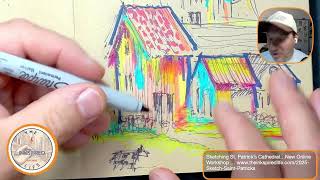
Jason Nicholas sketches live on kraft paper, sharing his tool choices and why they matter: Sharpies for commitment, Zebra Sarasa pens for line quality, Prismacolor pencils for color. He explains how sketching helps him process frustration and achieve flow, and introduces his "3 Gs of color" method for intuitive color picking.
Chapters
Hey, happy Wednesday evening. Jason Nicholas Nicholas here from the Inkspired Life. Yeah, I'm on twice live in one day. What is going on? Um, I'm back. So it's 10:10 PM here in the awesome state of New Jersey. I just wanted to pop on before I go to bed, um, and do some more sketching. Just, just feeling it. Um, some days I like to sketch a lot and some days not so much, but I do try to sketch something every day, and that's just one way to get better and better. Um, For me, you know, sketching is, is a learned skill. I feel like anybody can do it if you practice and put time at it. It's like anything, so don't be afraid to try. Uh, so we're looking at a sketch I did earlier today. This is, uh, inspired by St. Patrick's Cathedral, and I love the way this came out. It's, uh, it's really cool. If you didn't see the process of this go back, watch the replay on YouTube. Um, also on Facebook, you can see the replay there. Uh, it'll be fun. You can kind of see my thought process and how this all kind of happened. So what I thought I'd do tonight is I'd pop on. Let's just do— I don't have anything planned for tonight, nothing specific I want to sketch. Um, I'm just going to throw down some pen, maybe some color, and we'll just see what happens. And yeah, we'll take it from there. All right, thanks for joining. Uh, feel free to let me know where you're watching from. You might hear the tiredness in my voice. Um, I am sketching, just so you know, I am sketching on kraft paper. I love it because of the— I love the brown color, um, and I love the way that the Sharpie Creative Markers pop on it. Color pencils pop on it as well. So maybe actually we'll break out some colored pencils tonight while we're sketching. I have some right here. So, uh, let's just throw down some ink, see what happens. Feel free to ask questions and we'll take it from there. I'm going to zoom out a little bit, I think, just a little bit. Let's see, um, I'll just talk a little bit through what I'm— what's going in my brain as I'm creating here tonight, as I'm sketching, starting with a Sharpie. Love Sharpies. Love the fact that— love the fact that when I throw the ink down, I know it's going to be staying here. It's permanent. If I want to come back later, add color like an ink wash or watercolor, I don't have to worry about the Sharpie ink bleeding. It'll dry. So it's one of the reasons I love Sharpie. And I also love that it just forces me to be committed to what I'm throwing down on paper, not worried about erasing anything. For me, each line, each mark I make tells the story of the creation of this sketch. So I kind of like it for that as well. What am I seeing here? I'm just sketching maybe since I've been doing a lot of cathedrals, St. Patrick's Cathedral, I have kind of a church going there. Maybe we'll do like a little town scene or something, some different types of buildings happening. So let me know. Um, hey Alexander! Oh my God, Alex, how are you? Long, long, long time no see, man. I hope all's well. Alex, you're, uh, yeah, man, it's been a long time. So happy to see you on here. Very, very cool. We'll have to catch up one of these days. Never thought about drawing with a fine line Sharpie like this. Hey, that's cool, Alex. I'm glad I could, you know, put something new out there for you. It's one of the fun things about doing what I do live. I just love connecting with people and hopefully just sharing some fun things, some inspiration, motivation. Hey Chip, I see you over on Facebook. Great to see you, man. How are you doing? Can you guys see this okay? Should I zoom in? Let me zoom in a little bit. So this is all just coming from my imagination. I'm kind of just letting— I'm listening to music, it's helping me. I can't play it because it's copyrighted and I don't want to be flagged for it, so, uh, but the music is just helping me lose— keep loose with the pen. So sketching architecture really comes down to just knowing some of the basic elements of buildings, right? We have roofs, we windows, doors, walls, basic shapes. Here I'm sketching just a basic gable roof or a pointed roof, peaked roof. It's called a gable roof. And when you put the basic pieces down, that's where it's like building blocks. You put these building blocks down, it creates the forms and the shapes that we recognize as being architecture. So I, I'd like to do a, a workshop or even a course on just sketching the basic building blocks of, of buildings and architecture. I think that'd be a fun thing to do because once you have those basics, you can create, build things, stack things together, um, kind of like Legos, right? Legos are basic building block shapes and you can just stack them in infinite infinite ways to create different results. All right, I think I'm gonna throw down some color. So I have some lines on there, pretty cool. All's great, been doing nothing but working lately. Hope all's going well with you as well. Yeah, I get, I get the working thing. So I am, I am working this summer. I'm still— I'm actually working with the school district. I'm working with the tech department, um, setting up computers and classrooms and all kinds of things like that, getting ready for school to start. So this is actually the only, uh, I took 2 weeks off. This is the second week I'm— I've taken off this summer. But yeah, I'll be back in school before we know it. All right, let's just throw down some color on this and add a little bit of pop. So Alex, I get the working thing. Alex, if I remember correctly, are you— do you still do, um, man, was it paintball? I think it was paintball if I remember. It was a while ago, so if I'm not remembering correctly, you gotta forgive me. But I, I'm pretty sure that you were into paintball. All right, so I'm just popping down some— these are Sharpie Creative Markers. They don't sponsor me. I wish they would because I love, love, love their stuff. Everything from the regular markers to their creative markers, they, they just do me no wrong. So I'm more than happy to share and talk about them. Let's start on some yellow. It's almost kind of a mustard, mustardy yellow here in person. So, um, popular question I get is how do I pick the colors I like using? And honestly, I grab and go with my gut. The 3 Gs of color selection. Grab, go, gut. Yeah, I'm just picking up and whatever I'm feeling in the moment is the color I'm throwing down. I'm not worrying that these buildings— maybe they are these colors in real life and they're not even— it's not even a real building. These are all from my imagination, so I could do whatever I want. And even if these were actual, like, based on a real building, I could still make it whatever color I want, you know, just like I did today. This is kind of the St. Patrick's example. I was just— the colors, these are the colors I was feeling earlier today. Chip says, if you could choose only 3 pens to sketch with, what would they be and why for beginners? Oh, Chip. All right, guys. Chip, I love that question. If I could choose only 3 pens All right, I gotta ask a— I'm gonna ask you a question. Do markers, do markers like this count as a pen in your brain? So depending on what you— what your response is, I'll, I'll come back with an answer. All right, Chip said yes, markers do count as pens. All right, cool. All right, so here's my response. Only 3. Um, I definitely will have to start with— so I know you said for beginners, and it might sound weird, but I will pick Sharpie permanent marker as my top number 1 choice. A couple reasons is number 1, I feel like Sharpies force us to commit lines onto paper without being wishy-washy and being worried about being precise and technical. Uh, oh, I mean, maybe I said that wrong. Once we start throw a Sharpie down, we're committed, we can't erase it. And I like that challenge even for a beginner. I think it helps to build creative confidence by not being able to erase. So that's number one. Uh, second pen Holy moly, wow. Well, since we're going to say the markers count, I'm going to throw Sharpie Creative Markers in. You know, if I had to pick a specific color, it would be this aqua color. So this would be number 2 on my list of pens. Number 3, you know what it's going to be. I have been using— let me pull this out. I have gone back to ballpoint pens and I am loving these, um, Zebra Sarasa pens. These are 0.5. I think I have 0.7 somewhere as well. So different colors. Here's a couple, couple here. So these are 0.5s. I know I have a 0.7. I prefer sketching with 0.7s. They're a little bit wider, but no complaints. So number 3 right now as we speak today would be these pens. Yeah, so hopefully it answers your question. Coming in, coming in at a close 4th, if I had to pick, if I had to pick one more, is definitely, um, either a Pilot Precise Pen Red, or this is the V-Ball, this is 0.7 Red, so this would be a 4. So really, really great question. I love, love it. And I did discover recently, actually this week, um, another pen. It's not in my favorites yet, but it is a new pen I've been trying out this week. It's the Pilot Frixion pen. It is erasable. So if you need a cheat code when it comes to pens— here, I'll throw some down, you guys can see this. Let's just throw some pink on here. I'll just throw some here on the side of this building. And I'll just show you how it does erase. So I have to be honest with you, when I bought— when I bought the pens, I didn't know they were erasable. All right, so here, check this out. Ready? I'm gonna erase it right there. Boom. So if you are looking for an erasable pen, these seem like they're really cool. MJB333, if you're on Instagram, hello to you. I do think this Sharpie is running out of steam, but, uh, here's a pro tip. I like using my Sharpie markers until they absolutely dry out. I like the drier they become. You get some really cool effects when you're sketching. Um, I like to call it like broken lines. I'll do one up here. I'm actually working on putting together a sketching course, and the first lesson is going to be about line types. So these are— I call these broken lines. Boom. But as the pen dries, like, I kind of— I did this myself, but as the pen dries, it'll automatically create these kind of broken lines. So don't be afraid to use your, your markers as they're drying out. You can get some really cool effects. This is a really quick way to show windows. I'm not drawing rectangles, I am loosey-goosey indicating maybe we have some windows on this building. Maybe let's show some here. And then I want to pull out this cathedral spire a little bit more. We have a cross up top. Let's break out some, uh, color pencils. QQQ. Yeah, guys, don't be afraid to put some questions in the in the chat. I love answering your questions. And I see, uh, I see Chip has one. What emotions are created with it within you when you sketch, or are they there from the start and that's what ignites your passion to begin with? Oh dang, that's, that's a deep one. I like it. Let me drink some. Let's drink some water. Let me think about that. What emotions are created within you when you sketch, or are they there when they start and that's what ignites your passion? Hmm, it's both. It's both, to be honest with you. Um, that's a really great question. Let Lots of times, I think you can tell by the types of lines that I sketch. So if I'm starting off, say I'm having a rough day and it's just not going good, and, you know, maybe, I don't know, maybe I got angry or at something or upset with something, right? I'm kind of frustrated. Um, lots of times, you know, when that happens, I will go to sketching. I'll bring those kind of anger and frustrations into the sketch. As a starting point because it's very therapeutic for me to get what's up here onto paper. So when that happens, you might see me sketching some really frantically. I might start— let's do an example here. You know, say I'm really angry right now. Ah, I feel tense, right? So you might see me sketching like really— ah man, like this. Really jaggedy lines, right? So, you know, you can, you can channel those kinds of anger, those anger or emotions into jagged line work just to get that frustration out. So that's one way. So sometimes I do bring emotions into what I'm doing. And it could be the other way around. I could just be totally calm and sketching. Chip, this is great. I love this question. It's really making me think because I never thought about it. You know, sketching can trigger emotions as well. So as I'm sketching this scene here, I, I lots of times I'll try to put myself into the scene. In my brain. I'm thinking I'm actually here. What am I feeling in this place I'm sketching, right? So right now I'm looking at this, I'm, I'm kind of having— I'm feeling warm tropical vibes. I'm feeling very, uh, maybe, maybe happy. Happiness is coming out through the vibrant colors that are on here. Um, so I can trigger that feeling by the colors I'm picking. And again, this— I just went with my gut when I chose these. So inside, I must be feeling kind of, kind of really vibrant right now. So it's coming out in the colors. You know, if I went with a very blue, cool palette, maybe I'm feeling very calm, or more nature-inspired palette. Really great question. I know it's kind of a lame answer. I'll have to think about it more, and I'll get back with a more precise answer on that. For me, sketching— one of the reasons I do love sketching is it is a tool for me. It's a transformation tool. Um, it can, it can transfer, it can transform my state of being pretty quickly by grabbing a pen, marker, and a sheet of paper. Um, so I love it, I love it for that purpose. So it's a, it's an emotional transformation tool. Uh, sketching for me is also a way to escape I think I talked about it in my livestream earlier today. A lot of noise. They're doing some kind of pool construction fixing work in the house behind us. Obnoxiously loud music. It was ridiculous. Anyway, um, I was able to— that's one of the reasons I actually came online and sketched earlier today. The music was— I was— it's my day off and I didn't want to hear that. But anyway, I started— I came to sketch earlier today because I was able to escape zone out anything around me when I'm in this paper world. The rest of the world around me kind of dissolves, um, and that's one of the reasons— and that's one of the cool things about going to New York City is I really notice it there— is I could be sketching on, you know, busy, busy location in the city, and when I start sketching I kind of just zone out the busyness. Um, so it's a transformation tool. Sketching for me is also an escape tool. Um, and honestly, another, another thing, I, I'm very— I don't like— I'm not really good in big crowds of people. I'm very socially awkward. Um, especially people I don't know. So one of the reasons I always have a sketchbook with me is a couple reasons. One, I can kind of escape that crowd, that social awkwardness, by kind of retreating into my sketchbook. Maybe not the best tactic, but it also helps to generate conversations, and I'm pretty shy and awkward and I'm not great at talking in crowds. I could present to a crowd, I could be on stage to a crowd, that's not a problem. But it's just being in a big— like, imagine you're like at a wedding and all these guests and stuff. Uh, yeah, that's not for me. But sketching will help open conversations. People will come and ask questions and, you know, say, what are you doing? What are you sketching? And it's just a great communication or connection tool, especially for people that are kind of introverted. This is cool. I like the way this is looking here. Um, in addition, does music play the same role in how you sketch? I would assume the answer is yes. Oh, music. Oh, music is huge. I rarely sketch without music unless I'm like out. If I am out in the city urban sketching, I am listening to what's around me, so I don't have music on. But home, I need music. So yeah, music fuels my drive. It definitely influences what I'm sketching, how I'm sketching it, what I'm sketching. Love that question. And I'm pretty open-minded about music. I like to say I listen for— I could listen to anything from Neil Diamond to Metallica, classic rock, alternative rock, jazz, blues jazz. I mean, country, not so much. Sorry, country fans. That's a great question. So I think I see music as a tool in our creative toolbox. A tool that can fuel how and what we're creating. This is fun. I actually— I'm really loving these colors that are happening right here. Boom. So right now, just so you just get an idea what I am listening to, I am— I have a— I love the Imagination— the Imagine Dragons. Um, I got them going right now. That's just like a playlist, and there's other music mixed in, some Coldplay mixed in here as well. And, uh, just, I just come back to this kind of music regularly. I like the messages, I like the vibe. But nothing will stop me from putting on some Metallica or, um, yeah, old school Aussie, rest in peace. Um, This is cool. I'm actually really like— I'm going to zoom in on this one building I'm liking the most here. Here, I'm just shifting things around because I want to make sure it gets on the YouTube as well. I'm sorry, the Instagram. I'm loving this building here. There's something really cool happening with all the colors I layered. Um, I don't even remember what I picked up and what I threw down. I some neon pink, some yellow. I'd have to go back and watch the video, but I was in the moment. I was in the flow, that state of flow where you just create. But it's really cool, and I just like kind of almost looks like maybe an old— maybe a barn somewhere in the, uh, the French countryside. I just dropped my pencil. Oops. All right, maybe some kind of barn in the French countryside. I don't know. So these vertical red lines could be, you know, indicate the barn, the barn board siding. Yeah, it's looking kind of cool. I'm going to throw down some Let's actually use, uh, light. So I love Prismacolor color pencils. They're not— they're not a sponsor, um, but I do— I love their stuff. This is light aqua, my favorite color pencil color. So let's throw some down on this building here. So it's very similar in color to that Creative Marker we used earlier. You can see some of that top of your screen here. Yeah, this is looking really cool. This is actually very cool. Look what I did. Yeah. All right, so one of the ways I can tell that I'm kind of in the flow is I don't pay attention to the caps I put on things. So I put, I put the wrong cap on the Pilot pen there. Silly me. All right. The caps have found their homes. I want to do some growies, some growies. Let's, uh, I think I have a green, uh, yeah, I have a green marker here. Let's throw some of that on. One thing to be mindful of though, once you throw down color pencil, um, it's really hard to go back on top of it with a Sharpie marker, right, because of the wax, the wax properties in the, in the, uh, pencil, colored pencil. Here you can, here you can see what I was talking about with the pen, the marker kind of drying up. I'm getting these kind of skippy broken lines happening automatically. That look I like. Not Skippy like peanut butter, that's a different Skippy. You know what, this one might be, uh, might be— I think we might be done with this one. So I just threw some people on here just to give a little bit of scale on that scene. So yeah, maybe this is some kind of rural building somewhere in the countryside. Somewhere, somewhere, the countryside in my brain. Somewhere. Um, it's fun just creating these imaginary locations. All right, now I was Do I do it? Let's see. Yeah, I guess. I don't know, let's just do it. All right, he did it. I attempted— I attempted to show a, uh, cow on there, but let's ignore the cow. Um, yeah, so this is a cool imaginary place. I'm going to add a little bit of shadow on here. I think I'm going to use— we're going to use purple, some purple marker, create a little bit of depth for these overhangs. Maybe under this roof here. We'll throw some here, pop these windows a little bit. So I'm just trying to pull some, some of the shapes out a little bit more. Cool. And I want to break out a white marker, and I'm going to just shade these people in. Let's throw a frame around this and check it out. Just look— I just want to pop these figures out, so I'm just throwing down white. I think they'll pop out against the paper, and we'll give the cow some white there. All right, all right, cool. So here's, uh, I have some frames here. We're going to zoom out. So a couple things. Do I, you know, do I like— I don't, I don't think we need that building in the background. I think we could focus on the lower part, right? So if I do a horizontal framing, let me straighten it out a little bit. There we go. You know what I could do is actually— let me keep this frame here. I'm seeing this as part of a roof in the background, so let's just, let's just kind of finish it here a little bit. And we'll make it— maybe it's an old wonky roof here, and it's— maybe this is a chimney. So I'm just taking shapes and lines that were part of the— another part of the sketch, and I'm transforming them into a new purpose. Let's throw some color on there. Alright, cool. So there we go. So I kind of like the way that looks framed up. So it'd be something like that. And I have a smaller frame opening. Let's see what that— ooh, I kind of actually, I kind of like the smaller one better if I framed it like this. Maybe something like, maybe something like this. Could look kind of cool. I think it kind of balances. Um, if you look at this, let me just slide it to the left. We have a lot of busyness here and a little more empty space on this side, which, which I think is kind of like a yin-yang thing, right? It balances it a little bit. Hey, Noel! Noel's over there on Instagram. Hey, great to see you! Hope you're having an awesome, awesome day. It's always good seeing you, and I appreciated all your feedback earlier, so thank you so much. Right, so we could frame it like that. We could also, boom, flip it this way, make it vertical. I am— I'm kind of ignoring the building in the back. I don't really— I'm not digging it. So I really, for me, I think it's, it's really this piece of it that's speaking to me. So don't feel like, um, if you sketch on an entire sheet of paper, don't feel like you need to keep every single thing you sketched on that sheet. You can, you can selectively edit, selectively crop out the areas that really, uh, that really resonate with you. For me, having these, these mats here is just— it's a great tool for me to kind of crop out and pick what I really like. And I have even— I have mats over there with even smaller openings that I could, you know, I could really size down if, say, I wanted to do something like that, right? So look at your artwork, look at your sketches from different scales, different size points of view, different perspectives. Don't be afraid to crop sections out that you like. And really what it all comes down to is don't be afraid to have fun. Play. This is your, this is your sandbox. Build some fun things in it with your pens, your markers, your, your crayons, pencils, whatever medium you want to use. Awesome. But I think if I had to— if I have to pick a final result, my vote is personally going to be for— I cut the cow out. That's okay, it wasn't a really good cow. Um, actually, it's actually kind of like it. I— can I get the cow in there and have this look good? I don't know, let's see. You know, it's a possibility, but I think— I really think it looks better having a frame like this. Boom. All right guys, this has been Jason Nicholas Nicholas with The Inkspired Life. Hope you have a really great rest of your day. Remember to get out there, sketch boldly, live creatively, and inspire endlessly. Until we meet again, I'll see you guys real soon.





