Zen House - Mixed Media Painting
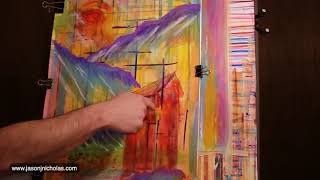
In this 1‑hour‑plus live stream, the creator (Jason Nicholas) continues work on a mixed‑media piece titled “Zen House.” He explains his plan to extend a loosely rendered building into the foreground, using red acrylic, water‑thinned layers, and a variety of other media (purple ink, blue acrylic, yellow ink, wax pastel, and a waterproof black pen). Throughout the session he switches between multiple cameras, zooms in for detail, and engages the audience by answering comments, asking for name suggestions, and sharing personal anecdotes. He frequently references his studio companion “Bob,” uses everyday office items (binder clips, triangle ruler) as artistic tools, and intersperses humor about Bob Ross, genius, and everyday life. The stream culminates with final touches, a discussion of balance and intuition in art, and a closing message encouraging viewers to trust their gut, enjoy nature, and keep creating.
Chapters
Hey everybody, how you guys doing tonight? Hope you enjoyed the snow day. It was, uh, this weather is absolutely crazy, but hope everybody's having a great Monday. Just gonna do a little bit of painting tonight, and I'm gonna continue working on a project I started last week. If you guys were watching, we'll be working on it again. It's actually this piece right here. Yeah, so if you're watching, give me a thumbs up, say hello, leave comments, questions. I'll be checking as We go through the night, I'll be checking, I'll be responding to your questions and comments and all that fun stuff. Yeah, so I just love doing these. It's a great way for me to wind down a busy day and relax. So hopefully you guys are gonna join in and relax with me and just hang out for a little bit. So that's it. So let's get started on this bad boy over here and see where it takes us. I'll focus on there. Oh, Bob forgot to say hi. So I have Bob in the studio as always. Bob, say hello. Bob's saying hi. Cool. So I started, I did this painting last week in a couple of painting sessions and this is where it is right now. I kind of, I want to work on this area right in here tonight where the building is. And I started a building and I was going to leave it like that. But the more I looked at it, the more something is telling me just to continue it down into the foreground. So it'll end up being a, you know, a 2, 3-story building. It's not really— I'm not going for an architectural detailed image here. But I just want to give— just block out something kind of loose and abstract. And put it in the foreground. So I'm going to be working on that area tonight. I also have this cool camera thing I'm going to be playing around with, so you might see me switching back and forth so I can engage and talk to you guys more directly, and then I'll focus back on the painting. So let's get going. So I already actually started a little bit to block out the vertical lines of where I want the building to go. I'm just going to move Bob out of the way, otherwise we'll end up with some red streaks on his hair, which would go well with the blue and orange he has in his hair already, right? So I'm going to use some red acrylic paint tonight and put some out on the palette and just fill in the areas over here. So I don't know if anybody's watching, if you guys are on spring break with your families, I hope you're doing something fun. Let me know what you're doing out there, I'd love to see what everybody's up to. Um, I'm gonna be hanging out with Noah tomorrow and Wednesday, just chilling out and doing some fun stuff. Don't know exactly what we're doing yet, but I'm sure it'll work out. Any time we can hang together is fun. So I have some red paint on the paintbrush and I have some water on it too. I don't want a really thick, thick layer of the red. I want a little more on the transparent side. And you can see how I'm just kind of pulling down that red color just to fill this in. I really, I like the way this purple is showing through. The more I look at this, the more I'm seeing almost like a Japanese Asian type of print going on here. I've had some comments that this is more of a tropical scene, which is great. I could see that too with the bright colors on it. So it really is, it's all about what you guys see in the painting, how you're enjoying it and experiencing it. You know, my interpretation is not the correct one. It's whatever you see. That's what makes this really fun. I'm just continuing to use this red color. And if you kind of notice, I'm not doing really clean strokes up and down. I'm kind of doing some choppy areas. I just want to give it more of a distressed kind of look. I don't want the paint to be very even. Like in this area here, you can, you can see some of the texture going on between the layer underneath and the color on top. Well, I can, let me try something. I'm going to actually see if I can zoom in a little bit closer for a second. So you can pick up on that. I'm trying some new camera stuff here. So I guess you can kind of see that a little bit better right now that I zoomed in this area in here. So I'm just going to zoom out a hair. There we go. I think that's good for now. Cool. I was one this this structure to appear that it's coming out from behind this outcropping. I don't know, it could be, you know, a hill. Maybe it's a little more in the foreground. So I just took some clean water on my brush just to wipe away a little bit of where that red paint was coming down in front of the hill. I want it to appear more just a little behind it. And I'm not going for any depth or 3D in this. I kind of want it to appear almost as everything's just flat in the same plane. You know, it's not really a perspective, so to speak, that's showing a lot of depth to it. Yeah, I think that's good. And like I said before, I kind of like the way this is showing The layer underneath is showing through on there. Let that dry for a second. I'm gonna grab a bottle of water and just check in. And I see— who do I see watching? I see Jennifer and John. Hey, if you guys are watching, hello! Thanks for tuning in. Feel free to make any questions or comments. Thanks for hanging out. So is it really going to be in the 60s on Wednesday? This weather is absolutely crazy. It's, uh, at least the good thing is, you know, the snow is going to melt away. Pretty much most of it melted, you know, the roads are clean and the cars are clean, so that's a good thing. I'm just— now I'm adding some paint in this corner. I have a roof that's coming down in here and I want to just bring that out a little bit more. So I want to add just some red in there. I'm actually going to come in later and I think and make it dark so it's almost like almost in shadow. Just give them a suggestion there. So I have this purple, Lin ink. I don't know if it's picking up. It's a purple ink that I use to do all these lines. And I'm gonna, I'm gonna add some more of those just to give some definition maybe to the edge. Of where this structure is. When I put the paint on, you'll see how it separates this area here from this area over in here. So I'm going to get a— and I actually used a triangle last time to do that, just to give me a little bit of straight— just of a straight edge I could kind of work on. So let's try that again. This guy, this triangle, this goes way back to my college days. This thing is old, just like me. It's ancient history. So when I was in college, we didn't have CAD or, you know, computer-aided drawing until my last year of school. So all the drawing or drafting we did was by hand. So I have a lot of these old school tools. I have, you know, this, T-squares. And, uh, a lot of stuff from college still that I'm glad I kept because it comes in handy. You never know. So right now I'm just taking some purple ink and I put it on the brush and I'm going to go over this area. I'm going to outline it. Now I don't care if it's not perfectly straight. I just, I'm just going to use the edge of the triangle and go against it. Pull it off. Now you can, you can see, right? You get a better sense now of how that edge of the building is separated just a little bit from this area. And I'm going to do the same thing on the other side. I don't know why, but Barney The purple dinosaur just popped in my head. That, that is not going to be an image I can get out of my head now for a long time. Good old Barney. I'm so glad no one really did watch Barney, so I wasn't subjected to that. And he actually, he didn't really watch that, that Teletubby show either, so I was lucky in those respects. You guys remember those Teletubbies that— actually, I think it was a British show, right? And you just never understood what they were saying. They kind of creeped me out, actually. I don't even know if that's still on or not. So I added just a little dark line here in the shadow area just to suggest that the roof line is coming down in this area. This is maybe where the overhang is. You know, if I was getting technical with this, with light and shadow, which I'm really not on this painting, but you know, if this is where the sun is or the light, you know, everything coming this way on this face should be brighter and everything on this would be more on the backside of a building, so it should be darker in tones. So that looks good. I'm gonna highlight this area just a little bit here. So you can tell this, this I did without a straight edge and these I did, they're a little bit more clean. What do you think, Bob? Digging it so far? Bob is like, he's the best. He is the best. Best ever. So while that's drying, these areas here are a, uh, it's almost like a gray color, and I'm going to put some more of that on there to suggest maybe, um, windows or door openings. I'm going to add some more of those on here just to give a little more detail to the structure. So what did I use for that? Hmm, I'm trying to remember what actually I used for that. That's okay, that's the magic of painting. You can mix your own colors, right? So let's try— I actually have a little bit of this. I have some purple, more purple. No, I don't think I want to use that purple. I have some blue. Hopefully my head's not in the camera, I can't tell. So I have some of this blue acrylic paint, which I'm almost out of. There we go. I have some of that blue and I'm gonna just put it real, just really lightly back here just to give a suggestion. And it's gonna be the first layer. I'll put something else over it, I'm sure. I just kinda wanna block out maybe some— just some suggestion of maybe where some windows are on here. And they don't have to be very clean rectangular lines. It's very loose strokes. They're obviously much different in color than the ones I did previously. Here's the magic of painting, right? I can go over what I did before. I added some water because I want to just water it down a little bit, make it a little more transparent. There we go. Nice. I'm gonna put some more on there, some more water, a little bit more of the blue. Maybe I'm just eyeing this up, you know, I feel like maybe, maybe some kind of a door or something back in here. Maybe another one over in here. There we go. Me, maybe, uh, maybe just a few more. I don't want to get too crazy, too crazy with all these window type opening things. Maybe I'll just put the line across here and here, just make these a little taller. There you go. I don't know, I, I, this is kind of blank in this area and this area, but I'm afraid if I put more— oh, what the heck, let's see if I put more windows. It might get too busy, but let me just put a couple in. I guess 3, 3 is not a couple, is it? I always, you know, I always got that wrong. I always, you know, couple is two and I would always, I never associated the word couple with two for the longest time. So that came out a little darker, so I put some water on it. There we go. Now we're getting crazy. It's always good to have a paper towel because you can, you wipe stuff off if you want. I'm just putting more of this blue on here just to tie in what I did down below. I'm gonna pull just a little edge on here. Good. So I'm going to step away for a second. Actually, you can see it dripping down there, which I don't mind because it is kind of tying in with the other drips I have— drips, drops, drabs going on on the painting. So if you guys are just watching, hey, thanks for tuning in. I'm working on this painting from last week. Just moving along on it, putting a building in the foreground. And this was pretty much the only thing I had pre-planned tonight, is I know I wanted to bring the building down. So whatever I'm going to do from here on out, I have no idea. I'm going to be winging it. I'll come back and add some more detail to this after it dries, either with some paint or some ink. Um, You know, it's starting to look pretty good. One of the things I did notice, and this is just a tip, if you guys look up in this area here or this area down here, what happened is I used these clips to hold the paper on the board, and obviously where the clip was, I didn't paint there, so you can see those areas are just left white. Which maybe is not a bad thing. I just want to look at the bottom one here. Yeah, you see down here, it's really, really got a lot of white paint there. So maybe I'll just kind of fill those in with just a little, little bit of color. Let's just clip these back on. There we go. By the way, I think binder clips— I think this is my favorite office product invention. These things have so many uses, it's unbelievable. So whoever came up with this idea, kudos. Kudos to you. Maybe it was the same guy that came up with the Post-it notes. I have no idea. But you know, it's just these ideas that people come out with and It's just amazing. I have so many boxes of these clips that it's ridiculous. I always find a use for them, you know, whether it's for painting, holding cables together for, you know, wires for your computer or plugs and things like that. Obviously for papers, I use it for papers and binders. Actually, another thing these are good for, maybe I'll pan the camera here just so you can see. Showing you my little office here. Let me pan the camera around so you can see this wall here where I have some art pieces hanging up. And I have the binder clips as a way to hang the pictures up on the wall. I just have thumbtacks, clear thumbtacks, through the ring of the binder there and you can see the pieces on the wall there. So that's another use. Like I said, these things are pretty amazing. Let's go back to the painting. That was a little detour, that was a little field trip. I hope you guys had your permission slips signed on that little field trip we just took to my wall over there. So I'm going to fill in these areas with a little bit of paint. Let's see, I have, I think I have some yellow. Ink over here. So I have this Liquitex ink that is the yellow I started out with on day 1 as the background. I'm going to fill that in, in these corners. And I'm just— these have cool eyedroppers on them, so I'm just going to drop a few drops in here. And just brush it on. Here we go. You see me brushing it down and then across, so I'm just kind of doing two different directions just to spread the paint out so it's a little more even. Or ink, rather. You say tomato, I say tomato, right? You say ink, I say paint. There we go. Let me hit that corner down there. While I'm using this orange color, I think I want to add a little bit more on some areas of this painting. It'll help give a glow in some areas. So maybe, you know, my brush keeps going to this section, so maybe I'll add a little bit here, right above the purple, or even on the purple, just to contrast. Right, you can see how it just gives it another layer. I don't want to do the whole section because I do want a lot of differentiate— differentiation in here. I just— you try to say differentiation like 3 times fast. Differentiation, differentiation, differentiation. It's hard. It's a tough one. Maybe I'll put a little bit more up in this section. There we go. I think by, by brightening these areas, it actually helped to pull the corners in a little bit more. Yeah, yeah, yeah. I'm gonna let that dry for a second. I'm gonna check, check in. I just kicked the easel, sorry about that. I'm still gonna go on camera for a second. I'm back on camera. So, uh, if you're watching, thanks, I appreciate it. Hope you're enjoying this creative painting session tonight. I think you You know, I think this painting is in the home stretch. This is the third session working on it. And, you know, paintings like this are really about layers and just building up layers upon layers upon layers. So they do take patience and a lot of— what's the word— courage because you don't know what's going to happen. For me, I don't know what's always going to happen on here. And so far I'm liking it. What do you think, Bob? Bob's gonna come on camera for a second. Bob, say hello. Bob's in the house. My inspiration here for painting. So while this is drying, I'm going to get, I think, a black pen and maybe do this little bit of ink work. So let's do that. I'm gonna switch back to this guy here. There you go. Okay, let's see. I'm gonna grab a pen back here. Here we go. The magic of television. I love it. I was like off camera getting stuff and it's just exciting. It's like a little mini studio in my little 10 by 10 office here. If you think about it, right, however they created television shows are pretty amazing. You know, all the, like the— I always think of I Love Lucy and the different sets they had for that show and how they filmed it. Just the technology and the technical aspects of putting a TV show together. Pretty amazing, actually. So I got my black pen. It's right here. Trusty black pen. This is actually a waterproof pen, so if I do go over it with paint later, it, uh, won't bleed. I think I'm just going to kind of just do a little bit of outlining where these hills are. You could be very loose with these lines. You don't have to follow exactly the contour you have with, with the purple edges. It's really just to give a little separation between the lines. I mean, separation between the colors. I said lines. I'm drawing the lines. Okay, so you can see that edge just a little bit more. That has some black on it. I'm going to do the same thing down here. So I'm looking for suggestions for names for this painting. If you guys have any suggestions, feel free to write them in the comments. I'm always curious to know, you know, I'm always looking for ideas and I like to pick other people's brains too. But, you know, the creative process isn't really about me creating, it's about collaborating with you guys as well and getting your input. You know, I've done some paintings where people have suggested, you know, doing splattering and some other techniques on them, and it's great. I love when everybody pulls together with different thoughts and ideas and we come together and we end up with a complete product in the end. You know, too quickly in life we tend to shun other people's ideas rather quickly. You know, we should really just take the time to listen to what other people have to say because our ideas aren't always the best. And I know that for sure with me that I embrace the collaborative creative process. I think it's important. And that doesn't just apply to art or drawing. I mean, it applies to everything. You know, even when you just have this conversation with somebody, just kick back and actually listen to what they're saying. It's important. We're not always the ones that have the great ideas, and we're not the ones that are always right. So as I add these lines, I'm just adding a little more detail on here, freehanding the roof area. You know, maybe this is some kind of a metal roof on this building. This gives it some movement, some little bit of texture. Little bit of, you know, suggestion of some kind of material on the roof. I'm just stepping back looking at this. Now, let's see if these are dry. Yeah, this stuff dries pretty quickly. So maybe I'll just kind of come over here and maybe just outline Some kind of doorway or opening. I always know I'm in the homestretch of finishing a project when I break out the black pen and start putting ink lines on the painting. This is the part where you the details start coming in. And I'm purposely not continuing these lines solid all the way up. I am drawing it, leaving a little break, and then drawing it again. I don't— I really want a loose look to it. Kind of like, you know, demonstrating a blank piece of paper. So you can see a little bit better what I'm talking about. Now you would think I'd have paper here somewhere. Of course I do. Here we go. So actually, I just wanted to bring out this piece of paper because it gives me an excuse to bring out my favorite Sharpie in the whole world right here. The Sharpie Magnum. I love this pen. This thing is amazing. So, what I was talking about before, so why, you know, I could draw the lines continuous like this, just all the way up. That's not a problem. You can see that on the camera, right? Let's come down a little bit. There we go. So what I'm actually doing on the painting is my lines are more like this. So you can see the difference, right? This— these type of lines give it a more loose kind of sketchy look, whereas this is more of a rigid line, very solid. It would definitely define the edge very well, but this is kind of the style that goes with the painting I'm doing here. Or the feeling I have for this one. I could really contrast this building and make the lines all solid and rigid against a very free-flowing background and it would totally pop out. But I just, I kind of want to stay in this character with the loose sketchy feel to it. So that is, that's some line, different line types for you. If I really wanted to get sketchy and loose with it, I could do these kinds of lines. You know, just really, you know, actually if I do that and make it really kind of wavy, right? So that's really a very loose sketch. You know, you've probably seen me do these on those lunchtime sketches I do live sometimes on Facebook where I do basically the doodles where I have all these crazy lines going on. That's a little bit of lines for you. And this is always a good reason to bring out Mr. Sharpie here. Again, thank you, Mr. Sharpie. Sharpie, if you're watching this, feel free to use this as an endorsement. Send me some free pens. Alright. Just kidding, of course. Just kidding. So where did I put that little— where did I put the little pen now? I got it. Right here. En bas. So I'm just going to go through and add some more. Another way to create really loose lines is be quick with them. Don't put too much thought in them, just let your hand go. That's weird, my pen doesn't want to draw in this area. I'm not sure why. Maybe it's the paint underneath. Maybe my pen's dying. Nope, it's not. It's good. I think I'm running out of ink. I should have a backup somewhere in here. That's okay. There we go. So you see how it, you know, I just really, I didn't even do all 4 sides on some of these. I just want to give a suggestion of, of, uh, some window openings there. So we'll put this guy over here. Take a step back. So do you think anybody have any suggestions for a name for this painting? I think I want to do some more of these, these almost purple grid lines. What I actually, I After I did this the first time, I came back and looked at the painting, and I almost saw— if you picture like an ancient, um, like a Japanese temple pagoda kind of structure, you know, they had these timbers that kind of did this thing. So that's— I mean, that's another reason I'm, I'm always— I'm drawn to this feeling a little bit more like Asian-inspired. I think I want to put another kind of idea like that back in this section. So to do that, I'm going to take the purple ink I was using before, clean off my brush, and I had that triangle out. So here's the triangle, the trusty triangle. And I think I just want to put, I don't know, I'm just kind of, I'll keep thinking in here. And almost, I really want it to be kind of a small background structure. We'll put another line in here. Maybe I'll just run a horizontal one. Somewhere there, maybe we'll put another one in here. And it's just helping to tie this area with this area, same similar pattern going on. I'm actually, I'm also feeling like doing one, maybe a bigger one here that almost runs off the page. There's one that's actually started, maybe we'll continue that down. What do you think, Bob? Do you think it's a good idea? That's a yes? All right. Bob thinks it's cool. For those of you that have watched Bob Ross paint, you'll notice on a lot of his paintings, he'll do like a big tree in the foreground of the painting on one side or another. He'll do a group of trees. But there's always, for me, there always seemed to be one tree that would run all the way off the page. And I think that's to help frame your image a little bit better because if you have a big, you know, a big tree or something on this edge, it's kind of forcing your eye to keep within the painting. Like here, you know, if I leave this off, your eye just want to wander off the page, right? So let's see, I'm going to, uh, do it over here. Make sure you can see it on camera. Let's just run the blue, blue with a purple ink. You know, you can kind of see the idea of how it just ran off the page. I'm going to add a little bit more to it. Maybe I'll do another one. I'm going to move this clip. Let's move the clip down here. There we go. Let's move this one up. Oh no, Timber! I got another painting behind this one that I'm working on. You want to take a peek? Here's a sneak peek at it. It's actually sideways. Um, I'm actually— it's going to be some kind of a tropical sunset with water in the front, tropical-looking sky, or sunset or sunrise going on here. But, uh, we'll work on that one a different night. Oh, there we go. Perfect. So let's add some more Another one of those purple structures on him, we'll call it. Be somewhere maybe in here, and I don't want it to be the exact height of the other one. I want some variation. Maybe I'll put another line over here on this edge. Get some more ink on here. Add some horizontal lines. So if you notice, when I I painted across and I dragged the triangle down and left a little kind of a trail mark, which I, which I like. It wasn't done intentionally, but I'll keep it there. I'm not going to try to erase it. That happens because I have ink on the back edge of the triangle, right? If I wanted to not that, I didn't want that to happen again, I could just wipe off the ink. There we go. Stepping back here, taking a look. I think, yeah, actually, I actually like that. I think, I think just by doing this area, I think it did help to bring your eye in, you know, more into the interior of the painting. While I have this purple ink on my brush, I'm going to put some water on it and I just want to go over some, some of these areas a little bit here. Oh, I picked up some red. That's all right, it's a happy little accident. So I got some red on there. Cool. I like the way it's looking. I'm going to let that dry for a minute. Check in with Facebook land. Say hello. So how's everybody doing tonight? You guys doing good? You having fun? I'm gonna try something here on this, uh, I have this software I'm using to do these shows and I can do some cool things with it. I figure out how I can type. Here we go, let's see if this works. I'm gonna type a message. There we go. Let's see, let's see how that works. Oh, look at that. See, that was cool. I was able to type that and put it on the screen. There you go. Technology is amazing. And I can turn it off if I want. Somehow. Let's see. Yeah, there we go. We turned it off. Very cool. I'm just stepping back, looking. I think I actually want to do some more of those purple, some more purple lines, not too many more. And then I'm going to hit this area next. I feel like I want to do something with this. I'm not sure yet. I'm going to put— this is where I want to put another line up here. Let's see. There we go. Maybe here. Maybe just one horizontal one, maybe. There we go, something like that. I think that's good. I think that's enough of the purple lines. Gonna close up the ink. One of the things I learned is to make sure I close up these inks after I use them because I have a tendency to be clumsy and knock the things over. So we don't want to— I don't want to do that, not with the purple paint. So what should we do up in that area? Let me bring Bob. Let's bring— me and Bob are going to contemplate here. What should we do? If you guys have any suggestions, let me know. Any ideas of what we can do over here in this area? I'm not sure. I feel like I want to add something on that. I don't know if I should use more of the red color and make it brighter. Maybe some dark color around it so the red pops out a little more. What do you think, Bob? You have any ideas? No? I'm thinking dark. I think we want to put a little bit of dark around it. Should we try that? Oh, camera's over here. Which camera are we on? That camera. I've got a split screen here. I'm not sure which one to look at. That's fun. So the real funny thing is the other day— the other night I was doing a Facebook Live painting session just like this and I was like an hour and a half into the show and I realized I was broadcasting the show to nobody. It was set to private. Which I do when I'm testing this, you know, when I'm getting ready, and I forgot to change it. So I'm sitting here like talking for an hour and a half and painting, and, uh, which I probably would have done anyway, um, but nobody was listening. Just me and Bob. But that's okay. I do that all the time, right? I'm sure I'm not the only one that talks to myself, right? You guys do it too, I know. I know you do. You can't fool me. I think it's a sign of genius if you talk to yourself. It's also a sign of genius if you leave the house with just your underwear on because I believe Einstein did that at least a few times. So, I haven't done that yet, but I definitely do talk to myself. So, embrace your geniusness. Is that a word? Your geniusness. Oh, right. Enough looking at me, I'm going to go back to the painting. And we're back. So let's embrace our geniusness, all of us. And we're going to do whatever we feel like doing here. I don't know. I'm going to pick up the brush and I'm going to pick up— what kind of paint do I want to use here? You know what, actually, I think I want to use orange. I think I do want to go orange. I'm not going to go dark. So I have some orange acrylic paint right here. I like to show off the tubes, I don't know why. I know it's not quite in focus, but I have some orange paint here. I don't know, let's see what happens. I feel like I want to pop this out and make it a little bit more vibrant. If not orange, maybe a yellow. Which I'm going to go grab over here. Somewhere in my, uh, magic paint bin I have yellow. Here we are. Right here. Got some yellow. People use a combination of yellow and orange to get real crazy. We're living on the edge. Mixing up yellow and orange. Yes, yeah, I know it's sad. That's the extent of my craziness is mixing up yellow and orange. That's the life I lead. I have this small brush, the one I was using for the purples. I'm gonna— actually, you know what, I'm gonna switch. I'm gonna use a wider brush. Usually I switch to smaller brushes when I'm trying— when I'm getting to doing detail. Type of work. This seems to be the brush I use the most when I'm painting, is a 1-inch brush. So I like to use it, it gives me wider lines and I'm not focused on just the detail. So I'm going to mix up a little bit of orange here. Let's pan down, let's see, you want to see me mixing some paint? Let's see, can we do that? Wow, look at that. They're doing it. I'm mixing up some orange here, a little bit of yellow. You see it on the brush? Let's go back up to the painting. Yeah, I'm having fun moving this camera around. And let's go a little higher if I can. There we go. And I'm going to zoom in a little closer on that top area. There we go. Now let's just go up here and see what happens. I feel like I'm painting with, uh, with mustard on my brush. Actually, now I feel like I'm looking at ketchup and mustard. I must be hungry. It always comes down to food in the end, doesn't it, Bob? It's always about the food. I don't know, am I in the way? No, I don't think so. Actually, I like that. It was— I, I would drag the brush very lightly across the paper and it kind of skipped a little bit and left— you can see texture there, which I like that look. It's a very dry technique with the paint. There we go. Oh yeah, another use of binder clips is they're good at making music when they bang against the background. See, I told you they had endless uses. I'm going to put some more yellow on the brush. So you can see I have a mix of— there we are— some yellow, and orange on there. That was kind of cool, the camera just automatically focused on that. And I'm just following the basic outline I had before of the circles going on. You know, maybe it could be a sun or moon, maybe it's an eye. Looking out upon the world. This paint's drying really fast, so I'm just putting some water on the brush to keep it a little more flexible, give a little more life to it. There we go. See, I'm liking that better than before just by adding a little bit of color on there. I'm going to put a little bit of that same color and some other places on the painting. Maybe I'll put some down in this corner. Get some water on the brush. Of course, now I'm off camera, so let's zoom out again. Zoom down. Here we go. Down a little more. Hi Bob. Bob's making an appearance down there, isn't he? Cool. I'm gonna put some down in the corner, just darken this area up a little bit where I painted the yellow earlier. And the reason I'm doing this is I'm trying to drag in this color to other places of the painting so that it's all tying together. If I just had one area with one color and nowhere else, you would be drawn right to that immediately. Could put some more water on the brush. I'm going to use— I have a little bit more of that color on my palette. I'm going to mix it up and we'll use it. I'm going to just brush it really, really lightly on these hills because I like the colors here a lot and I don't want to take away from it. So I'm just brushing it really, really, really, really lightly. How many times are we going to say really? Really? Really. There we go. Maybe down. There we go. See how I just, just a little bit of a glow, just to, again, just to kind of pull these elements together. Maybe a little bit on top of this roof. Do you guys say roof or rough? I say roof for some reason. So I'm putting some paint on the top of this roof. There, I think that's good. I don't want to put any more of that on it. I think it's, uh, where it needs to be. I did want to do a little bit of painting down at the bottom here. Sorry, Bob, I'm going to move you off camera for a second because I want to do some painting down in this bottom corner. Clean the brush off. I'm going to keep using that 1-inch brush and I want to— I'm going to try this. I'm going to break out one of these, these crayons I call them. It's actually a wax pastel. And I'm just going to put a little bit of color on here. It's a, I think it's a blue or ultramarine blue. And I just want to make this a little darker in this area. Just so it pops out ever so slightly from this area. And rather than breaking out the ink, I could have used the ink or I could use paint. But I had this pastel sitting here, I figured I'd give it a shot. So the cool thing about these pastels is once you add water, that's when the magic really happens. I'm just trying to get the yellow off my brush from before. Might be a little bit, that's alright. Let's see what happens. I don't know if the camera's picking up on this, but it's, it's so subtle. It's such a subtle contrast. That's, I think that's all I'm really going for. Add a little bit more. There we go. It just sets this area off a little bit from the lighter area behind it. I'm going to do it, it's calling my name. I just keep— this is calling for me to use that color over here, the one I just used. Yeah, I think I want to use a smaller brush though to go over that one. I have this one right here in the water. Put some water on the brush, and I don't know what it's going to do, if anything. It's actually— it's not really There you go. You can see a little bit of it. So there's just a little bit of that same purple bluish color here that I put down here. Again, trying to tie some things together. Just wanna give a— just add some vertical lines on here ever so slightly. Just to suggest some kind of a texture or material. On the building. Now I could do horizontal lines to show like siding, but I'm— I want this building to be very vertical in the painting. So that's why I'm doing my lines vertically, just to give it that verticality. I'm just bringing some lines up in here just to help draw your eye from the bottom up to the top. I don't want to get too crazy with it. I mean, sometimes that's all you really need to do is just a little bit of subtle— subtlety can go a long way. This is looking pretty good. What do you think, Bob? I think this one might be almost a wrap. Yeah, Bob thinks so too. Just gonna take a break for a minute just from the painting, just to kind of come back with a new perspective or a new look at it, a fresh look at it to see what's popping out or if I want to add anything. Something keeps telling me to do something else up here. I have no idea what to do up in this area yet. So I'm going to get a drink of water and we'll check in. So if you're still on watching, just type hello, just so I know you're on. I always like to know who's watching so I can get back to you and just give you a personal thanks. Because I really appreciate spending a minute or two of your time with me. It means a lot to me. That is my shoulder, you see. I'm just— I want to move this up. There we go. There we go. Hopefully I'm not in the— am I? No, I'm not on camera. Oh good. I don't want to block the picture. I'm kind of— I'm just standing in front of it taking a look. All right, I got it. I think I know what I want to do up in the section. I want to bring out The same purple color I used for the mountains here. I have to find it. It's like I'm losing my voice. Purple. Where did I put it? It's gotta be over here. Hmm. Oh, it's, it's right. It's right here, almost right in front of me. I'm like looking around and it's right in front of me. How did that happen? So I'm going to put some of that purple on the palette. Pal, let's put some purple paint in the palette, pal. What do they call that? An alliteration, using the same words that start with the same letter. Purple palette pal, please. Perhaps, perchance. Alright, that's enough. Enough with the P words. So I have some of that nice purple paint on the brush. I wanted to see if the camera was going to focus on it. Not sure. I think I want to maybe just, just do some, uh, like a, some kind of swirl or something. There we go. Yeah, I think I like that. I think it needed, it just needed something else up there. Nothing too, too crazy. You know, I think what my gut was telling me was I needed to somehow frame this. And I'm again, going back to kind of the theme of tonight is tying things together. Tying these colors here, tying them up in here as well. You know, kind of a balancing act going on of colors. I think, I think that's going to be good for the purple paint on there. And I think we're going to call that a wrap for the night. What do you think, Bob? We wrapping on that one? Yeah, I think, I think we are. So that's the painting. Let's go back on camera here. We'll try a little split-screen action. Oh, there we are. So this painting is pretty much— I think it's pretty much done. If I do anything more to it, it's going to be minor, minor things. Signing it, of course, I'll do that. But I think I think I'm really happy with where it is. I feel like if I add too much more to it, it's going to just start looking too crazy and too busy. So, you know, like we always say, is we being me and Bob, not we as in me and me. Like we always say, you know, you got to trust your gut and you'll know when it's time to stop. You know, and stop painting or whatever in life. It's just listen to your gut and trust it. And that's where we are, right? Yes, sir. I should practice being a ventriloquist. Let's see. Yes, yes, sir. That sounds good. That is a horrible Bob Ross ventriloquist act. That is not going to get us on America's Got Talent by any means. So this painting is a wrap. If you guys were with me from the beginning on this one, I appreciate it. If you just joined me tonight, I appreciate it as well. This really wasn't announced, just kind of came on. And as we always like to wrap these things up, we always leave with some kind of something positive or encouraging or some kind of words of Wisdom. So what do you think? What should our words of wisdom be tonight, Bob? Hmm. Well, we did talk a lot about tying things in. You know, maybe it's balance. Maybe we'll talk a little bit about balancing. You know, just like in life and in artwork, you know, there's always a balance. You know, in this piece here, I was really— I'm trying to balance colors in different locations. I'm also trying to balance space or shapes. So we do have a circle or oval kind of shape here, and we have the, you know, building shape here. They're not the same, obviously, but just the idea of having 2 contrasting shapes, but where they're located, it kind of helps balance it because they're, they're opposed to each other. That doesn't make sense. It's opposed and it balances. We get too technical. It just feels right. That's the lesson of the day. If it feels right, go with it. You know, you don't have to be so technical and analyze everything. Um, sometimes the more we analyze things or we analyze our lives and analyze all the details and get bogged down. Our heads get crazy. It's overwhelming. It's stressful. I know some— for some things we have to do that, but not every single thing in life. Right, Bob? There we go. Okay. Right, right. Look, we match. We both have blue on. Um, yeah, that's, that's the lesson. Don't, you know, don't get bogged down in so many details. It's just if in the end it could ultimately just be a headache. Pay attention to those details that you have to pay attention to. You know, act on those, get them resolved, but don't let them, the minor details bog you down. And, or that, you know, don't go so technical. I was just getting really technical on this and this isn't a technical painting. This is a painting from the heart, from inside. And, uh, For me, that's how I— one of the ways I express myself is through this kind of medium, through this type of creativity. Find your inner voice, find what makes you happy, find what, you know, how you can express yourself to everybody, you know, in positive ways. That's what it's about. So I think we're gonna wrap on that note for tonight and for this painting. What do you think? You have anything you wanna add? You do? Bob wants— this is a first. You guys are witnessing a first. Bob never adds anything. What do you want to add tonight? Okay. Okay. Bob wanted to end on a happy note about squirrels. He loves squirrels. We're seeing more squirrels running around. Spring is getting closer, and that's a good thing, right? Yeah. Bob wants to say the weather's changing. The creatures outside are being more active. Get out there, enjoy nature, embrace it, and have fun. So I think on that happy note, we're going to leave tonight. And as I always like to say, or we like to say, is, you know, peace and live creatively. Thank you so much for watching this. I'll definitely be back again, probably later in the week. I'll try to make an announcement when I know I'm going to be online. So that's it. Thanks again. Take care, everybody. Have a great night. And, uh, peace. I'll see you soon. He's the man.





