
Are You Making Business Harder Than It Needs To Be?
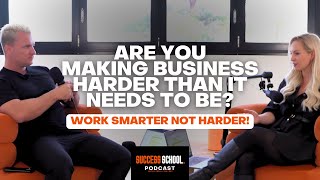
Tim Frey and Steph discuss working smarter vs. harder (Success School podcast, episode 70). They argue entrepreneurship is hard especially in the first 3–5 years but can pay off with freedom once systems and KPIs are in place. Practical advice: track KPIs, let data show what to fix, simplify processes (batch video days, hire for copy/scheduling), and avoid overcomplicating work out of boredom or misplaced worth.
Questions this video answers
Episode 70
November 17, 2024
Facebook, LinkedIn, Instagram, Twitter, Threads, Shorts (six platforms)
Close rate ≈ 50%; current leads ~200 but needed ~462 leads (so she needed to roughly double marketing)
Approximately 30k per month (a common income barrier)
Chapters
People usually make things harder and they look for problems because they're bored in their life. And if you get bored in your life, you need to find something to do that's outside of business. People look for happiness in their business when they need to just get a life.
They believe that the harder they work for it, the more valuable it is. When in actual fact, that is so wrong. Like, the sooner that you can get it done and the simpler that you can make it is actually more valuable for the consumer. On the end.
Foreign. Welcome to the Success School podcast. We're on episode 70 today. We're talking about how to work smarter and not harder. Steph, how you feeling?
I, as always, always excited to be here with you. Always an honor to have conversations with my husband online on the air.
Yeah.
People always say to me, hey, I would love to be in the car with you and Tim while you're driving around Australia. I'd love to hear what the conversations are. Do you reckon that we should do an episode from the car one day? I mean, obviously we're not very dangerous.
Yeah.
Not have this production value.
Yeah, I didn't get this set up in the car.
Mostly we just listen to podcasts and then we get like hell riled up listening to podcasts and then we pause them and then we just talk about them for like 10 minutes.
Yeah, we can't. We can barely get through a podcast.
Honestly, it takes us so long, so much discussion. Yeah, yeah, we keep pausing it like every couple of minutes, like, okay, but what do you think about this?
Yeah, they're usually not podcasts we can talk about.
What are we here to talk about publicly?
Yeah, we're talking about how to work smarter and not harder. I'm totally not prepared on the show notes. So we'll see what goes into that. I'll kick off with my personal update. So we have gone multi channel on our content recently. So we're on Facebook, LinkedIn, Instagram, Twitter, Threads, Shorts. So six platforms at the moment. And you might be thinking, damn, that's a lot of work. But actually there's a lot of reusing of content in there. So most of the time it's only two content pieces that are reused on multiple platforms. And there is a little bit of a notion or an understanding that each social media platform is inherently different, which is true, but also they are not. So what we did is we went and studied. Everyone was crushing it in social media and they're basically posting the same thing on multiple platforms. So I was like, okay, if they're doing it. Maybe I can. So we've been doing this for a couple of weeks now, and it's going incredibly well. Reach has grown tremendously. Followers connections are growing tremendously. And why this strategy works is because every time a social media platform changes their algorithm slightly, it affects that one granular social media platform. But if you're on six, you can kind of withstand the fluctuations in the algorithms, which is great. So one's gonna be popping, one's gonna be doing shit, but you're still gonna be growing your profile overall. But if you were just all leveraged on Instagram and Instagram was basically thrilling reach, which it does, you'd be kind of fucked from a business point of view. So it's really cool to kind of spread your seed.
I didn't think you were gonna say seed.
Spread your seed across multi channels.
What do you think channel is your favorite at the moment?
Favorite to consume or favorite for growth?
Oh, tell me. Each.
Favorite to consume would be definitely tick tock. I love the dumb vibes on there and just the silly videos that kind of happen on TikTok.
What's your like, favorite series of silly videos on TikTok?
I really like two turn Tony with his duck. I just like watching him troll his parents and with his duck and then favorite for growth. And I really don't want to say it because I don't want too many people to go on it, but LinkedIn. LinkedIn's becoming like a bit of a Facebook. They kind of do everything.
I feel this really deeply. I think that I'm starting to favor LinkedIn, which is really. Guys, don't go over there.
Don't go on LinkedIn.
Don't take our advice.
Don't tell all the biz babes in the world to get on LinkedIn.
Don't tell everyone to get on LinkedIn. It's our secret sauce right now. But yeah, I'm also really liking it. My. My lesson of the week would be that it was harder work than I thought. It took me longer. I would say it's hard work at all. It took me longer than I thought to optimize all of the profiles across all of the platforms.
You were, you were not giving it.
That took so long. Yeah, I was like, yeah, yeah, cool. We'll just start posting on LinkedIn. We'll just start posting on Twitter. We'll just start posting on like just even. Okay, so just even getting the logins.
Yeah.
Was a mission.
Yeah.
Because like, some of those platforms I haven't signed in on for in forever.
Yeah.
So, like, Twitter as an example, I hadn't been on there in months. I actually ended up, I have three accounts on Twitter because I kept forgetting the passwords, starting new accounts scammer. So, yeah, like, my lesson the week was like, we had to have a really, you know, very serious effort to set up those profiles to be, as I would say, I'm going to say pro. But they're not even that pro compared to the program. But to optimize all those profiles, it takes some work, guys. I reckon it took me like six hours in total to get on.
And you had it easy because you just copied mine.
I copied a lot of your stuff. Yeah. I mean, I copy most things, like, to. I leverage most things from other people anyway. So, like, when I was doing YouTube, I was like, okay, what's Cody Sanchez doing? What's Ravi doing? I went on LinkedIn and I was like, cool. What are the biggest people on LinkedIn? So I looked at Tim Fray. What's Tim Fray up to?
What's he up to with this thousand connections?
Matt Lakovich. I went, had a look at, like, who is crushing it on these platforms and how can I optimize my bio to be similar to theirs? So I think, like, it's pretty simple. Definitely don't start from scratch and try and figure it out. Like, just go look at what the killers are doing and do that. But it did take me longer than I thought. So my lesson of the week is if you want something good to happen, you do have to put in a concerted effort.
100. I love that. That is a good lesson. Steph, do you want to tell us what we're talking about today?
So this is our Finger on the Pulse episode and what we want to talk about trends and things that we see in society so we can comment on them and see and kind of give our two cents, I guess. And one thing that we are seeing quite a lot throughout social media and definitely in the business world is this kind of push for millennials and Gen Z to kind of push back against the hustle culture. And it really got us reflecting on the concept of, you know, the smarter is harder movement. I think a lot of people talk about smarter rather than harder, but I really don't think that anyone knows what that means.
I don't know what that means. Like, what does that mean?
Oh, no.
I'm like, what does that mean? This is what I'm going to get.
You to explain today.
Like, does smarter and harder mean?
So my question to you was, what does it mean to work smarter and not harder? Okay, so let's just address the first thing. Let's just address the first thing. We are seeing almost an anti ambition movement where people are like, you know, it's not worth it, like life's for living, you don't have to work that hard. Do you think that's a helpful kind of notion in today's society? Do you think that this work easy, easy life notion is going to be helpful for the future of our world?
It's helpful if you're rich, yes. But if you're not rich, it's going to be a fucking shit existence.
Totally.
Like money makes the world go round. No matter who is going to tell you otherwise is is full of shit. Like you have to have financial security and means, like try to live your best life when you've got no money is virtually impossible. So to get money takes great effort. You have to put out energy into the universe and then it comes back to you in a monetary form. Without that you're going to live a pretty existence. So I completely disagree with that. I think it's probably just something that's caught on on TikTok and they jump on the trend. But I don't think that's an existence worthy of bragging about.
Well, we do see a lot of entrepreneurs who tap out of the entrepreneurial race. Yeah, right. And maybe they're not entrepreneurs, maybe they're entrepreneurs at some level. We do see them tap out of the race because it's too hard. Yeah, business is too hard. And I kind of wrote a bit of a post on social media around this and I was like, yes, it's hard.
Yeah.
Especially the first five years do. They're grueling. It is so hard. And there are days where you're going to want to give up and on your worst days you'll see your competitors winning and it's just the hardest thing ever and people will quit and you will get trolled and people will say nasty stuff. And it is hard, but it's hard for like five years and then it really does get easier and you still have hard days, but it can't be as hard as working like 40 hours for 40 years, nine to five. Like it just can't be like, yes, that's easier in the immediate term. We actually spoke with a friend about this recently and she recently went back to a friend, kind of a loose, I would say more like a loose queens. She went back to her nine to five, which is so fun. Absolutely no judgment there. And she was like, it's actually so easy because I finish work and then I don't have to think about anything. And like, when she was in entrepreneurship, she was like, it was hard. Like, I was really exhausted, you know, all the time because my brain never turned off. And I was like, yes, I see that. I can see the easefulness in the level of responsibility is so different. However, you now have to work for the rest of your life in that job, doing the same amount of hours with the same amount of exertion. And while it may be less exertion, it is longer exertion. So instead of it being a sprint, it's now a lifelong marathon where you have to ask for leave and you get performance managed and reviewed. And all of this stuff that I just think is like so unsexy. And so I think that yes, it's hard. The first five years of business are really hard. That's why most people give up. But if you get past the five years, and the reason that five years is the number, is because that's when your skills really start to develop enough to actually do something meaningful and for it to actually get easy. Once you get past the first five years, it does get easier. And it is so worth it. Like short term pain for like a lifetime of freedom. It's just so worth it.
I don't get it. Like, I completely don't get having a job.
Yeah. Tim doesn't get it.
You're saying this to me. I'm like, this sounds like the worst thing in the world. Like, imagine working 40 years for someone and then at the end of it, you wouldn't even have a pot to piss in because you can't even afford anything.
Like, we look at our parents who worked so hard, you know, and your parents, you know, recently retired and, you know, they paid off their house, which is amazing. And now they're like waiting for their government check every week. And it sucks.
Yeah. They're not living.
They're not. They can't do stuff, they can't afford stuff, they can't go out. You know, my parents are exceptionally. Even more poor.
Yeah.
You know, dad worked his whole life for this retirement, this freedom that he hated and could barely afford to do anything. And I just think he worked like three jobs, you know, and I just think, like, for what? You know, like, we have more freedom now than our parents ever had because we put in the hard yards for five years. Because it was hard. So, yeah, I do think that we're seeing.
I feel like when you're Young. It's the perfect time to hustle and build a business. Like, what else do you have to do? Getting drunk, chasing girls, chasing boys. Whatever you're doing, that's all fun. But, like, at the end of the day, like, that runs out eventually as well. Like, I would rather spend 20 to 25 just getting kicked in the face learning all the entrepreneurial lessons, like, getting good at something because, like, it, like, in reality, and I mean this with no disrespect, when you first start, you just suck.
You suck.
Like, you just suck. Like, the product's bad. You don't know what you're doing. You don't know how to market, you don't know copy, you don't know branding. You don't know anything.
And you're so vulnerable.
And you're so vulnerable. And your mindset is, like, so paper thin, dude. A gust of wind comes along and you get blown away. Like, it's so bad. But once you get through it all and you kind of establish your worth and you know what you're doing and your products not shit, like, life gets pretty good, but you got to get through that.
You got to be prepared to suck. You've got to be prepared to suck.
So this is perfect. Stephen, I really love this question for you. Why do business owners tend to lean towards making things hard in their business? I feel like this question was made for you. You should get this tattooed on your forehead, why do I make things hard? So, Steph, answer it from a pov, and we can make a reel out of this pov. Why do I make business hard?
Pov. Why do I make business hard? Why do you make business hard? Why do we make business hard? I actually have so much to say on this topic that I think it.
Could be a whole.
This could be a whole episode. This probably could be a series on its own. The first reason why I think we make things hard is because we want to add value. So I think that naturally, like, I see it in our clients all the time. Like, literally clients that we've worked with as contractors and people, we work like, they. They make it hard because they believe that the harder they work for it, the more valuable it is. When in actual fact, that is so wrong. Literally, the simpler you make it for the person on the other end, like, the sooner that you can get it done and the simpler that you can make it is actually more valuable for the consumer on the end. But I do believe that there's inherent worth, like self worth, achievement in making things hard. If I do this and it's really hard and I put a lot of hard work into it, then I feel like I've really achieved an outcome. When I'm finished, right. If it's too easy and I finish it, I feel like I haven't earned it. And it's probably not very good because it was too easy. Does that make sense? Yes, there's that, that element first. The second thing is that our minds are problem solvers. And so literally, like, that's why we're the most evolved, you know, species on the planet, is because you look at.
Luna like she's an evolved species, apex predator.
But the reason that we are the most evolved species is because of our ability to critically think and our ability to problem solve. And we are naturally, our brains are wired for problem solving. So if things are going pretty well, you will notice that clients, me, a lot of entrepreneurs will go and make things hard so they have more problems to solve so that they can really feel like they're achieving things constantly. Right. And these are two things that are terribly unproductive for your business.
So how will they know if they're doing it and what's the solution? Hint outside of the business.
I don't know what you're hinting at, but I'm going to say I thought we were telepathic. I didn't pick that one up.
I'll answer how they do it, but you tell us how they know.
How will you know? Oh, look, if you're burning out, like full stop, if you're burning out, if you're getting tired, if you say stuck at an income level, if you can't break through an income level, and usually there's thresholds, so 30k months is one of them. Like, most people can hustle their way to 30k months and then from there they usually get trapped around 30k months. They kind of can't get above it. You will know because that is a harder, not smarter approach. Right. The similar thing goes to 10k months. From there, from basically a million to like 3 million is the next jump. Like, if you can make 30k, if you can get to 50k a month, you can pretty much sail through to a million really easily. Yeah, like that's fine, but that 30k a month is a crux point. And if you're hitting the same income ceiling over and over again and no matter what you do or how much more effort you're putting in, you don't seem to break through it, that is an indication that you're making things harder than they need to be 100%.
And how you fix it. People usually make things harder and they look for problems because they're bored in their life. And if you get bored in your life, you need to find something to do that's outside of business. People look for happiness in their business when they need to just get a life, essentially. And I mean no disrespect to that, but if that's talking to you, I probably did kick you in the face with it.
Well, you're going to realize it probably at about year three in business is where the sparkle wears off. So for anyone who's at less than year three, the sparkle will wear off. The highs don't feel as high. The lows feel lower. Because in the first two years, you're on this, like, adrenaline hit of just like, yes, yes, yes, yes. Every achievement is exciting. It's so fun. Then year three, they're not as exciting because you've hit all of the milestones, you've probably done a lot of what you expect more than what you expected to do. And now you're just, you know, it gets less fun, it gets less sparkly, you get more tired. And so, yeah, I think that definitely that's when you know, how do we stop ourselves from overcomplicating things in our business?
Yeah. So how we stop ourselves from overcomplicating things in business is we focus on the numbers. So what are the numbers telling us? Are you following a KPI? Are we tracking revenue, profit, sales, cost, marketing, leads, all those types of things? And how we do it is every Monday, we have our team meeting. Everyone in our team presents their KPIs. We look for the three worst ones and then we fix them after they are fixed. We let the week play out, and then we go again. Okay. We're not spending the whole week looking at our business being like, what can I fix? Because I'm bored. We only want to fix what is going wrong according to the data. Okay. And that's how we keep the finger on the pulse, which I think is the name of the episode.
You gave out some really good advice to someone recently. I'm gonna call her Soph.
Yeah, I think she listens.
Oh, so well. I hope you don't mind us sharing the story.
Yeah.
Do you want to tell us kind of what her problem was and how you helped her to kind of realize what the crux was?
Yeah. So. So I've put this, you know, quote unquote emotional post up in a group that we're in about not being able to crack an income level that she just can't crack it. And I basically went back and I said, give me your numbers. And she didn't have her numbers, which would indicate that she wasn't focusing on her numbers. So she was looking at business from a purely emotional point of view, as I can't grow when growth is in looking at the data, finding out what's working and multiply what's working and fixing what's not.
Eventually, she did come back with the data.
Yes.
She went away. She found the data, she came back with the data. She gave it to you. And to her, the data at that point was meaningless. She couldn't see any number in the data. Yeah, I think from memory. I did have a quick look at it just because before. Because I thought we could do a podcast episode out of it. Her close rate was 50%, basically. Yeah. The data showed that she needed to double her marketing. So she was getting 200 leads in order to get the volume of sales that she needed. She needed to get 462 leads.
Yeah.
And she needed to basically double her marketing efforts.
Yeah.
And so that was where it came down to. She was like, why can't I crack it? So you literally, for the amount of sales you're getting with the current closing percentage and the amount of leads you're currently getting, it's just not making sense. That's why you can't grow. And the data will always tell you what needs to be fixed. Where she was like, is it my program? Is it my offer? Is it this? Is it that? It wasn't. It was. It was the data. It was marketing.
So how to not overcomplicate your business, guys, is just focus on the data. So, Steph, with the kind of quote or notion that simple scales and complex fails, how have we applied that at every level in our business? What have we done, like, specifically tactically and what can they learn from it?
Well, one thing we did recently was our social media stuff. I was making that complex. We have, you know, someone in our business that's helping out with some of the scheduling of our content and putting that across multi platforms for us. Obviously, Tim and I can't sit down and post on every single platform every single day, multiple times a day. That would be a huge waste of time. And so one of the ways that we had to simplify was, okay, well, we can't do social media the way we used to do it because that involved writing really lengthy captions, putting a lot of time and effort into writing These really long posts. But what we could do is we could record a heap of videos at once that were of us speaking that don't require captions to be written, or they can be written very effortlessly. And so we were like, okay, if we move from creating written content to making video content, saying what we would say in written content, much, much easier to schedule across multiple platforms to, you know, basically change our entire way of doing social media, it really simplified things for us because we now no longer have to really create any content. We just have to show up to video days and video all the content.
Yeah, for sure. I'll give you another example. So we recently hired a copywriter, Bonnie, to come and fix our website. So she went through all of our pages, essentially fix them up, and then every question we've ever had on a sales call, we aim to defeat those objections on the landing page. And then finally we put in testimonials of basically all the major industries that people come to us with their growth, all the FAQs. Then we put a walkthrough of the program, what exactly that looks like. And that's a drastically reduced the amount of back and forth we have with prospects because essentially we can just send them to our website. A lot of people, you know, especially in the 10, 20, 30, 40, 50k month mark, they just don't have a website that's dialed in and optimized for their ideal client. So that's how we made it super easy, systemizable and scalable for someone to come into our funnel and then obviously sign up.
Yeah, I think it's like looking at where are you spending the most time and then how can you create or change the process so that it takes you less time? So if you're spending a lot of time answering questions backwards and forwards with prospects who aren't buying, yeah, that's a really easy way to fix that.
Steph, do you think that hard work is still required to grow a business?
Yes, yes, I think we say more. Say more, say more. All right, Chris. Hard work is 100% required. Like, and I think it's a difference between working hard and hard work. So working hard is like doing long hours and putting in the slog. And, you know, like, I would say Bricklayer works hard. Yeah, right. I would say that's working really hard. I don't think you need to work hard in business. I don't think you should be doing shit that's like monotonous and grueling and difficult. But I think that if you put in Bursts of hard work, and hard work being like, oh, God, I have to sit down and optimize all of my profiles, which is super annoying. Right. Or I'm going to have to sit down and create all this video content. Or I'm going to have to move all of the couches out of this room so that we can set up a podcast studio. But the payoff is huge. Yeah. And so I think that you are still required to do hard things. However, I think that you should opt out of, like, working hard, if that makes sense. Like, doing the grueling shit. You shouldn't have to do the grueling shit like that. Like a VA should be doing most of your grueling shit.
I think in the first five years, you're going to have to work hard. There's no way around it. Like, until you've got an established business and you're making good money and helping a lot of people, like, there's no way out of. Should be long. It will be grueling, but eventually you will learn how to make it smarter decisions and work smarter in your businesses.
And it's so worth it. Like, it pays off so much. Like, you were able to offer your friend $10,000, which is so beautiful, you know, because they were buying a house and they were a little bit short to be able to up the price for their bid. And Tim was like, here, like, you're welcome to have this. And like, we couldn't have done that four years ago, you know, so it's so worth it.
What would you say to anyone who, you know, has a tendency to overwork or make things complicated in their business from like a. Someone who has done that for the last couple of years? And then I'll probably hit it with more of a tactical. Here's how to do it.
Yeah, I just think you have to be willing to change.
Yeah.
Like, what's got you here is not going to get you there and it's going to look really different. And I think I've only just really started to accept that at every level, things have to change, you know. Yeah. At the beginning, you know, I wanted to individually, one to one, coach all of my clients. And I wanted to do all the sales calls. You know, the first thing I outsourced to get stuff off my plate was, was the sales calls. I didn't want to. I was scared. I was like, no one's going to buy from me. They're going to want to speak to staff if they're buying from staff. Like, all this stuff Or I had those beliefs. But that was the first change. The next one was like, okay, we're going to have to move to a group coaching model. The next change was, okay, well all the ways that I've done content to build my following is going to have to change it to the next level. And so the change is the only constant. And you have to be willing to let go, to grow and like that. That has been really big for me. So the way you've done it is not going to be the way that you always do it. And so don't marry yourself. The process. What would yours be?
So I'll just give you a, like a tactical, strategic example. So here's how I kind of like frame my wake up to basically create a lot of content. So on Sundays, I'll time block an hour to write seven emails. Email is, like I've said in previous podcasts, is one of the ways we get people into our funnel. So I'll time block an hour, 3 to 4pm on Sundays, I'll write that out. Then Monday morning I'll time block an hour and I'll write out the 7 quote posts a week for the next week. And then I'll write out seven video reels. And then later in the week on Fridays from 9 to 10, we'll go and film all that stuff. And it's very time blocked and structured. So that's four hours a week. I'm getting seven emails, seven quote posts and seven videos. But everything's time blocked and structured and very simple.
Yeah. And we have a process for every.
Process for all these things, which makes.
It really, you know, we like for this podcast, it took me 30 to 40 minutes to put it together, these podcasts, like, like three of them in a row.
Yeah.
Because we have a document that elicits the answers really simply. And so I think it's just like you're an incredible process creator.
Yeah. All right, guys, if you got some value from that, we are on a push to grow our subscribers. So if you're on YouTube, maybe you're on Facebook, Santa clip. If you're on Spotify, if you're on Apple, hit that subscribe button. We really appreciate it. And send us a message. Steph and I love the DMS about the podcast. We'll see you guys next Monday.
Thanks for having us.
Sam.










