
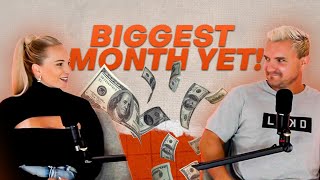
YouTube podcast episode (Success School, ep.46) with hosts Steph and Tim Frey explaining how they achieved their biggest cash month. They attribute success to (1) deliberate brand building (paid omnipresence, Facebook community, free value), (2) consistently over-delivering for clients enabled by a sustainable delivery model, and (3) focusing on one core offer/audience ("master of one"). The episode includes personal updates (Bali decision, early hustling memory), metrics about podcast reach, and practical advice on cost-control, tracking data, and simplifying offers.
Questions this video answers
Episode 46
About 600 downloads per episode
1,000 downloads per episode
June 2, 2024
Chapters
A lot of what I see in today's day and age with entrepreneurship is that everybody starts their business and they want to be at level 10 when they're only at level one. And they want these really beautiful Instagramable events, and they spend all this money on all these additional stuff like cookies and, you know, table settings and the right chairs. You drive your costs up so much by doing that stuff.
If you're building the brand, disassociate yourself from the brand. Therefore, its success has nothing to do with how you're feeling. Because when you attach the feeling or your worth to the success or your brand or the likes or the shares or the comments or all that type of stuff, you're going to be probably a little bit disappointed because it can be very slow. Welcome to the Success School podcast. We're on episode 46 today. We're talking about how we had our biggest months ever.
Yeah, it has been. It's been a month. It's been a month. High five. Yes, it's been a month. It has been an incredible month. And so we wanted to break that down for you guys. But before we do, let's dive into a podcast update. Tim, give us a little update on what's going on.
We've had so many shares lately. We are super grateful for that. So thank you so much, guys. If you guys have been sharing the episodes, we love you. So thanks so much. I think we're up to about 600 downloads per episode, so slowly climbing that up. So just a reminder, guys, once we get to a thousand downloads per episode, we're going to have a paid VIP experience with us. So we're going to fly someone over to Perth. You guys are going to get put up maybe at our house, maybe somewhere else. We're going to have a full day together, run through everything you need for business. It's going to be like a mastermind brainstorm session. One on one with Steph and I flying you from anywhere in the world over to Perth. How good would it be if they were in Perth? But no, we're happy to fly someone in from anywhere.
In that case, we'll get you a limo.
So we'll let you guys know. So what you to do in the meantime is just share the out of the show with anyone that you think could find this information valuable. And then we're going to announce that competition once that all happens. All right, so a little bit of a personal update. Steve and I have been toying with moving to Bali forever. We have come to the conclusion, finally and put this to bed that we. Drum roll. Could not move there. Okay. So unfortunately, we could not move to Bali. There are so many factors. I think we were driving home on our trip the other week, and I think a cow, a dog, a cat, and a chicken came out at me on the same ride coming back from the gym, and I was like, I can't do that level of stress every single day just on a scooter. Let alone, like, the medical. Getting our dogs there, it was like, it's pretty dodgy process to get your dogs there, getting them home. Like, there's just so many barriers to it. Like, from a tax implication point of view, it makes sense. From a lifestyle, you know, point of view, it makes sense. But from, like, a overall life point of view, it doesn't make sense. So, like, very sad, but also not sad, because Perth is pretty epic.
Yeah, I was a little devo. I was pretty devo at the time that we couldn't move to Bali. Most of the dogs is the biggest inconvenience for us and in terms of moving. But what we have decided to do is, you know, just make sure that we, like, love our life here and travel there really often. And it's so close, and we're so lucky that it's so close. So we. We'll still be spending a lot of time there. For all our Bali friends that live over there, we're still gonna visit you a lot. And we do love it over there. We can see why you love it there. It's just not. It's a. Not for us anywhere, anytime in the next couple of years. My own personal update. I actually had a memory come up on Facebook the other day from just after I quit my day job. So it must've been, like, seven years ago. And I was putting a call out on my personal Facebook for anyone who worked in corporate if they could please print off my booklets for my event. I think it was. It's so random, but, like, I think it was like, I had, like, a thousand pages of printing. We must have been so broke. That's what. That's what I thought to myself. I was like, wow, we must've been pretty broke that I couldn't, like, go to officeworks or, like, one, buy a printer or two, go to officeworks and get them printed. And it reminded me of, like, oh, it's a very sobering and reminding, like, experience of what startup entrepreneurship is really like. And I think sometimes, you know, when you have been in it for five or six or seven years, you can kind of forget those early days where you're like, go on, I've got to go spend, you know, 150 bucks on printing today, you know, when you're not basically making any profit in the business yet at all. And so I put a call out on my social media, on my personal Facebook to get these pages printed and obviously completely forgotten about it. But even back then, it reminded me that, like, Steph, wow, you're a hustler. And you were always thinking about, you know, lowering the costs and saving money and making sure that we're making profit in the business. And. And I wasn't scared to ask for help, and I wasn't scared to allow myself to be supported by somebody else. And I remember that I did have a friend who worked in corporate. She was like, yeah, baby, print if you come over and pick it up tomorrow night. And I gave her a bottle of wine that I had sending a house, and she printed me the pages. And. And I think my biggest reminder to you guys is it's okay to ask for help. And it's a smart thing to focus on your costs and to lower costs. And I think in a lot of what I see in today's day and age with. With entrepreneurship is that everybody starts their business and they want to be at level 10 when they're already at. When they're only at level one. And they want these really beautiful Instagramable events, and they spend all this money on, you know, all these additional stuff like cookies and, you know, table settings and the right chairs and the right, you know, cutlery or the. The best catering and all of this stuff. And it's like you drive your costs up so much by doing that stuff. Like, Tim, you know, we. We have friends that, like, open, that want to open gyms that are like $2 million worth of build. And, you know, you and me just started in our homes and in other people's homes and, you know, doing it really cheap and cheerful and putting the effort and the passion into it instead of being so, like, freaking out about the money. And I highly recommend, guys, if you're starting a business, like, look at the cost, like, find ways to save and don't hesitate to ask people for support. I would way have rather spend 200 bucks on getting, you know, a phone call with a business coach than to. To get a thousand pages printed when I knew that someone could do that for me for free.
Yeah, the thing that's stopping your success is not the, you know, flashy event or the flashy setup or Whatever it is, it's honestly like, when you start, you're just such a bad operator that you just don't even know what good looks like. You just need to become a skilled operator and an entrepreneur, and that's how you're going to be successful. It's got nothing to do with your office, got nothing to do with your car. It's got nothing to do with the quality events you put on or how pretty everything is or how flashy your gym is. That stuff comes down the track. But, like, I think a lot of people are trying to skip that step. Like, my first gym was an absolute shit box. Like, I filled in a swimming pool by hand with my dad and concreted over, and I had one squat rack, 60 meters astroturf, and 60 kilos worth of plates. That was it. And then I built a seven figure gym from that. I didn't start with anything flashy.
Yeah. So guys just reminded you to start where you are.
All right, Steph, do you want to tell us what we're talking about today?
Yeah. We are celebrating that we just had our biggest month ever. And the reason that we're celebrating that with you guys is not a brag. I want to be very clear. It's not to brag. It's not to pump ourselves up. In fact, we'll be really honest. We actually hate sharing this shit.
Yeah.
Yeah, we actually hate it. We hate talking about money on the Internet. We hate that it's about money. But at the same time, guys, what we want to do is normalize this for you. We want to normalize that you. You know, we too, are also going after goals. Um, you know, I hope that, you know, that, you know, money isn't everything, but, geez, money makes things a lot easier and makes life a lot more simple. And we want you guys to have that, too. And so we're going to share with you in today's episode, you know, what our biggest takeaways have been. What specifically? We've changed so that you might be able to replicate and take what we've learned and have spent a lot of time and a lot of money trying to figure out and implement that into your business. And you could have your biggest month, too. So, Tim, let's talk about what was one of the biggest changes that we made over the last six months.
Yes, the. For us, probably one of the biggest changes is we focused on brand building. Okay. As our biggest thing. So, you know, that might be a very pie in the sky comment. Like, yeah, let's focus on brand Building. But honestly, it comes down to three main things which we've done. The first one being omnipresence with paid ads. The second one being building a Facebook community. And the third one is lots of free value. Okay. So free value in the forms of masterclasses, training lead magnets, answering questions in groups, presenting in other people's masterminds. This podcast, like we literally give it all away on this podcast for ads. We have spent a considerable amount of time and money getting our face out there in the small business world. You know, if you guys know Steph, she's like literally fucking everywhere. Because that is a purposeful endeavor for us. We want people to think small business growth. And Steph Gordon, you know, and then secondly, like, you know, back to the Facebook group, like we've put a lot of effort and time into growing that thing and resources that it has become a little bit of a pillar of our brands.
Yeah. And I think like we have just spent so much time, like we're constantly creating new free resources, we're constantly giving out new free value, we're constantly testing out new things, new master classes, you know, inviting people to our intensives. But we focus on just really like the. I really think the omnipresence has been huge for us. Like people kind of knew who we were before, but now there's kind of no doubt that, you know, in the small business community people know who we are and we're building a lot of trust because we give a lot of free value because we help a lot of people with our podcast, in our Facebook group, with our freebies, we've just really developed that. And it's actually, and I want to be really clear, the reason why this is relevant and the reason why it's been a huge change for us is because what we've actually done is we've kind of put our brand building on a bit of autopilot.
Yeah.
Because we do have so much running in the background with ads and we do have so many top of funnel ads running which are just like awareness based ads as well. And, and just getting them to know who we are and what we're passionate about, what we talk about and the things that we help people with that. It's been really easy for us to continue to grow the brand and to generate lots and lots of leads and to build it know like a trust and nurture. Because it's been on autopilot. I think if you guys are having to actively every single day go and brand build very manually. It's, it's really exhausting, which is why we're so passionate about, you know, teaching our clients to do ads. Because, yeah, ads aren't the answer to everything. And I want to be really clear here. There's so much that needs to be done organically as well, but it's something that has allowed us to just really take our step a step back and our foot off the gas and allow it to work for us. And I've been following a brand and a little story about, you know, why this is relevant. I've been following a brand the last few years who, who have always, you know, posted to get clients. And then you can kind of see the journey of this person. Like, they get fully booked and then they kind of stop showing up on social media because obviously they've taken on as much work as they can take on. And then they practically only show up on social media and try and connect with their audience when they need more clients or when they're trying to sell something. And I noticed that in the last kind of couple of months, they've been complaining more and more about how competitive the market's got and how hard it is to get clients and how they're feeling really burnt out and really exhausted from the marketing. And then this week I saw that they announced that they were shutting down their business. And it really made me reflect on kind of our journey the last six months. And, like, it is exhausting having to, like, constantly be showing up and creating value for people and, you know, writing really good posts and doing, especially if you're owner operator guys, like doing the business work and doing the client work and doing the marketing work. And you have to create a system that works for you. Because getting leads and clients for us over the last six months has probably been the most effortless it's ever been because we've really dialed in that ad strategy as well as our organic strategies. And so we've created a process for our organic stuff. We've created a process for our ad stuff. The ad stuff just takes over in the background until we need to change it, which is probably once every couple of weeks. Couple of weeks, which is, you know, and then every week we have a process that we create content. And so it's become. Become something that we can spend a couple of hours on a week and not have to get too bogged down in, which has allowed us to just really build that. That audience. And obviously, guys, if you don't have an audience, no one's going to buy. So I think one of the Biggest reasons that we've made this, you know, this had our biggest month ever and had our biggest amount of signups and our biggest cash flow is, is because we've really intentionally built this brand.
Yeah. I'm just going to say here, you can't really measure the ROI on building a brand, and it can be quite frustrating as well. So if you're putting a lot of time into doing podcasts and YouTube and, you know, getting out there, networking and speaking and, you know, connecting, creating content, all those types of things, it can be very frustrating if the rewards or the results don't seem or feel worth it to you. But it's something that's a bit of like a compounding interest type thing. So the more you do it, the more consistently you do it, the better it gets over time. And then eventually it's kind of like a ball running down a hill and the ball just gets bigger and bigger and bigger and the hill gets steeper and steeper and steeper and then it's like a runaway train eventually. And that's your brand. Okay. But the hardest thing to do is get that ball rolling and consistently rolling without getting deterred. So what I want you guys to think about is if you're building the brand, disassociate yourself from the brand. Therefore, its success has nothing to do with how you're feeling. Okay? Because when you attach the feeling or your worth to the success or your brand or the likes or the shares or the comments or all that type of stuff, you're going to be probably a little bit disappointed because it can be very slow, especially in the starting phase of the first 6, 12, 18 months.
Tim, can I ask you a question on that? We always have personal brands. How would you encourage someone? How have you been able to dissociate from the numbers? Because it's easy to say dissociate from the brand. I think it's harder when it's a personal brand. Right. Because you're like, oh, they don't like my video of me speaking. You know, you can get very caught up in that kind of mentality. What's been something that's helped you to like, dissociate from the personal brand and not take it so personally.
Yeah, it's honestly, it's been a work in process and like, it's been a lot of time, effort and money spent on, you know, counseling and mindset coaches to get to the point where, like, I honestly don't care that much about how my content does. I think it's just Awareness that for me, it has nothing to do with my value as a coach or my value as an entrepreneur on how my content does. Honestly, I think it's just becoming conscious of what it actually means. It just means that the algorithm is favoring a certain type of content and not yours. Or maybe your content's not that good and that's okay. And it's all a process. So for me, it's more like I see it as a learning curve rather than I'm a piece of shit that I can't create content that goes viral.
Yeah, I love that. So takeaway number two for why we think we've had our biggest month ever is because we execute above and beyond for our clients. Now I'd say that most people would say that they probably execute above and beyond for our client for their clients. And I really believe that you do. But after working with hundreds of entrepreneurs over the last, you know, 12 months, one thing that we've noticed is that you have to be able to execute above and beyond all the time. Not just sometimes, not just, you know, until you get burnt out. So you have to set up a business model that you can deliver on and over deliver on for clients. Because if you over deliver for clients and they love what you're delivering for them and they feel like they're getting mass value, then they're going to talk about you and you're going to get more referrals. And referrals, obviously, for the most part are the backbone of like 90% of small businesses. And so for us, one thing that was really important and I think one thing we've done really well with Successful that we hadn't done in any of the businesses prior to this was we set it up a business model that we could deliver on but not just deliver over deliver. So we're able to give more and more and more to our clients. If you signed up for successful 12 months ago, you know, we've added in like extra, like free business retreats, we're doing monthly live trainings, we're doing bi, monthly, you know, huge, like live intensives, we're adding new resources, we're adding deep dives, we're adding in person events, we're adding, we've added, added, added, added so much stuff like audits for our clients, like so much additional stuff that we've added because we had the capacity to do so. Because we, we set this business up so that we would only have to coach, you know, six or seven hours a week between us. And because of that, we can create. We have so much time, energy and space to be able to continue to over deliver for our clients. And so if you're in a business right now where you keep getting burnt out to reach your financial goals and you're, you know, servicing your clients starts to feel hard and heavy, it's, it might be an indication that it's time for a model change. And I mean, it kind of reminds me of this week in Successful, Amy, one of our clients, she had posted that she just hit her Q1 financial goals and had said that she had consistently hit 10k months for three months in a row and had never been able to do that before. And I remember when she came to us, she was burnt out. She'd hit her ceiling financially. She couldn't earn more in her business than, you know, 5, maximum 8k per month. But then she was burning out. She wasn't able to spend time with her family. And in her first few weeks in Successful, what we focused on was changing up her service to focus less on needing her and more on getting results for her clients, simply in a way that didn't require so much of her input. And she messaged us this week and she was like, yeah, I hit my financial goals. I can't believe it. She said that she all she had to do was readjust her service and her pricing. She had to fire a heap of unideal clients, which we all have that, and they take up too much time and for not enough reward. We hope to replace those clients. Now she loves her business again. And because she simplified it, she said her profit margin went from 60% to 87% profit margin in her business, which is so wild. And it all comes down to just getting that model right.
Let's talk a little bit about the master of one. Okay. It's something that we have chatted about so many times. So yeah, we've had people come into our coaching programs over the last five years and you know, I'm going to give you a really like, wild example. But just to illustrate the point here is we've had people come in that do massage, they do Reiki, maybe they do a little bit of bookkeeping on the side, they're doing nutrition. And then they come in and they're like, I want to be a bookkeeper that does Reiki and I give massages to my clients. And you know, and then they create this crazy service which doesn't exist. And then they go to market and they're like, they wonder why their business is not growing. Because no One wants that, okay? Because people want simplicity. They want one thing. They come to you and they. They want you to be the expert at one thing, okay? And that's the one thing is you want to have one service, you want to have one product, you want to have one target market, you want to have one sales process, you want to have one main marketing channel. As soon as you get away from that, you create a lot of complexity in your business, and you create a lot of confusion for your target market. When your target market is confused or your ideal client is confused, they will not buy. Okay, let me say that again. They will not buy what you're selling if they are confused. Another example was, I've seen this on landing pages on tons of our clients is they'll say, hey, Tim, can you check out this landing page? And I say, hey, no worries. Go down to the bottom. They've got like 46 payment methods or options that you can choose from. When someone is confused, they will not buy, okay? So you need to make it very simple. So what do you see go wrong with the master of one? Outside of my crazy perspective there, Steph.
Yeah, So I think that people find it scary to go all in on one thing, but they don't realize, and I've used this analogy before, that you. If you have more than one offer, and let's say that you have a high ticket offer and a low ticket offer, that means that you need to have marketing messages for both, because they have two ideal client. They have two different buyers. So they're gonna have two different marketing messages. That's two different types of landing pages. That's two different nurture sequences and funnels. That's two different payment methodologies. That's two. That's two different delivery modes and modes of delivery for each of those clients. That's two different types of ways of communicating. It's just exhausting. Like, even just thinking about having to do two lots of all of those things when just doing one lot of all of those things is a lot. And then you have to optimize and tweak. So, you know, let's say you and you create a nurture sequence to warm people up from when they are a lead to when they become a client. Well, okay, we want to be able to optimize that nurture sequence. We want to send it out, we want to get the data, we want to tweak it, change it, and keep doing that until it becomes the best thing, the best nurture sequence in the world. And it's converting really highly. You have to do that across three or four or five different nurture sequences. You just don't have the bandwidth to optimize and make it better. It's kind of like trying to cook three main dishes with all of the trimmings at one time and hoping that one of them doesn't burn. Like of course one of them is going to mess up because you just can't keep your eye on the, on the prize of that many dishes. And so unless you have a process for it. And so I highly like, guys, you will simplify your life and you will simplify your buyer's mind and you will simplify your business and you will simplify your overwhelm. If you just stick to one offer and make it the best friggin offer in the world, that is what's going to get you rich.
All right, we're going into our third point and this leads perfectly into it. We have stuck with one approach, one offer and one audience since we launched Success School. So Steph and I are classic entrepreneurs. I literally wake up every day excited to start a new business, create a new venture, create a new offer. Like we were ecom coaching, then we're ecom business, then we're gonna do another brick and mortar. We're gonna buy seven gyms, we're gonna start a journals business. And that's been in the last week. So I can't even imagine the rest of the entrepreneurs out there and how you guys are thinking. But we stuck with one thing. We focused on Success School only. Yes, we did add in Startup school recently. That is like a secondary on what we did. We got to 2 million per year, like run rate before we did that, by the way. So we have our AS team, everything dialed in super well before we did add that in. But Startup School isn't our main focus. Success School is. So by staying focused or hyper focused, we have the data on that and we know that our data is going to accurately predict our success in the future. And I want to give you guys an example of that. So it takes us 61 leads to get a call booked. Our conversion rate is around 60 to 70% depending on the month. And then from those two statistics there, we know exactly how much we need to spend to acquire a client. If we had seven different services or eight or different businesses, we would have no idea on that data because we just simply don't have enough hours or energy or focus in the day to work that out. And my favorite saying to summarize this guys, is if you chase two rabbits, you will catch none. Let me say that again. If you chase two rabbits, you will get none. Okay, so pick your rabbit. Who do you want to chase? How are you going to get it? What is the service? What is the offering? What is the target market? What are you going after? Okay, get really clear on that yet.
Honestly, focusing on one thing for us has been an absolute game changer. It has been so. It's also just been so easy and. But it's not easy, guys. I want to be really clear. It's not easy to not get distracted like we get distracted like everybody else. We have to. We have to really hold each other accountable to not getting distracted. We actually have one of our clients, Corey recently, who's been in the same boat, you know, he's had. He started getting some real momentum with his, with his business and all of a sudden he's. Because, you know, well, guys, when you get momentum, when you get in flow, opportunities are going to start attracting to you. And so he started to have all these opportunities. And Tim and I are constantly having to be like, no, no, no, no. Like, stay focused on the path. Stay focused on the path. The path of least resistance is the one that you just stay focused on. I promise you, the grass is not greener on the other side. We've had lots of businesses in lots of industries. We've had lots of ideas. And I can tell you right now that the grass is just greener where you water it. So focus on one thing, stick to one offer. Make it the best thing in the world. And then once you hit a point where you feel like everything's running without you and it's been running that way for quite some time, then, yeah, let's do something new and let's do something exciting. So for our episode recap for today, number one, build a brand and find a way of marketing that suits you. So really focus on building a brand. Make sure that you can stay do marketing that you can stay consistent in doing. Doing consistent marketing is the way to build a brand. Okay? So just making sure that you can find a way to make that happen for yourself. Number two is to please know your data. There's no point in going all in on like trying to go viral on Instagram or personal Facebook or starting LinkedIn because you think your ideal clients are over there. You want to focus on the one that makes the most sense for you and your business, not just what everyone else is doing. Don't get shiny object syndrome. And last but not least, you want to rework your model to suit you long term. So something that's sustainable but allows you to still over deliver for your clients so you can get those referrals. Marketing becomes so much easier when you nail that.
All right, guys, that was an amazing episode. If you got some value from this episode, please subscribe or follow on the relevant platforms. We will see you next Monday. Guys. It's been amazing.
Thank you.










