
Q&A - Why you SHOULDN’T start group coaching, how to get MORE signups & why people aren’t buying
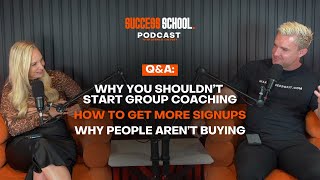
Tim Frey and Steph answer three questions: why group coaching often fails as a low-price option, how to get more signups for a masterclass in 10 days, and why people say they'll buy but don't. They point to the say-do gap, lack of emotional investment, and insufficient trust as the real blockers.
Chapters
People keep saying they have the money to invest, but yet they still aren't buying. Why is that happening?
What people say and do are two different things. What people say online, like, yeah, I'm so keen, I'm so in. But, like, the real test is when you pull out the credit card and you put your details in.
I think trust is the thing that oftentimes is the thing that is the undoing here. And you can build trust in a lot of ways. It actually doesn't really happen in your sales process, which is wild. It happens a long time before your sales process.
Foreign. Welcome to the Success School podcast. We're on episode 65 today. Today we have a schooling episode where we have a Q and A. So we're going to go three questions. We're going to answer them for you. Steph, how you feeling?
I'm great. Could we. We might change up that question. But I am very good. I'm very happy, I am very excited and I am nervous because I know that you haven't seen a question for me and your face tells me that I should be concerned.
Steph, just something I've been wanting to bring up lately, but you've really realized, like, a role in our life as spare parent to the dogs. How's that feel? So what happens?
So it's really annoying because, like, I feed the dogs, I walk the dogs. Like, you walk the dogs, too. But, like, Tim's like the fun dog dad, and I'm like, the discipline like that with real kids, I don't reckon it will be. I think you're gonna get fed up.
I.
And the disciplining mu. And so, yeah, they just don't like me as much, which is really annoying. Like, especially our boy dog, Felix. Like, he literally, like, follows my little boy. He literally follows Tim everywhere. Tim's out of the house. He just waves by the door to Tim, gets home. Like, he will lick Tim's face and then come over to me, sniff me and walk away.
Like, it's like, fuck this chick.
Yeah, he just. It's like I said to Tim this morning, I was like, do you think he loves me?
He does.
In his own little way. In his own little way.
All right, personal updates.
I've got a question for you.
Oh, she's prepared, kind of.
Tim, I want to know, how much money do you reckon you've spent on some of your hobbies in the last couple of years and how much use. How many, like, pay per use. How much do you think you've actually got out of them?
Which I'll be.
Okay, let's start with the motorbike.
Okay. I bought a Wiser 250 a while ago, used it three times, then it got stolen. And then, you know when something gets stolen or gets taken away of your life, this can go into my personal update. You just appreciate a little bit more. You don't know how much you love something until it's gone.
Right. So how many times you've ridden it since you got it back? Twice. That's actually pretty Good.
Yeah. So five times total for how many years? $12,000. Two years.
It's been like three years.
Every six months.
Every six months he rides the bike and then. Hold on, there's more. But wait, there's more. What about the guns?
Guns? Yeah, the wa. Please make it really hard to shoot guns. So it's been challenging to shoot them as much as I want. I've also been doing this thing, it's called running the biz. And it's quite time consuming and I do do a lot. We did a ops chart and I actually have five roles.
Yeah.
So how many do you have?
Brianna was like, yeah, like it was super cool. Like Tim came into the business and Steph and Tim like went down to a really small team, went to a really lean team and Tim took on five roles. That's basically what happened.
So she gives me a shit, but I'm single handedly supplying the lifestyle.
No, no, no, here he goes. Okay.
Sales is weak though.
So is that your personal update?
No, my personal update is I've been doing some deep diving and I was like, cool, good question to ask myself is what are the people ahead of me doing that I'm not? Because success leaves clues. And I did have a look at a lot of coaches that were doing big money, million a month type shit. And you know, one of the really simple, easy ones is they all have really good high quality video setups, audio. When they're presenting they do all this kind of not elaborate but like high quality stuff where I'm just fucking rolling an imac camera that sucks and is smudged most of the time. And I don't ever use any sort of a headset at all. So I'm literally rolling imac set up for video. We have a multi seven figure business and that's my level of audio video. So what I've done this week is I bought a camera for both Steph and I and a microphone. So we've kind of stepped up. We've got 4K cameras now, which is epic. Got this wall put in. We're going to be learning how to use the iPad very soon to draw and do presentation things with the Switch deck, which is epic. So the question was, what are other people doing that are ahead of you? And one of them was stepping up the quality of how they execute. So my personal update is if you want to get to the level of where other people are, you need to do what they're doing.
And that brings me to my personal update, which is actually not going to be the personal update that I was going to share, but it has led me to one that I want to share, which I think is way cool, is you're to look the part. And I think it really ties in beautifully to what you were just saying. But Cody Sanchez shared on her stories this week. She was like, if you want to get taken seriously and you know, be at the top of the game, like, you have to look like you're willing to play the game. You have to look like you're in the game. And so, you know, there is a lot to be said for, you know, when Tim and I fly, it's so much more comfortable to fly in a tracksuit for sure. However, we always fly in full dress attire. And you know, especially Tim, I don't wear dresses, by the way dress attire is. He wears his suit.
Okay.
And you get taken a lot more seriously. You get a lot more like at the end of the day, like the more seriously you take yourself, the more seriously you will be taken. And so we've really adopted that to a lot of areas of our life and we've really been stepping up in terms of, you know, getting custom merch made for us. You know, the way that we dress, the places that we shop, you know, buying investment pieces, not investment pieces like Louis Vuitton because we think that's fucking crazy. But just like, you know, buying better quality stuff and putting a lot more effort into the way that we look. And I think it's being sentimented online as well. Like I think that that whole conversation is like the way, you know, you dress, the way they present, the audio visual gear, the way you like come across on zoom. Like those things matters. Those like those 1 to 3% changes really, really make a difference.
It all matters. Let's get into the question. So first one from Abby and I'm going to ask you, Steph, I would like to explore group coaching or a cohort or a membership option for those who can't invest in one to one coaching just yet. Would love to hear your Thoughts? Let's see where this goes. This is like coaching hot seat. You guys can see what goes on in success school all the time.
I don't like it, I don't like it. And I did send this to Abby and it's not that I don't like it. I obviously love group coaching. I also love memberships. I'm part of, I've been part of really good memberships. You know, I love our group coaching containers. I also really enjoy one to one coaching but I don't like the reason for why it's being done. So the reason was because she's worried that people can't invest in one to one coaching and I just think she needs to go find the right people. At the end of the day you can get pretty fully booked on one to one coaching very quickly. If you actually have the offer stack right and you're going out to the right people, you only need probably like 10, 15, maybe 20 clients at once maximum to be fully booked. So we just need to go find those 20 people. And so if you attract people who can't afford your service, we need to look at your marketing so we can attract the people who can. That's the main issue here. So what she's trying to do is band Aid. The solution with, you know, I'll offer something lower cost. What we always see happen when someone does that is they just massively dilute their message. Now they have to speak to two different target audiences, one that's cheaper and one that's more expensive which means that these people have two different types of problems, which means that you need to have two different services, which means you have to have two different sales processes, which means you have two different landing pages and email sequences and everything just gets more complex from there. Whereas all she really needs to do is actually spend time focusing her marketing in to actually go and find people who can't afford her service.
Yeah, I love that. So I was sent to URL and there's this famous coach and like he might be one of the best coaches but his name's Steve, his last name's H. I've showed Steph his profile before. This older guy lives in Arizona and he's a one to one personal development coaches and he charges 200k for one on one for six months and he's, he's had over 600 clients. So do the math on that. 200k times 600. A lot of people do group coaching because they think they can make more money when they just need to get really good at one on one and they can make all the money they want. If Steph and I would do it again, we would probably just do one on one and work with the right type of people like that. The higher end.
Yeah, yeah, yeah. Oh, yeah, for sure. I think yes and no. Like, I think, like, I personally have a love for group coaching and I love the presentation model of it. But in saying that I, I think that a lot of people do group coaching for the wrong reason. They do it for money. And it's. That's the wrong reason to do group coaching. You're going to do a really awful job for people too. Like, you know, it's a skill.
It's way harder than you think.
Way harder than you think. Like to hold people together, to hold the space, to hold the standard of the community. Like there's so much more to it. Like then, you know, and how to ask questions, how to stop people from going on rants. It's a real art form. And I think you need to really want to do it. You need to really want to be in community. You really need to want to have mass impact. And if you don't, then you, yeah, sure, create a course, but make it no touch and let's sell that instead. But at the end of the day, I don't think the reason for wanting to do it here was the right reason. Sure, yeah, sure. Okay, question two. This is from Rachel B. I've launched a low ticket masterclass. How do I increase signups over a period of 10 days?
Awesome. I'm not going to hit this question, like with the direct answer because, you know, we can just give you a couple of strategies and we're going to go from there. But my strategy for low ticket Steph might disagree with this and that's fine. We can have a little argument on camera and you guys can see that'll be cool. But I think you should be developing a system that you roll out for low ticket, high ticket workshops or promotions or whatever. And I think you should follow the same process every single time. What Rach did here is she kind of exhausted all options and went as hard as possible selling a $50 thing, which is great, but then you burn up a lot of goodwill. Okay. And I knew selling a $50 thing, whereas you could use that same energy to sell a much bigger thing and have a much bigger result. Especially for like masterclasses and these types of things and low ticket stuff. I would be doing email, I would be doing ads and maybe some stories, but I would Be doing the exact same process every single time. So I could split test evenly, essentially the quality or the different ones that you run every time. If you execute a different marketing strategy every time you run something, you're going to have different results. Therefore you're not going to be able to tell which produced the best results for you. Steph?
Yeah.
Your thoughts on this?
Yeah, I think that a multichannel approach is 100% required and I don't know if that was what was done here. I know she definitely did email and Instagram. I think definitely running some Facebook ads would have hugely boosted the sales. I mean, she did an incredible job. I think she had like over 200 sign up.
Yeah. Which is amazing.
Phenomenal. But how to get people to invest when they're not buying. So there are different stages to the buying cycle. I think this is worth talking about for a launch business. So there are the people who just freaking love your stuff and the like, if you do a good warm up, which Rach did a really good job of this, if you do a really good warmup, you know you're going to have a series of people buy. I think she had like 60 people buy in the first couple hours, which is huge. Like so, so, so good. And so she had six people behind the first couple hours. And then they're the people who were always going to buy like they were 100%. They're like waiting to like click, go like, you know, that wanted to be in the first 48 hours because there was a deal or whatever. And then you have pretty much the lull. So over the next, if you have a period of 10 days that you're selling this thing, you know, between probably days like two and days like seven, it's pretty quiet. Like you're going to sell a few, you'll get a few runs on the boards, you know, probably sell 50% more than what you sold at the beginning. You know, you won't get that many more through the door, but then there'll be a huge push at the end because there's always a last minute buyers. And actually most people fall into last minute buyers. I reckon 70% of buyers are the last minute buyers. They're like, oh, it's going to run out. I got to quickly get it. Or almost like forced to. And I think the way that you can think that is like when you receive a bill, are you the kind of person who pays it immediately or the kind of person that will wait until you get like the overdue notice to pay the bill? So I think that most people are the kinds of people who wait for the overdue notice. And I used to be like that until I started having to pay extra fees on all my bills. And I realized just how inefficient that was. And now as soon as we get a bill, we pay it because I don't want to have overdue fees. But there are a lot of people who will wait until the last minute to buy things. And so you've got to understand the buyer psychology of that first and foremost. So Rach did have a huge amount of tickets bought towards the end as well. But some things that we did in the middle to pump up this launch were she created a graphic for every single person that shared and got them to share it to their stories to say that they were like joining this thing. So she got like triple, quadruple, like 100x the amount of reach that she had before because every single person who was attending, those over 200 people who attended shared this graphic to their stories. So all of their audiences would also see it, which is really, really smart. Posting in Facebook groups, if you can, leveraging other people's lists is a really great way. So if, if you know somebody who has a similar audience, you can either pay for them to put stuff on their social media, pay for them to send an email to their list, or if you have a really good relationship, you could do list swaps. So you could say like, hey, will you send this email to your list? And I'll send an email about your product to mine affiliates. Like, she could have done kickbacks if she wanted to. There's a lot of really cool things you can do, but a lot of this does have to be planned for prior going into the sales period. And so like Tim said, it should be a really well planned out thing where you know, you know all of your marketing channels, you know exactly who you're going to, you've got it all teed up and lined up. And that means that you do need a longer Runway. You can't just kind of go, oh, next week I'm going to run a challenge. It's going to be about this. So it does mean if you're going to be doing marketing like that, you do need to be a little bit more intentional about it.
Awesome. Question number three from Mon S. People.
Keep saying that they have the money to invest, but yet they still aren't buying. Why is it happening?
So many answers here.
There are so many.
First one, what people say and do are two different things. And what People say online, like, yeah, I'm so keen, I'm so in. But like the real test is when you pull out the credit card and you put your details in, if they're saying no, then there's a no. So like, even if we get a wait list for something, even if we get all these people that say they're going to buy this thing or join or whatever, until the contract is signed, the deal is not done. Okay? And we take nothing for granted when it comes to that. Second thing here is we don't know any of the specifics around the sales process of this, but I feel like there has to be an emotional investment from the prospect to get them really in and they have to see the, the benefits of results to guarantee the outcome. What this actually is, I think the main thing here is like, what's the outcome that we're trying to sell? Does the prospect know they're going to get it? Is there a guarantee that they know they're going to get the result? And then thirdly, is there an emotional investment attached to them actually getting a result? If you have those three things. For me, I feel like a sale is a home run unless something logistical comes up. But I don't know the context of this, but I'm going to say, like, if you guys are listening to this right now and you want to get more sales, you have to have an outcome, you have to have a guarantee, especially in this buying market. And the price has to be a no brainer for them as well.
I want to talk to your first point, which was the fact that, you know, people, people say and do two different things. There's a really cool study that was done and I think it was by Virgin Airlines and they were basically saying that they surveyed all these thousands of people, thousands and thousands of people, and everyone said they would prefer to have more legroom on the plane. And Virgin, like, cool. So what they did was they went and, you know, crafted all of these planes that had all of this extra legroom. But of course, because there was more legroom, there were less seats, which of course drove the price up when they actually launched the airline. And the new planes, they end up having to scrap it because they couldn't get enough seats sold. Because the thing that they failed to ask was, yes, everyone wants more leg room, but the question they failed to ask was would they actually pay for it? And so I think that that talks to that point really perfectly. It's like people can talk all they want, but when it actually comes to putting Your money where your mouth is, that's a very, very different concept. And so you can't always just take what everyone's saying for face value. But the second thing I would add here is trust. I think trust is the thing that oftentimes is, is the thing that is the undoing here, you know, and you can build trust in a lot of ways. It actually probably doesn't really happen in your sales process, which is wild. It happens a long time before your sales process. So, you know, the ways in which we build trust a lot. We share a lot of client wins, we share a lot of proof, we share a lot of testimonials, we have a lot of case studies and we built that over the last few years of having really incredible client results. And so we've got a lot of trust. And because we share that and that's available to people, they can see it, so they have belief. The second thing that we do to build really massive trust is that we do a lot of long form content. So between trainings, between the podcasts, between masterclasses, you know, our intensives that we invite guests to our in person events, like people can really get to know us and listen to us and hear the authenticity or the vulnerability or the passion in our voice and really understand who we are as people. And so because of that, again there's a buy in of trust. So we're not for everybody. There'd be a lot of people who's outlived this podcast will be like, see ya. But the people we are for binge our podcast love it and then, you know, want to continue working with us. And so I think that in this case it's a lack of trust. I don't think that there's enough proof, I don't think there's enough connection, long form connection. And I think that people in this market right now, they want to see those things really badly, 100%.
And if we offer you, we love you, we love the crazies and we love the people that are hanging out and just want to be involved in the successful podcast of the brand. On that note guys, if you got something from this episode, let us know in the DMs at Real Tim Ferreira on Instagram @Steph Gorton. Two underscores on the end there, the crazy handle for Steph. If you're new around here, guys, subscribe, review the show for us. Five star reviews only. We strongly appreciate it.
Thanks so much guys. Share the show and we'll see you next week.










