
Steph’s Story: “The Hardest Decision I Ever Made in Business…”
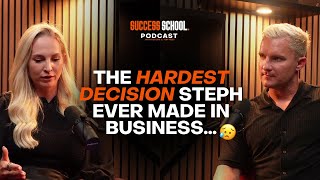
Steph Frey built a million-dollar coaching program, Purpose & Profit Mastermind, but the stress triggered neurological symptoms that forced her to shut it down and rebuild. She pivoted to Success School, kept more clients with fewer staff, and now emphasizes designing a business around your health, not destroying it for growth.
Questions this video answers
Episode 84.
February 23, 2025.
About $85,000 per year.
About $12,000 (later built to ~$15,000 before quitting).
About 40 people at roughly $400 each.
Chapters
One day I woke up with a rash. Rash was really bad. It was all over my body and it was so itchy. About five months later, the rash was replaced with this weird sensation that when I would put my head forward, I'd get this like electric jolt down my spine. I woke up with head to toe numbness and I got you to feel my body and I couldn't really feel it. I got my own hand for my body and it felt like this weird sensation and all of a sudden, business just didn'.
Welcome to episode 84 of the Success School Podcast. Steph, how you feeling today?
Is it definitely episode 84?
It is definitely episode 84. There's been many banters and wars with our podcasting team.
There have been, but yeah, no, I'm feeling really good today. Excited to be here in a new studio again.
Yes. We're in our second studio in two weeks.
Yeah.
Hopefully no mental breakdowns today. Maybe. We've got Steph's story, so we're going to be going through Steph's story. So I'm going to kick off with my personal update. So we've been doing a bit of a deep dive on brand and we wanted to basically articulate or show our personal brands a little bit better. And you're probably wondering why. The why behind this is. I think AI is becoming so prevalent in our society, it's going to be very hard to stand out because there's so much content. So one thing that can't be replicated or can't be copied is my own brand. So how do I articulate that in a better way? So Steph and I have been back to the drawing board, putting our heads down and then working out how we can create a better personal brand. So you probably be seeing this on our Instagrams coming up. So let us know your thoughts on it. I think it's how coaches are going to stand out in the future rather than just being like, here's fucking business ideas or here's fitness stuff or here's whatever you guys do and just talking about your actual creative zone. But like, as a brand, what do you stand for? What are you about? What are your values? What do you do on a day to day basis? Steph, what do you think about brand? Do you think it's going to be prevalent going forward?
Yeah, I love this conversation. And we were watching a really cool documentary the other night when we about this, we kind of touched on it and, you know, it kind of feels like people are just creating for the algorithm these days rather than for other people. And I think that we've been really locked into creating for the algorithm. We've at some points lost our way a little bit with that. And I probably speak more for myself than you. Yeah, I. I love what you're doing with brand at the moment in terms of articulating and trying to really define what personal brand means. What have you come up with so far around personal brand versus, like, brand?
Yeah. So there are seven key pillars to it. I'm not gonna reveal it right now. All seven key pillars. So there are four for your person and three for your business. You need to hit all seven, in my opinion, every week to build a solid brand. A lot of people think as soon as you start posting personal content, everyone's gonna like you and you're gonna be rich and famous. It's more of a compounding effect that we go through in compound marketing and successful. But I'm not gonna reveal it right now. Maybe we'll talk about it in our podcast going forward.
Yeah, cool. But, yeah, diving into personal brand, what's your update? My personal update. It's so weird how worlds collide and I think you just end up consuming a lot of content and then, you know, everything lands at once. But off the back of personal brand, I think something that I've been or become very aware of recently was that we're watching more and more creators be themselves. And I've noticed that the everyday creators, the ones that aren't Alex Hormozy and can't afford to have a content creator following them around 24 7, they must be creating their own content and they must be taking their own videos and their own photos and using tripods. And we have all the gear that we've really no idea standard us that we've really never used either like that well. And so Tim kind of made this suggestion of like, why don't you just learn photography as one of your hobbies this year? And so I was like, that actually makes a lot of sense because it's a really usable hobby. So I went out to all my photographer friends the last few weeks and I've asked them, who are the best people in Perth, to teach me how to use these incredible cameras that we have. And really excited to get started. I have two workshops booked in the next month to learn how to take photos. So I have an incredible model. Hopefully I get lots of great photos of you because it's been 10 years of pretty average photography by me.
Yeah, I was about to say, big sigh coming up for me, like, I was like, why have you waited 10 years to start this? You could have started this year. 1. I'd have a way better content right now.
We would be so personal brand right now if I started earlier. So sorry about that, but I appreciate that.
Thank you. I feel like I'm going to strongly benefit from this hobby that's coming up. So without further ado, the episode everyone's been asking for is Steph's story. So we have four distinct phases to this. So, Steph, do you want to kick us off? How did Steph Gordon become or Steph Frey now? Steph Frey, on the synthesis of your brand coming soon. How did this start off? What was your childhood like?
So I think a bit of background for the listeners. The reason we want to do these stories is because I think sometimes you might be joining at any stage of this journey and think that we are just the people we are and it's just so not the case like that. We've gone through so many reinventions. And if you go back and listen to Tim's episode, it was really great when we spoke about this, but where did it start for me? I am an only child and I have two incredible parents who, you know, did the best they could while raising me. When I was 7, my dad went bankrupt. And so that was probably the beginning of a story, I guess, or part of it. But what that created for me when my parents went bankrupt was that I should definitely just stay safe. Business was never on the cards for me. So, you know, when I first met you, many, many years later, you know, when you floated the idea of business to me, it was like, that is so off the cards. There's no way that I could do that. There's no way that, you know, I'd be smart enough to have the skills or I don't have any formal education. Why would anyone want to learn from me? And so I didn't think that anything like this would ever be on the cards for me. So growing up, I had a pretty good childhood. My, you know, parents were incredibly loving and incredibly spoiled, as you will know, come Christmas time, but never really encouraged to think outside the box and very much designed to go to school, go to university, get a good job, get married, have children and retire at 65. That was definitely the path that I was supposed to be on and so definitely not the path that I ended up on, though.
Do you think, like, being a single child was a benefit or having siblings would have been a benefit for entrepreneurialism or like, was there anything in that?
I do think that there's probably some benefit. Look, I think there's probably benefit both ways. And obviously I don't know what it's like to have a sibling, so I can't fully comment, but I do think it was beneficial for me growing up to be an only child. And I think that was beneficial for business because my parents, even when they didn't agree with me, they supported me and they believed in me. And I got really good education, I got really good opportunities that, you know, my parents were low income, obviously. We went bankrupt, so you can't get loans. We lost our house, we lost our car. My parents divorced. It really started from scratch again and went to zero. And so I didn't come from a high income household, which meant that, you know, my parents had to work. My dad worked three jobs to put me through school and when I started going off on the wrong track, he'd put me into private school and so had to work even harder. And so definitely if I had been in a multi child household, I think maybe I wouldn't have ended up here. So I do think that for me in this lifetime, it's been super helpful to have parents who are all in on just me.
Yeah, I can attest to that. It's been amazing to see. So let's talk about the money mindset stuff. And I know money mindset can stop a lot of entrepreneurs in their tracks. So how was your mindset or money mindset when you first started entrepreneurship? We're going to get into the other phases and how has it changed now and like, what have been some of the things that you've learned along the way?
I'll tell you a story about money that I think will really paint the picture that Tim is fully involved in. You don't think your money mindset's bad. It just is your money mindset. Until someone. Yeah, it's just your mindset. You just think that everything like I.
Thought everyone thinks like it.
Yeah, totally. I thought my money mindset was normal until you pointed out that it was really unhealthy. And the way that I found it out and the moment I found out how limited my money mindset was, was actually with you. We had gone on holiday. We were probably in our first year of dating and we went on a trip to Melbourne for your best friend's wedding. And at the wedding we decided to go down the Great Ocean Road. Anyway, I had like maybe $12,000 of savings in my savings account at the time. Tim was an entrepreneur, which means that he doesn't have a fixed income. So he can earn more money if he just trains more clients or he just puts in more hours, or he just sells some one to one packages. His income is something that can just be made back. So he spends money in a different way to how I spend money. I spend money like I split every hair, every single dollar. Was not tracked it because my dad went bank. He taught me how to budget and I was very scarce with cash. Over the course of that trip, I think I spent like $6,000 of my $12,000 that had taken me years to save. And I had a meltdown one day on the Great Ocean Room. We were driving and I had like a panic attack in the car. And you were like, what is the problem? And I was like, we're spending so much money. And you were like, so what? Like, what's the point in having it if you don't spend it? And I started to have this realization that actually, you know, I have this really unhealthy relationship to money. And Tim had this really abundant relationship. I had this really, incredibly scarce, controlling, tight relationship with money. And Tim had this really open and fun and yeah. Abundant way of seeing it. And that was the first time I realized that I had money mindset issues. My money mindset issues have followed me for decades. Like the whole seven years I've been in business, it's been a problem.
Let me just say I don't think I have great money mindset because I'm the other end of the spectrum, which is also dangerous. I'm like, yeah, let's fucking go. We're going to always make more. It's going to be epic. So let's switch gears. Let's go to House of Hobby, Steph's first business. How did it come about and what were kind of like some of the mistakes on the way?
So my first business was called House of Hobby and it was a workshopping business. The reason I started it, I actually wanted to be a coach. So, you know, I got into entrepreneurship because Tim was an entrepreneur. He had this really abundant money mindset. He had this business that he loved waking up for in the mornings. And I was waking up and I was hating my job and I was hating my life. And the best thing you know about my life at the time was hanging out with you and how happy your your job made you and all your work made you. And so I was like, I want a piece of that. Didn't know how, I didn't know where to get started. But I knew that I wanted to help people. And so I went to an event, and they bought something that's really passionate for you. And at the time, it was body image. Because I had some pretty bad money mindset, some pretty bad body image, had some pretty big stuff that was working through, and I wanted to coach women on body image. But two things. One, I knew I hadn't fully healed, what I was going through. Two, who the fuck am I to coach on something? I have zero qualifications. I wanted to do an NLP course. Couldn't afford to do one. I just thought, I need to start a business. I need to just get into this somehow. So I started house of hobby. And I did it because as somebody who was single, obviously before I met Tim, I needed a hobby. I needed something to busy my time instead of just obsessing over the loves that I had lost or whatever was going on in my life at the time. Very dramatic. But it wasn't the books. Yeah, the books I read. And so I started this business, and basically, it's like hobbies with wine. That was the premise. It was super fun. It took off really quickly. I was really fortunate. And so the biggest mistakes I made throughout that business, we scale up really quickly. So within nine months, I quit my day job. Within 18 months, we have 14 team members. We were running 10 events a week across private events, corporate workshops, workshops and shopping centers. And the workshops that we were running to the public. The biggest lesson I learned throughout that was money, funnily enough. So my money mindset really reared its ugly head in this section of my life because I avoided looking at money. I just saw revenue as all my money. And I didn't see outgoings. I didn't count those sorts of things. So there was one day where I was like, tim, the bank account just seems to be going backwards despite us earning so much money. What's the deal? We sat down. I remember we were driving so many of these conversations. Oh, my God, so many every fucking month. I was having a very fast learning curve. But I remember the conversation where I really realized that we're sitting in the car, and we just quickly whipped out our phone, and you just did some basic maths, and you were like, yeah, you're running at a loss. And I was like, holy shit. Obviously, it's just very. The bank account's going backwards. You're running at a loss. That was when I was like, I need to make some redundancies. And it was shit. So biggest lessons for house or hobby were like twofold. One, know your numbers and make sure you're actually making a profit. Two, I had some lessons around team, just around like systems and having onboarding processes. We had a lot of casual staff that were cycling through the business. So onboarding processes, super powerful throughout that period.
It was a fun time. So I just want to reverse a little bit. You had this job prior to this. We totally forgot to mention that you were not working for the car company Audi, you were working for Aldi.
Yes.
So tell us about that. And then after you tell us about that, I want you to go into taking the leap from one foot in corporate to full time in business because I know a lot of people would kind of be at this transition that would be listening to this right now. So tell us about Audi and then the transition and what made you like go, let's fucking do this.
Yes. I worked for Aldi, the supermarket company and I was working in their corporate head office. It was, it was actually a really good job in terms of like, it was great pay for someone who. I never got a degree. I dropped out of university. I wouldn't have seen myself as a smart person. So I thought it was a pretty good job for me. I thought I was rich, didn't I, when we met?
Yeah.
I think I was only like 85k a year. Yeah. And so. Which is a great wage for someone at 25. I think I was, I knew there was more for meeting you, so obviously we've had that discussion. And I went to this self development event and I realized that I could do more. And then we went to Tony Robbins and then I was like, I'm going to quit my job.
Everything was rah, rah, rah.
But there was a plan to quitting the job. And the plan was, I have my $10,000 saved.
4,000.
No, no, I built it. I built it back up.
So after that, how do you get up to 20?
I think I got to around 15,000. Yeah. And I had it figured out. So I had $15,000. I wanted to be able to last a couple of months on that amount of money with our expenses to know that I was going to be able to give this business a red hot shot. I was already making money in business. I knew the only glass ceiling was the fact that I couldn't put more time in. So I was like, if I could just double the amount of time that I'm putting in, bearing in mind that was working full time. So if I could just double, triple, quadruple the amount of time I'm putting into this, I should be able to double, quadruple the amount of money that I could put into this. Logic, logic. And I gave myself eight weeks to make back basically my salary, my corporate salary. Again, the business was already earning money, so the marketing already worked. It just needed more time. And I said if I didn't make the money that I needed to make, I think it was like four and a half thousand dollars a month, then I would go and get more work. In the end I did go and get more work. I got a little part time job which I ended up quitting about and hated it the worst. I got another part time which I quit about six weeks later. I just went all in and it, and it worked. And like I said, within that next 12 month period was wild. It really took off.
What kind of advice would you give to someone who's like at that point.
A big mistake I see is that people jump without having the safety net. Yeah, we see it in, we see it all the time. Don't jump without the safety net, guys. Like, don't be desperate because if you don't have the safety net, you become desperate because fear takes over, scarcity takes over. Especially if you have money stories, if you have any kind of money stories, which we all do, but I had extreme money stories. So I had to make sure that the safety net was there so I could feel comfortable not worrying about money and just going all in on being of service. And I think that's the biggest thing. So know what your safety net looks like. Especially like it was a bit easier for me because I was 26, 27, you know, we didn't have kids, I didn't have a mortgage. Actually I did have a mortgage, but it was rented out, it was covering itself. But if you're in the middle of your mid-30s and you have kids and a mortgage, like you've got to have a safety net before you jump, guys. Otherwise you're going to come across desperate and it's going to feel like a failure.
Awesome. I love that. That's great advice. So let's fast forward a little bit. So you've got House of Hobby, it's doing well, you're making good money. Revenue, not profit. And then there was an idea for this big expansion. Tell us about the expansion. Where were you going to go? Where was House of Hobby going?
I thought that I wanted to franchise it and I had a business coach at the time and she said to me, have you thought about what franchising involves? And I said, well, yeah, more money, obviously, easy. And she goes, well, you spend a lot of time traveling interstate and looking at the franchise and blah, blah and yada yada and, you know, be putting out a lot of fires externally that I even considered that I don't really want to be traveling at Tim, at home and my dogs. I love that. I love that life. And so that disillusioned me pretty quickly into that. And then, I don't know, this feels really weird to say, but all of a sudden it just kept getting signaled to me that we needed to be online, on the line. And you had a gym at the time, not on the line.
So off.
So offline. I had an events business, fully brick and mortar and we went to like this business event. They were like Aaron Sansoni. And he was like, you need to have an online income.
And we were like, oh, which is an online business.
So funny now because obviously that's what we teach. Literally what we teach. And at the time I was getting a lot of requests. So the way the House of Hobby was structured was that contractors would come in and they would run workshops for me. I'm not creative. So I would put them in front of audiences so they could do their creative thing and we would all make money. They started coming to me being like, how do you run a business? And so I was already kind of casually coaching on the side. And that was when I decided to start a business coaching course. I just put it up on the House of Hobby website. One day someone inquired, I thought, fuck, I'm going to have to go all in on this. I'm actually going to have to bloody do this. And I DM'd a heap of people and I was like, you wanna. I've got a. I've got a good opportunity for you. Got on sales calls and just sold em. And then that was when coaching started.
And what was the moment? And I know the big C that you went all in on coaching.
Yeah. So obviously Covid hit and luckily Tim and I had an on the line business because. And we're saying on the line because it's a great movie. I can't remember what the movie was called, but.
The Intern.
The Intern, yeah. With Vince Vaughan. Such a great movie. If you haven't watched it, go give it a watch.
So you went into a coaching program. What did that look like? Tell us about that.
It was obviously a tricky time to go into coaching. People didn't have money and they were scared. So I created a make money in Covid mini course which was Like a four week pivot booster, basically. And I think I sold like 40 people into it for like 400.
Yeah.
And I was like, wow, I'm fucking rich. So much money. And I couldn't believe it. I couldn't believe it. And off the back of that, I invested in a very expensive coach that was $30,000 for 12 months. And that was a, that was a really big stretch because we did not have, we did not have the money to invest in that. And when I say there's payment plans. So I just knew I could make the first two payments and then I was like, I've got to get in there and just work to make sure I can continue making the rest of the payments. And that was my mentality. And it worked. And within 12 months I produced and developed another program which had gone to a million. And what was the name, the purpose and profit Mastermind.
And where'd that come from?
Tim hates the name, which is where the digging is here.
I thought it was going to be the success made simple. That's what I thought. I was like. There was one in the middle.
There was. That was the first one I launched. So I did that one. It's actually a great name. We should bring that back.
You have this. Mastermind went to seven figures. Incredible. Everyone's dream. This is amazing. What didn't go well? What would you improve on?
I'd say probably the. Some of the worst days of my life. I think that, that there's so much that goes into that, like being broke and coming from a household where you don't have money and where everything is really hard to come by and where you get secondhand clothes from Symphony's for your birthday to having this amount of money, I thought that I would feel different to how I felt. And I know this is so cliche, like money won't make you happy, but like it wasn't the money, it was the way that I saw the money, the way that I viewed it. So I thought that the money would make me happy. And I didn't realize that actually the work needed to make me happ happy too. And that my life needed to make me happy too. And that there's equal parts of all those things. Like money's cool and exciting, money will definitely position you to have a way happier life. I want to be really clear. The things that I was sacrificing to make the money didn't bring me joy. And so I was working a lot. I scaled incorrectly, I copied someone else's model, brought a heap of team members on. I basically bro scaled. And it wasn't until another mentor that I'd hired. By the way, guys, we hire mentors, like, it's going our style. It wasn't until another mentor I hired was like, how much are you making? And I was like 1.1 million a year. He goes, how many teammates have you got? And I was like, 13. And he was like, why?
That's like the worst revenue per employee ever.
Yeah, totally. It's like he was like, how much you taken over the end of the year? I was like, yeah, like 100k. You're so. What's the. What's the point?
Yeah.
And it wasn't until he positioned that back at me that I thought to myself, oh, yeah, like that doesn't make a lot of sense. It was a lot of pressure to keep all these employees happy. We had hundreds of clients. A lot of pressure to keep 100 clients happy. There were a lot of things that I hadn't dealt with. You know, going from 10k months to 100k months, that's an identity shift. And I didn't have time to figure out who I was and how I changed and what I wanted because I was so busy working to sustain the thing that I'd built. And in the meantime, we were getting married and we bought a house, and there was a lot of really beautiful stuff that was happening, but I was burning out, like, really hard. And it was doing a lot of damage to, well, my health, which I'll talk about in a second. But it was doing a lot of damage to our marriage. It wasn't great. It wasn't super helpful for our marriage because I was very my masculine all of the time. I wasn't very soft. I wasn't very feminine. I was very aggressive a lot of the time. And my health suffered massively. And, you know, it's a whole other story that goes into that around a diagnosis I got, but it was pretty awful when I realized this isn't it for me.
Let's talk about the health stuff. So we want to get really clear and transparent with everyone, like, what happens when you push. So from what I saw, Steph was working like 60, 70 hours a week. Steph's not someone that can like, just switch off and emotions don't matter. And, you know, she. It doesn't phase her. Like, she holds on to stuff for quite a while, and that's fine. I think you were less aware of yourself. You were not able to process as well as you should. There were things that were just nagging at you all the time, which created stress, which I guess I'll leave you to tell the story, but kind of what happened.
I'm a people pleaser by nature and I'm a big empath. And so what that means is that I like to make people happy. And that's a lot of responsibility to be responsible for. We had 130 clients and I have 14 team members. And I was trying to make everybody happy. And the only person whose happiness was sacrificed in the journey to try and make everyone happy was my own. And as a byproduct, yours as well. And I didn't have time. Like this was the problem. Like anyone who scaled quickly, you will understand this. You don't have time to settle in at your new level when you're jumping mass levels. You know, you have to change. Like your leadership soul has to change the way that you behave has to change the way that you integrate into marriages and friendships and your conversations and your belief systems. Things are changing really rapidly. And that's all happening under the service. And if you don't give it time to air and to breathe and to understand it and to become aware of it, it will attack you. And so I was holding all of this guilt, fear. I didn't really believe that I was worthy of what I'd created. And so there was a lot of self doubt. This was just icking away inside of me and I just trying to outwork it, trying to outwork it, trying to work it, but it wasn't giving myself a break. And then, yeah, one day I woke up with a rash and the rash was really bad. It was all over my body and it was so itchy. I remember we were flying to Sydney for a business event. I laid in the hotel room at night and I remember just covering myself head to toe with like washcloths because this rash was just so bad. And it lasted six weeks. It was just. It was there for so long. And the doctor's like, oh, this is just, you know, could be from stress. And I was like, oh, cool, just give me the cream. I've got to do full body cream. Yeah, yeah, full body, head to toe. Lathering this cream up right didn't change anything else. Eventually, the rash went away. About five months later, the rash was replaced with this weird sensation that when I would put my head forward, I'd get this, like, electric jolt down my spine. We were down south for Tim's birthday. We'd smoked joint the night before, and I thought to myself, oh, I'VE just smoked enough. Something in the weed was off, right?
Crack weed, yeah.
And so I woke up with head to toe numbness and I thought to myself, jesus, this is weird. And I got you to feel my body and I couldn't really feel it and I got my own hand for my body and it felt this weird sensation. So we're pretty worried. So you made me call the doctor. I was keen to ignore the symptoms again, but you forced me. And she confirmed that she thought it might be multiple sclerosis. And so the next eight weeks were the worst ever because I thought that I was going to have this thing that was going to put me in a wheelchair and that Tim was going to have to be my carer over the next 30 years and. And all of a sudden business just didn't matter. It just didn't matter. And sometimes you need a wake up call and I hope that no one else gets to the point where they need a wake up call like that. But that was the wake up call I needed to really change the way we do things.
So probably every weekend after that for six months, I would say we were probably having a little mini mental breakdowns. So we'd go to a cafe in Burns beach every Sunday morning and the.
Burns beach crying walk.
Crying walk. And I would just drop little like nagging kind of hints and Steph was like, I get it, we've got to change something.
Yeah.
And then I just dropped this idea and it was like, let's just go into business together and fire everyone. And what was your reaction to that immediately?
Yeah, it was a little bit like, let's go into business together. We can build it in a different way and we can make it more simple. And we wouldn't need any of the team and so we'd have a lot more profit, you'd have a lot less stress. And I loved my team. Yeah, I loved those people. And so it was pretty awful, to be honest. Like, I cried. So I. It might. It was the cry walk at this point because we did every weekend and I cried every weekend. But I knew in my gut that that was the right move. It just was the move that scared me the most.
Yeah, I guess let's talk about success school and how that came about. There was like a bit of a period where you're announcing PMP was closing down success school. People were piss, obviously stuff were like raging and, you know, we love those guys. We love you guys. And it was nothing personal kind of. What was going through your head there? What were you feeling. How was that for you?
Once you have a truth, you can't unknow the truth. Right. So once I knew that that was the right decision and my gut was like, that's correct. Even though it scares you, I could no longer keep doing the business the way that I was doing it. I just didn't want to. So we made a pretty fast move. We basically built out all of success school in the background while I was still running this other program. So we didn't mention anything about it. And we did something really risk. So at the time we had 130 clients. They were locked in on six month contracts and some people had paid upfront, some people were on payment plan, some people were on a month by month kind of rolling membership because that's what happened after the six months. Originally we were just going to transfer everyone over to success school and say, hey, this is what's happening. But it was a completely different offer and it felt like the wrong thing to do for people to force them into a new thing that they hadn't signed up for. And so we did something really risky, which was we made the decision to end everybody's contracts effective or get them like a week's notice. Obviously I had let the team know that they had been made redundant the week prior to that. It's the worst two weeks of my life. Then we let everyone out of contract and we told them, we're letting you out of contract, but we're doing this other thing and if you've loved any part of working with us, join us because it's going to be freaking cool. And out of 130 people, I think we had initially around 65 come and join us straight away immediately. I think we ended up launching with around 85 people on day one and 110 people by at the end of the month. Yeah. And it's been amazing ever since. And it's been this really cool thing that we get to do together. And it's been simple and it's been effortless and I have time, freedom and I don't feel stressed anymore for the most part. And it's been great.
Anytime you make an uncomfortable decision like this, as I couldn't imagine for Steph, it would have been the most uncomfortable thing she ever went through. But people will be upset. Yep. And I just want you to talk about, everyone runs their business for their clients, obviously. But the other component of running a business is for yourself. You finally, for the first time in your life, you probably had to put yourself first. And what did that feel like?
Yeah, it feels like shit. It feels. It feels. It felt like crap. Like sometimes you have to let a lot of people down to put yourself first. And that was the decision I had to make. But at the same time, if I looked at the paths in front of me, I had this path in front of me where I let a lot of people down, and that hurt me. But on the other side of that, I actually get to have a fulfilled life that I desire, or I. I can keep going down the road that I'm going down, and eventually I'm going to burn out and have to stop anyway because it's not lighting me up and I'm exhausted and it's killing me. Then it ends and no one gets access to it. So then I let everybody down anyway. So the letting everybody down was inevitable. Regardless of which way I went. I just wasn't willing to drive myself into the ground further and further. You either make the hard decision now, or you're forced to make the hard decision later. That's basically it. So.
So we're in success school. You've got a new business partner. He is crazy. He's a cowboy. He is a cowboy, and he doesn't run anything past anyone.
He's a very handsome cowboy.
What was that like for you, going from 13 women to one man and his VA?
So I think the hardest part, I mean, yeah, the hardest part was the fact that I had been the leader of that company. All decisions were mine to make. Tim could give me advice and suggestions. I would choose whether I took them or not. It was my business business. And then we had success school with. Well, what were the first hundred clients? Effectively? My clients. People who had come from the coaching programs that I had built. And then Tim's in this business. I was so grateful for his help, but there was an issue in leadership. There was two chefs in the kitchen, and both were bossy. And so there was this alpha thing that was going on where I was still very masculine by nature, wanted to make all the decisions, didn't trust. Trust myself. I thought I didn't trust you. But then when it got reflected back to me, do you not trust him? I was like, oh, of course I do. And then it was like, so who do you really not trust? And I was like, it's me that I don't trust. So that was a whole thing. And eventually I realized that Tim was just the better leader for this company. And so I handed over the reins. And that was really uncomfortable and really hard. And we Had a lot of conversations to get to that point, but it was the best thing for our marriage, and it was the best thing for my health.
So tell us about that story. How did you come up with this epiphany that you don't trust yourself? I think they probably want to hear about Bali. Maybe you don't have to go into the full depths of what happened, but.
We went to Bali for New Year's, and we just had this really incredible opportunity to have a really deep, open, and honest conversation with each other. And I think it was the space and it was the energy of it, and we weren't working. There was nothing for me to do. I'd been laying in the sun. I was very relaxed, you know, And I think it just allowed for space for us to have a conversation that we'd been needing to have for a while. And Tim was like, I just want you to be happy. And he was like, what would make you happy? And I just don't want the responsibility of this anymore. I'm exhausted, you know? And Tim said, let me do it. And now I'm a generator. If you're into human design, my gut speaks first. So, you know, I've spoken about my gut a couple of times in this podcast episode because it does tell me. And so it told me. It said, that's the right thing to do, Tim should lead. Even though, again, it was uncomfortable, even though I didn't feel fully safe in myself and didn't know your capacity to handle it either, it felt like the right thing to do. And so we made a pact that day that you would stop telling me stuff that was going on in the business and you would just handle it. And if you needed me to do something, you would ask me to do something. It took some trial and error, but eventually we got to a point where that's how we roll. And it's been awesome. Awesome.
Love that. Thanks for sharing. So fast forward to now. Where are we? 418 clients in 18 months. Change some lives. How's it been for you? Was it like you expected? Was it better than you expected? Just tell us about that.
Yeah, I think that when you design a business, it's actually for you, and it takes some trial and error. I don't think you get this right the first time. I don't think anyone does. You definitely didn't like. This is something you do over time. You refine your offering, you change your offers as you try new things, and you realize what works for you and what doesn't. But this works. Works. This just works. This works for me. This works for you. This works for us. This works for our clients. You know, we were really forced to build more systems into the way that we coach and more frameworks and more robust coaching materials to help our clients get results. And we put a lot of time and effort into building our curriculum to make sure that it was the most supportive thing so that it didn't require as much coaching from us to make sure that they could get a result. A lot of our clients come into our program and get results in the first few weeks simply because they follow the curriculum. And so it is really robust. We've had to develop that really heavily. But once you put a lot of effort in to the thing that you want to do to set it up the way that you want it to be set up, so worth it. The freedom's been amazing. The clients are amazing. It's always in refinement. We're always adding new stuff. We're always changing things. It's been incredible. Yeah, it's been an incredible last 12 months.
So, guys, I can tell this episode's been big for Steph. She's seeing, and I'm seeing emotional things on her face and in her voice. So if you listen to this, I want you to message Steph on Instagram @ Steph Gordon 2 underscores. Hopefully it's free at some point soon. I want you to let her know what you thought of the episode and your biggest takeaway was. Okay? So if you're listening to this and you're not gonna do it, please do it. Okay? I want her phone to blow up with a thousand messages of what you got from this episode, Steph. Anything else?
Guys, if you. I think that my biggest message, and I think my message for life, will be, like, you didn't start a business to work all the time. Like, you have to design it in a way that suits you. So if you ever find that you're overworking, you're doing too hours, it's a really good indication that something needs changed. It doesn't need to be an entire program shut down. You know, now that we've done the entire program shutdown, we built the second program. I probably realized I probably could have fixed the other program.
Felt too big.
It felt too big. It was easier to start again. But I do think that most businesses can be saved with a few tweaks and a few changes. You don't have to start something new. You don't have to get a new revenue stream. I really think that every single person should be sitting in their business with the intention of trying to find true freedom, which is time to spend the way that you want to and financial freedom to not have to worry about the bills. So.
All right, guys, if you love the episode and you're a first time listener here, hit that subscribe button. We are really chasing the subscribers at the moment, so we would appreciate that more than you know. Until next time, guys. Thank you.
Thank you.










