
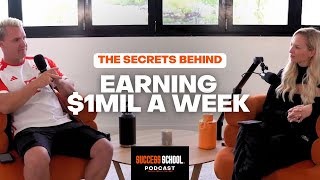
Tim Frey and Steph discuss what they learned from entrepreneurs making $1M a week. They track 70 metrics but focus weekly on the worst three. Successful founders stay relaxed because their systems and teams run the business, not them.
Chapters
A million dollars a week. What does that look like? What does that sound like? What does that even mean?
And I was just thinking, man, this guy's doing like, 400k a month, and he's just surfing off an island in Fiji.
Like, a million dollars a week. Like, damn, I know what it takes to make a million dollars a year. Million dollars a week. I'm like, that's, like, so much. That just seems too hard, and I want to burst that bubble for you.
Welcome to the Success School Podcast. We're on episode 72 today, and we are talking about Lessons from Ballers. I know that might sound like a shit name to you guys listening in, but I promise there will be goodness in there today. Steph, how are you feeling?
I am excited. We are. I think you missed the first part of the title, which was $1,000,000 per week.
Okay, cool. 1,000,000 per week, which I feel like.
Is a lot more interesting. Like, a million dollars a week. What does that look like? What does that sound like? What does that even mean?
Sounds like a lot.
Sounds like a lot. It is a lot. But I'm feeling really good. I love your. For anyone who's watching on YouTube, I love your outfit today. It's a diversion from where we've been previously. Yeah, talk us through it.
We're changing it up. So right now there's, like, this really popular sport called soccer or football in the world. And obviously, I'm a supporter of the best team in the world, FC Bayern Munich. No, not biased at all. We went to their opening game last season in Verda Bremen. Steph, how was that experience? We saw Harry Kane's debut.
Yes, they lost.
But they won.
Did they?
4:1 against vertebrae.
You actually, like, from the stands, you actually could not see. Yeah, you literally cannot see at the games. Like, there's literally. You can't say. Basically, there's just, like, flares and flags and people screaming and it's. It's wild violence. You don't get to see the game.
What do you learn from the culture?
Like, they're very committed.
Very committed.
Very committed and very loyal.
Yeah.
Like, these people had traveled around Germany to, like, come to this game and, you know, to stand in the cold and the rain and to have really expensive beer and walk, you know, many, many miles, even just to get to the stadium. And it was very committed. It was very beautiful.
When do we use that metric Now? Miles. We're on the American metrics.
What are they measuring in Germany?
Kilometers.
They're measuring kilometers? Yeah.
It's only America that uses math.
Well, I'm American now.
Math and like simple stuff.
Yeah, that's not good with tend to over complicate. What's your personal lesson of the week?
My personal lesson of the week. We've made a bunch of highs in successful which has been incredible. I was a little bit allergic to hiring people just due to previous bad experiences. But then I realized it's very hard to scale without the right team and manpower past a certain level. So we have a big mission of helping a thousand entrepreneurs grow a seven figure business. And without the right team to do that, it's going to be very hard. So we've hired. It's been great. We've got some really good A players on the team now which is incredible. And it's helping us grow faster, which is amazing. The reason I bring this up is I know many of our clients maybe scared or allergic of hiring and you know, it's pretty common to it up especially when you're first getting started. But fear not that there are good hires out there and there are a players.
We actually dive into this in today's episode.
Oh.
So that's a really nice connection.
Exciting.
What's your segue? If we were going to have one?
Yeah. What's your.
We have been creating a lot of content. A lot of content. How many videos have we filmed in the last week?
92.
92 videos in the last week. And I'd say previously to that we're probably pretty allergic also to recording content. Would you kind of put it in the too hard basket?
Yeah.
And it's interesting because it's not actually that hard.
We did the three a day challenge a while ago.
We did. We did three a day. So we did 90 pieces of content a month and then we stopped doing that. And we don't really know why. I think what we do, we were just, we were tired, exhausted. We were doing a lot of other stuff. I'm pretty sure it was when we're doing 75 hard as well.
Okay.
Not good. And I think that we kind of told ourselves it was like too hard to create content that way. But we've created a system. We've created a flow. It's actually super easy. And so you guys, I mean by this point now listening to this podcast, you'll be seeing a lot more brand new content which is super exciting and I hope you love it. And if you do love it, let.
Us know a hundred percent. All right, Steph, what are we talking about today?
Right, so we have learned some valuable lessons over the last few months after an event that we went to with some really high level, high net worth individuals. And some of these people, we're not going to name drop, but their household names, like you would know them. And so we wanted to share highlights and lessons that we've implemented along the way since then so that you can hopefully learn something too. Because, you know, when you're hanging out with rooms of people who are literally doing $1 million a week, I think we came in with our own preconceived perceptions of what it was going to be like to be in those rooms. And one of my preconceived perceptions, which we're going to talk about, I think it's the final point was that they must be so tired. Yeah. They must be so burnt out. They must be so exhausted. They must work so hard. Like a million dollars a week. Like, damn, I know what it takes to make a million dollars a year. Million dollars a week. I'm like, that's like so much. It's like 52 times the volume of good math. 52 times the volume of that. And I was like, nah, like that just seems too hard. And I want to burst that bubble for you guys today. We're going to dive into that a bit later today. But what were your. Some of your, like, I guess, misconceptions or preconceived notions going into the room?
They were cooler than I thought.
But what did you think that they were going to be like?
Yeah, I thought they were going to be a bit like pompous, like snobby and arrogant. Arrogant and all those things. But actually they were just way cooler than I thought. Way more down to totally. There was, I don't know who told me this, but I heard this on a call and they essentially said, like, no one is cool when they are basically fighting for survival. Like, there are no cool people. They don't let out their personality. You can't see their quirks because, like, they're just struggling with the Maslow's hierarchy of needs of like food, shelter, water, getting enough bills. But as soon as you got a bit more money, you can kind of comfortable. Yeah, you get more comfortable and you let your freak flag fly, which obviously brings in people. How's that freak flag fly with my braces?
Yeah. You have been doing incredibly well. You have been doing incredibly well with the braces, I have to say. Okay, so let's dive into some of the highlights lessons we've implemented and learned. Tim, let's go. I'll let you Take US through number one.
Yeah, I think it's your favorite one. KPIs and data should drive decisions. And this is quite a funny one. We're in a bunch of Facebook groups with business people and they post a lot of questions in there. And a lot of it's like, I feel X or I'm feeling this or I'm feeling that. And usually the replies are like, what's the number and what's the stats? And what are the KPIs around this? And they usually can't give them. And Steph and I talk about this all the time. But, like, feelings should not drive business decisions because feelings are usually wildly inaccurate. If you're running your business based on feelings, you probably won't have a business for long. So we have been really fierce on the KPI since then. I've said on a few podcasts, but we're tracking 70 metrics in our business now, and we focus on the worst three every week and implement and improve on those. But I think, like, just having a, you know, like, mindset around that we need to focus on the KPIs and the data and the numbers and not how we're actually feeling about our business has been a big one.
How did that come up in the event that we went to, like, at what point did you realize that for you that was going to be like, damn, dude, we're not tracking enough. We're not tracking well. How did you know?
Well, I think there were a few, like, sales conversations that we had, and some guys were like, hey, what's your biggest bott neck? And I said, sales? And they said, what's your setup percentage from open message to booking a, you know, sales call with us? And I couldn't even give them the stats. And then they also said, hey, what's your, like, close percentage? And how long does it take? Like, how many days does it take for someone once they're in your database to close? And I couldn't give them those numbers, so they couldn't coach me on it, which is like, if I don't even have that data, how are they going to accurately coach me on it?
Totally. And I think what we saw from that was, like, the people at the top, they really are tracking all of those sorts of metrics. Now, that doesn't mean if you're listening to this right now and you're not at that point, like, that's okay, but you do need to be tracking some metrics. So, like, start with the 20 major ones, which, again, like, we'll link our KPI tracking spreadsheet that we give to our clients in the show notes below. But at the end of the day, like, you do need to be tracking at least, you know, a handful of the main data points, and then over time, you can increase those. So for us to get to a million, there's like 20 to 30 data points were really important to track from, you know, one or, like, from where we are now. So two to, like five. It's a lot more data points you have to track because it's not necessarily about doing more, it's about dialing in and doing it better.
Yeah. So do you want to give us point number two, Steph?
Point number two? You can't, can't.
You can't.
Well, I am becoming a. Yeah, we're in America. You can't and don't want to do it without a team. So we kind of touched on this at the very beginning.
We've been like 360 on this.
We have been 360 on this. So we.
Oh, God.
And it's so hard. Like, it's so hard because there's so many people on the Internet that preach in either direction. And so we have scaled up.
Fuck the Internet.
Yeah.
Honestly, fuck the Internet. I'm so sick of it. I'm so sick of Instagram and culture.
Live in a cabin with you and the dogs. Yeah.
What the Internet says, man. I'm so sick of that.
So in any case, we had previously grown teams, many teams. We've grown a lot of teams in the past, and we kind of probably didn't do it the best in every situation, which is fair because no one does it the best the first time they do it or the second time they do it. You know, like it's an iteration you're learning. Like you're never going to be perfect something the first time you do it. So of course we weren't perfect at it. And we got burned by teams, as I'm sure many people have, which is why people are very reluctant to hiring teams is because they have hired somebody and then, you know, they've stolen their IP or they've taken their clients or they've. Whatever. And so we know those feelings because we've had all those things happen. And we kind of were like, you know what? We don't want to run it with team anyway. We just want to do it with me and Tim. That will be easier. We can scale it up, you know, million dollar, multimillion dollar, consulting style business, blah, blah, blah. The problem with it was that we got really bored of doing everything ourselves. Really hard. Pretty like we got pretty offered, to be honest.
A lot of work.
It's a lot of work.
Yeah.
Even in an easy business, it's a lot of work. And so we realized when we were at this event, a lot of people kept saying, you need more time. And we were. Kept being like really? We were really against it at that. And it was only after we left and realizing that there was a lot more growth available to us that we really weren't tapping into the level that we should be, you know, and, and that we are actually probably a lot closer to our next level of growth than we thought with a couple of key hires. And so we have actually made a lot of key hires and we've really learned a lot about changing up our thoughts on team. And also our hiring processes have really dramatically changed.
So if someone's quite new to hiring, they're not really great with team. They haven't had many successful hires. We're a bit of a no BS coaching and consulting business. And podcasts. What are some like, you know, key pieces advice you would give someone? Is it like just expect that there's going to be a bit of a learning curve? Like what would you give them?
Here the three things I would say is like one, you need to have brand. Like people have to want to work for your company, people have to want to work for you. So you know, not just brand but like, is it cool to work for you? Like if you want to attract good talent, it has to be cool. It doesn't even have to be the best paid job that will help. But it does need to be a cool product, a cool brand somewhere that they feel proud to work that's going to attract high level players. And I think we didn't tap into that for a long time. I think we probably waited too long to tap into that.
Yeah.
The second thing would be that the people are only going to be as good as the processes. So the better the process is, and we've really dialed this in, the better the process is for the person coming in and the training and the onboarding and all those things, the better the person is going to be the better product you'll have. And then last but not least, yeah, like of course you're not going to be good at it the first time. So like give yourself some space and grace and don't put so much pressure on yourself. But anything to add?
Nothing to add there. It's funny, the brand one is a Huge one. It's like, you need to be a desirable place to work or employ, otherwise you're always going to have a hard time or struggle. Our best team members or staff always come internally. So from someone in our network or someone in our network knows someone, that's where we always get the best people from. So.
And if someone's kind of sitting there and they're like, oh, but I don't think that I'm a great place to work. I just don't think at the beginning. You don't think you do.
No, you think you're best shit.
You kind of think you just crap at everything. You're like, why would someone want to work for me? You're just so grateful that anyone wants to work for you.
But, yeah, I still feel like that.
You've got to remember. Yes, same. You got to remember that it's like, it is a sales process. Yeah, hiring is a sales process. You're not going to go and be like, hey, I'm pretty shit, and I don't know if you want to work here, but I've got some good pay and stuff.
We've hired a lot of salespeople recently. Selling salespeople is a. It's a skill in itself.
That's a whole process.
Yeah.
Yeah, that's a whole process. Tim, take us through point number three.
So point number three. Are there more levels than you think? And what I mean by that is, you know, we thought we were doing pretty good. Like a couple million a year cruising, you know, everything's great, Clients calls booked all the time. Like, you know, things are going good, and then you meet someone that's doing a million dollars a week, and you're like, man, I am nowhere compared to these people. Like, I am less than nowhere. Like, there are crazy levels to this thing, but it's kind of like if you're, you know, smartest person in the room, you're in the wrong room. That whole analogy. And I just. It was really eye opening to me to meet people that were just like, absolutely sending it from, like, a business point of view. And they didn't even seem stressed. I feel like they were less stressed than us, which was pretty crazy to see someone just making so much damn money and making such a big impact. And they just were completely chill because I think they just had their systems, processes, team. Everything was dialed in. Everything was focused on the data and not the emotion of business.
Totally, totally. I think that for me, that just more levels thing is, like, we really thought that we were kind of Done with growth, which I thought was. It's such a funny God, the mind is so crazy. Like, you could convince yourself of so many things. Right. And I think that it's cool. You know, I really believe in seasons of, like, reaping and sowing. And so, you know, for the last couple of years, like, we've worked really hard, and we sowed a lot of seeds and we started to reap. And so what that means, it's like, we took our foot off the gas for a bit, and we rested and we enjoyed our life, and we traveled, and we didn't focus so much on hustle and growth for a little period. And then you kind of get comfortable and you kind of go, like, it's very easy to sit there and go, what's the meaning? What's the point? What's the. But if you're feeling that way, it's probably just because you're not inspired enough. That. That's something that. I really think I learned from this, because when we got in that room, I didn't think I had any more that I wanted from life. I was really happy. And there's nothing wrong with being content and still hungry, so I was really happy, you know, But I did feel a little bit aimless and a little bit directionless. And I think you also felt that way, too.
Yes.
Then we got in that room, and then there was all these people, and we realized there was just. There wasn't just another level. There was, like, 10 more levels. And that was actually exciting and inspiring. And we got lit up, and we got like, I haven't felt like that in a few years. And so it was nice. It was nice to be like that.
Sidebar. We have spoken about this off camera, and I want to bring this into this episode. Do you think being content is a curse for entrepreneurship in terms of, like, just being super grateful with what you've got?
This has been a conversation we've been having a lot, and I think that you. I think that the misconception here is you can be both at the same time.
Yeah.
I think you can be content. I think we're very content.
Yeah.
I think we're very happy in our lives. We are so grateful. We practice gratitude and joy, like, every day. We tell each other how happy we are and how good life is and all those things, and yet we're not willing to settle here. And so I. I do believe that you can have both. And I. I do. There's nothing wrong with wanting both of those things. To want to have More impact, you know, I think it will lead to a more fulfilled life. But I do want to hear your take on this, because we've spoken about this at length, and I think you have a slightly different perspective. Like, I know you agree that you can have both, but I do think contentment for some people. I think some people think I can only be content or I can be in pain.
Yeah. If I look historically at a lot of, you know, people that have had massive success, they are driven by, like, the dark arts or the dark energy. And people that are content and happy and, you know, joyous with what they have. Usually, you know, a lot of the times they don't make things that are amazing or great. Like, yes, they do, but not to the same extent of someone who had, like, a really hectic upbringing and they're trying to prove to the world that they're the best and they're going to make amazing products and all these types of things until a certain point. So if you get it to a certain point, like, you know, imagine an entrepreneur gets something to 10 mil, and then they get a CEO and a board, and then they take it to 100 mil. Yes. Like, maybe that can be a machine that builds that up there. But I think, like, you know, the dark arts are important.
Just for anyone who doesn't know what you're talking about, what the hell are the dark arts?
You get so frustrated with me when I say this.
I, like, I just am like, the dark. I think it's the dark energy, but it doesn't matter either way.
It's a joke.
Yeah, yeah, talk me through the. Like, what does that mean to you?
Like, there is a certain type of power that comes with harnessing negative energy and negative opinions on you. And, like, it is a motivation in itself. It's like a, you know, external motivation that's applied on you, that drives a lot of people and a lot of successful entrepreneurs.
I agree. Yeah, totally. I agree. And so number four was the people at the top are chilling. You've already kind of touched on this a little bit. How did you know they were chilling? Like, what was it about witnessing them that you were like, that's chiller level.
Yeah. So we. Yeah. A friend of ours was actually at this event, Toby, and he kind of just rocked in, and he looked like he'd seen way too much sun. And I was like, where have you been, bro? And he said, yeah, I just been surfing off an island in Fiji for two weeks. And I was just thinking, man, this guy's doing, like, 400k a month, and he's just fucking surfing off an island in Fiji for two weeks. No reception, no phone, nothing. Like the team were just running it. And you think about, like, even I think about it in my position sometimes, like during the week after Monday or Tuesday, I don't have that much to do. Like, if I'm really honest with myself, like, my calendar is basically blank for the entire week. But I work because I want to and I work. There is growth. But I think, like, the higher you get, the less you have to do. But what you do have to do is of more meaning and higher quality. And I don't mean any disrespect by that to anyone that's. That's listening here. I just mean. Yeah, there's. There's just more free time.
There's a lot more free time. And I don't think it's just because of team.
Yeah.
I think it's a couple of things. I think it's also because you just have more skills.
Yeah.
So things just get faster.
Yeah.
Like, we can produce 92 pieces of content.
Yeah.
In a few days.
Yeah.
Most people was.
Four hours. Yeah.
Yeah, Four hours. Most people can't do that because they don't have a system.
Yeah.
They don't have the reps. Yeah. You know, having a podcast, running YouTube channels, speaking at public events and engagements on camera and coaching as much as we have done speaking to camera feels pretty comfortable for us at this point. And so it is a little bit faster for us. I just think that you are like, they say that the first five years of business is the hardest. And the reason they say that is because you are going through such a rapid skill development.
Yeah.
And you're basically bad at everything. Everything takes forever. Like, you and me can jump into Canva now, or you especially, you are really good with graphics. You can jump into Canva now and you can, you know, mock up anything within, like, a couple of minutes. But in the beginning, it would have taken us hours to do that. You just learn so many skills, and so things get faster. And I think over time, you dissolve all of the emotion, a lot of the emotion that comes with running a business as well. You know, what will they think? You know, the dark arts that used to really fuel your life was like your competition.
Yeah.
Local area of running a gym. And it's like over time, you just dissolve all of that stuff, and you just have a lot more free time to think and play and do. But, yeah, it was crazy how much they were chilling. I Thought they were going to be the most stressed out. And like all of them, not just some of them, all of them chill. Anyone who's doing a million dollars a month, a million dollars a week, the most chill.
So giving, like walking around barefoot.
Barefoot, Just walking. Literally the most chilled out people you've ever met. And it was inspiring. I was like, I actually, it made me want to get there more.
Yeah.
Because I felt like there was even more levels of joy and chill on the other side of that.
Yeah.
Yeah.
I mean, since then, since the event, which was a couple months ago now, it's been tough, I must say. Like, we've worked like dogs. I feel like we're coming out of it now. Like, I, I look at my calendar next week. There's not. I don't have that much to do.
Why? Tell us why we work like dogs. Tell us like what happens.
Because we realized there were so many holes in our business. So when you realize there's holes, obviously you got to fix the holes. Otherwise the water's going to leak out the bucket. You know, on the leaky bucket theory. But yeah, that was for me. What about you?
Yeah, I think it was just like, oh, there's new levels. Let's go. Let's freaking go. Like, I'm pumped. Like, I want to see a new level. Like, it's been a long time since I felt inspired. Like, yes, there was stuff to fix, but the reason we wanted to even fix the leaky bucket, like you always want to fix the leaky buckets. But was because we were like, we want to fix this leaky bucket so we can pour more in so we can reach that next level. You know, before we were kind of like, we could fix the leaky bucket as we go.
Yeah, it doesn't really matter.
It doesn't really matter. And then all of a sudden it was like we put some hot sauce on it. So, yeah, if you want anything, if you want to reach the next level, I promise you it's going to be a grind. It's going to be a grind before you get there.
But business is so hard.
So hard. But I think it's just again, seasons, like you just grind for a period. Then you calendar clears up a bit.
Yeah.
Then you feel it. Yeah.
And then you feel it. I need to go play golf or something.
Yeah. Yeah. You do need to get one of those long 10 hour hobbies. Yeah.
So Steph, I'll give top two takeaways was make sure that KPIs drive your decisions. The second one is Hire the right team. I'm just going to, you know, summarize that and saying you don't know what the right team looks like until you've had the wrong team. So you have to go through bad hires to get to good hires as well and give us your two takeaways.
Yeah, I think you need to expose yourself to new levels. I think that that's super important. And I think that if you're not exposing yourself and not just like on YouTube, like, yeah, you really have to.
Be in, like, got to get in the room.
Doesn't matter if you're like, yes, in the room, like, you know, at retreats or events or whatever, but also like even just in online groups and things like that. Like actually getting on zoom calls and meeting people who are at that level. They just hearing the questions they ask and things they talk about. You just, you expand so quickly.
Yeah.
And last but not least is like, the people at the top are relaxing. And I think that that's a really big takeaway for everybody, is like, yes, you will have to go through it to get to that point, but it's worth going through to have that freedom and that relaxation at the end. Otherwise, like, what other option do you have? Like, go and do your 9 to 5 for the rest of your life and retire at 67 or probably 75 by the time we get there. Yeah, it's just not worth it. So it's worth the grind now.
Speaking of the room, guys, if you want to get in the room with multi six and seven figure business owners, we are hosting retreat in Thailand coming up. It's going to be amazing, but if you're thinking of this and you're like, cool, I need to be around those people. We are those people for you.
Yeah, send us a message. We have a few guest spots available and so if you'd like to come send us a message. We open to opening that up for you. If you're a cool dude and you want to get in the room, or cool gal and you want to get in the room, we'd love to have you there.
Yeah. If you're a cool day. All right, guys, if you got some value from the show, don't forget to subscribe wherever you're at. If that's YouTube, if that's Apple, if that's Spotify, wherever it is, we would love to see you hit that subscribe button. We are measuring in our KPIs every week, so make sure that number's going up.
It's Tim's KPI as well, guys. So if he doesn't hit it, he's gonna get fired. So please subscribe.
Get it done. I can't find myself. See you guys. Sam.










