
The truth behind running a multi-7-figure business as a couple
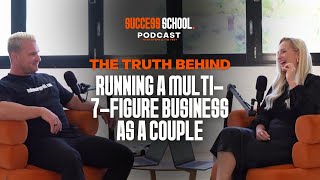
Tim and Steph run a multi-seven-figure business together. They doubled revenue and tripled profit in 12 months by splitting roles: Tim handles operations, Steph focuses on coaching. Their main rule is relationship first, with clear leadership, non-emotional communication, and hard boundaries between work and home.
Chapters
Everyone thinks their partner is in the wrong with most things they're doing, when in reality it's probably your that's actually.
Going wrong by allowing Tim to be the leader of this company is that I actually just get to do more of the stuff I love and I get to spend more time in my genius zone. And I don't have to do that I want to do, which is awesome by just letting you take charge and take control.
Welcome to the Success School podcast. We're on episode 67. Steph, how you feeling?
I'm excited to talk about today's topic, which is the truth behind running a multi seven figure business as a couple. Oh. Oh.
I don't know what you're gonna say.
Oh, Tell us about smiling. Actually, I'm gonna tell a story about smiling.
Okay.
So I've noticed Tim's been doing something pretty creepy lately. Every time we're in the car and it just kind of does this thing where like out of the corner of my eye while he's driving, I can kind of see him lean into the rearview mirror and then just do this, like, weird.
Hey, good looking.
With this weird movement with his mouth where he kind of like grins and like bears all his teeth. And I'm like, okay, this is interesting. And I keep asking him. I eventually was like. Kept seeing him do it. I was like, what are you doing? And he was like, I'm practicing my smile. Which is just, by the way, so terrifying because he. He doesn't know how to smile.
No, I've never smiled.
Never smiled. And people might think that Tim hasn't ever smiled because he's grumpy or mean or whatever. Yeah. Or whatever it is that people might think. But it's actually because he grew up being really embarrassed of his teeth.
Yeah.
And so he always did one of those kind of really, like small closed mouth smiles. And now as an adult, now he's got braces on. He's starting to practice for when smiling. He's smiling for when he gets his braces off. So tell me about that process and what you've learned so far about smiling.
Yeah. So there's actually a technique to smiling. Most people would take it for granted. So I think when I got him, like, I walked over to the car and I was really embarrassed. I was like, stephanie, look at me, I've got braces now. And then the next day I was like, hey, babe, how's my smile? And I look like a murderer. Like, I look like. I look like a psychopath.
Yeah.
I might have to get you guys a video. Yeah, I reckon, like I opened, I smile with like my top and bottom lip maximally extended and then like wide as well. And if you think about doing that, you just look like a clown that's going to kill someone with like a psychotic smile.
Yeah.
I didn't actually know that smiling is just top lip movement and then width. So I got it dialed in. I've been doing it in the rearview mirror and every time I do it I'm like, hey you, who's that good looking, kind of straight teeth guy?
It's been so funny because, like, it's a technique. Just take it for granted. And like I was trying to coach Tim on the smile.
Yeah.
He was like, what am I doing wrong? And I was like, I don't know, but it looks terrifying. And he was just walking around like, like almost like it was so creepy. And then he was like, oh, I figured it out, Stephen. You keep your bottom lip straight like normal and you just move the sides and your top lip. He was like, I think I've got it. And then I've been teaching him to like use his eyes because like smiles should reach your eyes. And so he kind of sometimes puts his eyebrows up. It's this whole thing.
I look like Vince McMahon with my eyebrows.
Literally look like Vince McMahon.
If you guys haven't watched, that's a good doc.
So good.
Great docker.
Such a great documentary on Netflix. But yeah, it's been, it's been bloody funny. It's been super funny watching you learn how to smile as a 33 year old man.
Yeah, I got trolled on an ad once and I haven't been trolled on my teeth before, but I know you shouldn't listen to bullies, but they got me.
They, that was.
They, they made fun of my lower tooth and that caused me to get seven teeth removed and spend $30,000 on my smile.
We have to find that man's name and send him a thank you.
Yeah, he, it was so bad. He was like, look at this guy's up teeth. And then he tagged seven of his friends and they were all piling in people on my video and I was.
Like, what pricks, man, that was so.
So, so we're gonna get into personal updates. We have a caravan trip coming up and we are going to Tasmania. So. Yes. We live in Perth, Western Australia, guys. So we're going to drive over the Nullarbor, the longest straight road in the world, over to Tasmania, which is ages away. I don't even know how far it's like 4,000 cases.
And there's an ocean.
And there's an ocean. And then we're going to get a boat with our caravan car and dogs across Tasmania, do a Tasmanian road trip. Then we're up the coast seeing some mates. If you're on the east coast, let us know, hit us up, we'll drop in. We want to do some podcasts and stuff as well.
Yeah.
But yeah, I'm super pumped for it. It's. It feels like a big adventure.
It is a big adventure. It's super exciting. So we'll probably be spending about three months away from home. So if anyone wants to rent our house. Yeah, you're welcome to come rent our house for three months.
Also, if you want the studio, if.
You want the studio, the setup, you're welcome to come here. But yeah, we're super excited for that. And my personal update is a little bit around nervous system regulation. I was having a conversation. Oh God, I'm so regular.
You're so biohacked.
Gym girly. Nervous system regulation. I'm just dialing it all in. But no, I had a really cool catch up a couple weeks ago with one of my best friends and we hired this hotel room out and we had like really nice chat and which is like seven hours of just being a doom girl, like being girls, you know. And one thing that she said to me, she was like, I do think that sometimes it's not that we're stressed, it's just that our nervous systems have run at a level for so long that they don't know how to like kind of come down. It was really interesting because I was like. The only time I really actively try to like lower my nervous system is when we go on holiday, which is like also super rare and far in between because most of the time we were on holiday. We're working.
Yeah.
So I was like, wow. I think the last time my nervous system chilled out was probably New Year's. And also then before that, like our honeymoon. And I was like, wow, I really need to find a way to lower my nervous system. And I've been really practicing that a lot more lately. It's just been like. And you'll hear me, I do lots of like breathing in the afternoon. Yeah. Hectic breathing.
Is she having a heart attack?
I've been trying to like walk past naked, take time off, off and play a bit of PlayStation. That's kind of one of my downtime things now. I don't know if that's the right thing to do. But it feels good at the moment for me.
Steph has an aura ring and it tells you when you're stressed. And Steph plays Call of Duty and it's basically in stress the whole time.
But I have a good time. I have a good time.
Yeah, she's so bad.
So bad at Call of Duty.
All right, guys, so we're going to transition to the topic. So we're talking about what it's like to run a seven figure business as a couple. Like, people want to know the results. Maybe we actually should. We should start like from the start. Like, what's been my involvement in. Yes, your businesses. We'll call them your businesses over the last couple of years.
That's a. That's a heavy word. Yes.
Yeah, your businesses. What's my involvement been from the start? Like, what does that look like?
Yes. So when I first got into entrepreneurship, the only reason I really got into entrepreneurship was because of you. So I kept seeing Tim wake up every morning just at like 3:00am, like, so pumped. So pumped to go to work. Like, you were pumped. Like, you couldn't wait. And you spoke about it all the time, literally obsessed with running a business. And I thought, imagine having that much passion. Like, I was waking up at 9am and dragging us to work. So I was like, there's something in this. Like, I want to be that passionate about something. And so the only reason I started my business was watching you. And so obviously it was natural that when I first started my business, you would give me advice. And so it was just you. Like, I was very fortunate to have a good business business coach right from the beginning.
For free.
For free.
Yeah.
Well, you know. No, I'm kidding. For free. And so I really loved, like, having you in the business. And. And even though it was my business, you've always been very much a part. So it was the first business, the second business, it's always been the same. You've always been there, giving me advice, being like, try this, do that. I'm like, tim, this isn't working. What's happening? And so you'd always be there. So even though we ran separate businesses and I would help you with Helix, once I figured out business a little bit more and I had a bit more to provide, I would help you with the gym. We always ran businesses together, but separately. However, making the transition to success. School was really big for me and I actually just spoke about a lot on another podcast that I went on a couple of weeks ago. But it was really big for me because I built this whole thing on a personal brand. And so to have you coming into the personal brand felt uncomfortable because I thought, you know, you're very different to me. And. And that's a gift, actually, for our clients. That is the biggest gift they have, is that you are different to me. And it was different running two businesses and helping each other versus having. You know, I think I got quite in my alpha energy over that period of time, and I liked being the boss at some level and. Or had an identity attachment to being the boss potentially. And then you actually coming in, I realized probably too slowly that you're a better leader than me at running this company. And so it took a little while for us to figure that out, didn't it?
Very painful.
It was very, very painful for me to figure out that actually Tim is a better leader for this company. And what that means by allowing Tim to be the leader of this company is that I actually just get to do more of the stuff I love, and I get to spend more time in my genius zone, and I don't have to do shit I don't want to do, which is awesome. By just letting you take charge and take control. And the business has grown, like, insanely from having both of us in it. And so I think we've doubled our revenue in like, 12 months. We've doubled our revenue. We've tripled our profit. I'm working in extremely decreased hours compared to what I was working previously. You know, we have more joy. You know, we're having more fun. We enjoy it more. It's been awesome.
Yeah.
I don't know how it's been for you, but from my perspective, it's been a good time.
Yeah, it's been incredible. It's been. It, like, it's been hard for me as well, like, internally, like coming into business coaching, which is your thing. I've been doing it five years. Like, not as seriously as you have kind of on the side, but, like, there were a couple of, like, there's been those snide comments that people have given me over the years, which has been pretty gross. There was, like, probably like two years from selling Helix. People would say things like, me, oh, it must be nice to have a wife that's so rich and you don't have to do anything and you just get to ride on her coattails. And I was like, man, if you actually saw what the goes on behind the scenes, you wouldn't say that. There was a period of probably like a year where people just said like, that all the time. Like it was. It's pretty uncomfortable.
Yeah.
It's been amazingly beneficial, I think, due to the fact that we have differing skill sets and we both are, like, experts at certain things. And you did mention the running of it, but, you know, you're a far better coach, and you can hold space a lot better for our clients, which is incredible. So it's great for them. And in terms of, like, a lot of our clients are women, I'd say 80 are women at the moment. Like, having a female role model to look up to is incredible as well for them, rather than, like, the business world is 95 men.
Yeah.
Especially as. As we transition. So I think it's super beneficial. We both have our skills and we both have our strengths, and I think we complement each other well. I think the biggest benefit now we did allude to this on the last episode was if there is an issue, one of us usually calms the other person down and we can see a voice of reason. And I think, you know, Steph throwing out grenades. I catch the grenade, I put a pin in it, and then we talk about it, and then we make a logical decision on it. I feel like sometimes if your partner isn't in the business or they don't know the business or they don't understand the full context of what's going on, it can be really easy to throw lots of grenades around, blow up, and never really get anywhere. So I think from the highest level point of view, I think having someone that gets it and gets what's going on is the most beneficial aspect to this. So if you're like someone that's listening to this and your partner isn't in business with you, but having them just understand is. Is key. Like, I think just them getting it.
One thing that was really good for us. And I would say this to anybody, whether you are a couple, whether in business together, or you're a part of a partnership where maybe you work in the business and your significant other works a day job. One thing that massively helped for us was we went to a mindset coach, and we went to a mindset coach individually, but it was the same coach. And shout out to Tara. Yeah, Say her name. Yeah. Yeah. You are such an angel. But one commitment that we made to each other throughout the time that we were both seeing Taryn was that after every session, we would unapologetically and from a really unfiltered perspective, tell each other what went down in the session. Yeah. And so on the way home from Taryn, which is like, literally, she lives 10 minutes around the corner from both of us. From us, obviously, because we both live here. I would call Tim and I'd be like, here's what came up. Here's what we talked through. Here's my, like, realization. And I think that really helped us because you can't help somebody unless you know what's going on for them. So, like, I might be having extreme emotion about something. Like, for example, my parents went bankrupt when I was quite young. I hold a lot of money. So stuff, like, it's pretty big and it comes up a lot.
It's pretty big.
It's pretty big. And if Tim doesn't fully understand that, he can't support me through it. And if I can't articulate to him, like, oh, my parents, my bankrupt, I have money stuff, that's unhelpful. But if I'm like, okay, when this happens, you're not going to understand it because you don't experience it. But when this happens, this is what it feels like. So if we go below this in the bank account, this is what's happening for me. And you being able to understand, understand that that's my trigger means that the next time that happens, you know exactly how to walk me through it. I think that has been a real gift for us. And I would say to anybody, consider, even if your partner is in a day job, like, talk to each other, like, tell them, you know, hey, if I'm starting to behave like this, this is why. And maybe just like, do this instead. You know, if I'm starting to. If I'm on my phone at night, like, this is a really good one. If I'm on my phone night, you want me to be off my phone, tell me to put the phone down. Yeah, we're really hard on that with each other.
Yeah, yeah.
And so tell your significant other to, like, hold you accountable and what's going on and how it's affecting you. Because that is going to just help you so much in this situation.
Yeah, 100%. Let's switch into lessons learned and I'll kick off. So we'll kind of. Maybe we'll go two lessons each of, like, biggest lessons you've learned running a seven figure business with your partner. I'm probably going to hit the obvious one and you're going to hate me for stealing one of these. But I think, like, communication is key. I think the number one thing here is communication. If. If you're not happy with something that I'm doing, I need to know if I'M not happy with something you're doing. We need to know and we need to approach it from like a non emotional point of view. I can imagine some couples would be listening to this being like oh yeah. But like I don't want to have an argument and I think you're just, you're delaying the argument down the track and, and the argument is going to blow up and be Even worse in 3, 612 months time if you don't immediately address it. Sometimes I'll bring up stuff with Steph and, and then I'll realize I'm being a. But the fact that I've just got it out of my body and I've said it makes me realize I'm a dickhead rather than just storing it and then blaming Steph for things which has happened so much in relationships. Everyone thinks and like to some degree this is true. Everyone thinks their partner is in the wrong with most things they're doing when in actual fact and reality it's probably your. Yeah, that's actually going wrong. So I like talking about things immediately. Super uncomfortable for Steph most of the time because she's like, like I also.
Just now know that's your process. So if I'm, if Tim lays it on me for something I always just do a quick self reflection. Do I feel like I actually have radical responsibility here? Do I have I contributed to this? Usually I will find self blame first. Like my, my radical responsibility is pretty extreme. Like if something's going wrong, I usually figure it's my fault somehow.
Yeah.
So if you lay something down on me. But if I, if you lay something on me and I'm like that's so not true. I'm like okay, this is just his process.
Yeah.
So I don't make it mean anything about me. I just like, I'm like let'll let him have his process and in a couple of hours he probably come and apologize. And that's just how it is. So yeah, communication is key for sure.
My second one is have clearly defined roles and I think we aren't perfect at this now but like we are a lot better. We know who's doing what, what's doing who and who's in charge of what. I think there can be a lot of butting heads in relationships, especially business partnerships. Not even romantically and you know, life partner. But like when you guys aren't critical or you aren't really set in stone or on paper on who's responsible for what and what KPI and etc. I think there can be a lot of misinterpretation and miscommunication around it. So I think it's really important. It's been a big lesson for us that Steph knows what she's in charge of. I know what I'm in charge of. We're both running towards the same goal. We both need to hit our KPIs. We both need to hit our goals and targets. And we are going to have a successful business relationship, marriage, kids, family, if we stick to that. I think where the lines get blurred is where we have a lot of issues or we did had used to have a lot of issues previously.
Yeah.
Yeah. Do they make sense? What are your two.
I would have. You have to have one person. Has to be the leader.
Yeah.
You can't have two leaders. It doesn't work. Too many chefs in the kitchen. It just. I don't think it works. And when I was trying to be the leader and you were trying to be the leader or actually what happened initially was you, I just let you. You let me be the leader. And, and I didn't actually didn't like it. I didn't like telling you what to do. I didn't like that. You know, I. I had so much respect for you that I knew that you knew so much and it just didn't feel right. So one of you has to be the leader and that person has to want to be the leader too. So that's. That was something that was really helpful for me. And the other thing that I would say is just like, you have to switch off. Like there has to be time for non business chat. Yeah, has to be. And sometimes it's really hard to do that because one of you can be really hopped up and really lit up about something with work and the other person could be like, had a shit day and be really dragged out and not want to talk about it. They would. You know, if I've coached literally all day, if I've had back to back calls and I've been in school and you know, I'm usually talked out so, you know, getting on the couch at night, I just want to play some Call of Duty or have a glass of red wine and cook some dinner and, you know, mong out watching YouTube videos, I don't want to talk business. And sometimes you're lit up because you've had the whole day to learn and study and you're really excited and it's about just being honest with each other about like, hey, I don't want to have this Conversation right now. Like, I'm super pumped that you're lit up, but let's talk about it tomorrow for sure.
So next question is. This is great, because there'll be a lot of people listening to this that are like, all right, I think it's time to bring my husband, partner, wife into each other's businesses. How do you know it's the right time? And I know the answer is there isn't a right time. But, like, what are you looking for? What are some considerations you need to think about? I've got so much to say on this. I think probably the number one thing here is, like, do they want to be in the business? Dragging someone into a business because you think it makes sense financially is the wrong way to look at it. I think they need to want to do the thing you're doing. I've been business coaching for a long time before I got into success school, so it was really a natural transition for me. But if you do something and your partner isn't really into it, this. The passion's not going to be there. Yes, you can do it for the money. Yes, it's going to be beneficial. But I think they have to want to. If they like what they're doing at the moment, let's say they have a job or they love their career or they love whatever it is. Just bringing them in for, like, a financial thing could cause a lot of issues. And, you know, when I'm not lit up about something, I don't really put a lot of energy into it, and it ends up being shitty. So, like, Steph, how do you know it's the right time to bring a partner into a business?
Yeah, 100%. You both have to want it for sure, and for the right reasons, not just for money. We have just had a lot of people recently, like, suddenly decide, like, from. I think actually the Bali retreat was when it happened, the last Bali retreat that we had. I got cornered in the pool one afternoon by a few of the clients, and they were like, hey, I'm thinking about bringing my partner in the business. And then there was, like, a crowd of people that were like, tell us all the things about bringing a partner to your business. And I was like, you know, they have to want it. One of you has to be the leader. That's like, again, that's a really big piece of conversation is like, especially if you. Especially as the female. If. Which, again, a lot of our clients are. If you're the head of the business so far and you are planning on Bringing your partner in, you just really need to have really honest conversations about what does this look like if it doesn't work as well? Yeah, totally. What does it look like if it doesn't work? How we know it's working, how we know it's not relationship first, always. Like, so there have been times where it's got hidden between us for sure. And it's got to the point where it's like, if this isn't working, it's not working because our relationship matters more than anything to do with.
That's important.
That's super important. So I love you, obviously, and I. You are my number one priority and in terms of the health of our relationship. So. Yeah, I wouldn't sacrifice. I wouldn't sacrifice anything for that.
No, no. Yeah. I think number one thing is keep the relationship. The relationship and keep that number one. And we're very honest with each other. Like, I need some time. I don't want to talk about work. I don't talk about business. I don't talk about clients. I don't talk about. I just want a wife.
Yep.
Like, that's what I want. Like, can we have a dinner and. And like, have a red wine and just have a laugh a little bit? Yeah, have a laugh. So for us, that maybe looks like Netflix or what's the Tom Segura?
Tom Segura. What a great guy.
Love Tom Segura.
But I think if you're thinking about bringing your partner to this, you will know. Like, you know, our clients typically know that they thinking about bringing it in, their partner in, and their partners are usually also excited about it. I just think you need to have some pretty, you know, hard conversations. And I think you should definitely have clearly defined roles when making that transition.
Yeah, for sure.
Yeah, definitely.
So how do you separate business and home life? Like, is there any strategies? Like, kind of. What are your strategies here besides feelings?
Besides feelings. Okay. So for me, I mean, I manage my own workday and you manage your own workday, and we're on slightly different timelines.
Yeah, Yeah.
I have got the role of wife in our house. And what that means is that I love to. And it's an honor to cook all of our meals from scratch. And I really enjoy that. That's something that I've really taken on in the last couple of months. And so for me, every afternoon I need to be done work by 3 o' clock because that's when we go on w the dogs. And that's walk for anyone who couldn't.
Spell that out probably listening to the wrong podcast.
Totally. If you can't manage that. So, you know, three o', clock, we have to walk the dogs, make sure they get exercise, make sure we get our steps in. You know, I typically like to start prepping dinner by 4, 4:30, because we are literally nanas. So we can eat by 5, 5:30. Then we can get everything cleaned up. Dogs fed on the couch by like six o'.
Clock.
And that gives us some time to just have some down time together. You know, watch whatever we're watching. Play FIFA. Play FIFA Call of Duty. I don't play fever. Whatever it is that we're gonna do for the evening. Or go out. Like go out or whatever it is. And so that's my afternoon routine. But because you don't have to do some of those things, it looks slightly different.
Yeah, it looks a little different. Yeah. I don't cook. I just eat and clean.
And I think that. So the boundary here is like, you gotta stop.
Yeah, for sure.
Like, that's the thing.
Yeah.
Is you gotta stop.
I think the cooking is good for you.
Like so it's been so good for me.
Steph's quite like a high wired person. So she's just go, go, go. At the end of the day. She's like a big ball of energy.
Yeah.
And it's really hard to switch off. So I think like the scheduled breaks is good for you. And you've got to use your hands. You can't be on your phone. Like there's the whole thing. So I think it works really well. I kind of use the time that Steph's cooking or whatever. I. I just study.
Yeah.
And I just learn stuff. But that doesn't get me like more pumped or more energized or whatever. It's just like, I like to take in information because I want to create a better product for our clients. Really. That's kind of why I do it.
I think it's important, like to have that switch off time. So I think it's just like you need to have a process for switching off and almost create like a routine around the switch off, you know, and just hold yourself super accountable to it. Like there is nothing urgent that cannot wait until tomorrow. It is not life or death. Like it can wait.
Yeah. For sure. This is a cool question. I think there's a couple of prongs to this one, but how do you handle it when one of you is not on the same page as the other?
I think this has happened before. I can typically be very Ambitious.
Yeah.
I can be very, very ambitious at times. I can see what other people are doing and be like, that's what I want. And I can switch in a heart, in a heartbeat. Like, I could be like, oh, I'm so content and happy right now. And then literally in 10 minutes, I could be like, we're going to change the world, and we got to do this, and I've got to get on Oprah, and, like, I can get really easily lit up by a new goal. And so that's not helpful when we are driving towards the same mission. And so sometimes Tim's not on the same page, or sometimes I'm completely off the page, and Tim's, like, trying to get me. Trying to get me back on the.
Page, not on the desk.
Yes. And so something that's really helped me, like, or helped us is like, we. We have a list of what we don't want. And I think that I sometimes feel like I need to have that staple to my forehead.
You won't be able to read it then.
Yeah, well, I need to stable it to your forehead. Yeah, yeah. So I can constantly see.
My fault.
Yeah, of course. But I think I need to constantly see it and. And because shiny objects. Right. Like, of course everything looks sexy online. And sometimes you just have to be really reminded for me that, like, of what we. Exactly what we want. You know, the lifestyle we're trying to build. Like, yes, we could have a $10 million company with 40 team members, but also, we don't want that. Like, we never have wanted that. So I think that for me, it's like that constant coming back to, like, yes, that could be fun. But also, that's actually not what you want. And I think really being really clear about what you don't want or what you do want has been really important for me. But just to keep me on, we have a page.
Yeah.
It's literally written down. I often just go off the back page. But what would you say to somebody who maybe. Whose partner maybe isn't on the same page?
Yeah, I think, like, I'm gonna obviously treat this as the analytical question, and that's how my brain.
Logical man.
Yeah, we have our KPI sheet, and I kind of use that as our North Star. So, example, yesterday, Steph came to me and she said, I think we need a sales manager. And I was like, no, we don't. We don't need.
I really feel that that's a good decision.
And I was like, we're like, 20 off hitting our KPI to build to go to 5 million successful in terms of sales. And I was like, can we get 20% more juice out of our current sales team? I was like, of course we can. So we don't need a sales manager because that's another person. It's 100 grand. Like, that's the whole thing. We have to manage them. So I kind of use our KPIs as our North Star, and I think it's very important to have KPIs. So if you're listening to this and don't have them, get them.
I laugh because it's like. And straight after, like, I was like, so sure. I was like, babe, I really, really think, think we need to consider this. And he was like, showed me the KPIs and was like. And I was like, oh, yeah, you're right. We don't need one. Like, it was so instant. Yeah, yeah, yeah, yeah.
So I just follow the KPI. Steph comes to me with some crazy idea and I'm like, babe, we're hitting our marketing target. Like, we're getting the leads. Like, what do you want here? Like, we just get more leads. Like, what's the point? Like, we're hitting our numbers.
Yeah.
So I think if you're not on the same page, look at the numbers, look at the KPIs, look at the stats, do Steph's feeling stuff. If you're not quite ready for that. No, obviously, add that in. I'm joking.
You need KPIs.
Yeah. You need KPIs, but you're actually mentoring.
Someone in one of the programs that we're part of. You know, we're part of a program for our own development. And someone the other day was like, oh, I have a lot of feelings about, you know, why I'm not at 50k months yet. And Tim was like, cool. Well, but what other stats? Like, how many leads are you getting? How many sales calls are you booking? What's your sales conversion rate? Because, like, if I have the stats, I can tell you exactly what's wrong, but right now I can't see anything because all you give me is feelings. So it is so helpful. Like, KPIs are an insane game changer.
I feel like a dum dum for not doing it sooner as well.
Like, we kind of had them, but it's not good. They weren't. We've really dialed it the last six months and it has been phenomenal.
Yeah.
Yeah.
So kind of what it looks like if you're on the outside, we have 70 KPIs. You don't need to start there. And that sounds like a lot.
We have a lot. Yeah.
But every single person in our team is responsible for a bunch of KPIs. So in our team meeting every week, everyone gets on, they go through their KPIs and they present, present them to everyone. So they're going to be up or down or red or green, depending on where you're at. Super important. I'm responsible for some steps. Responsible some Ruben Paul. Like everyone's responsible for their own KPIs. And I think that's the best way to run a business is on the metrics and not on the feeling. So that would be quantitative as qualitative. And this is even how we coach sometimes in success school. A lot of the times some of our clients will be like, hey, what do you think of my landing page? And we're like, looks good, dude, give me the stats.
Yeah, how many land people who landed on it? How many people click through? What's the like time spent on page? Like how many, how much they scrolling? Where's the heat map?
Like show us 100% for like a lot of them aren't professional copywriters. So like the landing page is something very subjective. They got a headline, they got a sub headline, they got features, they got benefits, they got all the stuff. Yes, it could be tweaked, but like, is that where we need to spend?
Maybe the landing page is phenomenal and maybe you're just not driving enough traffic there. Maybe that's the problem.
We need to know the stats. That's where it's super important. So I hope that gave you some insights. Is there anything we missed, Steph here?
No. I think that if you're thinking about bringing a partner into your business or you currently have a partner in your business, like, I hope that you found today really helpful. I really highly recommend having switch off time, you know, do date nights, all those things, like have fun together. Like we played mini golf the other day, like go and just like do. That's not work as well. Yeah, it can be really easy to both work a lot because you're both lit up and on the same mission, especially if you both enjoy it. But ultimately, like, yeah, you've, you've got to have that time to be husband and wife or whatever it is in your world. And so it's. Yeah, it's super important to create that space for that for sure.
If you guys got some value from the episode, we're looking to get to a thousand subscribers on YouTube and Spotify and all the other stuff. So whatever you're listening to at the moment, hit that subscribe button. We really appreciate you. We actually track this number in our KPIs every day.
Yeah, we do.
So please, if it's going down or it's not moving, we think we suck. So prove to us that we don't suck by hitting that subscribe button.
It's actually Tim's KPI, so, yeah, it's.
My KPI, so I'm gonna get fired, guys. Going to get reprimanded by Steph. No, she's not.
Yeah, yeah, yeah. We're so good to hang out, guys.
All right, guys, we'll see you next week.










