
We built a 7-Figure business with a tiny team… Here’s how
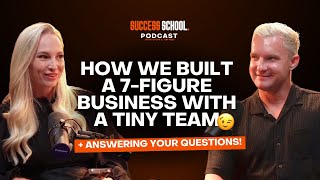
Tim and Steph discuss building a seven-figure business with a small team. They cover frameworks and high-performing hires over bureaucracy, why personal branding matters as AI rises, and how economic pressure is stretching sales cycles to 2-8 weeks. The fix: make your offer a smart buying decision with better copy, testimonials, and guarantees.
Questions this video answers
86
March 10, 2025
8 kilograms
175.4 centimeters
102 kilograms
Chapters
People are getting squeezed and buying decisions are taking longer. Our buying cycle has blown out. Usually we would have someone jump on a sales call. They would sign up that day or the next day. Now they have a sales call. It might take week two, three, six, eight weeks. And people are just taking longer. They're making smarter buying decisions. So the question I have for you is, are you a smart buying decision? And how can you become a smart buying decision? Foreign. Welcome to the Success School podcast. Today we are on episode 86. Super excited. Bit of a different episode today for this one. Talking about some hot topics in business. Right now, sitting next to my lovely, sexy, hot wife.
Oh, wow, a compliment.
Jeff's gone red like the chair.
Yeah, we've been on a health journey, so that could be part of it. Tim, tell us a little bit about that.
Yeah, health journey, personal update. So, yeah, in case you're wondering, I have lost weight.
Yeah, you look so good.
Yeah. If you guys are out there at home. So I've lost eight kilos. Steph hates that. Her weight loss not going as well.
So annoying. Guys, anyone will relate to this. I think it's like My husband's lost 8 kilos and I've lost 500 grams. What the fuck?
So I've been on a. I'll speak for myself here. Steph could probably agree. I've been on a perma bulk for my whole life, which means I've just been eating and training, which is great for building muscle, not so much for your body composition, which is a little bit a wakeup call. So I got to 102 kilos and I was like, boy thick, you know, like, I'm not the tallest dude. I'm actually 175.4 centimeters. So I got that officially measured yesterday on the height.
So how much under six foot is that though?
Yeah, quite a bit under six foot. So I think like five, nine, kind of. Yeah, kind of range. Yeah, but still huge.
Huge, big for me.
So I was like, yeah, I need to lose some weight. Going upstairs was getting hard and I was out of breath. Especially carrying our 40 kilo rot while up the stairs. Plus my body weight. So went on a diet, been eating a little bit less. Steph would say I'm still eating the same, but metabolically still eating so much less. So, yeah, feeling good. Still 17% body fat. Have some abs, which is annoying as well. For Steph, she's like, how are you this? So I had a BMI. I had my BMI done. I'm officially obese on BMI. Actually, I'm 31, which is terrible.
This is why BMI needs to go in the bin.
Did a DEXA scan yesterday, and the guy was like, you just hold all your fat on your stomach. Which was uplifting, but it's great to see the numbers. So, yeah, on a health journey, guys, I'm gonna go for about 85 kilos, which I'll still be obese on the BMI tracker.
We're both on a health journey. We. We watched that Brian Johnson Johnson documentary. He's called Don't Die. That was very extreme.
We don't want to die.
We definitely don't want to die. That is. It's definitely a longevity play for us. The Brian Johnson doco was inspiring and extreme. And so we don't want to live like that, but we want to optimize more. And the sooner you do it, the younger, the easier it is. And so we've really been on this optimization journey and it's been really cool because I think that I've come from a culture personally. And just to piggyback off your personal update for my own personal update, I've been on a. I think any woman will relate to this. And I was having this conversation with one of my girlfriends recently. I used to train because I hated myself. So I used to be like, oh, you're so fat and disgusting and no one's ever going to love you. And so then girls will get it. Girls. It's so intense, dude. But girls are going to get this.
I'm the opposite.
You trained because you wanted to get skinny and you starved because you wanted to be thin. And so this was like the culture. And then once you heal that relationship with yourself and you don't hate yourself and you want to respect your body, it's really hard to then be motivated to train or to do the things consistently because you're kind of like, ah, like, I'm in pretty good shape. I could stay in pretty good shape and be okay. Especially once you're in a loving relationship and you know, it, it can get very easy to not do the things. And that documentary really sparked something in me about just me versus me and that I still have that naturally competitive, like, I want to win, but that it kind of put me as the villain. Like, there's a version of me. I think he speaks about it in the. In the documentary, he kind of speaks about, like, there's this version of you, this, like, this lazy, like, just eating, like, version of you that comes up and sabotages all your hard work. And that's how it definitely feels. And so it's like, it's been really cool to go on this health journey where, you know, do what you say you're going to do. Commit to taking all the supplements. You know, if I'm going to go, I've been running. You've been running. We've both been running. It's not easy.
We've run.
Not. Excuse me, I've run out.
You've completed one run. Excuse me, Steph, count walking as running?
No, I've run two times 10,000 steps.
Of run since we.
I fast, small steps. But it's. It's been really cool to just go on this. This journey of just actually just trying to optimize for you. So we got all of our baseline data is being done and it's been fun. It's actually been fun. It's made me motivated to look after myself.
Let me give you a little fact about Steph. She likes to flex on her step count every day.
I do flex on my step and.
Steph's like, I do 17, 000. She says. She said, I do 17, 000 steps every day. And I'm like, okay, cool. There's something. She's not doing 17, 000 steps, by the way. So I was like watching her just. I call it stop around the kitchen. And Steph takes really short steps. I'm talking like heel to toe steps. So she's just racking up this incredible step count when she's not actually moving very far.
Yeah.
So that's how you do it. That's the hack. So if you guys want to get.
Your steps up, I shouldn't even really need to train because I get 16, 000 steps.
Guys, we're talking about four hot topics in business right now. How it's going to run is I'm going to ask Steph question. She's going to ask me a question. We're going to jam and just see where this goes. So super interesting one. Personal brand versus company brands. With organic reach dropping and people craving authenticity, should business owners put their face front and center or focus on building a brand that stands on its own? What are some pros? What are some cons? What are your thoughts?
Okay, so last week I spoke about AI and I promise you that this week we would speak about something to do with personal brand. Yeah, I want to connect the two dots here. So I do think that in a world and I think that with this will eventually be its own episode. But I do think that in a world where there is going to be more and more AI and our bots are talking to each other and everyone's playing a game, trying to please an algorithm rather than trying to actually connect with the community. I think that the power of a personal brand is going to be more important than ever. Or I do think that you need to personalize your company brand, almost humanize it. And we have some clients who have company brands, but they're super personal. There's heaps of like human faces obviously because they're humans, but there's heaps of, you know, personal touches throughout their social media, all over their websites, photos of them and their stuff. And I personally think that we are going to make a bit of a move away from big company brands. Now I'm not sure how that extends to like large scale companies. So, you know, I'm talking hundreds of millions of dollars of companies. I, I don't know if they're going to put a face to their brands, but I definitely think for small businesses that the humanizing or the personalizing of brands is going to be absolutely necessary. As AI comes into play more, I think that we're gonna detach a little bit from each other and want the human connection. And so I think that moving forward it's gonna be really powerful. The benefits of having a personal brand. There are pros and cons to having a personal brand. It's really hard to build a personal brand. Tim's trying to come up or working on at the moment, a framework so that we can teach it really conclusively. There's nothing online that really teaches you how to do this. They kind of just say model what I do, but then that's not personal because it's actually not you. And so I think that personal brand, it's tough because you really have to, there's so many barriers. You have to be really okay with sharing your opinion and your thoughts. You have to be okay with being trolled, which you will 100% be trolled. There's a lot of kind of barriers that get in the way of like, am I even interesting? What can I even say about myself? And so building a personal brand is tricky, but also the easiest thing you'll ever do once you tap into it, because be yourself. And so I do love it for that reason. I think people relate and connect more with personal brands. I don't think I've ever seen a company profile with as many followers as a business profile outside of like Nike. So I think that. And even then they humanize their Brand because it's always athletes and people and faces with shoes. And so I think that the personal brand is here to stay. I think it's going to get bigger and bigger and bigger. Company brands are great because if you don't like having a personal brand, it's awesome. I do think that you can humanize a company brand without having to be vulnerable and share and cry on the Internet as well. I think again, it just kind comes down to what are our values and how do we live and breathe those values online as human beings within this company?
I just want to talk about my experience with a personal brand. So you've got varying degrees of personal brand. So you've got like 10 out of 10. You share everything. You cry on camera, you share all your opinions, and it's crazy. And then you've got like a 5 out of 10, which is somewhere in the middle. You share your opinions, but maybe not your fully extreme opinions or what you'd really say to a friend. I think you can be anywhere on this scale. I don't think that everyone should be crazy. Conspiracy. Here's everything. I think all the time, especially if you have a business, it can work for you and it has worked for people. I just think you guys should work out where you want to be on the scale. Dip your toes in and then maybe ramp it up. See the audience reaction or your brand's reaction or your ideal client's reaction and see how you go. I'm not telling you not to be yourself online. I'm just maybe thinking about this from a business perspective of how much you do want to share. If I were to rate myself on a personal brand scale on how much I actually show all my thoughts, beliefs, values, I'd say I'm a five. I think five's enough. I think you kind of get it without me having to actually say it. I think you can be one of those brands as well.
Talk to me about why you choose a five. Because a five is a choice, right? Like, this is very much a choice. And be honest. Like, why really is it a 5 and not because you do have.
If I knew I wasn't gonna get trolled, I'd probably go 10.
Yeah.
Like, I think our clients in success school would be cool with knowing every aspect of my thoughts, beliefs. So they could probably guess anyway. It's probably just for that trolling. Like, I'm okay with trolling, but when it gets like every post and every case gets draining and, like, it's super draining. Like, I. We used. There was A period. I don't get it that much anymore. We used to wake up every day and I have three or four or five trolls day. It was like, you suck. This sucks. I hate this opinion. Yeah, it's just like super straining, man, because it's just like, it's just what I believe, dude. Like, shut up. Leave me alone.
I think that you have to have. I, I think this is something that gets built over time. Unless you were just born this way, Tim's pretty strong. So I think it's an armor and I think it builds up. I think it's almost like a shell that gets layered and layered and layered. Because there was a time back, you know, a couple years ago where one troll would rattle me for a week. Now it's like it would have to be like 50 trolls to really start getting to me, you know? So I think that your, your armor thickens over time. The longer that you do it and the more that you kind of breach out and share a new opinion and drop a new thing in the ocean and see how, how the world reacts to it. And so I think that, you know, you may edge from a five to a six or a six to a seven and you don't have to be like Candace Owens to, to get a point across. Right. So I think there's some mid ground on it as well. But again guys, it comes down to you can choose just how much you do share.
I love having a personal brand because it's my creative expression and my outlet. I don't even do it for business. Like I do it for me. Yeah, I'm like, I like, yeah, I was doing it before. Like I love it. Like it's the best thing ever. We discussed it. We were like, I actually don't need a brand is Tim, but I just love having one.
You enjoy, always enjoy creating content. Yeah, for sure. So the second topic kind of off the back of that is, you know, obviously we now are well and truly entrenched in online business culture. They're brick and mortar businesses for sure and they will be very successful, I'm sure for a very, very long time. But if we're looking at online business specifically, what are the most profitable online business models right now?
This is an amazing question and I'm glad we went here. So a big misconception in online business is that any business you don't have is far easier than the one you do have. So we are coaches. We have wet dreams about having a product or we have wet dreams about having an E Com product. Or starting a low touch membership or whatever it is because you just fantasize about what it could be. And fantasizing about what it could be is not what it actually is. I think every business is hard and if you choose a product or whatever it is you want to choose, it's going to be hard. We know people doing every aspect or every phase or every type of online business from low ticket to high ticket to memberships to courses to products to whatever it is, they're all hard. So if you guys are fantasizing about something else, that's going to be easier because you saw it online or you saw some person lying about how much money they're making doing X and you believe that and you think it's going to be easy. You're going to be sorely disappointed with what it actually takes online. I think to make anything easy or anything you go into, it's really good to have a brand, to have really good marketing, to have a big email list, to be really good at what you do and be really into what you do in terms of getting a result for your client or making your product epic. I think you could choose whatever modality you want and if you had those five things you would crush. But I think like fantasizing about a model that's better than what you've got is super unhelpful.
The best business is the one that you stick to.
Yeah.
Uh, and I think that, you know, we've seen this play out a lot. Like, you know, I'm gonna use one of our clients as an example and she has a website building business and a couple of years ago, you know, she was kind of stagnating around maybe 30, 40k months. And I, she didn't say it but I remember it came up in a conversation where she said, oh, someone's asked me if I should mentor them. And this is really common. If you start getting any kind of success, someone's gonna ask you to mentor them. And she said for a little while there. And guys, this just happens. I wanna be really clear, this happens in every business. You will hit an income level and you will stagn. It doesn't matter which industry or business you're in, this will happen because you need to change a lot of things at that point in order to get to the next level. What got you here is not going to get you there. And sometimes it can feel easier when you're at that point and you're just driving and you're driving and you're driving our Last six months was like this. We just drove and drove and drove and drove and nothing seemed to happen. And I know that this girl thought about going to business coaching.
Everyone does.
Because they all think that for some reason this is some magical money making industry where everyone's just going to get rich and blah, blah, blah, blah. And any coach will tell you that it's just as hard or hard, harder than running a gym. It is just as hard as any other business we've had. They're all hard. And she said recently she just hit her first $85,000 a month and I have no doubt she'll hit a hundred thousand dollars a month this year. And she said, I'm so glad I didn't swap and go to business coaching. I'm so glad I just stuck this out. If you are hitting in ceiling, there is a way around it, you just need to find it. It is so much faster to find the way around it because she would have started business coaching. Here's what would have happened. So that conversation happened about a year ago when she started being like in the next 12 months she went from like 30k months, months. If she'd have gone back to zero, she'd still be at 30k months or less by now. So she wouldn't have grown at all because she would have had to shut everything down, fire everybody, start from zero, feel like an imposter, have no systems, have no processes. It would have all started from zero and she'd be at 30, 40k months now. But instead now she's almost, you know, this year she'll hit 100k months. The business that is the most profitable or the easiest to scale is the one that you stick to every single time.
The analogy here guys is you're on a mountain and your business is a rock and you push on the rock, up the mountain, up the mountain, up the mountain and as soon as you quit and you're like, this is too hard, I'm going to do something else. The rock falls down to the bottom and you're on a new mountain pushing up an even bigger rock. Okay? And you've just, you've lost all your systems, processes, teams, everything that you've built so hard over the last couple of years because you think it's going to be easier somewhere else. And we're not saying that you shouldn't change or pivot if you don't want to, but I'm saying if you're just chasing money, there's probably an answer here that's really simple and probably just sitting right there in front of your face.
Yeah, totally. And this is where I think having people in your corner, like, we have people in our corner that we've, we've fantasized over many types of business and we've had coaches tell us, don't. One thing that we fantasized over for a little while was like, imagine if we only coach companies that were like at, you know, 4 or 5 million kind of thing. Yeah, whatever. And someone was like, yeah, they have more money to sue you when it goes wrong. And I was like, ah, yeah, never considered that. So, like, everything that you fantasize about has a con, for sure.
All right, Steph, question three. Scaling to seven figures without a big team. This is a hot topic. Let's start off with. Is it possible to get to 1 million without a huge team?
Yes.
Yes.
It's not only possible, it's super possible. It's hyper possible at this point. Inflation, first and foremost. I think a million dollars used to be a big deal.
It's like 10 cents.
Yeah. A million dollars is not as big a deal anymore. Here's the thing, you have to be very, very, very, very good at what you do.
Yeah.
I think if you come into it and you are very, very, very good at what you do, or you're willing to spend the time to build out frameworks and systems around the knowledge that you have. So first, there's a couple of key things here. One, what you do has to be in demand and of interest. That's first point. It has to be an industry that people are interested in learning about. They have to want to pay for it, they have to want to buy it, they have to have a means to pay for it. That is the first part. The second part is you have to know it really well. And if you know it really well, you should be able to put frameworks around what we were called pulling frameworks around your ip. So this is like your knowledge. Again, you know it very well. If you know it so well, you should be able to teach it in, in a framework, which means that you should be able to teach it without people needing your personal input. Right. And so if you can teach it without, or provide it doesn't even necessarily. He'll be a software, it could be a resource, whatever. If you could teach it without people needing your input and you know it really well, and it's a growing industry or a big market, then 100%, you can scale that thing up to a million really quickly with a very, very small team.
Let's talk about that decision from us. So we went to a million without a big team and we've gone to multi millions without a big team. We have people in our network that have also done those revenue numbers but with huge teams.
Yes.
What was that decision from you? Like why do you not want a big team? Why do you think we should do it without. The cons are we can never really take a week off for me but like what was that decision for you and why did you want to get.
A week off in December?
Yeah, we get a week off in December.
I think everything has a sacrifice. Yeah, that's what I think. And to be fair, we could set up differently. We could set up success school to say like there's two weeks into every year that we don't work. Like, you know, we take five weeks a year and these points throughout the year or whatever, it's just not our style. So I think that the reason that we made the decision was Tim and I are not naturally super extroverted by nature. I think I used to be but I think it was from needing to be validated rather than actually being an extrovert. And so for me and Tim, talking to people a lot outside of coaching and having to manage teams and have meetings and deal with stuff that's going on and blah blah blah, it actually feels very taxing to us. And so as much as we love the team environment, like we love hangouts and we love, you know, team catch ups and we enjoy the bent or that are on the team meetings, we also don't love the management side of teams and we also really hate having hard conversations. It's not our favorite thing to do. And so for us it just having all those moving parts of a team people, you know, you've got leave calendars and you've just got all this stuff like that you're constantly managing. If someone leaves or someone takes a sick day, you need someone to be able to fill in and there's a lot that becomes out of your control. And when it became out of our control and we were constantly managing all these things, it actually took us away from the things that we enjoyed doing because we were spending so much time managing. For us that just wasn't fun. So that, you know, for me that was part of the reason. Was there anything else?
That was basically it.
Yeah.
Like I've had, I would say over a hundred team members and employees. I've had every conversation, I've hired every role I've trained every role I've done All that stuff. And I was like, I just don't enjoy that. Like, it was just something I just don't enjoy. Like, everyone we have in our team is like a player. They don't need much management. It's amazing. And I kind of said to myself, it's a bit of a challenge. Like, we can grow revenue infinitely with infinite amount of team members, which is fine because everyone you bring on the team does add something, and it's great, but it also takes away the profitability of the organization. So I was like, cool. For us having a client, success manager, an admin, a setter, and a salesperson. So four people on our team, you and me, how many people can we impact? Like, how big can we grow this thing? How many lives can we actually help in this exact model we have right now, rather than having 50 people on the team, everyone doing some crazy job and doing it at 10% capacity.
The other thing as well is that Tim and I, we're big advocates for change. And we are. We're learning ourselves as much as we are learning how to grow businesses and, and how to scale businesses. And so part of that is that we make changes. And when we decide we don't want to do something, we don't want to do it. If we decide we do want to do something, we want to do it, and we want it done yesterday. And so one of the things about having a big team is that you go from being in this. I always like speedboats and cruise ships, but when you're in a small team like the size of ours right now, we can turn the boat at any point, very quickly. So if we decide, hey, we're not going to do sales calls anymore, we're going to go to an application funnel, we're going to do this. This isn't this. The team's like sick on board. We have to have one meeting. We have to roll out one new SOP to one person. We move in that direction. It could happen by tomorrow. But if we have 15 team members and that person's role, you know, affects that person's role, who affects that person's role? And six people need training, and all.
Of a sudden we're feeding 10 families.
We're feeding 10 families and, and, and then what if we make a decision that, you know, impacts like, our responsibility to them and, and it all becomes very hard and you start trying to turn this cruise ship, which obviously is not as fast as speedboat, so that one change may take months, months to roll out. Not our cup of tea. Because we are fast movers. So I think there's the agility of a small team that really appeals as well.
That's a great analogy. But look at how long it takes something to go through in government because they have millions of employees. Like, you've got to have, like, you know, to change your signature in your email. You've got to have a meeting with 22 people about it. And then to fix a pothole in the road, it takes nine months. You know, like, it's crazy. So if you liken us to the Australian government in terms of employees, like, we can move quick.
Yeah, Y. Okay. So it's possible to scale a small team up to a million. In fact, we know people who do it pretty much solo. It's a couple of contractors. So definitely, definitely possible if something that you desire. The last topic that I'd love to talk to you about is the economy. It's shifted again. So how is the economy, Tim, hitting small businesses? Because we have rising interest rates, we have inflation. How are business owners staying profitable?
Backstory here, guys. We're going to go back covert time. So massive amounts of money printed in circulation. Trillions of dollars. Incredible. Everyone's getting stimulus checks around the world. It's party time for business. Everyone's got money. Everyone's making money. And then what happened in that time is governments expanded. They started spending a lot of money. Everyone is spending money. So time. The reserve banks of all the countries, they jack up interest rates as, like a mechanism to stop the spending. That's what's happened. And then we get these massive government bloats. And I'm going to speak about America in particular here. So they have these massive government bloats. They get so much debt that repaying the interest on the debt equals like trillions of dollars, which is crazy. So interest rates are all time high. So the latest government has come in. They have implemented doge, which is the Department of Government Efficiency. So they started making cuts now in America. And what we know about America, basically, they have a big part in the global economy around the world. So now they're cutting billions of dollars a day, which might sound terrible from the humanitarian aspect of, you know, people are getting fired, contracts are getting cut up, they're handing back leases of buildings. A lot of people are affected by it. But it is actually a good thing for the economy because the debt ceiling is lowering in America and interest rates will drop eventually. So there is light at the end of the tunnel on what's going on right now from a business perspective. In America, people are going to have more expendable income and money is going to come. The problem is that right now it's tough, okay? It's tough right now in business, which means people are getting squeezed and buying decisions are taking longer. So if we talk about success school, our buying cycle has blown out. So usually in the good old days of success school, in the first six months, 12 months, we would have someone jump on a sales call. They would sign up that day or the next day. Now they have a sales call. It might take week two, three, six, eight weeks, and people are just taking longer. They're making smarter buying decisions. So the question I have for you is, are you a smart buying decision and how can you become a smart buying decision? For us, that was investing in our website, making it look better, getting better copy, upgrading our podcast, making that look better, upgrading our content, getting testimonials on the website, getting case studies, improving our ads, making it a smart buying decision. We included a guarantee and successful. But if you join, which I hope you guys do, you get 10 clients in your first year, you get your money back. Obviously the stipulations to that as well, you can't just sign up, not show up and you're not going to get any clients. So that's not going to work. But I guess the thing I want you to think about is how can you make your business a no brainer, or how can you make your offer a no brainer? How can you make your business a better buying decision?
I want to touch on something that you mentioned there, which I think is super relevant. We sit with our clients a lot, but I hear it in conversations a lot. Oh, I lost that. Like that sales call didn't convert. You shouldn't be stopping on that day like that. You know, that's your first mistake. So buying cycles have blown out. If it's not a yes right now, it may be a yes in three weeks time. Ask when it is going to be a yes. Like don't hesitate to kind. Continue to warm that conversation because it may be a no right now, but in two, three, five, six, seven, eight weeks time they may turn around and go, actually it's exactly what I need. Let's do it. So don't close the door and just think, oh, that's lost. Continue to like converse and warm those people and create nurture sequences and ways of checking in with those people. Because the cycle is definitely taking longer. And I want to hit this conversation from a slightly different perspective. One of the questions that I asked you was how business owners staying profitable. So yes, how can you make yourself a smart buying decision? But also as you, you can't blow out with costs right now. Like, you have to be really smart about the way that you are scaling your businesses. The team members you have, are you doing things the most efficiently? I'll give you an example. We have a couple of clients who have had a lot of success very quickly and they have a, I think a fitness business. And they were like, look, Steph, the amount of time we're spending for the amount of money we're making doesn't make sense. We have to charge more. Now their ideal client can't afford more. They're in a low socioeconomic group. They have big impact mission on their heart. They're like, we're a double our price. I was like, you are not going to sign anybody at double your price because that's just not your market. So we need to now solve the problem because the problem is the constraint. The constraint is we don't have the time, so we need to fix that problem, not just double the price point. And so the time constraint was pretty much immediately fixed. They were like, we're going to hire a Filipino va. They're going to help us with some of this admin. We actually need to stop over delivering and simplify the ways in which and automate ways in which we communicate with our clients a lot of the time so we can take on more clients. Clients and do it in the amount of time we're currently spending at the moment. This is a really obvious thing to say, but it's about working smarter and not harder. It's not just about doubling your price point. We've spoken about this. There's not a lot of additional income in the market right now. There will be. It's going to grow. But at this exact moment, doubling your price point doesn't solve the problem. You're just going to get less clients, which is cool. But if you fix the constraint, which is the time you'll be able to take on more clients and have the impact that you want. And there are ways around it. And so how do you stay profitable? Keep costs low, find smarter ways of doing things, smarter ways of working and yeah, maybe price increase. We highly recommend a price increase. It's only doing little bits at a time, small ones at a time. Yeah.
I'm just going to leave you with the final takeaway here, guys. I just want you to think about your service offer, product, whatever it is. How can you make it better? How can you improve it? How can you get a better result for your client? That is the key to growing a business. Really? In a nutshell, Totally.
Guys, if you loved this episode, it was really fun. I really enjoyed talking about all the topics, topics that are happening in the business world. If you enjoyed the episode, let us know if you like this style. We're trying some new stuff out, so we do it for you. We do it for us because we love it. Yeah, we do it for you. So let us know if you liked and if you loved it, we would love, love, love to hear about it.
All right, guys, you know what to do. If you are new around here, hit that subscribe button. We loved having you. It was a super fun episode. And we'll see you next week. Ra.










