
What we had to Change to Grow Past $1 Mil per Year AND Be Profitable
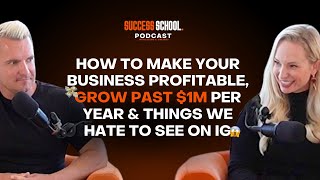
Tim Frey and Steph break down what it takes to hit $1M in annual revenue and stay profitable: track 75 KPIs, raise prices, cut costs, and replace underperforming team members. They also call out fake claims in personal branding, like claiming seven figures without a full year of revenue.
Questions this video answers
Episode 80
75 KPIs
Chapters
If you think that you are too boring to have a personal brand, it just tells me that you're not being yourself.
Here's how to decide if your team member is worth keeping or not. Is would you rehire them? And if the answer is no, then you should probably look for a way to get rid of them. There's nothing worse for growing and scaling a business than having the wrong team. Welcome to the Success School podcast. We're on episode 80 today. We have a schooling episode. We're talking about how to make your business more profitable, how to grow past $1 million a year, and the things we hate to see on Instagram. Steph, how are you feeling?
I'm scared to hear what you're going to say here.
Yeah, I hate a lot of stuff on Instagram.
Mostly hate Instagram, but spends a lot of time on there.
All right, I've got a story, guys, and it's about doing a weird sniff.
Oh.
And not the kind you're thinking about.
Who was the politician that sniffed the chairs?
Yeah, I'm not sniffing chairs. I'm not sniffing butts or bras. Maybe I'd like to. Maybe this is going weird. Back to sniffing, guys. So Steph's looking at me like, what the fuck are we doing here? So what I mean by this is I nearly bought a course the other day and what I do is I do something called the sniff test. And it's a process to see if the person I'm sniffing is essentially full of shit. And what I mean by that is metaphorical shit here. And it's like, are the claims that they're making bs, are they bogus? Is it not? Right? And you'll get a general sense of this when you are researching someone. So before I buy anything now, because there's so many rip offs, charlatans and scammers online that I don't like to get ripped off when I'm buying stuff online anymore. So I'll go through, I'll check their links, I'll check their Instagram, I check their website, I check their testimonials. So if they say they got a testimonial by someone, I'll usually go on their Instagram profile and see if they've actually worked together. Even text the person. Okay, that's how deep I go with this. And I would suggest that you actually do this. When you are going to buy a course, program, coaching, mentorship, even a product online, check out the people that you're gonna work with and see if they pass a sniff test. So that's a sniff test. I didn't sniff anything weird. Steph. Did that make sniffy sense?
Made so much sniff sense. And another one, if you wanna take it one level deeper, is to Google them. Google Reddit threads will tell you a lot about somebody oftentimes so. Or about their program, about their offer. So definitely recommend doing the sniff test. But yeah, we were looking. You were looking at a course. We were both pretty hopped up on it. We were like, this looks like exactly. It was cheap. It was thousand bucks. It wasn't like, I mean it's cheap in our world because we spent a lot of money on courses, but it was thousand bucks. We wouldn't miss the money if we'd spent it. But we don't like giving our money to assholes. And so we're both very hopped up. And then you said he doesn't. And then the minute that seed of doubt is planted, it's done. So do you pass the sniff test? I think everybody here has you pass.
It for your business.
Yeah. You have to think about this. Do you pass it for your business? If someone went online and they saw your offer and it was good and they saw your landing page and it was good and they looked at your social media and it was okay, and then they went and they found some stuff, the website wasn't built that this wasn't there. There was no testimonials, there was no reviews. You haven't posted on social media in three months. Would you pass the sniff test?
If your website is diabolical and your social media doesn't make sense and your business is struggling. Is there a correlation between those things? People are checking you. They are seeing if you're going to pass a sniff test with them. We are in the coach Armageddon, the coach recession, the trust recession. You need to put your best foot forward online and pass all of those things with FL colors.
Yeah, 100%. Okay. Mine is a little bit different. My personal update today, I've had quite a few people come. We, I think we both had this a few times lately. We've been talking a lot about brand on social media on this podcast and it's created a lot of conversation, more than we actually expect.
Single handedly growing businesses within successful.
Yeah, like for the personal brand conversations. Yeah, totally. So what we have noticed or something that people often say it's cool for you guys. Yeah, like, oh, that's cool because you guys are, you know, it's easy for you wealthy. You, you're wealthy or you know, you look Good on camera. Or you guys, you know, you dress well and you have this, like, brand, you have this thing going on or you have this interesting life. I'm pretty sick of hearing it, to be honest. And I wanted to talk about what it actually means and why. Oh, today. Damn.
Let's get it backhand ready.
I think that if you think that you are too boring to have a personal brand, it just tells me that you're not being yourself.
Yeah.
Because we're all pretty fucking weird.
Yeah. And boring.
And we all think we're boring. We think we're boring. Like, if you actually followed us around a day in the life, you guys would be like, that's what they do all day. And so I think that you can sit here and think that we're interesting because we're not you. Okay. But ultimately it comes down to you're not being yourself, because the more yourself you are. Like this podcast, a year ago, it was pretty boring. Pretty boring because we were too scared to be ourselves. We were too scared to swear because someone told us that we shouldn't. We were too scared to be vulgar because someone said that it wasn't professional. I was too scared to say things like, don't be a ho. Share the show because I thought people would feel offended by the word ho. And just how many masks are people wearing? Are we wearing? Have we worn to get to this point where we're now interesting, when really all it is is a process of self discovery. You know, we chose to wear all black because we actually love all black.
And I look slimmer and we.
Yeah, we look slimmer for sure.
We don't wear black.
And we. And a bit messy with the eating. If we wear white.
Yeah, it's just stains on this.
Yeah. The yarn gets just. It's basically hasn't been washed.
Yeah, Never washed. It's about one shirt. It's so washed from when I was 10. That's why it's so tight.
And so I think that if you think you're too boring to have a personal brand, I think that you really need to lean in and think about underneath all these masks and all this pretending that I'm doing and all this people pleasing that I'm posturing as online to try and be this person that I think that I need to be. If I stripped all of that back and I just went, who actually am I? What do I actually feel most comfortable in? If I was having a conversation with a best friend, it would sound like this conversation. So why am I not having those Conversations with people. Why do I feel like I need to hide it? And I just thought that was something worth sharing. It's something that we. But especially me. Me more than you. You've always been yourself. And I've almost tried to stop you from being yourself at times because I thought it was too much or too this or not professional enough or whatever. And God, life is just too short.
Yeah, for sure.
Life's just too short.
Just an anecdote on why you should do this. You know, we have a subject matter of one here, so we can speak from personal experience about our experience. But as soon as we start being ourselves, we help more people, we impact more people, and we make more money. Do you want that? There you go. All you guys need to do is implement an action. That very simple advice. And what I mean by that is like, we took our brand more seriously. We learned how to take a photo. Or I did Steph, still learning. And that works for when I take photos of Steph, but struggles the other way around. We got better cameras. We invest in lighting, made better content. We really cared about our content that we're putting out. Our business started growing because we took more care in it. And people sit there and they're like, oh, I don't have the money to do that, or I can't afford to do that. Everyone's got a phone and you can watch YouTube videos on how to take better content. Really simple way to do it. Or they can't get their carousel slides to look great. Well, go on, fiverr. Pay someone five bucks an hour and get someone to design you some carousel slides that look good. They this shit doesn't cost the world. You can go to the extreme and have a 30k set up on a podcast like we've got here. But it's not about that. It's about trying and making active effort to improve your brand.
Yeah, you don't start at your final copy. You start at your first draft. Everyone does, us included. So today we're diving into our schooling episode where we answer questions from you, the audience. Now, we have a mix of questions here. We have some from clients, we have some that I put on my social media. Guys, if you want your question answered, please post it on social media in the question boxes when we put them up on our socials. But the first one, Tim, I'm going to ask it to you. So this question is from Louise.
Yeah.
She said, what is the biggest thing you've had to change to grow beyond the $1 million point in business?
I think growing 0 to 1 million is pure hustle. Like it is working finger to the bone making sacrifices. Not like hormozy level making sacrifices, but making some sacrifices to get yourself there. Because I think you just don't know what you don't know and you don't know much. And it's literally just a grind to provide good service, or hopefully you think it's good and then keep doing that, working with clients, getting kicked in the face over and over. And then once you get to the million dollars, you're like, cool, I made it. And that's when the real work begins. Because sorry to warn you. Yeah. Going from one to two is hard. Going from one to anywhere else is super hard. And what I mean by that is you have to get really dialed in on the specifics. It's not about doing more, it's about doing it better and the things you are doing better. And I think the main thing here is tracking your numbers and going off your KPIs and trusting the numbers and not the emotions. Okay. And the process that we do, we track 75 KPIs. You don't have to start there. I'm not trying to freak you out.
But.
But track KPIs. And then we work to improve the KPIs. If they slip, why did they slip? Okay. And we're just doing more of an inquisitive introspection into the numbers and the statistics of the business. And then we are improving three a week until we don't really have too many weaknesses, until more problems come up. What about for you?
Yeah, that's mostly been it. Which sounds so simple. Yeah. Honestly, if you've grown a business to a million and Louise is probably close.
To the press business, you've got the skills.
You've got the skills, so you know what you're doing. You've got brand rapport. People are buying from you. People know who you are. At the 1 million point onwards, it's refining those skills. So, you know, one thing that we are probably still learning or a skill that we're now dialing is management. Because to take it from where we are to where we're going, we're going to need people and we're going to need to attract really good people. And if we get really good people, they're going to want to have good leadership. And that's something that we have to now really refine those processes. Again, you don't know what you don't know. So we're in an upskilling phase. I think that the other thing to answer, Louis, this question that happens from the probably 50k mark up to the mil mark is there's a few different periods of reinvestment where you have the money coming in. And then for a period of around 50k months, you're probably banking quite a lot. Your profit margins are probably pretty good, pretty comfortable. You're banking quite a bit of money in the business. It feels really safe, feels really nice. In order to grow to the next level, most of the time it will require a period of reinvestment. What that means is taking some of that money out and putting it back into the business to grow it to the next level. And you will invest it in many ways. You'll invest it in paid marketing, in increased ad spends. You'll invest, invest it in hiring people. And the most painful part of hiring people is the fact that you will invest it in the wrong people probably many times. And that's really hard and it's very demoralizing and it's very frustrating. But it is the only way to grow. And so I think that what happened for us, well, I'm going to speak for myself especially, but I think I can speak for both of us on this one, that we grew and we hired the wrong people and then we went anti team and fuck team. Fuck team. We're not going to pay people. We do it ourselves. We'll do it ourselves.
My money we don't even get.
Correct. Correct. And I think anyone listening that's been at that point is laughing also, because this actually happens every time for every business. This is hilarious. It happens every time for every business because you pay people and they fuck you over or you pay people the wrong people and they don't deliver and you get really pissed off because it's your money. You got to remember it's actually not your money. It's the business's money. There's no point you're keeping it because you're going to tax on it. I mean, that's not true. Keep it. But like, and get financial advice. But it's not your money. You can only take what you can take. But it feels like your money because.
You'Ve worked and slogged for it, dog for it.
Oh my God. And then you're giving it to somebody who's not even doing the fucking work. Like it is the worst. It is actually the worst. And you have to go through. It's a trial by fire. And you do have to go through that period to learn the skills on how to Hire a team and how to manage team and what you're actually fucking looking for and how to write an sop. You do have to go through it. You have to go through it. And so we went the anti team and then we were doing everything ourselves and realized after about six months how much that sucked. And we were like, we don't want to do that. So we do need a team, but we need the right team. And the right team starts with the right us. And so that's the phase of business that we're currently in at the moment, is really refining the company, the mission, the values, the vision, the person, the people, the upskilling, the process, the management. And I think that that's what will take us to the next level.
Can I ask for your permission to share a story about something that really pissed me off from a client? Oh, gosh, I won't name names. It's not that bad.
Yeah, but they will know.
They will know. Of course they'll know. They should know. I hope they hear it. I want them to hear it. So I had a.
First of all, we love you all.
We love all.
We are so grateful for you.
I got a dm and they said something like, my business isn't going well. What do I do? And I said, cool, send me your KPIs. And they were like in a whiny voice. I don't track KPIs because there's nothing to track. And I was like, dude, send me your KPIs. I need to know how many times you're posting on social media, where you're posting, what emails, what's your reach, what's your engagement, like, how many offers you're making, how many sales calls you're actually getting, how many leads are you getting? There's stuff to track.
Yeah.
Without the data, even if you think your business sucks, I still need to see what you're doing. So not tracking KPIs. I think everyone should be tracking KPIs at every level. I think when you first start, like, from zero, if you're at zero dollars, you should be tracking KPIs right now. At least five or ten. It's not hard to do. It takes minutes, like, fucking minutes to do.
Tell me that you're mad about it.
Oh, my God. It pisses me off.
I actually had someone come on a group call the other day. Yes. Like, two days ago. And she said the same thing. And she goes, I. I know I need to track my numbers. Steph. I don't. I don't want to track 20 of them. Where do I start? I said, send me a KPI sheet. I'll highlight the ones that I need you to track to start with. Yeah. And that was cool. And I said, I need you to do this. I need you to submit it to me every week. And the only reason that you won't do it, because it will take you five minutes, is because you are creating meaning from the numbers.
Yeah.
If you don't create meaning from the numbers and if you just. Or fucking create the meaning because you.
Know what the something about it.
Do you know what the best motivator is? Pain. Yeah, pain Being slapped in the face over and over again. At some point you're going to go, I'm fucking done with this bullshit and I need to do something different. And at that point, that is when shit will change for you. But you can lie to yourself if you don't look at the numbers. You can pretend it's okay. You can pretend that it's something to do with something else. You can pretend that it's the economy or I've just been busy or blah, blah, blah. But the minute that you're looking at the numbers, you know, and it's an unavoidable truth, and that truth will move you so much faster than any other truth in business. And so, yes, it's uncomfortable, but that is business. And if you want it to be comfortable, you should go get a job. Honestly, like, business is not for you. You've got to be uncomfortable. I'm at the point now where we experience pain in business. And I actually let myself feel it so deeply. Like. And I think we're both in this phase now where we feel a pain and we sit down, we really, like, we kick ourselves while we're down. Like, we get. We get really into it. Like, we're like, we sit there, we're so fucking disappointed in ourselves. The energy of the house just drops. Like, it's awful. But if you make it okay and you, oh, it's all good, and we can just be optimistic about it. No, no. It's like you're not learning the lesson. The deeper you feel the pain, the faster the lesson is Learned. So that KPIs. I love it.
Do you want to know something that drives me every Monday in our meeting?
What does?
I'm the fucking paid ads guy. And the number of leads we get, I make it my mission. If I'm presenting it to you guys and it's not enough, I'm like, you suck. You can't even do your job. You call yourself the fucking paid ads guy. So that drives me. I got to present to my entire team how many leads we got for the week. And if I don't hit KPI, I make it mean something about me, which means I hit the fucking number every week.
The making something mean something about you is twofold. It can help and it can hinder. So I think that it can help someone like you. You love the dark energy and you enjoy.
You've embraced the work.
You drive from darkness. Often you will run from pain more than you will run towards where you're going. Yeah, I'm actually the same.
I like good stuff. I like that.
Yeah, I'm the same. But a lot of people with a pain will actually demoralize them and take them backwards. And if that's you, you can't make many from the numbers.
So question two, from unknown, can you tell me about how you would turn around a business that has little to no profit and make it profitable?
Steph, the question actually was that when she asked it to me, not a client, someone on social media, she was like, how do you do it within your program? And I was like, well, our company is called makemoreprofit.com for a reason.
That's what we do.
But profit is one of those things that people massively overcomplicate. And when I figured it out, I was like, this is actually so simple. And it's why we're able to turn our clients, businesses from not profitable to profitable very quickly. Because once you know the four ways of increasing profit, there's only four ways, so it's actually very easy. So there's the four ways of increasing profit. You can either increase your prices, which is the easiest way and usually the one that we would recommend, depending on.
How often competitive your market is.
Yeah, and sometimes we'll tell you to reduce the price, but more often than not is increase your prices. There's increased the average order value. So it's sell more stuff to your customers. So, you know, we sell successful. We often people upgrade to one to ones which you sell more to the people that you already have in your world. The second thing is, the third thing is always reduce cost. Reduce. So how can you if you're still paying for kajabi? What the fuck are you doing?
Get on. Go high level.
It's crazy that they're charged. It's drug.
Drug money? Yeah.
Rug money. An active campaign. I've just found out. Drug money.
SAS companies can have a reckoning.
God. So cut Costs to reduce the costs of the business will increase the profit in the business. And the last one, which is the last one for a reason, because it's the first one that people try to use and it's the last one you should use. Adding more revenue streams. There shouldn't be more revenue streams being added until you're at a point where the first business is already humming along like an absolute beast and it's absolutely amazing. And then you can add another revenue stream. We do not recommend that. To add more profit to the business.
Yeah, typically, for sure. I agree. All of those points are incredible. What I'm going to add is a little bit of different takeaway here. So I recommend you go full Elon Musk and fire all the deadwood in your team. Because usually in a business there's a lot of operational drag in terms of the team members. So people get very complacent. A story I heard from Mark Boris, he's a successful business guy in Australia. At his mortgage broking company he went and chopped the tops off the team. So he got rid of all the leaders and the teams and the managers, etc. And let all the new blood come through. He got rid of all the wages which were high level wages, which was like 200k a year wages for a lot of people. So he created profit in that and then he let a lot of the new people jump up and step into these roles at a cheaper rate. So it created a bunch of energy within the team and eventually grew their business. So if you've been in business for a while and you have big expenses and a lot of them are team, I would look to the team. Are they hitting KPIs? Do we need to set new KPIs? What's going on in the team?
What's the question you ask yourself about team members when you are trying to decide whether you're going to fire them or not.
So here's how to decide if your team member is worth keeping or not. Is would you rehire them? That's it. And if the answer is, and if the answer is no, then you should probably look for a way to get rid of them. Yeah, there's nothing worse for growing and scaling a business than having the wrong team. I would rather work 10 times harder and handle the jobs of multiple people than have the wrong people on the team. And that's the attitude we have within our company.
And if you're a company, if you, if you have team members and you're a manager and you find yourself in that position and you find yourself feeling guilty for firing team members or feeling bad or. I just like. Oh, just like. You didn't get into business to be everyone's friend. No. And if you don't feel comfortable firing people, you shouldn't hire them.
No way.
All right, question three, Tim. What's one piece of business advice or one thing that you see on Instagram that makes you roll your eyes? I'm super nervous, actually, for you to say this.
This might be a little bit of a controversial take, but I feel like getting thotty on Instagram to sell stuff, AKA create attention by showing body parts, whether they be on the front or the back, is a bit of a deceptive way to get attention. And I feel like you should probably not purchase something from someone because of the way they look more the outcome or the value you are going to get for it. And I'm pretty sick to death of it because I see Instagram is just becoming like a sex factory online of people just getting their shit out to sell stuff. And I think it's just. It's gross, to be honest.
I went through the phase. Yeah, I did go through the phase.
Yeah. I called you out.
You did call me out. And now I look back and I wildly regret the phase because everyone else was doing it. So that's why I did it. Which is the wrong reason to do anything ever, full stop. And I think that. Controversial take. But can we just bring back some class?
Yeah, Decency.
Just decency. I don't know. Just. I don't think that we need to be sexualizing business. I don't. I don't think it's necessary. I don't think it is relevant. You know, if you're really amazing what you do. Gotta be really amazing what you do.
Yeah.
But you know, controversial take for the girls that are out there doing it. Get it. Whatever you do. Like, no judgment, honestly, no judgment.
Judgment.
It's just that, like, I don't think it's necessary. And you know, it's.
But if you got your tits out and your tits are really out and you're trying to say something inspirational, motivational, or get a message across, no one is looking at what you're saying.
Yeah.
They are looking at your tits.
Yeah.
That is it.
Yeah. And you can still wear stuff that shows things.
Yeah.
That's classy. But there's a lot that's not. And you're talking about the ones that are really not.
Like, nips are nearly out.
Yeah.
You can see whole butts.
Like, it's a whole thing. We're not talking about the ladies who have a bit of cleavage. We're talking about tits out fully for the boys, only fans levels. But not doing only fans, selling business, coaching. Yeah. So for me, the thing that annoys me or frustrates me on social media and this is a me thing. So this is a standard thing for me and something that I wouldn't do and so that's why it rattles my cage so much. But people who say that they are a million dollar business when they haven't actually made a million dollars in a calendar year.
Yeah.
So they've made it over a five year period or a ten year period or I've heard nonsense like people have sold a house and they've included that as part of their. Like I've just heard nonsense. And I think it's deceptive. Yeah, I think it's deceptive. When we talk about making a million dollars. I never celebrated the fact that we made a million dollars until we made a million dollars in a calendar.
Yeah. In 12 months.
In 12 months. And I want to be really clear. I saw Marie went to this the other day. She's a liquid millionaire, meaning she has million dollars cash in her bank account, which I think is so wild for a lot of reasons from investment perspectives, but whatever. We love what you are crazy, Maria, but that's cool, sis. You do you. I love you. Amazing. But we're not millionaires in liquid cash. We're millionaires in assets. And there's different variations of this.
But we could liquidate and have a million dollars.
We could liquidate and have a million dollars. Yes, but, but the crazy thing that I see online is these people who have maybe had five or six different types of businesses that are saying let me coach you because I've had a million dollar business or I've made a million dollars is deceptive because anyone who wants to get to seven, I know someone right now that's doing it and she's very young and she has made this million dollars over a five year period and she's coaching people how to get to seven figures. But she makes five grand a month. She's never done it. And that's fine. It's just deceptive as fuck. Because you're going to sign people up who want to make a million dollars and the things that happen at 50, 60, 70k months to get to the million dollar point because 84k is a million dollars. What happens usually from 70k is you hit 100k pretty quickly. You can't know what happens at those points unless you've been at those points. Because stuff happens that happens. It's unanimous. Stuff happens at 120k months as well. Yeah, that's unanimous. It happens to everybody. And you can't know or coach that unless you've been through it. And it's just my pet peeve. It just pisses me off. I have some standards, have some etiquette. Don't lie, just say it how it is. I make 40 grand a month. That's amazing.
You can't coach what you haven't been through. It's like me coaching women on menopause. Yeah, I haven't been through it. How the fuck am I going to coach that? Or it's how to coach. You get lean. I've never been lean. Why would I coach that? Yeah, I'm like, how to get fat strength boy.
How to get run fit.
Yeah. How to get run fit. I'm not a runner.
There are exceptions to these rules. And you know, we have an awesome client who coaches mums who are overweight.
Yeah.
He's chosen moms because he has a really beautiful story about why he's chosen to work with mums. But also he's been overweight at the level that he's speaking about to lose the weight. He knows what it feels like to have been at that point, which is over 100 kilos and wanting to lose weight. And so it still is relevant even though he's chosen a different niche. A niche that's not who he is. Yeah, there's a lot of relevancy to that. So we're not saying that there's anything wrong with that. And I'm also not saying there's anything wrong with saying that there's millionaires. I know people, people I love to do this. Okay. Yeah. It just annoys me.
Yeah. Seven figures is seven figures in 12 months. Don't say you're a seven figure coach if you're not a seven figure coach. It's lying.
Yeah. So the wrap up for today would be the biggest thing you want to. That you have to change in order to grow to a multi 7 figure business. Is honestly probably tracking KPIs which ties very closely into the profit conversation of if you want to increase profit, you actually have to look at your money really regularly to know what's going on and where it's going, which you will do if you track your KPIs. And the third one, which is really also a lot about money and I think standards. I think the third one is really about standards. You're like, the standard is that you don't have to be naked to make money. The standard is that you aren't deceptive in what you sell. You know, I think that that's it.
I was just thinking, could we call ourselves an eight figure coach now? Because we've nearly. I think we're close to eight figures.
We would be at this point or in the next 12 months.
We would have total, but then we'd be just like everyone else. Fucking lying.
We would have made over $10 million, but then we'd just be like everybody else.
So this three episodes of podcasts that we've recorded, we've been saying a thing at the end and I just want to see if Steph will give us one more time. If you love this show, share the show.
Don't be a ho.
All right, guys, that was epic. Sharing the show is really important to us. If you got some value from this, if you found it controversial, if you are one of those people, share it, get it out there, spread the awareness. Tim and Steph's take on getting your tits out and call in seven figures and growing a business. Track your KPIs saying words.
We'll see you next week.
Thanks, guys.
Sam.










