Beyond 1.5 Series | Seeing the future: What do success and failure look like?
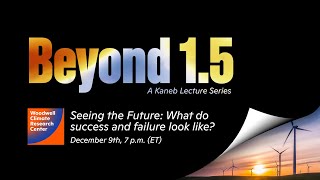
Climate scientists and science fiction authors explore how stories help us imagine climate futures. Vandana Singh and Xia Jia read excerpts about sea-level rise and community adaptation, while Dr. Jennifer Francis explains how fiction fills gaps that climate models can't: it shows what actually happens to real people in specific places.
Chapters
Welcome everyone. I'm Heather Goldstone, Chief Communications Officer at Woodwell Climate Research center, and I am thrilled to be welcoming you to the final event in our Beyond 1.5 series. I would love to see a show of hands, digital hands, unfortunately, of course, if you have been with us since the beginning of this series, all the way back to September and Climate Week when we kicked off with a look at the risks and opportunities in front of us, we have come through multiple events since then and conversations talking about underexplored risks and tipping points about the options, the technologies and other options policies that we have at our disposal. And we have also then taken a little bit of a break for cop the conference and parties this year's UN climate negotiations, which actually did happen this year despite the pandemic. And we are back now as we are in this final month of the year and in kind of a reflective mode, I think at this point to really soak all of that in and take a little bit of a different look at it. And I'm seeing about two dozen folks who have been with us for the whole season, so kudos to you guys. It's really been quite a series of conversations. We're glad to have you with us and we are so glad to have the dozens of you who are with us this evening who haven't been around for the whole series. And believe me, you don't have to have been around for the whole series to appreciate what we have for you this evening. Before we dive into that, I want to thank the Knab family for their support of this event series and our virtual events broadly at Woodwell Climate. It's really just a fabulous way for us to be able to reach a much broader audience, many more of you than we would be able to with in person events. As much as we love in person events, this has been one of the silver linings, I would say, of the past couple of years. We have had viewers from almost a dozen or about a dozen countries on our recent events and we are thrilled to be able to connect with all of you. And as you will see tonight, it also means that we are able to bring together panelists from around the world for our discussion. So we're really grateful for that. I though, am sitting right at the traditional and sacred land of the Wampanoag people who who are still very much a vibrant presence in our community and also acknowledge land stewardship in addressing climate change. Now, different tack than is usual. Woodwell Climate Research center, as our name implies, or doesn't really Imply States is all about bringing science to bear on the problem of climate change. We are an organization of top notch researchers working with a global network of partners to develop and deploy strategies that can really make a dent in the emergency that we are facing right now. But we recognize that science isn't the only thing that we need to bring to bear in order to address this crisis. In fact, imagination is a really critical tool in making wise long term decisions and, and speculative fiction is a way that we can begin to look into the future, to see our future as it might be and imagine how we might get there. And so we several months ago, probably close to a year ago, my team started talking about this idea of engaging speculative fiction authors in a conversation about where it is we're headed and how we bring together science and science fiction to really get a more holistic understanding. And it was a few months ago that we encountered a program at Arizona State University called the Climate Imagination Fellows and thought, oh my goodness, this is exactly what we have been thinking about and talking about it. And I reached out to Joey Eschrich, who is the editor and program manager for the center for Science and Imagination at Arizona State University and assistant director for Future Tense, a partnership of asu, Slate Magazine and New America, exploring emerging technologies and issues like culture and policy and society. So I reached out to Joey and we had a conversation that really felt as if I had met or remit an old friend or kindred spirit. It was really wonderful. And so I am thrilled this evening to, to hand it over to Joey for a couple of minutes to introduce that program and the authors joining us this evening who are Climate Imagination Fellows right now.
Thank you so much, Heather. And thank you everyone for joining us tonight and for having me. And I'm so glad that you found us, Heather. This has been just really great and very instructive and educational like all of our events and activities that this fellowship event so far. So yeah, I'll tell you all a little bit about the Climate Imagination Fellowship and then two of our fellows are with us here tonight, so I will introduce them as well. So the fellowship is presented by the center for Science and the Imagination at Arizona State University, as you said, where I've worked for 10 years almost. And we have really generous support for this project from the ClimateWorks foundation, which is headquartered in the Bay Area in California. And the fellowship is designed to bring together talented fiction authors from across the globe with researchers as well as policymakers, community members and other creative folks to craft visions of positive climate futures. Those Visions are intended to be both grounded in real science and inspired by scientific and technological realities, but also attuned to local particularities and the complexities of specific physical and social geographies. When we talk about climate fiction and storytelling at our center, we often talk about it as a phenomenon that needs to be attentive to global forces, but also incredibly attentive. I think more so maybe even than all forms of literature, you know, the other genres to the local and to the way that the local connects to the global. And that's some of the, I think, the challenge that our, that our fellows and authors are taking on. And you know, the project's motivated by a simple idea, which is just that we have a lot of narratives of collapse and catastrophe, and those are incredibly motivating for some people. But we also need stories about successful climate action ideas and models out there in the universe that we can work toward and that we can hopefully gather around. And so far we've been lucky to be able to contribute to COP26, the UN Climate Change Conference, and we've hosted events and workshops with TED Countdown, the British Library, the Hay Festival, Arequipa in Peru, the magazine Shoreline of Infinity in Scotland, and a bunch more partners. And the project will publish a Climate Action Almanac, which will be a book that will feature fiction from our fellows, both pretty substantial novelettes, and then also flash fiction pieces covering a bunch of different possible climate futures, also essays from experts, interviews, art, and a bunch more stuff. Hopefully we're hoping it'll be a really kind of polyvocal jamboree of a book and you can learn more about this project@climateimagination.org okay, so that's enough soapboxing about the project. Let me go on to introduce our two of our talented fellows. There are four fellows currently, so we have half of them here tonight. So first, Vandana Singh is an author of speculative fiction, a professor of physics at Framingham State University in Massachusetts, and an interdisciplinary researcher on the climate crisis. She's an author of two fabulous short story collections, the Woman who Thought she Was a Planet and Ambiguity Machines. The latter, Ambiguity Machines is like the science fiction book that I give people when people are like, I don't read science fiction, I'm like, well, you should read this book and then you're going to be hooked on it. And Vandana also is working on writing up her justice centered approach to the climate crisis as part of a forthcoming volume from UNESCO. And she and I are also two of the co leads on EcoFut, which is a project about climate justice and speculative futures with a particular focus on marginalized communities in India. And she was brought up in New Delhi and now lives near Boston, near Framingham State. Vandita, thank you for doing this with us and it's been an honor to introduce you as it always is. We also have with us tonight Xia Jia, who is among China's most renowned speculative fiction authors and an associate professor of Chinese literature at Xi' An Jiaotong University. Seven of her short stories have won the Galaxy Award, which is like China's most prestigious science fiction award, a bit like perhaps the Hugo here in the United States. She's the author of the novel Odyssey of China, Fantasy on the Road, as well as an academic volume, coordinates of the discussions on Chinese science fiction in an age of globalization. And she's written a number of short fiction collections, most recently one called A Summer beyond you'd reach that I strongly recommend. You can also find her stories in English translation in several venues including Nature magazine and Clark's World magazine. Yeah. So thank you both so much for being here. It's great to see you as always. And Heather, thank you for allowing me to talk a little bit about our project and make those introductions.
We are so glad that we got connected with you guys and to have both Vandana and Shah with us this evening. So thank you so much. We're going to keep adding to our Hollywood Squares here. When Joey and I first started talking about this event, he was really adamant that what would be most appropriate would be to have speculative fiction authors in conversation with scientists, as he just described very much the model of the whole fellowship. And I can't think of anybody more appropriate to bring into this conversation. From the Woodwell side of things then Dr. Jen Francis. She is our acting deputy director right now. Sorry, trying to get Jen added here to our squares. Just give me one second here. And we will add Jen so that everybody can see you. And Jen is really a fabulous storyteller in her own right, based on her science usually. She is an award winning climate science communicator and she is a frequent resource for top journalists. So we're really thrilled, Jen, that you could join us. And for those who don't know Jen otherwise, she lives on her sailboat eight months of the year and she is joining us from Costa Rica right now. So Jen, thank you for joining us for the event this evening. And then last but certainly not least, I want to introduce our moderator this evening, really someone who has shaped this event since before it was even an event. Bina Venkatraman is the editorial page editor of the Boston Globe. Currently she's a fellow at New America. She formerly served as a senior advisor for Climate Change Innovation in the Obama White House. And and she is the author of the Optimus Telescope. And I met Bina and had the opportunity to interview her when the Optimus Telescope came out. And there's an entire section in that book about the importance of imagination in informing decision making. And I think that was my favorite part of my conversation with Bina then, and it very much stuck with me. And so when we started thinking about how do we move into this realm of where science and science fiction connect and how imagination plays a role, immediately we said, okay, Beena's got to moderate this event. So I love moderating, I love interviewing. I'm really thrilled this evening to hand this over to Bina and get to sit back and enjoy the conversation that is about to unfold. So one last thing before I hand it over to Bina and our panelists, and that's just to say that as always, we love getting your questions. Please try to use the Q and A feature, which is the two thought bubbles, instead of the chat feature, which is the one thought bubble down at the bottom of your screen. And I will be combing through there trying to pull out and highlight for Bina some themes and questions as they arise for later in the conversation. With that, I will hand it over to you, Bina, and to our panelists.
Great, thank you. Heather, thank you so much for hosting this event. Thank you to the Woodwell Climate Research center and to our wonderful esteemed panelists and than thanks to everyone for joining us this evening. So this is an exciting conversation and we're getting you wound up for it. You've heard a bit of a preview from Joey. You're going to hear some fiction, you're going to hear some speculative climate fiction. We're going to talk about the confluence of science and the imagination. So the title of this event is Seeing the Future. And we all know that we do not see the future. Nostradamus and Magic eight balls and all kinds of tools and prophets aside, we never actually see the future the way we see what's in front of us in the present. We, of course, have seen the past, and the past can kind of come back to and be conjured in our minds, but we conjure the future. And what do we use to conjure the future? Well, we use predictive science like climate models, but we also use our imaginations and that is the two kind of sources. One is information, rigorous information that comes from the world of science, and one is a set of creative practices and storytelling practices. And of course, for anyone who's been following and tracking and thinking about the climate crisis, you know that for many years, for decades, we've had a surfeit of scientific information that only becomes more and more clear about the problems we face. And increasingly, but much more recently, are these people like you're meeting today who are thinking about how we bring imaginative practices into addressing this crisis and see it as just as critical. I want to start the conversation, Jennifer, with you as our climate scientist on this panel and someone who is very interwoven into the work of the Woodwell Center. You've been studying the changes in the Arctic. Tell us what your view is. What is it that we can know through science, and what is it that we might need these imaginative practices is for? Do you actually see a need for them?
Thank you, Bina.
Thank you all for being here. It's very exciting to be part of this beyond 1.5 series. And probably you all know what that 1.5 refers to. We're talking about the change in the global temperature that we expect to see happen probably very soon. We're already over 1 degree Celsius warmer than we were only back in the 1950s or so. And it's very likely, actually, that we are going to go beyond that 1.5 in temperature. We are talking about beyond 1.5 in a more abstract way, but in a physical way. We are very concerned that we're going to blow right by that 1.5 and reach 2 or maybe even more degrees warmer than that, which is really bad. At Woodwell, we're all about not letting that happen. But in the meantime, we're also studying what that means for each of us. How is it going to affect us? As Bina said, we do have some tools to help us see what the future might look like in this much warmer world that we think is coming our way. Of course, as she mentioned, one of these main scientific tools are these very complicated computer models that take into account what's happening in the atmosphere, in the ocean, on land, the biology, and putting all of those processes together, using mathematics in a computer program to try to see what it might look like in the future. These models allow us to ask, what if? We can ask, what if we stop burning fossil fuels and we stop cutting down the forests? We can ask, what if we can't do that? What do these two different futures look like? Those two futures really depend on us. These models are really good at giving us a glimpse of how warm the Earth will get, where some places might get wetter, other places are going to get drier, how much ice in the Arctic is going to melt, how much the seas will rise, some sort of very more general kind of changes that we expect to see happen. But when it comes to the most important impacts on people and ecosystems, those kinds of impacts really happen at a local level, as Joey said. So we're thinking about these very specific types of changes that are also episodic. They come and go. They're not the same every year. And the models are really not very good at predicting those kinds of things. And that's where imagination comes. That's where we take what these models are telling us for these different scenarios of the future. And imagination helps us visualize what this might look like for, say, farmers in Greece or water managers in California dealing with drought, or winemakers in Chile, or engineers maintaining the Pacific Canal, the Panama Canal, or even cranberry growers right around the Woodwell Climate Research Center. This is what Bina, I think, was talking about as we take this very scientifically based tool of the models that give us a pretty good sense of how the Earth is going to change in some pretty general ways. But then we have to take that information and translate it to the impacts that really matter to people in local areas.
Jennifer, I'm going to come back to you at some point and ask you what some of your favorite examples of imaginative practices you've seen are, but I want to make sure we bring in our fiction writers into the conversation. Of course, there are lots of different forms of imaginative practice. There's visualizations, there's art, but there is storytelling. And we happen to have these two luminary authors and writers with us ready to talk to us about how they think about climate science and also ready to share some excerpts of their work. Bandana, I'm wondering if we can start with you and if you can tell us a little bit about how you, I know you are a scientist, so you have this kind of bridging of worlds already kind of baked into your profession and your career, but how do you see the intersection of science and imagination? And then I want to invite you to share, I know we're going to share an excellent of your novella reunion and to say a little bit about it and share that excerpt with us.
Thank you. Yes, thank you, Bina. And thank you, everyone. Such a pleasure and honor to be here. So for me the imagination is. Firstly, it's important to first acknowledge that imagination is necessary for doing science as well. And my background is in theoretical particle physics, which is as far removed from climate science as you can imagine. So it's been a great fun journey and an ongoing journey for me to learn from climate scientists. But. But one of the things about a background in theoretical physics is that the way I see the physical universe is that physics is one way for us to eavesdrop on nature's stories. And, you know, protons and planets and rocks have stories to tell. And, you know, we live in this bizarre stage in modernity when we are divorced from everything that's not human. You know, our modern Anglophone realist fiction, for instance, is all about humans interacting with humans. We don't acknowledge the physical universe, let alone other species. So to me, it's like, it's really fascinating that science in a way can be thought of as a kind of narrative of the non human. And to listen to that and to make sense of it and to be part of it requires invoking the imagination. And when it comes to storytelling the way we understand it, as in telling a story, making up a narrative, to me it's a very energizing process because it does something that so far in science we're always supposed to have this subject object difference that in order to study something you have to step away from it and look at it as a separate thing. But when you write a story about it, then that's not the case. Then you can be a participant observer, as the anthropologists like to say, in a way. So to me, the imagination, particularly in the context of climate change, is absolutely essential for both storytelling and science. And the way I see it for storytelling is that one of the key things the imagination can do is to shake us loose from the kind of paradigms and the unacknowledged, invisible ways of thinking through which we make sense of the world. So we may have a particular idea of what the good life means, and we have no idea that there can be other alternative possibilities that may be even better than what we think is the good life. One of the things that speculative fiction in particular can do through the use of the imagination is to immerse us in an alternative reality, whether it's a terrible alternative reality or a better one than we have now. And then we realize that there are things we never thought of or concepts that we never imagined that really important or that make us happier than we can imagine or, you know, relate us to the rest of nature. In some fundamental way that we've missed so far. So yes, I think that's part important part of it.
I love so much of what you said. Science is a way of imagining the narrative of the non human. I'm paraphrasing there. Would you mind sharing with us an excerpt?
No, not at all. So I'm going to like. This is an excerpt from a novella called Reunion, and it's about a woman called Mahua who helps reinvent the idea of a city as something that is not only ecologically sound and therefore not something that contributes to the climate crisis, but is also socially just. And in this world, buildings are actually designed to suit the landscape. So every city is different and energy comes from a mix of renew renewable sources, including a device that I invented called the Sun Tower, whose technology is based on biomimicry and it works through a kind of intelligent network. And there's a social revolution that necessarily accompanies the technological one, where it includes the fact that despite the availability of high tech, people lead relatively low energy lives with a return to community and a renewed relationship with the rest of nature. So this extract opens when Mahua, the protagonist, who's in her 70s and looking back at her life, is sitting at the window and looking at and reimagining and actually looking at what has happened to the city of Mumbai, which is one of the largest cities in India. So here goes. Sipping her tea by the window, she watches the sunrise accompanied by the dawn chorus of mynas, doves, jungle babblers and birds she can't identify. The light is sufficient now for the shadows to have acquired clarity. The trees in the mist wrapped greenery, the vegetable gardens between the domiciles lower down the hill. From her vantage point she's looking southwest towards what was once Mumbai, the greatest of all cities of the Age of Kuber. In the distance, the glass towers rise above the drowned streets, glinting gold where they catch the low light of the sun. She can see dark patches and holes like blind eyes on the sides of the buildings where storms and human violence have taken out the windows. The sea has reclaimed the city. Fish now swim in what was once Charne Road, and crabs and mussels have taken up residence in the National Stock Exchange. The fisher folk ply their boats and barges in the watery streets, and she thinks she can hear their calls mixed with the cries of seabirds on the wind. She turns. The child Mina is running down the stairs two steps at a time, her hair a tousled mass. Did I miss it?
No.
Come and Look. They stand at the window together. At the bottom of the hill, shrouded in semi darkness, is the river, waiting for the sun to edge its way above the hills to the east. There the light breaks over the rim. The lazy meander of the river through the land is like a word written in fire. The sun is full on it. The new marsh, dark by contrast, edges the brightness like rust on a sword. This is poetry, this moment. The sun's brushstroke on the water. The sun tower on opposite hill is turning slowly, its petals opening to the light as they watch a flock of ducks rise high over the mangroves at the edge of the marsh, wheeling in a sinuous half arc and settling again among the reeds. The Miti river is running full because of the monsoons. Twenty years ago, the edge of the river had been a waste dump, bordered by shoddily built high rises. The developer mafia had held the reclamation project at bay until the super storms came, leveling buildings, forcing the river to flow backwards and inundate the city with decades of effluents, sewage and other refuse. Mahua had joined a citizens group engaged in the cleanup, and she had eventually recruited them to turn the abused land into a mangrove wetland that would restore the ecology and clean the water, protect us from storm surges, natural sewage treatment, experiment with new ways of living. She remembers the arguments in the city councils and all that it had taken to win over vested interests. Years and years of work during which the seas rose and Mumbai became an archipelago again and resettlement became a crisis of enormous proportions. All these years later, her reward is this daily ritual with the child watching from the window. Each time she sees the ducks flying over the sun tower, turning in a wide arc to settle on the marsh. In the dawn light, her heart beats a little faster, a druth of joy. Once, a basti of this design was just a dream. Look at it now. The persistence of that dream. The dwellings on this hill, dome shaped to reduce the impact of the storms. Thick walls of clay, straw and recycled brick, covered with greenery. The architecture a marriage of the ancient and the new modern. The walkways follow the natural contours of the land. The vegetables cascade off the walls on vines. At the next house, the children are harvesting monkey like on rope ladders. Before the monkeys come, the nearest sun tower rises like a prayer to the sun. On the next hill, its petals open to the light, speaking through electronic messages to the next one and the next one, distributing power according to algorithms developed by the networks themselves. This basti, like most of its kind is embedded with sensors that monitor and report a constant stream of data, temperature, humidity, energy usage, carbon storage, chemical contaminants, biodiversity. I'll stop here.
Thank you so much. Wow, beautiful. I'm going to ask everyone on the panel to hold some of their reactions to that and think about them and also invite the audience to think about questions you might have for Vandana or for the panelists about what you just heard. But I do want to invite Shah to now join the conversation and also do a reading and then we'll talk about these the two works. Shah, thank you so much for joining us. I know in the morning your time in China and I want to kind of get your take on how you view and think about science coming into your work and then would love to hear an excerpt from up in the Air, your story.
Yes, thank you. Thank you, Bina, and thank you. Thanks for many thanks for everyone here. I'm delighted to be invited here to share my story and also my views towards climate change. Actually similar as VA Dena, I used to be majored in science when I was in college. I used to be actually majored in atmospheric science and later I changed my major into film studies and then comparative literature studies. And right now I'm teaching Chinese literature at Xi' An Jiaozhou University, which is actually a university famous for its engineering studies. So I would say that as I understand that many, actually at least many students in China who majored in science and engineering who are very intent to focus in their own fields, which give them the limit to understand what is happening right now, especially when they need to understand the complexity of this climate change issue. It's not enough to use this engineering way of thinking to resolve these problems. So for example, when I gave classes to my students here at this university, many of them just came from the engineering fields. I think it's very important to give them to tell stories to them, to help them to build up the connections between their own under the knowledge and we have thinking of their own discipline to break this limit and to think about, for example, to think about the connection between their own and others about knowledge from one discipline to another and also to try to escape from the way of thinking, which I call it like the package deal, which means that when you have the problem, you just try to develop like a huge project, use very scientific methods. And the problem is that only a very small group of very smart person have this ability and this power to design this project. And later when it's completed, you just need to press A button and to resolve this problem like just with a snap. And what is happening in this reality, it not happens in that way. So when I like to share science fiction stories with my students in my class, I think it's very important to. At one side I need to follow the accurate size to convince them that what happens is real, not just a fictional, not just like a fantasy. But at other hand I need to invite them to imagine that how to. How to go into other people's stories and how to encourage them to think that there's like a general responsibility to the suffering of other peoples. And you need to try to think something, even though that you cannot do something right now, but in your whole life you still need to know more, to study more, to have more conversations with others. And I think it's very important. So I think that's it. Storytelling is very good way to build up the empathy to the other people. Story is always other people's stories. And we tell stories, it's for others. So that's my point. And next I want to share an excerpt from my story which is called up in the Air. It is a previously published story and included in my collection A Summer beyond the Reach. And the story is about. It happens in China. Happens in southeast China, Chinese city called Xiamen. And it describes the outcome of the sun level rising. And the main. The major thing of the story is about the injustice after that happens. And how can we try to do something to resolve this? And how can like normal people to collaborate with each other to do something to salvage what they have lost in this sufferings. So I just start to read the very. The very first paragraphs of this story when the protagonist is a teenage girl and her name is Heidi. When Heidi was 15, she lived alone on a boat. The boat was small, 15 meters from boat to stern and 6 meters from port.
Oh no.
I think Shah, you've participants sold their house. Angoula, looks like my network is not very.
So if you could start after the first line, that would be great. I think we lost you after the first line about her living in the.
Okay, okay, just start from the first. Okay. So when Heidi was 15, she lived alone on a boat. The boat was small, 50 meters from bow to stern and 6 meters from port to starboard. It was sturdy, tough and well equipped. Ten years ago, Heidi's parents sold their house on Gulangyu and bought the boat. The boat has become their home since.
Oh, I'm so sorry. We're losing you. We're losing you a bit. Shah. But I'm wondering if.
Does it come better?
It does come back, but I'm wondering if maybe we could just. Could you maybe read one more line and then maybe we can move to the conversation. I'm just worried a little bit about the time, but I want us to hear a little bit more of your words.
Yes. Okay. So that's better. Okay. I just finished this first paragraph. They decided to move back to Gu Langyu and they left a bow to her. So it's just the first paragraph. And I would just stop here.
I'm sorry we were losing you, and I'm afraid that that wasn't having the intended effect. But this is beautiful. And I loved what. I loved your comment and I had a chance to read the excerpt in advance. So I just have to say that Shah is a lovely writer and I recommend her work to everyone listening. And what you said about empathy, I think is so important because part of what the challenge we have when we think across generations, across the timescales in which people alive today are implicated when it comes to climate change. Right. We're implicated in the lives of people who will be alive centuries from now. We don't have the tools to. To see photographs of those people. Right. We don't have the tools of empathy that gave us empathy for people in far flung places during wars and other events. And so this work that you do, bringing this character to us, Heidi or Vandana, your work, bringing your characters to us does allow us to bridge what I see as a sort of imaginative empathy gap. And that's just the comment I would make. I want to invite Joey, could you give us a little bit of your reflection as you listen to these two excerpts and think about these writers, about what this is contributing to our understanding of the future?
Yeah, I mean, that's a big question, of course, to give myself a second to think. Yeah, I think to me, what climate fiction can do that is incredibly powerful is to show relationality and the interlocking of systems in like a globally coordinated, but again, locally specifically. So, you know, the decisions that are made in one place, we all know, you know, intellectually like effect have ripple effects all over the world. And we see that in the age of the pandemic in a really kind of obvious and poignant way. But I think that there is something about well written climate storytelling that can really give you a sense of the vibe and the feel of a place, but also the tendrils and sort of sprawling connections that can link places together. And we, in addition to this project, do this global climate fiction writing contest. And so many of those stories involve, it seems to me, like journeys from place to place, or the kind of literary trope of the stranger coming to town, someone from another culture coming into a place and having to figure it out and figure out its environmental systems and its like particular take on the connections between humans and the lived world, the natural world and ecosystems and climate. Fiction can be. It has the affordances of really emphasizing those connections, the connections between humans and other living things and non human systems, non living systems, and then also really, really zeroing in on like what makes a place particular and what has value and how people kind of construct meaning in their lives against and with their environments. And I think that both Vandana and Xia's work do that quite well. Both getting at that relationality, but also getting at the way that we're kind of like interlocked and entangled in and caught up in these systems. And in fact, the first story that Vandana ever wrote for one of our projects was in 2014 or was published in 2014. It was called Entanglement. And it's all about the kind of webbing and connections between not just humans fighting sort of climate battles all over the world, but also the entanglement between humans and the larger webs of ecosystems and inter relationality that we sort of like in some moments, like to be free from, like to be able to sort of snip ourselves away from and just be able to make decisions and avoid. But it's, it's impossible. So there's that sense of responsibility that comes with all that relationality and all that embeddedness in place.
Thank you. Jennifer. I want to bring you back in and ask you if you have any reflections as you heard these excerpts. I know you also had a chance to see Xia's work earlier. Yeah.
So what I keep coming back to is the fact that we're pretty sure that climate change is going to create disruptions to normal ways of life. And we've heard the word unprecedented in various extreme events this year, the last several years. It just keeps happening over and over again that communities are facing these extreme events that have never happened before to that extent or to that expanse or whatever it has been. I think what I've heard in these beautiful stories is how these communities that these writers know so well, when faced with a certain type of extreme event, how that community is going to adapt, adjust, you know, it won't be pretty for a while, but there's a future out there that they can Imagine that their community will look like or could look like. And that's a really empowering vision to me, to not just dwell on the fact that, that we're looking towards a future with a lot more of these very disruptive events happening in various communities all around the world. But there are these very imaginative people, very resilient people who are going to definitely suffer at first, but find a way to get through that.
That's a lovely comment. And I just scanned some of the Q and A comments and to just synthesize something that's also been on my mind as I listened to these lovely stories and have been thinking about the insights, Jennifer and Joey that you're sharing as well, which is this notion that from the predictions of climate change, most of the people who are aware of what the climate science is showing us are aware of the disasters, specific kinds of disasters, wildfires, sea level rise, floods, more generally, heat waves. But to actually get connected to a kind of world that people are inhabiting and having that have specificity, as Joey was saying, where you can actually relate to that world, to the people in the world and bring it to bear. And I see in the questions that folks are asking from the audience a sort of question about how you balance. Because obviously there's a very real tragedy of, I think, Shah, with your, with your speech of sea level rise and people moving to live on boats who might have lived on land before, or the sense that there was this disruption and sewage event, sewage events in Mumbai and then things became reclaimed, right? The mangrove came in and reclaimed, or the people built the mangrove community ecosystem to reclaim that place. Vandana, in your story and the question I think is sort of how to balance the hope and the tragedy. And someone put it that way in their question. And I'm curious how that comes to mind for the writers. But also I think it relates to all of us. How do we talk about both the tragedy that is the changing climate and also the hope that there is and that there could be. So, Vandana, do you want to jump on that first?
Sure, yes. I love that question because I've thought a lot about what it means to talk about a positive future. And the kind of positivity that we are not talking about is the blind or the Pollyannish positivity of either the utterly ignorant and or the ones who are so privileged that they think that they're going to be fine throughout whatever these calamities are. That's not the kind of positivity we are trying to talk about, the kind we are talking about is when you actually face the reality and the horror that climate change has already brought into so many people's lives. And you kind of walk with them through the valley of despair and all of that and then learn from them. As one of the things I'm privileged to do, and this is part of my pedagogical work on climate, that is to learn from marginalized communities and how they are going through things because they are the experts. The apocalypse has been unfolding for them for the longest time. And as I say this, I also want to say that I am here on the lands of the Nipmuk Nation. So indigenous people are a really, really important part of how we go forward. And whether we talk about equity and justice or whether we are talking about actually going towards rebalancing the carbon cycle and restoring biodiversity, as we learn from reports from the Woodwell Climate Research center, some of which I use in my teaching. But I've also learned from communities in India, for instance, who have gone through and are going through really, really difficult times. And yet they don't have the luxury of going into climate depression and so on. They have to figure out what to do the next day. And it's not just climate that they're facing. They're facing all kinds of, because they're marginalized groups, they're facing massive socioeconomic burdens as well as well as deforestation and so called development projects. So I've had to walk through those places, not literally because I'm still privileged enough that I don't have to live those lives, but I had to in my imagination, through what I've learned from them, witnessed what they have had to deal with. And then when I see the kind of ebullient determination to do better, to be creative and to come up with solutions that perhaps you and I sitting in our comfortable existences may not come up with, then that's what inspires me to write this sort of fiction. So I hope and I think that going through and writing about the hellishness and then seeing how despite all that, hope emerges, solutions emerge, human resilience emerges, and nature comes back. That's how I think about positive climate futures.
Shah, do you mind just giving us a few? We're actually running very short on time. So maybe just a quick answer from everyone on bringing hope and tragedy together.
Yes. So just back to my story that up in the Air is like my early story created about like 10 years ago. But I think I have learned like two very important things when I creating this story. So the first of all is that even though that a sad story is easier to sell but it's like the responsibility of the author to try to find a way to give a ending with some kind of hope. To give some like a possible solution to the tragedy. So if you have read a story you would know that in the end there's like a solution, imaginative solution. But in that story this solution is more like like a fantasy, a fantastic way, not that scientific. But as I finished a story I just started to continue to try to find like more like a practical solutions or more possible solutions for like my later stories. And I think it's my responsibility to give every of my story ending with this kind of like solution or hope. So that's first off. And the second thing is that I think it's very important to shape the heroes, the ordinary people as the heroes of my story. So in up in the Air the two main characters characters is a teenage girl and another one is old old man. And they just found with Z to build up this deep connections and they build up this. They found this way to salvage the hope. And this also become like a dogma of my, of my following later creation that I really need to think that to believe in normal people's courage and ability and their they do, they do have this way to find the solutions. So do not just focus on the scientific people as my heroes of my story. So that's very important to think, believe.
In people's courage and ability to solve problems. That's beautiful, Joey. And then Jennifer, I'm wondering if you could just give us your closing thoughts about this, the balance of hope and tragedy. And maybe if you want to reflect on how we bring more people into these imaginative practices, I invite you to do that too.
I think we're both trying to take turns. Well, Jennifer, you want me to go first to give you another.
Go ahead, Joey.
Okay, I'll try to be quick. Yeah, I think insisting upon hope in these stories can be powerful. But also, I mean there's just a simple thing of like the step of great writers is. Is to take a hopeful story and not use that to elide the challenges and difficulties and trouble that what we're going to get is not a clean future where all the problems get solved. We're going to be living with the legacies of our environmental degradation and climate chaos for a long time and we're not going to just. There's no salvific future. And a good story helps us grapple with those complexities. But also see ways that things can get better and both more just and more equitable too. Not just simply counting parts per million. And that is where I see a lot of the excellence in climate fiction. And in terms of inviting more people in, I'll just say, like this theme, this idea of environmental and climate literature, which felt niche at one point, is finding its way into mainstream literary fiction, into many, many works of climate fiction. And the sort of vanguard of global speculative fiction is incredibly diverse and progressive minded and really serious about the imbrication of politics and science. And so I think, you know, it's not a done issue, it's not an ended struggle, but I think there is a huge amount of creativity and talent going around out there. So I would encourage people to look for science fiction outside of the uk, the US and Canada, and to look at, you know, creators from sort of historically marginalized and non dominant groups because there's been a huge amount of just like amazing work going on that doesn't always call itself climate fiction, but is grappling with the power dynamics and the environmental issues in really serious ways and often really entertaining ways too. Enthralling ways.
Okay, Jennifer, I'm going to ask you for any succinct closing thoughts. I'm passing it back to Heather then, pretty quick.
Yes, so tragedy is often a great motivator. I mean, some people are shut down, obviously, but I think the generation that is coming along out of universities now is incredibly motivated. I have a daughter who just finished school and she and her friends are unbelievably motivated. Their imaginations are going wild trying to come up with solutions to solve this crisis that they are being, that they, that they're inheriting. So I see a lot of hope in the next generation. That's as you say, Joe, it's not going to be a solved problem, but I think they're going to do their darndest to make it as less bad as they possibly can.
I want to thank everyone. This was obviously not a conversation that we could exhaust in the short time we had, but thank you so much to the panelists for being part of this. And back to you, Heather.
I want to reiterate the thanks. Really, truly a wonderful conversation. Time flies when you're having fun and I think we could do this for three hours, maybe for four days. And I just want to acknowledge the number of questions that came in. Looking for more readings? Well, for access, first of all to Shah's and Vandana's work, to the work of the other climate imagination fellows, requests for exactly the type of work, Joey, that you were just talking about, by indigenous authors, by authors from marginalized communities. And what I will say is that I will work with Joey and our panelists here, and we will come up with a reading list, some suggested reading, because I also want that reading list for myself. So we will work on that. I won't promise that by Tuesday, but you will hear from us early next week with the recording of this conversation and also some information about some other upcoming events that we have at Woodwell. So keep your eyes peeled for that. And thank you all so much for joining us this evening. And again, my sincere gratitude to all of our panelists and to Bina for moderating and for Joey joining us this evening and being our liaison to the Climate Imagination fellows. Really wonderful. Thank you all so much. And have a wonderful evening.
More from Tod










WHRC's Sustainable Science Speaker Series - Dr. Toby McGrath speaks on Sustainable Fisheries
