Celebrating Rachel Carson
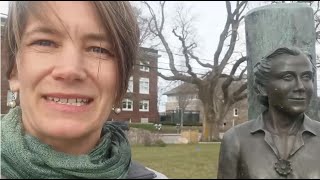
Speakers including Heather Goldstone, Susan Moran, and Chris Neal discuss Rachel Carson's influence on environmental science and policy during a virtual celebration of Earth Day and the first Rachel Carson Day in Falmouth, Massachusetts on April 24, 2020.
Chapters
Hi and happy Earth Day. I'm Heather Goldstone, Chief Communications Officer for Woods Hole Research center, and I'm speaking to you here today from Waterfront park in in the village of Woods Hole here in Falmouth, Massachusetts. And we had planned to have many of us here celebrating. But as a result of the COVID 19 pandemic, it's just me and the spirit of one very special environmental scientist, Rachel Carson, embodied in the statue here beside me. I first encountered Rachel Carson and her work as a 13 year old would be marine biologist. My mom gave me a worn copy of the Sea Around Us and I was instantly hooked. A decade later, as a graduate stud studying the effects of persistent pollutants on wildlife, I connected deeply with the sea around us and with Rachel Carson's personal story. And of course, her gorgeous writing continues for me to be the gold standard, a source of both inspiration and motivation in my work as a science communicator. And so it is with great pleasure that I welcome you to this very special virtual celebration of the 50th Earth Day and the very first Rachel Carson Day here in Falmouth, Massachusetts.
Hi everyone, I'm Susan Moran. I'm here on behalf of the Falmouth Border Selectman to honor the memory of Rachel Carson on earth day, its 50th anniversary, April 22, 2020. Today we celebrate the richness of Falmouth's environment and natural beauty and the numerous efforts of our community and to take care of our town and our Earth, including our initiatives to decrease the nitrogen content of our many ponds and abayments in Falmouth, such as restricting use of plastic bags, Styrofoam and plastic water bottle sales on municipal property, and even adding stretch requirements to our building code. Committing to reuse, renew and recycle Our efforts to to reuse include collaborating with our scientific organizations including Woods Hole Oceanographic Institute, Marine Biological Laboratory, Woods Hole Research center and the Woods Hole Business association and to partner with the town of Falmouth, especially the DPW Water Division, Falmouth Water Stewards to facilitate and install the waterfront park refill Reuse Falmouth Woods Hole Water Station I'm excited to read the proclamation which was approved by the board. Whereas this year is the 50th anniversary of Earth Day and whereas Rachel Carson's book Silent Spring is credited with the launch of the environmental movement provoked the passage of the clean Air Act 1963, the Wilderness Act 1964, the National Environmental Policy Act 1969, the Clean Water act and Endangered Species act, both 1972 and led to the establishment of the Environmental protection agency in 1970 and whereas Rachel Carson studied at MBL in Woods Hole during the summer of 1929 where she had her first significant and subsequent encounters with the sea and whereas Rachel Carson returned to Woods Hole in subsequent years to work at MBL and later at the Fisheries Service, now NOAA and whereas Rachel Carson, the environmentalist and writer wrote numerous magazine articles, essays and government documents and three Sea under the Sea Wind, 1941 the Sea Around Us, 1951 the Edge of the Sea, 1955 her fourth and most environmentally impactful book was Silent Spring 1962 and whereas Falmouth Citizens and Community Organization erected a life size bronze statue of Rachel Carson at Waterfront park in woods hole in 2013. Now therefore, we Megan Inglis Braga, Douglas C. Brown, Douglas H. Jones, Susan L. Moran and Samuel L. Patterson, as Selectman of the Town of Falmouth by authority vested in us, do honor and proclaim Rachel Carson for her significant contributions leading to April 22 being designated as Earth Day. Fifty years ago in Witness Whereof we have hereunto set our hand and caused the Great Sale of the Town of Falmouth to be affixed on April 6, 2020. And I want to take this opportunity to thank all the volunteers that made this possible.
Rachel Carson represents the marriage of the genius of science and the beauty of poetry. She is pure inspiration and through her inspirational words she changed the world.
Rachel Carson was the ultimate problem solver. Her inquisitive intellect and her passion align with her values to understand and protect ecosystems and wildlife.
Rachel Carson made us aware of the dangers of indiscriminate pesticide use and challenged us to become informed and act. Her legacy led to legislation to protect our drinking water, the air we breathe, our coastlines and our protected lands. Personally, Rachel Carson influenced my career to ensure that sound science was used to structure environmental policies that will protect our environment for future generations.
I first read Rachel Carson's biography as part of a sixth grade book project. Little did I know that her love for the environment and fearlessness in the face of injustice would inspire me for years to come. I honestly don't know if I would be in graduate school for oceanography now if I hadn't been exposed to Rachel Carson all those years ago.
Rachel Carson had a tremendous influence on me. When I was younger. I knew I really wanted to do something in science, but I had no idea what type of research to pursue until in high school when I read her book Silent Spring. And that's when I realized I wanted to pursue a career in environmental science. I still have that copy of her book in my office. Yellowed us the pages may be. And it reminds me of Rachel Carson. Her courage, her insights. And on this Earth Day, how much of her work remains to be done.
Rachel Carson was an enormously influential science writer. Who knew that language is music? When you read her 1962 book, Silent Spring, the pages just seem to turn themselves as she lays out very clearly for anyone to understand how the widespread use of pesticides such as DVT was wreaking havoc in the environment, killing wildlife, including songbirds, or leaving them sterile. This book helped to launch the environmental movement of the 1960s, culminating in the creation of the Environmental protection agency in 1970.
Rachel Carson's call to action about the dangers of DDT was heard by many people. The gravestones here could have been metaphors for countless more deaths of birds and other species. Instead, high up in this tree is a pair of bald eagles, bringing yet another new pair of chicks into the world this spring. DDT was banned in the 1970s, but we now know that its effects are still with us. It's in humans, for example. Baby girls that experienced high levels of DDT in the womb decades ago are much more likely to get breast cancer when they reach their 40s and 50s.
I'm Chris Neal, senior scientist at the Woods Hole Research Center. I've lived in Falmouth for more than 30 years, but I grew up on the banks of the Hudson river within sight of New York City. In the spring of 1968, the students in Mrs. Hodgins fifth grade science class were challenged to write a science report. I was captivated by a book published six years earlier and that book was Silent Spring. To say I read it is not accurate. I consumed it. It captured my emerging love for birds, but also my concern, and maybe panic is a better word over what Rachel Carson wrote was happening to them. For me, that did it. It opened up a door to thinking about ecological connections and the idea that these connections could be understood by studying biology. Rachel Carson's personal history intertwined with Woods Hole, where I've spent almost all my scientific life. Rachel Carson was a student here in 1929. She returned to Woods Hole many times, and Woods Hole science was the basis for her 1951 best selling book, the Sea Around Us. But Carson soon then turned attention to her growing interest in the harmful effects of pesticides, which consumed her for the rest of her life. For me, the most important legacy of Rachel Carson was understanding ecology. Creates pathways to fixing the environment. That's what many of us try to do in Woods Hole. There would not be an ecosystem center at the MBL or a Woods Hole Research center here without Rachel Carson, the ecologist. George Woodwell, the founder of both of these institutions. The harmful effects of DDT were one of the compelling issues of our time. George believes science showed us how to fix things. So did Rachel. And so do I.
Hello, this is Alan Robinson. And this is my Rachel Carson moment. Sun spangled morning, a shadow passing across the dock. I look up 50 years ago on the first Earth Day, rowing on the same river. Never could I have imagined a bald eagle above the sparkling Schuylkill waters in Fairmount Park, Philadelphia. Hi, this is Alan Robinson of the Falmouth Water Stewards here with my trusty refillable water bottle. Thanks to Rachel Carson's life work and the work of many many within our community, we are blessed with clean, clear, healthful Falmouth drinking water. The Falmouth Water Stewards, together with our Woods Hole Water Station funding partners, the Marine Biological Laboratory, the Woods Hole Oceanographic Institution, the Woods Hole Business association and the Woods Hole Research center, are pleased to present this water station to the town of Falmouth, our residents, and to visitors around the world. Because of the COVID 19 virus, water unable to take our first drink from the fountain today. But today we can celebrate together in spirit. Rachel Carson Day in falmouth on the 50th anniversary of the first Earth Day. So together, let's make a refillable water bottle. Toast to good health, to Rachel Carson, to our Earth and to life.
Thank.
You, Sam.
More from Tod










WHRC's Sustainable Science Speaker Series - Dr. Toby McGrath speaks on Sustainable Fisheries
