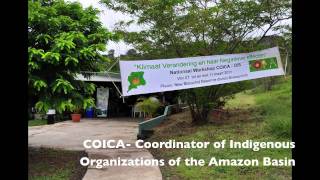
Dr. Alessandro Baccini and Dr. Wayne Walker describe the first satellite maps of carbon stored in tropical forests across multiple countries. They built capacity in indigenous organizations like COICA to measure and map forest carbon, enabling communities to negotiate REDD agreements from a position of knowledge.
Questions this video answers
Coordinator of Indigenous Organizations of the Amazon Basin.
Chapters
Hello, my name is Alessandro Baccini. I'm a scientist at the Wolsell Research center and I'm interested in the use of satellite data for the monitoring of carbon stock in the tropical ecosystems. I'm working with my colleague Dr. Wayne Walker, and together we have been collaborating in a Pantropical project that has the goal of quantifying the biomass in the vegetation. This project gave us the opportunity for the first time to generate a spatially explicit map of carbon stock for tropical countries. This data set is important in order to reduce uncertainties in emissions derived from land cover, land use change. I work with countries that are interested in participating in redd. REDD is a mechanism to reduce emission from deforestation and degradation. In parallel to the mapping activities, we have been working on country capacity building. Country capacity Building has a goal to train in the tools and the techniques that we use here at the center to map carbon stock and to generate the type of information that government NGOs and civil societies are requested to provide at the time in which they want to participate in redd. Hi, my name is Wayne Walker and I'm a scientist here at the Woods Hole Research Center. As part of my work, I'm involved very closely with Alessandro Boccini on the country capacity building that he described as part of our Pantropical mapping project. In South America, where much of our capacity building is based, we've been approached by coica. COICA is an acronym that stands for Coordinator of Indigenous Organizations of the Amazon Basin. Indigenous peoples throughout the tropics, but particularly in the Amazon, are interested in having a greater voice at the table where discussions of RED are concerned. And for them this means first having a better understanding of what climate change is, and then where RED is concerned, having a better understanding of the role of forests in reducing carbon dioxide emissions in the atmosphere. As part of our capacity building activities, we really play two roles. We first of all work with them to better understand the climate change piece and the relationships between climate forests and above ground biomass and carbon stored in those forests. And we also work with them to build technical skills, concentrating on tools and techniques that they can use to actually, on the ground, measure and map the amount of carbon contained in their own forests. During the course of these workshops, and by the time they are complete, we find that our indigenous friends are very much empowered with the information that they've gained and are in a new position, a better position to go forward in their own negotiations, their own discussions of RED and their involvement in it. Looking forward, we are working very closely with partners to help indigenous peoples in select Amazon Basin countries develop and operate their own indigenous projects. In doing so, we are providing current and future indigenous leaders with the technical background they need to make informed decisions about REDD and their forests.