Transcript excerpt from a Woods Hole Research Center presentation describing a field project at Howland, Maine measuring three key greenhouse trace gases (CO2, CH4, N2O) from forest and wetland soils. The team is using new laser instrumentation to make simultaneous, real-time measurements from soil chambers to understand how land/soil management affects emissions and consumption of these gases.
Eric. I'm Eric Davidson, president and director of the Woods Hole Research Center. Currently we are working on a project located in the forest at Howland, Maine.
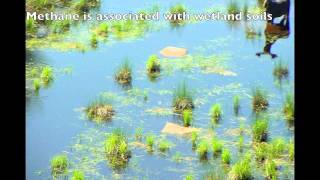
In which we are measuring the three most important trace gases with respect to climate change, what's often called global warming. It's carbon dioxide, methane and nitrous oxide. And they are emitted from soils, including forest soils and wetland soils. And in some cases, the soils can consume these gases too, particularly methane. Recently, we've been able to take advantage of new advances in technology, particularly the development of a laser instrument that allows us to make these measurements now in the field in real time. We're able to take gases that we pull from chambers that we put over the soil and into this instrument, and it simultaneously measures N2O and methane. And then we have another instrument right next to it that gives us CO2, so we get all three of them at once. We are the first scientists to be able to apply this to a field setting, particularly to a forest setting. So of the three most important greenhouse gases that humans are changing, it's easy to try to remember them this way. CO2 is the most abundant. It's mostly coming from fossil fuels, although forests are really important in terms of carbon storage as well. Methane is the second most important gas, and we normally associate its sources with wetlands. Nitrous oxide is third most important, although it is also the most long lived. So in terms of long term impact, it may become more important. It's mostly from agricultural soils, although it also comes from forest soils as well.
The concentration of all three of these gases, carbon dioxide, methane and nitrous oxide, are increasing in the atmosphere, which in turn affects our climate. It's very important that we understand how management of the land, including the management of the soils, affects the sources and the consumption of these greenhouse gases, whether it's in forests or in wetlands or in agricultural land.