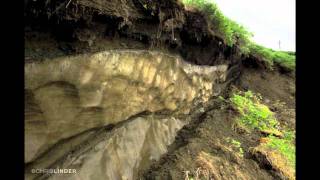
Scott Goetz, a research scientist at the Woods Hole Research Center, describes his work on impacts of climate change on high-latitude (Arctic) ecosystems, with field work in Alaska and northeastern Siberia. He combines satellite imagery and field measurements to study shifts in fire regime, hydrology, and especially permafrost thawing. Experimental manipulations north of the Alaska Range are inducing permafrost thaw; collaborators (Mike Laurenti) use new soil moisture imaging to capture thaw gradients (meters deep, tens of meters across). These data are being linked to surface measurements of CO2 and CH4 fluxes to estimate potential carbon releases from formerly frozen soils and their climatic feedbacks.
Chapters
My name is Scott Goetz. I'm a research scientist at the Woods Hole Research center, and I study the impacts of climate on high latitude ecosystems and the responses of those ecosystems to climate change. Most of our field work is focused in Alaska and also in northeastern Siberia. Arctic ecosystems have experienced some of the most dramatic warming in recent decades, and we study this using satellite imagery, and we also study it using field measurements. Some of the changes that we've noted include changes in the fire regime, the severity or intensity of the fire regime, and also the extent and timing of fire disturbance. And we also study how that impacts the hydrologic cycle. And most recently, we're looking at how that impacts permafrost. Permafrost is particularly important because hundreds of years of carbon have been stored frozen in the soil layer, and with warming combined with fire disturbance, it's mobilizing much of that carbon that's been frozen for hundreds of years. We're taking advantage of experiments mostly in Alaska, north of the Alaska Range, where manipulations are done that induce permafrost thawing. Mike Laurenti is a postdoctoral researcher working with me, and we use new technology to actually image the soil moisture down to several meters depth and across 20 or 30 meters length. He's been able to capture some of the first images of permafrost thaw across a gradient. Related to these manipulation experiments, we will use these data to relate the images of permafrost thaw to measurements taken at the surface of carbon dioxide and methane fluxes and try to get some estimate of how permafrost thar could release carbon to the atmosphere, which has the potential to be an enormous impact on climate change by exacerbating further warming.