George M. Woodwell Celebration of Life
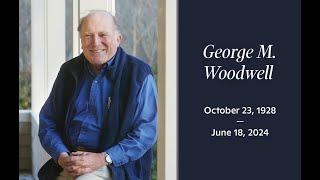
This is a transcript of the "George M. Woodwell Celebration of Life" (YouTube) featuring opening remarks from Max Holmes and extended remembrances from colleagues and family. Speakers highlight George Woodwell's scientific contributions (ecosystem experiments at Brookhaven, DDT research), founding roles in Environmental Defense Fund and NRDC, early testimony on climate risks (1986 Senate hearing), leadership in establishing the Woods Hole/Woodwell Climate Research Center, and advocacy for bringing science into policy. Family speakers emphasize his persistence, optimism, hands-on ingenuity (farm, home projects), and personal stories (longstanding battle with woodchucks, farming, building the center in a church basement). The event closes with thanks and a reception.
Chapters
Sam.
Welcome, everyone. Welcome. Good afternoon. I'm max holmes, president and CEO of woodwell climate research center. Thank you all. Thank you all so much for joining us today for this celebration of. Of George Woodwell's extraordinary life. I'm so deeply humbled by all of you coming. It's just this remarkable collection of people who George has touched for so many years. Thank you for being here. Thank you for braving the traffic. I'd like to welcome George's wife, Catherine, his children, Carolyn, Marjorie, Jane and John, their spouses, his grandchildren, his. His extended family, as well as all of you, George's friends, colleagues and neighbors. On behalf of the Woodwell Climate Board and staff, I want to express what an honor it is for the center to host today's celebration of George's remarkable and impactful life here at the research center. He and many of you built George's scientific career, touched on the biggest environmental issues of the 20th century. He was instrumental in the founding of multiple environmental advocacy organizations that are now household names. And he started and led ecological research programs at several institutions, all before eventually deciding that the work the world needed required a unique and independent organization that blended research and advocacy, not only doing the science, but engaging decision makers to put scientific findings to to use for the benefit of society. The result is this center, founded in 1985 and renamed Woodwell Climate Research center in his honor four years ago. Nearly 40 years later, George's vision continues to guide the work that my colleagues and I do each and every day. I want to give a few, just a couple of examples, and you'll hear many more as the afternoon, but a couple of examples of George's influence and the way that his early vision continues to guide us now. In 1986, George testified in the first major congressional hearing on climate change. One of the ideas he put forth was that warming and thawing of the Arctic could result in the release of greenhouse gases that would worsen climate change. Today, one of our largest projects, Permafrost Pathways, focuses exactly on this issue and is bringing together scientists, indigenous communities and policymakers at all levels to address this critical risk. George also testified that day about the importance of forest in our climate system, and later in 1999, was instrumental in a World Commission on Forest and Sustainable Development report that coined the phrase Forest Capital Index. Today, we are developing a Landscape Capital index that builds on that concept to ensure natural climate solutions are appropriately valued. These sorts of through lines can be found in nearly all our projects, which is a remarkable testament to the breadth and depth of Georgia's scientific leadership. Indeed, Georgia's vision for innovation and sustainability is infused in the very walls of our campus, which he helped design for energy efficiency, connection to nature and each other, and not least, beauty. With George's passing, we have lost a climate science pioneer and visionary. I was incredibly fortunate to have George as a mentor, an advisor and a friend for almost 20 years now. I distinctly remember almost exactly 20 years ago, when I was interviewing for a position as a scientist here, right in that office there, which was. Was George's office. And I knew of George, certainly I knew of his scientific career, the amazing things he had done. I had briefly met him in passing a couple of times, but I can say I was incredibly nervous when I walked into that office for the interview and somehow I made it through. But yeah, it was a privilege to work with George and Kathryn while they still led the institution and certainly still to be here today. And I was reflecting this morning, over the past three years when I've been in the position of the president, how my relationship with George sort of continued to grow. And he would frequently call me with suggestions, with encouragement and a lot of enthusiasm. And I spoke to him not so long before he passed and he just had read something about the work we were doing and he just called to say how fantastic it was and what a good job we were doing. And I, I say that really reflecting. I want our staff to hear that because we are all on a daily basis carrying on this legacy that he began. The world's a better place because George was here. Today you'll hear from George's colleagues and family members who will share with you what George meant to them. Starting us off today will be John Holdren and Phil Duffy, both past presidents of the Center. John.
Thank you, Max. Catherine Woodwell, offspring and grand offspring and friends. I met George in 1969 when I was 25 and he was about 40. His scientific brilliance and his commitment to environmental stewardship excited and energized me then and continued to do so in our interactions and collaborations over the next five decades. But I want to focus my few minutes here today on the extraordinary environmental science and activism George was leading already in those long ago days, even before he founded the ecosystem center at MBL in 1975, before he founded the Woods Hole Research Center a decade later. When I met him at the end of the 60s, he was running ecosystem research at the Brookhaven National Laboratory on Long Island. Two of the projects that he invented and led there turned out to be scientific home runs of a magnitude that few Scientists reach even once in their lifetime. And they, of course, were not. George's last home runs in the first one. He devised a way to subject a fenced off section of the Brookhaven forest to precisely calibrated gamma radiation using a cesium source on a post at the center of the plot. The post could be retracted into a lead lined pipe to allow the investigators to study the effects of the radiation, whose intensity declined exactly in inverse proportion to the square of the distance from the post. The effects on the lichens, the mosses, the ferns, the shrubs and the trees of the forest. It was an absolutely ingenious way to apply a calibrated stress of varying magnitude to an intact ecosystem. It generated insights of enormous importance to ecosystem science in general. And it also provided the first ever quantitative measurements showing how ecosystems would respond to ionizing radiation following a large nuclear reactor accident or explosions of nuclear weapons. George's second scientific home run from his base at the Brookhaven lab was a set of studies of the accumulation of DDT and its residues in the food webs of a Long island estuary. That work showed exactly how these compounds were ending up in the tissues of ospreys and other raptors feeding at the top of those food webs, resulting in thinning their eggshells and threatening them with extinction. That finding was a crucial piece of the science that led to the banning of DDT in the United States. Of course, George himself played a role in that outcome that went beyond his science. A hallmark of his approach to the world through his whole career was that he didn't just want to understand problems, he wanted to contribute to fixing them. He and a handful of colleagues founded EDF, initially Environmental Defense, in 1967, with the initial purpose of getting DDT banned. And they succeeded. They first succeeded in getting it banned in Suffolk county on Long Island. Then they got it banned in the state of New York. And finally, in 1972, EPA banned it nationwide. EDF, of course, went on to become one of the most consequential environmental organizations in the country. George also participated in the founding in 1970 of the Natural Resources Defense Council, which likewise grew to great national influence. And I should say, its longtime head, John Adams, is sitting here in the front row. Its initial focus was opposition to environmentally disruptive electric power projects. The founders of both EDF and NRDC were a mixture of scientists and lawyers. The informal motto of both organizations was sue the bastards. Knowing George as I did, I suspect he had something to do with that. Let me now turn the podium over to another in the line of George's successors of the leadership of the Center. Phil Duffy. Phil.
Thank you.
John, thank you. Max, thank you. Thank you all for joining us today. It's great to see so many of you, so many familiar faces and so many new faces as well. It's wonderful to see this organization which George founded and which we all have loved and nurtured in different ways. It's great to see it growing and thriving so successfully. I spoke a couple days ago to Max and he said the center now has 150 employees. I think when I arrived here in 2015, we were 45. And so that's a lot of growth. And that growth says a lot about the importance and relevance of the mission of the center. It says that that mission is more important today, more urgent today than ever. And George was instrumental in the notion that that science needs to move out of the laboratory and into the policy world. And I'll talk more about that in a moment. What I want to do mostly today is just talk about some of the ideas that George had. Very, very foundational ideas which today are cornerstones of the work we do on global climate policy. And one of those is simply that land use change, and particularly deforestation is a significant contributor to global environmental changes. Now it may seem unremarkable that that should be a new idea, but at the time George first proposed was new. And I just the other day re read a paper by him from 1978, a paper published in the Journal of Science saying, well, we think that the terrestrial biosphere is a net source of carbon to the atmosphere. And of course that idea, again it's a cornerstone of global climate policy today, limiting deforestation. And of course the folks here have been at the forefront of that work for decades. As Max mentioned, George also very early put forth, and he mentioned this in his 1986 Senate testimony, put forth the idea that in a warming planet, the terrestrial biosphere, that is plants and soils, start emitting greenhouse gases to the atmosphere. Now that's a, a bland statement, but it has very profound ramifications for the future of humanity. Because what that says is that there is a possibility of a self reinforcing cycle of warming. Warming leads to greenhouse gases, leads to more warming, and so on, and you're off to the races. And this is what George characterized that as the warming feeds the warming. And that's certainly a scenario that we really want to avoid. And that's why the work that folks here are doing, and Max mentioned the permafrost Pathways project. That's incredibly important work with really major global ramifications. George also believed and preached until the end of his life that reforestation, restoration of forests has to be part of the solution to global climate change. And that's true. And that concept has been broadened to include from forest restoration to restoration of ecosystems, generally, restoration of carbon loss from agricultural soils. And that collection of concepts goes under the name of nature based climate solutions. And nature based climate solutions are an essential part of climate policy, more and more important part of climate policy, because they offer the possibility of removing carbon dioxide, they do remove carbon dioxide from the atmosphere, and therefore they offer the possibility of actually cooling the earth or at least offsetting some of the warming. The final thing I want to say about George, I alluded to earlier, which is not a scientific idea per se. It's the idea that it's okay for scientists to come out of the laboratory. And I'm using the term laboratory figuratively to come out of the laboratory into the policy fray. And it may seem strange that it should be controversial, that the people who understand a problem best should have a role in forming the solutions. But there's a very strong thread in the culture of science that says that somehow the sanctity of science will be contaminated if the scientist talks publicly about the problem and about solutions. And that was very true decades ago. It's less true now, but there's still a very strong element of that in the culture of science. Well, George didn't believe that. As John mentioned and Max mentioned, George founded several organizations, including this one, whose missions were really about bringing science out of the laboratory into the real world where it can do some good. And George was a forceful communicator. He was a good writer, and he was a great speaker. And I remember walking over to an event with him one day where we were both going to speak, and he looked at me and said, now we're not going to be bashful, and guess if he was. And as you know, George did like to be a little bit outrageous. And I'll conclude on this note, George liked to say I'm mad as hell. And that's how I knew George was okay. When I say, george, how are you doing? He would go, I'm mad as hell. And okay, George is. George is all right. But George was mad as hell about continued apathy, continued lack of progress, continued misinformation, continued delayism, and continued obstructionism. And we should be mad as hell, too.
And as.
As we continue our important work, as we honor Georgia's legacy, let's be mad as hell and let's not be bashful. Thank you.
Thank you, John. Thank you, Phil, for those inspiring comments. We're next going to hear from some members of George's family and friends who will share their remembrances. And I think we're starting with John.
Thank you.
I'm John Woodwell. I am George's son. Much of what people have heard dad say is the recent message. The message about Paul. What we have to do, we have to refreeze the Arctic. We have to cut down on the release of fossil fuels, the use of fossil fuels. We have to balance the carbon budget. But much of what dad has done is research. As a scientist, that is mostly what he has done. And as a scientist, he answered or addressed the biggest of questions. His question was, how does the world work?
And.
And he answered that question. He pursued answers to that question throughout his entire life. And the answer that he came up with is that we have to preserve ecosystems intact in all of their details. All of their details. And he pushed back against all offenses. As a freshman at Carleton, I got a letter from dad. It was written in pencil on a yellow pad as he traveled to New York on a train. And he said, dear John, you may be interested in a conference I am chairing. Even a limited nuclear exchange would kick enough dust and soot up into the atmosphere to block out the light of the sun for weeks to months, leaving the Earth substantially uninhabitable. This is not acceptable. At the time, the Reagan administration opposed a nuclear test ban treaty, and that also was not acceptable. He and John Adams talked, and they said, well, we need a nuclear test ban verification team. And they put it together, and they showed that the nrdc, the Natural Resources Defense Council, could detect any nuclear explosion anywhere in the world. You have to push. How many times have I heard that from dad? You have to push. You have to push your way through, John. You've got to finish that dissertation. Let's talk about it. You got to push your way through. Just push your way through. If you're a big boy now. Push your way, way through. Okay. Thank you, dad. Dad's deepest, longest lasting struggle was personal. On a much more personal level, much smaller than these global issues. He sought to grow vegetables on the family farm in Maine and to harvest them himself. And he had a lifelong struggle with a dynastic population of woodchucks over who had the right to harvest these vegetables. He would plant potatoes, 50 pounds of Green Mountain seed potatoes, and the woodchuck would harvest most of them. And he would harvest 27 pounds of green green Mountain potatoes. And he thought that was a great success because he loved those Green Mountain potatoes. He didn't accept the loss, though. He fought back. He fought, he fought, he fought for years against these woodchucks. Among the many innovations was to take a tube from a vacuum cleaner and stick it on the end of the exhaust pipe of the corner and stuff the other end down into the burrow. Run that par. But no, dad, here's the thing. You and your colleagues, you pushed for the Clean Air Act. The Clean Air act made it impossible to asphyxiate a woodchuck with a car. You have shot yourself in the foot. So this went on for more decades. And dad had a backhoe. He finally had a backhoe. And he dug a trench, a deep trench around this garden. And he planted a woodchuck proof fence. So deep, so tall and so strong that no woodchuck could dig under it, climb over it, or chew through it. And he left triumphant. He left. Two weeks later, he returned and the bottom of that fence was pushed out, sort of bowed out, and the garden was denuded of all vegetation. He had fenced the woodchuck into the garden. Push on, push on, push on. Late in life, doctors checked all of his functions, all that he could do. And they showed him a series of sketches on these cards and said, what is this? That is a child. It's a house. It is a tree. How about this thing? They showed him a sketch of a beaver. Dad didn't see a beaver. Dad saw a fat rodent with big frog front teeth. And he said to the doctor, he said, that's a goddamn woodchuck. Thank you so much for coming. Thank you so much for your support of the Woods Hole Research center of.
All of Dad's activities.
Push on.
Wow.
Okay. I am carolyn wavell. I am carolyn, widow. Hi. I must have pushed. That says push. I'm Carolyn Woodwell. I'm George's daughter. So at the core of almost everything my father said in his professional life and in his personal life, because those two were indistinguishable, it was kind of bleak, end of the world stuff. And yet he insisted in a line he used over and over that there was no alternative to optimism. And I spent a lot of time in my life trying to convince my father that for those of us who took him seriously, despair was a reasonable alternative to optimism. He never agreed. And I finally realized it's because he was a person who never gave up. And that's one of the gifts he gave us, in our family, an understanding of how it feels to be someone who doesn't give up. When I was about 12, my father led our family in an eco guerrilla campaign at a tree. It was a tall locust tree on public land at the corner of South Country Road and Beaver Dam Road, across the street from the little church where we went as children in Brookhaven, New York. As trees go, it was not spectacular. Locusts are abundant and hardy. They thrive in impoverished soil, and they grow everywhere. But they're trees living, growing trees through photosynthesis. They're responsible for all life on earth. The campaign began when a company bought the farm field next to the town's high school for housing development. Mill Run is what they called it, not because there was a river or mill anywhere near it, but because it sounded historic and pastoral. It sounded like a name that would sell houses in the dry dirt of a flat Long island farm field. Long before a shovel hit the ground, the developers claimed our tree. They nailed up a neon green wooden sign. Mill Run. It screamed with an arrow pointing left. They wanted drivers out for an afternoon on South Country Road to turn at the next intersection and take a look at the farm fields. Imagine a brand new home right there next to the high school. Indeed, it would take some imagination to ignore the rotting cabbage and envision a modest ranch house, a paved driveway, a mailbox, a swing set. My father hated to see the farm fields of Long island fall to sprawling subdivisions. But it was the sign that really offended him in every way. Its garish color, the fact that it was up before the houses were built, and mostly that they nailed it to a tree. A tree. The giver of life. It was a crucifixion of all that he held sacred. So he enlisted his tribe, his four children. Every time we passed that tree, we jumped up and knocked the sign off, broke it in two and left it on the ground. Every sign. If we biked by, we stopped, leaned our bikes against the tree and knocked the sign off. If we walked by, we veered over and swatted the sign to the ground. If we drove by, my mother would pull over and one of us would hop out and pop the sign off the tree, crack it over a leg, leave it in a heap on the ground and hop back in the car. The company had many signs, and every time they lost one, they put up a new one. But we were relentless. They left a note asking us to stop. We didn't. They increased the size of their hardware. We got a hammer. They put it higher and Higher. We took a ladder. It gave us an exhilarating sense of freedom and effectiveness. We were under their skin, festering in their lives like a nail in a tree. We knew we weren't going to win this war. The company broke ground as we were in pitched battle on the corner. But we were doing something. We were saying something. We were united as a family, defending a tree, defending public property, standing up for life on earth. Soon, the bulldozers and well drilling rigs, the graders and asphalt layers arrived and transformed the land. Within minutes, the houses went up, every one of them alike, with an attached garage on the side and small tree in the front. It took no time at all for mill run to take shape, for the houses to be sold or fight for that tree to be over. They no longer needed the sign. But thank you, dad. Thank you for the joy of the fight. Thank you for turning neon green into a lifelong adrenaline rush. Thank you for seeing your hammer and ladder as tools for planetary justice. Thank you for understanding that a lowly locust tree is part of our community. And we don't give up on our community. We snapped those signs in two. We stood up for that tree. We saw that fight to the end. We did not give up. Thank you.
So I'm Marjorie Woodwell, and I was going to read a piece that my Aunt Virginia, who lives in Maine, had written.
And.
I can't do it. And so I've asked my sister Carolyn to read it for me. And I do want to tell you one thing about dad and that woodchuck. So, dad, my husband Woody and I were going up to the farm all of the time. And as John said, dad loves Green Mountain potatoes. Well, last year, Woody, dad and I planted a whole bunch of Green Mountain potatoes in order to be able to eat them just as regular potatoes and make a bunch of them into mashed potatoes, which both mom and dad love. Well, come to find out that when we harvested those potatoes with dad, we got 350 pounds of green mountain potatoes, more than we could possibly eat. And we wondered, what's going on with that woodchuck? Well, one day when Woody and I were driving up to the farm on our own and went up the lane, we saw something that looked just like a mink. It turned out it was a fisher cat. And we had never seen that before. And that fisher cat at some point had had a really good meal of that woodchuck. And I went home and I told dad what had happened to that woodchuck. And it was a good couple, a good. I Don't know how long. But anyway, a new woodchuck is now up there and we are battling the woodchuck, but with kindness. And Carolyn, thank you so much for.
Reading that for me.
This was written by George's sister Virginia, who lives in Maine, and she asked us to read it, asked Marjorie to read it. When Marjorie told me that I would have. Her name's Virginia, Virginia Woodwell. When Marjorie told me that I would have only five minutes to speak, I was appalled. What? Cram all that? That extraordinary big brother. That kindly, generous, farsighted big brother whose very walk and handwriting I tried to copy. That big brother who was often like a third parent with exasperating highs, exasperatingly high standards. That big brother who helped assemble my very first bicycle on the back porch when I was nine and he was 17. That big brother who would go on to show us all how we should reassemble ourselves to save the planet. That big brother whom I've known for 87 years. Cram all that into five minutes, but I'll have a go at it. Not long ago, I was reminiscing with George about our lives on the farm in York, Maine, a spread of rolling woods, marsh and field where we spent many of our summers. The times we got the car stuck in the mud in the lane, sometimes after dark and sometimes in the rain. And always after that long trip up from Boston. Times where I watched George and our father improvise a pry bar made out of a tree to leverage the car up enough to continue on up the little hill. When George was no more than 12, working hand in glove with our father to turn trees felled by the 1938 hurricane into the little 12 by 20 dwelling we still call the shack. When George, at 15, all alone, turned bricks from the burned out cellar hole nearby into the shack's chimney. Evenings at milking time, George and Father and I would often walk to the working dairy farm on the other side of the valley. Our father would talk with the farmer while George and I quietly absorbed all the intriguing details of the milking process. When we got home, our mother laughingly dubbed us Big Barn Smell and Little barn smell. On August 15, 1945, mother rushed out of the shack, flapping her apron, tears streaming down her face. The war is over, she was crying. The war is over. She knew, because she'd been listening to that most primitive of radios, a crystal set. And guess who built it? George at 17. These images conjure up some of the young George, but not all of him. George was Not a frolicker. Rather, George's fun was tied to accomplishments. And those apart from science were all over the map. From fixing his cars. I once watched him fix his car suspension with a piece of wood before he drove it from York back to its hole. To buying a giant sawmill in Delaware and hauling it back to York, then using the lumber he'd made to build a roof over it. I think that compulsion to do came from his father, with whom he developed a tight bond. The two began going to the farm together every summer and most weekends from the time I first remember him until he went off to college. And when that happened, our father cried. Clearly, what the farm would deliver to George was an immersion in the natural world. The experience of living reduced to basics in a place where ingenuity, skill and resourcefulness were invaluable. After a summer at the farm, all the produce we'd grown would go back with us to West Roxbury. Giant blue hubbard Squash and 50 pound burlap bags bulging with potatoes in the World War II Days of Victory Gardens. We were happy and proud standouts. Not that our father ever braggartly or boastful, was braggartly or boastful in the slightest. George absorbed that trait from all those days of close contact with his father. How do you happen to be going to Sweden? I once asked George. Oh, he responded, Volvo wants to give me an award. And that was it. No more. He went to Sweden, he got an award. He came back to grow more squash, fix more equipment, ask more questions, use his powerful mind to think about anything that could be figured out and made to work. A model, a Ford, a boat, an old sawmill, a forest, the earth. Thanks.
My name is Ski Houghton. I was going to say that I'm up here because I worked longer with George than anybody else, but there's some guys in the front row here who have at least as much experience working with George. But we began about the same time. I started working in 1966 in the biology department at Brookhaven National Laboratory. And I am both privileged and honored and fortunate to have known and worked with George since then. Pretty much my whole life and career were intertwined with his, starting then in 1966. And that was 58 years ago. George once told me that he hired me three times. And another time he said that he had never. That I had never had to look for a job. Both of those were correct. All of which confirms a long and productive association and friendship for which I am most grateful. And that is a gross understatement, because I was a year out of college. It's impossible to say what I would have been, what I would have done, what I would have accomplished had George not hired me. So it made all the difference. He contributed enormously to who I am. George was a remarkable man. Looking back, two things in particular stand out for me. One, he was a man on a mission. He was on a mission. Two, he had a genuine interest in others, in everyone around him. He was always thinking, always doing, writing, promoting, advocating, questioning. He was always engaged. He was on a mission. When I last spoke to him, about a month before, he was seeking ideas for and mulling over what to do with that family farm in Maine. Another great ecologist, Charles Darwin, once wrote, a man who dares to waste one hour of his time has not discovered the value of life. From which I conclude that George and Charles shared much in common. You all know at least some of George's many accomplishments, and I won't mention those here, but instead draw attention to another of George's hallmarks, his genuine interest in others, whether it be families or complete strangers. And when I say he was always engaged, that includes engagement with everyone in his sphere. Colleagues, staff, family, whomever he was talking with. I have no idea how Charles Darwin fared as a family man, but I know George, proud parent that he was, was, was always ready to share news about his children, grandchildren, and to hear the news from. From you and me. I'll miss him, but I'll never forget him, or the stories and memories of working with him through all sorts of endeavors, events and times. I'll end by just sharing a few things that George said, because they were so definitely George. And one of them we've already heard from Phil. If you've talked with George anytime over the last 20 years or so, you may recall how the conversation likely began. I'm mad as hell. And he also made a couple of little asides that were largely to himself, but that I noted. The first was sometime in the 1980s. I don't remember the occasion, but he said, life is impossible. And this was not an admission of defeat. On the contrary, it reflected George's good humor, his exasperation, and most of all, his commitment to get back to what needed to be done. He never gave up the battle for what he believed was right. More recently, in August 4, 2021, he said, I retired too early. He was 92 at the time. He wasn't disappointed with the center's director. Quite the contrary. Instead, George was expressing his frustration in not having a fulcrum Powerful enough to move the whole world. George was on a mission. A humanitarian mission. Thank you George, for everything. May you rest in peace.
I'm Alison White and I'm so honored to see all of you and to having been asked by the Woodwell family to speak about George, soon after I began working at the center. From our offices in the basement of Fisher House in Woods Hole, I was summoned to the inner sanctum of George's office to file his papers. Enormous stacks of papers that left little room for him to work. His filing system was not apparent and I just hoped my arrangement was suitable. Nonetheless, George never wavered from his perfectly organized, clear vision of establishing an institution for the study of terrestrial ecosystems and processes for a world that works. The inventor of post IT notes must have had Catherine in mind, for that is how she filed important things. Yellow Post IT notes decorated her space and boy was she organized. Our transition from four locations in Woods Hole to 149 Woods Hole Road was an exercise in pitch perfect planning. The complicated move of staff and packing boxes to the new building was accomplished without a hitch due to her smooth as silk orchestration. A filing technique matters little when a genius is called, constantly producing scientific papers, op eds, letters to friends, colleagues, politicians and perhaps outlines for speeches. Although George always spoke without notes, one of my favorite of his speeches was given at the Monadnock Summer Lyceum, I believe at the behest of Nerilus Montgomery. Because that talk was recorded, I decided to transcribe it and to this day I think of it as one of George's seminal talks. We have to turn our view of the world away from the explosive, from the exploitive view in which every resource is open ended exploitation, exploitation by whoever wishes to do it. It's an astonishing series of assumptions. We can dump anything, any waste of industry into the atmosphere and assume that it will be accommodated. That assumption is clearly not sustainable. It cannot be made to work in this world or any other. So turning this matter up to upside down, we have to take a view of the life of the earth as the central resource that has to be preserved to make and keep political and economic systems that work. The new view says that the life of the earth is the whole objective of government. We have to ask ourselves what is government for? The answer comes back that government exists to protect human interests. George had ways of pronouncing his frustration with government. After some pretty awful news he might land in my office and tell me that it was astonishing, appalling, outrageous. The worst thing he would say about certain Politicians, to me anyway, was those thugs. He was a fine and prolific writer, often reminding us that the earth is finite. And he paid attention to Catherine's opinion. More than once I heard her exclaim, george, you can't say that. I longed to note to what she was referring. But that was in any case classic George and Catherine, whose intellect, enthusiasm, hard work, mutual respect plus a healthy dash of humor became the mighty pillars of the center. George's prose was elegant and irresistible. In his last book, A World to Live in, whose original title was Common Sense, he wrote this. The 70 or more years that have passed since the dawn of the nuclear age have brought greater changes to the earth than any similar period in all of human history. The most fundamental involve intrusions into the ecology of the the globe, the biosphere, whose life giving envelope of light and air and climate has been changed irreparably in a century long storm of industrial development. A wink in the half billion years of biotic evolution, the changes have been legion. They have touched the lives of all, crushed some and empowered others. For an ecologist with an interest in the human condition, ever seeking paths to a stable and equitable future in a world of 7 billion humans, the trip has been both fascinating and frightening. What George accomplished in life is what he was meant to do. The greatest testament to his work is right in front of us with this extraordinary campus and its majestic turbine. The place that carries forth his vision for a world that works. Thank you, John. I will always love the center, whose essence stems from George and Catherine. It will go on to thrive because of them and because of the leadership and the staff who continue to strive for the health of this fragile planet. George informed the second half of my life in ways I could not have imagined. I will forever pinch myself for my amazing good fortune to have spent so much time in his midst. He was at once distinguished, genuine, fair minded, mighty and modest. Thank you, George.
Hi everyone, my name is Dan Webb. I'm a friend of the Woodwell family. They had to search far and wide to find a few speakers who were not renowned scientists. I was happy to be able to fill that role here today. I came to know the Woodwell family in the late 70s and early 80s when I went to high school with John and Jane Woodwell. And I got to know George more towards the end of his life in the last 20 or 25 years. And as Phil mentioned earlier, most of you know that when you asked George how he was doing, he would always reply, well, I'm mad as hell. And we all found that amusing and endearing. But that greeting, it really revealed a lot about George. He was forthright. He meant what he said. His greeting was a call to action embedded in ordinary day to day conversation. But of course, it always, it came across as amiable. It was never offensive because of the friendly tone of his voice and the slight smile he always had when he said it. He was irrepressible. Back in 2018, I drove George and several others to a court hearing in Boston. And it was a rainy day. Traffic was very heavy. About four different people in the car were all running different apps that were all giving different directions. I was at the wheel. We found the courthouse and found a courtroom and sat there for several hours with no real outcome. And then we got back to the car and drove back to the Cape in heavy rain and heavy traffic. And when I dropped George off at his house, he turned to me and he said, dan, that was a really great trip. I thought that really illustrated his attitude. And you've heard quite a few references today to the family farm in southern Maine. One of George's attributes was really unusual energy and stamina. Until the age of 91, he would drive two and a half hours from Woods Hole to that farm in southern Maine, work there all day long, and then drive back to Woods Hole the same day. I think at age 20, I would have found that to be a pretty rough day. Seriously, I don't know how he did it. George wrote six books and countless science papers. He had a remarkable writing style. It was meaty and academic, every sentence just packed full of information and meaning. But he also had an unusual, almost poetic, old world writing style. Here's just a little example from his book, the Nature of a House, which describes the rebuilding of this very property. He's describing a vent pipe for a chemical fume hood, Quote, a miniature rocket in appearance, firing unknown chemicals into an unsuspecting and helpless biosphere. I ask you, who else could put so much thought and so much eloquence into a description of one exhaust pipe? Really? And George's efforts were not just in the science lab or in hearings or in boardrooms. His personal life fully embodied his beliefs. For instance, in 1984, he built an enormous A frame in the backyard of his home in Woods Hole. It was an elaborate solar collector to generate hot water and heating for his home. None of us had ever seen anything like it. And today, 40 years later, that system is still working. It's still displacing carbon emissions. Not many backyard projects are still running. Four decades later. Academic and scientific excellence are always rare and precious. We are fortunate in this community to have more than our share of those skills. But what you don't often see is that scientific excellence intertwined with tenacity and energy and determination and the wherewithal to make a tangible difference in our society and in our world. And that's really what George brought to the table his entire life. In closing, I'd like to read you one more sentence from the preface to that same book quote not muddling through, but actively reaching for a big step into the new world we have to envision and build. I think those 20 words should be an ongoing inspiration to all of us and a call to action from George himself. Thank you very much.
Thanks to all the speakers who did a remarkable job of capturing the essence of this remarkable person. As we near the end of the formal part of the program today, I want to read the combined remarks of Foster Brown, one of the earliest hires, maybe the first hire at the center. He lives in Brazil and couldn't be here today. And George's daughter Jane. And I want to thank Alison White for helping to compile these remarks, foster recently wrote in a tribute to George. During the late 1980s, I watched as the center grew from one employee to become a referenced institution for global change research and policy. At the time he was hired in 1985, writes Foster, the entire Woodwell family was cleaning and painting the offices and workspaces for the center in the basement of the Fisher House, across the street from the Church of the Messiah in Woods Hole. Foster writes that George in some ways was a simmering volcano of emotion covered with a crust of New England stoicism. Catherine would help him navigate the course, acting effectively as George's better angel. They formed a team that managed to significantly, significantly changed the course of discussion about climate change. What time and my experience with George and his family have given me is the perspective on how important it is to dream and to work to make those dreams a reality, even when you are cleaning a dusty office in a church basement. On the occasion of her father's 90th birthday, Jane Woodwell, who played an important role in the nascent center in a tribute to both her parents, wrote of his first few hours and days. The first summer of 1985, I wondered and worried if the center would happen. Would my father be able to raise the money for a new institute? More importantly, would my parents be able to continue to help me pay for college? Will this be okay? I asked my mom. Will dad do it? She responded he will do it, Jane. If anyone can do it, he can do it. And while he was a powerful force that moved the center to a success, my father could not have done it without my mom. Dad started the center in the basement of our home, wrote Jane. I was at home from college, and I typed his letters. As the summer passed, it became clear that dad would need help. When I went back to college, there was one obvious person right in front of us, a Phi Beta Kappa botany major from Reed College who then studied at Duke University. She would be the perfect match, but all summer long she demurred. Dad would not push, but would wonder aloud if he should put an ad in the paper. Once I heard a comment from mom about how marriages can fall apart when people work together together under stressful circumstances. The summer passed, and my father and I waited and hoped. The day before I was to leave for college, I decided to break the silence. Mom, are you coming down to the basement? I guess so, she said, walking down those 12 steps to my father. And I waited and hoped. The day before I was to leave for college, I decided to break the silence. Mom, are you coming down to the basement? I guess so, she said, walking down those 12 steps as though we were crossing the Atlantic into a new world. Mom had never used a computer before and had never seen a floppy disk or a dot matrix printer, she learned that afternoon. By dinner time, she was clicking away at the keys full speed. She never looked back. Kathryn was right to believe in him. George could do it. But not without Kathryn. Her intelligence, wit and forethought made its mark in every part of the center's development. And as Jane wrote on George's 90th birthday, and we all resoundingly declare today, thank you, Kathryn.
It.
Thank you all for joining today in this celebration of George's life. I invite you all to remain for the reception, which will go. I don't know what time it is now, but the buses will run, I think, as long as we need them to run to get you back to your car. So thank you for being here. Thank you for being a part of this celebration. Thank you for being a part of the life of this center. And thank you for sharing all of your feelings, your thoughts, your experiences in celebration of this remarkable person and this remarkable life.
More from Tod










WHRC's Sustainable Science Speaker Series - Dr. Toby McGrath speaks on Sustainable Fisheries
