Human Prosperity within Planetary Boundaries
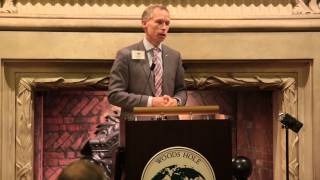
Johan Rockström presents the planetary boundaries framework, arguing humanity has pushed Earth toward tipping points. He identifies climate, biodiversity, and nutrient cycles as in danger zones, cites 450 ppm CO2eq as a risky threshold, and calls for rapid decarbonization and sustainable food systems.
Questions this video answers
December 3, 2014 — Huntington Prize event at the Woods Hole Research Center (uploaded to YouTube).
Nine processes (original planetary boundaries framework, published 2009 in Nature).
About 450 ppm (CO2-equivalent gases) cited as commonly seen as the maximum to avoid average warming above 2°C.
Approximately 1.6% (he translated IPCC-style analysis to a 1.6% probability of 6°C at 450 ppm).
Reported percentages stating trust/concern about climate science: China ~92%, India ~90%, South Africa ~90%, Brazil ~90%, United States ~66%.
Chapters
Welcome, everybody. I'm Will Merck. I'm the Chairman of the Board of Woods Hole Research Center. And on behalf of our board of directors, thank you for coming Tonight to the 2014 Huntington Prize. Tonight you will hear from one of the world's foremost thinkers on global environmental issues. And not just a thinker. Our guest is also an excellent communicator. His TED talk on planetary boundaries has been viewed over 600,000 times. And that's not including the Swedish version. Are we going to get the English version or the Swedish version tonight? Okay, but before we get to Dr. Rockstrom, I want to take a few minutes to introduce the Center's newly hired President and Executive Director, Phil Duffy. He's not even on the payroll yet, so we can't get a major speech out of him, but you should know who he is because you will see him and hear from him in the future. So, Phil, come on up and let the folks see it there. Phil. Phil is a Harvard grad with a PhD in Applied Physics from Stanford. He spent many years at Lawrence Livermore National Lab and has been in the nonprofit world before at Climate Central and in the government world, most recently at the White House Office of Science and Technology Policy. The most recent position there was as Senior Advisor to U.S. global Change Research Program. Phil is exactly the right guy to take the reins at Woods Hole Research center as we increase our attention on high level policy matters. So welcome, Phil.
We are glad you're here.
I've been told to limit my remarks to three sentences, so I have to choose my words carefully. It reminds me of. I'm a big Abraham Lincoln fan and it reminds me of an Abraham Lincoln story. He was, as you know, he could be rather taciturn, but was called upon frequently to speak. And I remember reading one of his speeches that consisted of one sentence. I have to say, it was a bit of a run on sentence, but he managed to do a whole speech in one sentence. Anyway, I'm thrilled to be here. I'm thrilled to have the opportunity to be associated with a place that's as excellent as the Woods Hole Research Center. I'm, as Will mentioned, I'm not on the staff yet. I'm spinning up, I'm engaging. I'm really pleased to see folks there developing some, I think, very exciting, very ambitious new ideas which I hope you all will be hearing more about in the coming weeks and months. So thank you. Thanks, Walt.
So now it is my honor to introduce a stalwart friend of the Woods Hole Research Center. He is our vice Chairman of the Board. He is a Senior Fellow at the United nations foundation and a professor at George Mason University. Tom Lovejoy.
So I have the great pleasure and delight to introduce our honoree, Johann Rockstrom. And as I said to him at lunch, I think people are more interested in hearing what you're going to say than having a long introduction from me. But let me just say a few words. Johan is a professor in water systems and global Sustainability at Stockholm University. He's the current leader of the Stockholm Resilience center and former executive director of the Stockholm Environment Institute. The important thing to say about Johan is as we look at this Gordian knot of global challenges, of course, climate change and distortions and the use of nitrogen and the complicated ways in which all the global challenges environmentally interact, it's very easy to get sucked into the.
Detail.
And miss the important big picture. Johan gets that big picture without being superficial about the details. And what he has proposed in terms of planetary boundaries, I think is the framework in which all of humanity needs to look at the great environmental challenges that we face. And basically it's defining the conditions under which civilization arose and the boundaries of those conditions which we are violating to our detriment. So it's one thing to define the problems in a big way, it's another thing to make a lot of difference that how they are understood and how they are converted into action for a better future. And Johan has done that too, as the chief designer of what is known as Future Earth, the Integrated Global Science Program, looking at all this in all its dimensions, which has never existed before. And he is the chair of the board of Future Earth, which should make us all feel a lot better about the future. In addition to that, he is just a wonderful human being. You know, I had Johan and his entire family in my camp in the middle of the Amazon, all of us sleeping in hammocks and figures out who snored, who doesn't snore. And that's where you really understand what a human being is really like. So I have to tell you, you are going to have a treat as Larry comes up, gives the award to Johan. And Johan explains a bit about the challenges we face and the way forward. Johan.
Well, I want to assure you that Dr. Rockstrom, okay, he's a sailor. Anybody who's a sailor, obviously is at home in this world. And when you hear him talk about his science, it's very clear he's in home. He's at home in that world as well. And I would just like, in presenting you with this award. And I think there's a trinket in there which I'll hold up for Everybody to see.
Dr.
Rostrum, the Huntington Prize recognizes leaders who have who inspire and promote research and communication on climate, earth sciences and conservation. And it's my pleasure to present this plaque and this memento to you and thank you for coming.
I have to have a look at it. Beautiful. Thank you so much. Tom, Will, Larry, everyone. It's an enormous honor for me and on behalf of all my colleagues at the Stock Museum center to have this honor to be bestowed such a fantastic tribute to the science that we're leading from such a prestigious research center as the Woods Hole Research Centre. True, I'm a sailor and I'll have difficulties in concentrating just because of awesome environment around this room. But what I'll try to do over the next 20 minutes is to give you the scientific story, inspired from this room of why we now must, as humanity learn how to navigate troubled waters in a truly turbulent world. And I will have to do that by starting by diving deep underwater in terms of diagnostics of the risks. But believe me, I'll take you up to the surface and hopefully be able to show that recognizing that we are the first generation to know that we're facing unprecedented global risks is actually a privilege. A privilege that we can use to our benefit to navigate a transformation towards a sustainable future. And the evidence that starts off the diagnostic part are three elements of evidence that we've actually only in our hands over the past 10 years. The first one is the empirical evidence. And I would argue it's the most important message from science to humanity that we have entered a whole new geological epoch. We 7 billion people multiplied by our industrial metabolism, have become a quasi geological force of change. We are now our own geological era. Anthros for humans, we've entered the Anthropocene. This means that we are in the driving seat. We're actually today starting to hit the ceiling of the ecological capacity of planet Earth to support humanity. This is the pressure on the planet and it comes from empirical observations of, of exponential rise. And you can pick any parameter that matters for our own human well being. It looks the same. We've all learned to know the hockey stick of carbon dioxide in the atmosphere. But I promise you, you look at biodiversity loss, deforestation, ocean acidification, eutrophication, depletion of stratospheric ozone layer, air pollution, it looks the same up until the mid-1950s. We have very limited impacts on the planet as a whole. But at that point, 10 years after the Second World War, we're 3 billion people. And we enter what science today has baptized the moment of the great acceleration of the human enterprise. We simply put in our high gear and off we go into an exponential rise of pressures. And we end up in a situation where we are today empirically showing that we've entered a whole new geological era. The second piece of evidence is that the pressure is only one side of the coin. The big question is, of course, how does the Earth system respond to being punched upon by humanity? And what we're learning, which is very dramatic, is that nature is not at all behaving as we thought she should. We have built our economy, we build our governance systems, we build our societies on the assumption that nature is this stable, incredibly strong system that forever changes linearly, incrementally, and therefore in a controllable and predictable way. The Universal Truth, after 30 years of empirical research on resilience, is the contrary. The universal rule is that nature, over very long persistence of time, can withstand punches. It has resilience, but you erode that resilience to a point and then through a little trigger, such as a disease or a drought or flood, the system can cross a tipping point and change state very abruptly. And we learn more and more that this can occur with rainforests abruptly tipping over to savannas, lakes that can go from clear water productive system with high biodiversity into murky, dead, stable zones which are very undesired. And we learn that this is occurring across ecosystems in the entire world. And the third piece of evidence is the fact that we are facing an enormous new social momentum, that the hockey stick patterns of change have been caused by the rich minority in the world. In fact, the 1.5 billion or so today, that's 10, stepped onto the Industrial Revolution in the mid-1970s. 17th, 18th century. Today we start the enormous journey of a world that is predicted to have 4, 5, 6 billion middle class citizens just in 36 years. And this is starting right now. And this is an enormously positive journey because it means that we for the first time actually have world leaders saying that we will eradicate poverty in the world, because we are today seeing the opportunity of doing so. So this is the hyperconnected, new turbulent world we're facing with pressures, tipping points and a social momentum. Now, how has Earth responded to this new situation? Well, up until very recently, and I will argue that the year can actually be put very precisely, up until roughly 1990, the Earth system was very forgiving. In fact, the Earth system was Basically buffering the pressures we were putting on the system. But from 1990 onwards, we can start seeing the reverse of that trend. To put it simple, the Earth system is starting to send invoices back to the economy. And this is a completely new situation. And what are the evidence that this is happening? Well, one piece of very, very intricately important evidence to recognize is the Arab Spring. So we all learn to know and recognize the rising of an educated, socially connected generation that was triggered to act under decades of oppression in a whole series of countries in North Africa. But recent evidence shows that exactly the same time phosphorus prices rose by 350%. And President Putin in Russia and Prime Minister Rudd in Australia shut their export borders of food because of unprecedented forest fires in Russia and 12 years of drought in Australia. And together this created a volatility on the world food market that created riots, food riots in all the capitals across North Africa, particular particularly in Cairo, which occurred simultaneously with the Arab Spring. And of course, this is a very debated issue, but it could be the first example of a social ecological collision occurring at the regional scale, destabilizing whole societies. The first time the ecology is sending invoices back, destabilizing economies. Another is very close to this building, namely when Hurricane Sandy suddenly veers right into Manhattan, putting even Wall street three meters underwater, reminding us that the financial system is coupled to the environmental system. Now, science shows, as you're well aware, that this was a total surprise, that these kind of extreme weather systems normally follow the east coast and veer out into the Atlantic. It's very difficult to explain Hurricane Sandy without factoring that the Arctic vortex collapsed a few years before, which is the system that holds cold air up in the Arctic, which pushed down the jet stream and suddenly causing this unprecedented veering in of an extreme event, which is the largest invoice of the city of New York in modern time. So this is the Earth system sending invoices back in the Anthropocene. Now we are facing therefore, new global risks. And I'll just run through a few of the latest scientific observations which we now need to take into consideration. You may have seen in May for the first time, something which I would argue is the scientific nightmare. We've always thought that the Arctic is the weaker of the two poles and that Antarctica is the more resilient. So to everyone's surprise, two independent teams showed on observation in, in May this year that most likely a series of glaciers in the West Antarctic ice sheet have crossed the tipping point, leading to irreversible Melting of a number of glaciers which correspond to committing humanity with a high likelihood to another 1 meter sea level rise. And that is added to the 1 meter sea level rise estimated by the United Nations Intergovernmental Panel on Climate Change, which would actually commit us to two meters this century. And this is the drama because the Arctic and Antarctica has not been factored into the climate models as risking to cross tipping points that could lead to irreversible melting. What's happening in Antarctica is that the ocean is warming up so fast that it's releasing the ice plugs that keep the glaciers intact on rock and they're sliding irreversible back into the ocean. Same kind of evidence is starting to be seen on the big rainforest systems in the world where deforestation combined with climate change could lead to abrupt shifts into savannas. And why could this happen? Well, the key is that you have feedbacks changing directions. And this might sound technical, but it's really important to recognize. So the ecosystems we've learned to depend on and, and that we learn to love have feedbacks that keep them stable. So rainforest for example, self generate roughly 80% of its rainfall. This is the negative feedback of a current intact green canopy that keeps humidity in the system. But unfortunately when we cut down the forest, that feedback can change direction into a self drying system which locks it into a savannah. So we must learn to understand these kind of risks. And now I'll give you a bit of a shocking translation of what that means in real hard risk language. So we know that this year is a very special year, 2014. We will by the end of the year most likely have reached 450ppm, which is the concentration of all venous gases. As you may be aware, 450ppm is generally seen as the maximum concentration allowed to avoid a warming above 2 degrees Celsius compared to the pre industrial level. So we are in a danger zone. But 450ppm, the current then concentration, the question is what risks is it that that could lead to very, very high warming? What I would call even unacceptable warming, because 2 degrees is the average prognosis. Now let's take something absolutely extreme and I do this on purpose because, and I'll explain why. What's the risk at 450pm that we reach not 4 degrees warming, I'm talking Celsius now I'm sorry for that, but 6 degrees warming, 6 degrees warming is a place we haven't been for the past 6, 7 million years. It is a warming that I would argue every citizen On Earth, agreement is totally unacceptable. It's a future which cannot sustain humanity. On Earth, every climate denier would agree that 6 degrees is unacceptable. Now, what's the probability of 6 degrees already at the current 450ppm? If you just translate the IPCC analysis. Well, if you do that, can you believe it? The probability of a 6 degree outcome is, is today 1.6%. Now, what does 1.6% mean in terms of a totally unacceptable risk? Well, dear friends, it would be the equivalent of accepting 1,500 aircrafts crashing every day. So it just shows you that for some bizarre reason that when it comes to the environment, when it comes to the planet, we're accepting risks that would never ever be accepted in any other sector of society. But when it comes to the planet, for some reason we're sticking our head in the sand and not dealing with the real risks. So this is the new landscape of the Anthropocene. It means to close the diagnostic part that two giants are colliding. The first giant is the recognition that we are in the Anthropocene and we can no longer exclude abrupt challenges we need to build in the recognition of surprise and tipping points in our navigation of these troubled waters. But the second giant is that we are committed to 9, 10 billion people. We're committed to a world where actually everyone has a right to development. We are committed to a world where we soon have 4, 5, 6 billion people with an average purchasing power equivalent to us in this room. So that's the situation we're in right now. To my students often try to say it means that we've gone from a situation up until 1990 where we were a relatively small world on a big planet. Today we are a relatively big world on a small planet, and that's a very different place to be. So what to do? How can we navigate this future? Well, to begin with, then we need to understand resilience. And that's what I described earlier on understanding the resilience that systems actually can change state very abruptly. But the second thing is then we must now explore the biggest scientific question of all, I would argue, which is what's the desired state of the planet? What state must the planet be in to support our well being, to support the modern world as we know it? And can you believe it, science can today answer this question. And it not surprisingly comes from ice core data where we can look back in history at least 1 million years and you all know the grinding in and out of interglacial and glacial periods with A cycle of roughly 200,000 years. But if you take out the last 100,000 years in that record, you see something remarkable. Why take out the last hundred thousand years? Well, because we've been modern humans during that entire period. And what you see is a tremendous jumpy ride for humanity in a. In fact, over decades, temperatures could vary with plus minus 10 degrees Celsius. We had a very jumpy ride for our living conditions on Earth. In fact, we were only down to a few million people at the cold point, roughly 75,000 years back, we were probably down to only 15,000 fertile humans. On Earth, we were virtually extinct. Sea levels were 70 meters lower, fresh water was tight. We were tied up in the poles because of the cold climates. We were hiding up in the Ethiopian highlands, where there was the only lasting place with food and biomass and water. We were 15,000 adults, which means that we're all close family today. And this is the recognition of the enormous dependence we have on a stable biosphere. What happens then when we exit this pier? Well, we enter at the last glacial period into what we learned in school to call the Holocene. And the Holocene is the last 10,000 years of extraordinarily stable conditions on Earth. It has actually appeared, can you believe it? During the entire phase, the maximum temperature variability in the world is plus minus 1 degree Celsius. It is so stable, in fact, that we barely enter it. And we do. Our most in important invention of all time, we invent agriculture. We domesticate animals and plants. And the interesting thing is that we invent agriculture in at least four different places on Earth simultaneously. And because we had no smartphones and could not SMS each other, it is a proof that the living conditions on Earth became so stable. Because what happened was that suddenly people learned that year after year you actually had 90 days of rainfall in the tropics, or you had 100 days of at least 15 degrees Celsius temperature, so you could go from planting to harvest. So we probably knew how to cultivate. It's just that it wasn't worth doing it when the conditions were so volatile. But in the Holocene, everything settles in. The genetic diversity of nature has been there for $100 million of years, but it's now everything that we love with planet Earth settles in the grasslands, the wetlands, the stock of archipelago, which I love so much. The rainforest, the wetlands, the coral reef systems, everything that we depend on, the natural capital that built our wealth settles into the Holocene and we learn how to exploit it and we Build our civilizations based on this. The Mesopotamian irrigation societies, the Maya, the Inca, the Greek, the Roman, all the way to the great acceleration point where we're 3 billion people, we're 7. Today, we're committed to 9, 10 billion people. And the scientific message out of this story is as simple as it is dramatic. The Holocene seems to be the only equilibrium of the planet that can support the modern world as we know it. We can live outside of the Holocene, but we cannot see any proof that we can take an ethical responsibility for a world of 9, 10 billion people outside of the Holocene. Now, this, to me, is a profoundly dramatic message, but it's also a message full of hope because it gives us a toolbox. Why? Because we know the Holocene so well. In fact, we know the carbon cycle, the nitrogen cycle, the phosphorus cycle. We know how the biomes look like, we know the carbon sinks, we know how the hydrological cycle works. In fact, it allows us for the first time, therefore, to ask the fundamental question, what are the environmental processes that regulates the stability of the Holocene? What does it take to remain in this stable state so that we can have a prosperous future? And that led to the planetary boundary frame. It actually is two simple questions. One is, what are the environmental processes that regulates the stability of the planet? And can we, for each of these processes, identify a control variable that steers these systems and quantify a boundary beyond which science indicates that the Earth system starts changing feedbacks and could abruptly and irreversibly change direction? And that gives us, if science can deliver that knowledge, a safe operating space. It gives us an area within which we can develop and prosper into the future. And we were very excited in 2009, after engaging with many of the leading global environmental change scientists in the world, that we actually could identify the nine processes that we believe regulate the Holocene. And I won't go through them in detail, but of course it include the climate system, the stratospheric ozone layer that protects us against dangerous levels of UV radiation, the ocean acidification. But surprisingly, perhaps, it includes biodiversity, because we know that the genetic richness of life on Earth regulates and delivers everything that we need, from food to clean air to a stable Earth system. Can you believe it? 55% of our emission greenhouse gases are actually absorbed by nature, thanks to the by geochemical processes related to the living biosphere. So land use change and fresh water use and the nitrogen phosphorus cycles are part of these nine processes. So this gives us a tool to Navigate the future in the Anthropocene. The first time this was published, in 2009 in Nature, it has led to an enormous scientific debate and scrutiny. Five years later, we're right now doing an update. It won't send so much for you who are outside of academia, but it has led to over 60 scientific publications directly related to this work. It has led to over thousands citations in science. As an academic, that means a lot in terms of updating and being much more confident today that actually the science is robust because nothing suggests that we got the nice processes wrong. And if anything, it has help to improve the updates. The conclusion is that we're in a danger zone on climate, biodiversity, nitrogen and phosphorus. But it also indicates that this gives us a kind of a guide on how we can navigate the future. Now the question is, is this a way of being an incentive for world prosperity or isn't it just limits to growth in camouflage? Well, this has triggered a lot of interest research, and I won't summarize that in terms of science, but let me just tell you that the conclusion so far in the way we've engaged with this, with business, for example, the World Business Council Sustainable Development, the global network of many of the largest companies in the world, has embraced planetary boundaries, translated into a set of criteria for business, and takes the stance that in fact, setting these kind of global criteria can be inspirational inspiration for innovation, technology development, and help a transition towards a future which is not sort of hampering growth, but rather being an incentive for real, true green growth. So I believe profoundly, personally, without any evidence so far, but this is a question to be researched in the future, that setting planetary boundaries can be the perfect way of providing incentive for business, for policy, for communities to start being inventive of how to navigate a safe operating space. To my students, I sometimes take the analogy that it's like playing soccer or football. You know, you would never ever allow the game of soccer without having a line showing exactly when the ball is out of game. You even have a referee that blows the whistle when the ball is outside. But thanks to this line which confines the game inside that playing field, inside that safe operating space. You can play like Zlatan Ibrahimovic or Leonard Messi, the virtuosis of soccer, or you can play as lousily as I would do, but nothing hinders you to have great growth inside a safe operating space. You can do brilliantly or you can do lousily. And I think that is one of the reasons why the Planet Boundary framework has resonated so Much with policy and business, it is not making any assumptions on whether or not we will have a thriving future. In fact, it just tells us this is the safeguard rail within which we can evolve as humanity if we want to have a stable Earth system. Now policy is actually starting to understand this. The United nations is, as you may be aware, working very actively to translate the Millennium Development Goals into Sustainable Development Goals. It's quite a messy process. It has 17 goals and 130 targets. But personally I'm quite enthusiastic because among those goals you have of course, the aspirational goals of economic growth, eradicating poverty, eradicating hunger, ensuring gender equity equity, transformation of transparent governance. But can you believe it? You have a global climate goal which translates to a global carbon budget which has to be distributed fairly among all nations in the world. This is planetary boundary thinking in operation. It has a biodiversity goal which says let's now halt the loss of biodiversity because we cannot risk losing the genetic diversity that builds our own human well being. It has an ocean goal and a freshwater goal. It's only four of the nine boundaries, but it shows that the world has started to recognize that we are in the Anthropocene. It's the globalized phase of environmental change. And if we want to be safe in the future, we now need to recognize that we have to have development within a safe and stable, resilient Earth system. In fact, Ban Ki Moon really adamantly states today that if we are going to eradicate poverty in the world, we need to do that within a stable Earth system. So I'm quite optimistic. And to close, let me just say that there are three areas of opportunity that we can now embark on immediately. The first is of course the most urgent one, which is a transition to a decarbonized world economy by mid century. This is the rapid bending of the curves with regards to emission of fossil fuels. And I think it's really exciting, which was shown recently in the Climate Economics study led by Philippe Calderon and a very high power group that in fact there's a lot of evidence today that we can go to scale with economically competitive renewable energy systems and it would actually make sense for humanity. Can you believe it? A country like Sweden has actually than having a carbon price of US$100 per tonne of carbon dioxide since 1991 and it has not killed the economy. In fact, this has decoupled the economy. The economy has grown fairly well, but emissions have been reduced. It shows that we can actually navigate a future where we put quite tough boundaries and at the Same time, provide incentives for good economic growth if we combine it with political leadership and economic policy. And here, of course, the Woods Hole Research center is at a prime position to combine the knowledge on the Earth system, how that links to the climate system, and really reach out to have influence on the policy agenda. And of course, this country is a decisive challenge with that regard, but also a very fundamental country in terms of the solution. Now, the second transformation is of course, a world transformation to a sustainable food supply system in the world. The reason why emphasizing agriculture is that agriculture is the world's single largest emitter of greenhouse gases. It's the single largest cause of biodiversity loss, it's the single largest consumer of fresh water, it's the single largest user of land on the planet. So what we eat determines the the future of planet Earth. And that's a really, really important insight because we have so much evidence that we actually can sustainably intensify food systems and feed a world of 9 billion people without destroying nature and even turning agriculture from a source of carbon to a sink of carbon. And that's very promising. It is nothing less than a green revolution, but it's promising that we actually have the knowledge. So can you believe it? For the two big transformations, we have the technologies at hand and we actually have the opportunities to succeed, even though time is running out. And what can then to finally close change the agenda? Because we all know that the political inertia is painful today in the world. And I must say that I was here in New York just a month back and nothing gave me so much hope as walking in the the Climate People's March with 400,000 people on the streets, signaling very clearly to world leaders that you have a mandate to act. And what excited me a lot was that in that march were of course the die hard environmentalists, but also the middle class New Yorkers with their kids, the great innovators from industry with Ban Ki Moon, right? This was a march that signaled that not only are we not accepting the risks of catastrophic climate change, we also see opportunities in the future of a decarbonized world. And I had a little secret walking down that demonstration because we had just released a survey where we had measured opinions in different countries in the world. Because you see, when I lecture in the world, I often refer to the fact that In Sweden, roughly 75% of the population trusts science, is deeply concerned about climate change and wants political leadership. And audience often says, well, but you know, you Swedes, you're so well ahead and you're so Environmentally aware, you're an outlier. This cannot be representative. So this survey actually asked exactly those questions in China, in India, in South Africa, in Brazil, and even in the US and, of course, even I was absolutely sure that the numbers would be much lower than 75%. But I crossed my fingers that let's hope at least for 50%. China, 92. India, 90. South Africa, 90. Brazil, 90. The US 66%. And you know, of course, there is difficulties in doing these kind of surveys in big countries like China. We could only reach people of access to Internet, for example. But it signals to you something very important, that if you combine these two, the 400,000 people walking through the streets of New York with such a high awareness among citizens, my conclusion is that we are simply underestimated. The respect and understanding of wise citizens across the world and the willingness to actually jump in the deep end and experiment with something really exciting, namely a transition to a much more prosperous future on a stable planet. And I cannot see any more exciting venue to dialogue this than this wonderful place which tonight. And I'm so honored to have been given this stage to share some of these thoughts with you. And I look forward to a conversation together. Thank you very much.
Thank you very much. Inspirational. Glad you ended up up on a positive note. Now, if there are a few questions for Dr. Rockstrom, I'd be happy to entertain them. Raise your hand and speak loudly so that people can hear and maybe want to repeat the question as it comes up. While you are thinking.
Sa.
More from Tod










WHRC's Sustainable Science Speaker Series - Dr. Toby McGrath speaks on Sustainable Fisheries
