Susan Joy Hassol: Telling The Climate Change Story
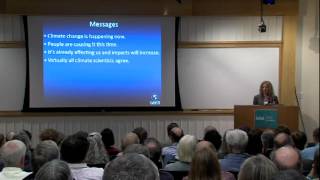
Susan Joy Hassol explains how to talk about climate science to people who don't agree. Research shows Americans split into six groups by belief. Word choice matters: "climate change" lands differently than "global warming." Lead with solutions, use local examples, and find trusted messengers outside science.
Chapters
My watch says it's now noon. I can say good afternoon and thank you all for coming. I know this is the noon hour so that many people need to get back to work. And so we're going to start promptly with my brief introduction and then hand it over to our guest Baker.
Susan.
My name is Eric Davidson. I'm the director president of the Woods Hole Research Center. This is a jointly sponsored event by the Woods Hole Research Center, Penn Biological Laboratory. And I also want to thank Bowie Graphics for coming here and videotaping this event. So this is really quite a wishful collaboration here. Susan has a background in communications and public affair. That was her academic training and worked for a while in the energy field. And it was through that process that she became aware of climate change and became aware of how well, frankly, what a poor job we scientists do about communicating about climate change. And as a result, she has made a career of not only being a communicator herself, but being an educator, a coach of science scientists to help us communicate about science for the public with a particular focus on climate change. She's no stranger to Woods Holt. She's been here numerous times and has worked with Jerry Melillo and others on I think they're now on their third national Climate Assessment in which she's played a key role in writing for that assessment, trying to translate what the scientific evidence is into plain language for abroad. Similar contributions to writing for Frequently Asked Questions for the IPCC assessments and for the Arctic Change Assessment as well. I had the pleasure of meeting her recently she at an AGU function. She now serves on the Board of Directors of the American Geophysical Union as an advisor, again helping scientists figure out how communicate.
Still a widespread misconception that it's ozone depletion and the hole in the ozone layer probably letting in more heat is what they think that's causing global warming. They really don't understand. Toxic waste, nuclear power, aerosol sprays are other things that come to people's minds when they think about climate change. And of course we know those are not so interesting and important information for us to keep in mind as we try to communicate about this. So my colleagues at Yale and George Mason have been asking 1,000 people a set of questions over a number of years and they've categorized them. They say there's not one public, there are six Americas when it comes to global warming, and they've categorized them from the alarmed all the way to the dismissive and everything in between. And they say that people seem to fall into these categories and of course, the ones that are the most concerned and alarmed are the most willing to do something about it. And of course, the dismissives have, you know, spokespeople that we hear all the time on talk radio, for example, and they're very vocal, so they sound like they're even more than the 10% that they are. I think one of the really interesting things here is that most Americans are in these four middle categories. And these are people who need more information and still have not fully made up their minds. And those, I think, are the people that we have to be thinking about speaking to the most. Here's another way of looking at it. And this shows you the partisan divide. Among Democrats, 78% agree the world is warming. Just 53% of Republicans and only 34% of those who self identify as Tea Party. And then is due to human factors, again, a majority of Democrats, a minority of Republicans, and a small minority of those in the Tea Party. So this just shows you a little bit about that. Excuse me, are you separating out Republicans in two parties as exclusive groups or is one subset of the other? I think they did it as exclusive groups and they did it with self identification. Yeah. So this is looking over time at the question of have the effects of global warming already begun starting in 1997 and going up through 2008, with the Democrats in blue and the Republicans in red? And so you see a growing partisan divide over time. I think there are a few important things to note here. One, I asked myself, what happened in 1997? Anybody know? Kyoto Protocol climate change became a policy issue and people started, now it's not a science issue anymore. And people started thinking about what do those policies mean and what will they mean? For me, the other thing is that I think the effects of global warming have really started to show themselves. And so that was the question, have the effects already begun? And now as these effects have begun, Democrats have responded to those effects by saying, yes, I see it, and Republicans haven't. They've basically gone down a little bit. So I think this is interesting information. Again, as we move forward to think about this. This is going to blow your mind. Okay, this is the influence. I'm going to explain this. So if you're a Democrat, the probability of your perceiving global warming as a threat goes up with your level of education. The more education you have, the more likely you are to perceive it as a threat. And if you're a Republican, it's the opposite. The higher your level of education, the less likely you are to see global warming as a threat. I'll let you digest that for a couple of seconds. What in the world is going on here? Right. So Dan Kahan and colleagues at Yale have taken a look at this, and they say, you know what? We have a conflict between individual rationality and collective rationality. For the individual, what's really good for you is to conform your views to those of your social group and your cultural group. That makes your life easier and better, doesn't work so well. For the collective, the fact that it's become a culture wars issue, the fact that leadership, that the people that people look to as opinion leaders are saying certain things and others in their group are saying certain things, that's causing that crazy lines we just saw in the last graph. And it turns out that people are very good at conforming their views to those of their social group. And people who are smarter and better educated are even better at it. So that sort of helps explain that a little bit. They also found that this polarization increases with scientific literacy, so not only their level of education, but how scientifically literate they are. So we used to think that one of the big problems was that the public's scientifically illiterate. But it turns out that for these people, for the people in the conservative half of our society, the more scientifically literate they were, the better able they were to defend a point of view that they made for political and ideological reasons. And so they checked this, by the way. They used eight questions from the National Science Foundation. Scientific literacy questions like, does the sun go around the earth? Does the earth go around the sun? Believe it or not, a lot of Americans don't get that right. So is there any way to address this? This is, of course, the big question. Is there any way to address this polarization? And I and lots of others have been thinking very hard about this. And one idea is to take an alternative angle on the response options to climate change. Because I think what's being rejected here is not so much the science as it is the response options that they think are going to be put into place. And they're rejecting the science because they don't want to see the policies. So is there a different way to think about that? And are there different messengers? Because we know that the messenger and the trust of that messenger is extremely important in people's perceptions. So one thing you want to do when you communicate with someone is to connect on values and to affirm rather than challenge or threaten people's values. So let's think a Little bit about how solutions to climate change have often been framed. It's all about regulation, reduce, we're going to cut, we're going to control, we're going to conserve and restrict. These are not happy words for people who are afraid of limits on personal freedom, freedom. But there are much different ways to present this, much different ways to talk about these solutions. And we have to be, I think, embracing these other ways of thinking about it. It's about ingenuity and innovation, entrepreneurship, harnessing the power of the free market, rising to a challenge, overcoming environmental constraints, competing in the world market, and American exceptionalism. Right. We're a great country. We can do this. So some people have already been trying to use these frames. Our Energy Secretary, Steve Chu, asked if we're going to recognize the opportunity and compete in the clean energy race, or are we going to just wave the white flag and watch all these jobs go to China and India and Japan and Denmark and Germany. And really that's what's happening right now. Some technologies that were invented in the United States are being produced in other countries. And part of it is because they have better climate policy. So here's another issue. The way we imagine and think about global warming. So think about global warming. What's the first image that comes to your mind? Shout out somebody. Oh, yeah, well, it's a bunch of Woods Hole folks. Sea level rise, Ice caps are melting. That's the first thing that comes to most Americans minds. Melting, ice, melting ice, polar bears. And you know what, that seems kind of distant for most people. So I think a better way to approach this. We need to change the image in people's minds from something that's happening far away to somebody else to something that's happening here and now in our own backyards. Because this is climate change. This is the, you know, three or four months out of the year where the temperatures are above 100 degrees. If you live in Texas or Florida or Alabama or Southern California, scary stuff and stuff that's happening right now, droughts longer and deeper because the air temperature is higher. Even if precipitation doesn't change much, just the hotter air means that the soils are drying out more. Out in the west, where I live, fires, the fire season is longer. More acres are being burned. People are being evacuated from their homes on a more regular basis. We're seeing more of the precipitation come in heavy downpours, meaning more flooding. This is climate change. And somehow we have to find a way to help people understand that. So how can we smarten up our communication? And I Choose these words very deliberately. One of the things that really makes me angry is when people call translating science into English dumbing down. The only thing that's dumb is talking to people in a language they don't understand. So we need to smarten up our communication. And what are some ways we can do that? Well, one thing is to focus on what our audience cares about. It's an engagement, it's not a lecture. It's what they want to know, not what we think they ought to know. It's about local impacts happening now. It's about taking advantage of teachable moments. So when we have those extreme heat waves or those really heavy downpours and a journalist says to you, so is this global warming? The first words? Most scientists say what they want to know, not what we think they ought to know. It's about local impacts happening now. It's about taking advantage of teachable moments. So when we have those extreme heat waves or those really heavy downpours and a journalist says to you, so is this global warming? The first words most scientists say are, well, we can't attribute any one of them to climate change. So instead of leading with what you don't know and what you can't say, how about leading with what you do know and what you can say? Well, what we do know is as the average temperature goes up, the extremes go up. We're seeing more of the extreme hot, we're seeing less extreme cold. In fact, over the last decade, we broke two hot records for every one cold record. In a stationary climate, you'd be breaking about an even number of records. So this is the climate on steroids. These are things you can say to help people understand similarly with heavy downpour. And you can say, so, yeah, this heat wave, it fits the pattern. This is part of a trend towards more heat waves. We're measuring them. And you know what else we predicted this. This has long been projected and now it's coming to pass. Same thing with heavy downpours. We know that we have a trend towards more of the rain coming in heavy events in the Northeast, where you all live, it's over 70% increase in the amount of rain falling in the heaviest 1% of precipitation events. That's an enormous change in the Midwest. It's over 50% increase in the heaviest rains. So when we get a heavy downpour, we can say, yes, this fits the trend. This is part of a trend towards more rain coming in heavy events and then longer dry periods in between, which gives you this flood, drought kind of cycle. And we're seeing that. We're also seeing the wet areas get wetter and the dry areas get drier. So now you've answered their question, you've answered the essence of their question in a way that's much more effective and in a way that's really communicated something even about the mechanism, you could say, and we know why. We have more heavy precipitation. The warmer atmosphere means more evaporations. There's more water vapor in the air. So when any given storm system comes through, it dumps out more water. We understand why this is happening. It's been modeled, it's been projected, and now it's been observed. So just using those teachable moments can be a really good thing. When we see flooding in coastal areas, we can say, this is sea level rise. This is what it means. More frequent events where we have water coming onto shore where we didn't before. I heard from my colleague Jerry Melillo, that some of the mass spectrometers, the important equipment that they have, they put them on the third floor of the building instead of the first floor because they're concerned that we may be seeing some more of these events where first floors are flooded. So this is our reality now. Connecting on values is critical. I keep mentioning this thing about values. We all share a value of responsibility. We all want to clean up our own mess and be responsible for the things that we've done. And that's a good value to connect with. And there are others. Stewardship, for example. Remembering to talk about solutions, actions, because it's part of the story. I know many scientists are not necessarily comfortable talking about that. They don't feel like it's their expertise. I'm not asking you to be advocates or to pick winners, but just to mention that there are solutions. There are some things, some of them are underway. There are lots of things we can do. It just has to be part of the story, or people just want to pull the covers over their head. I think we have to stop telling the Chicken Little story and start telling the Little engine that could story also. Of course, there are multiple benefits. Many of the things that we do to help us out with climate change help us out in lots of other ways, save us money, make our air cleaner and so forth. And partnering with trusted messengers. I think this is really important. Scientists are not always the best or most trusted messenger for any audience. We do know that across the American public, scientists are very trusted, much more trusted than politicians, for example, or even members of the media. It's not hard to beat out the politicians in that one. But scientists are trusted by roughly three quarters of the public, so that's really good to know. So who are some of these other messengers that we might partner with? Well, here's one guy. His name is Bob Inglis. He's a former member of Congress from South Carolina. He was a Republican, and he's extremely conservative. He understands and accepts the science of climate change, and he talks about using market forces to address it. He's a very powerful spokesperson. Unfortunately, the bad news is he was challenged by the Tea Party and lost in the primary and is no longer in Congress. But we need to be looking for other Republican and conservative spokespeople who can address this issue. Here's another one, the Reverend Sally Bingham. She's one of a growing number of religious leaders who are really taking a stand on climate change. They call it creation care. This is taking care of God's creation, being good stewards, and taking care of people who are less well off because they're the ones who are going to suffer the most. Rear Admiral David titley of the U.S. navy. The U.S. military is very concerned about climate change. They call it a threat multiplier. They're concerned about all kinds of changes that they expect to see, and they're doing scenario planning, and they're including it in their. In the work that they do. And these are very powerful spokespeople. Then we have Jim Rogers, CEO of Duke Energy, probably responsible for burning more coal than almost anybody in the United States. He's come out on climate change. He wants to see regulations. He says he's, you know, he's responsible to shareholders. But the bottom line for him is that if there's no regulation driving him to do a particular thing, he's not going to do it. He wants to see those regulations and he wants to know what's coming, and he wants a level playing field. So these are powerful messengers, and they're not the usual suspects. They're not just environmentalists who are worried about polar bears. So let's talk a little bit about how scientists fail in communication, because I think it'll be instructive as we move forward. So failing to craft simple, clear messages. Right. A lot of times I hear scientists talk and it's like a download of everything they know. Right. It's too much. People don't know what to think. So you have to, if you can really think about how to craft the simple, clear message. Jargon. And when I say jargon, I mean words like anthropogenic. I know that that Seems like such a common word to most of you, but most people do not know what it means. So just say human caused. It's much better. And don't overdo the details. As a group, scientists tend to focus on the areas of debate instead of what we already know. And that makes people think that there's actually much more uncertainty than there is about the basic facts of whether the world is warming, whether it's due to human activity and where we're headed. So that's really important. Not anticipating misunderstandings. Now, this is. I mentioned some of the misunderstandings that the public has. If you don't anticipate those, you can really blow it. So I'll give you a great example. I was watching some of our colleagues testify before Congress and they were going on and on about greenhouse gases and aerosols. Greenhouse gases and aerosols. Well, what is an aerosol to the common person? Right. They didn't anticipate the misunderstanding that people have about aerosols and about the ozone hole they think, causing global warming and all of that. So at the end of the hearing, one of the members of Congress said, well, you know, I'm so glad I was here today. I learned so much. And, you know, when I went to Antarctica, they wouldn't let us take our aerosols out on the ice. And now I understand why. Oh, dear. Who knows what they thought, right? But it wasn't the right thing. So if you can anticipate those misunderstandings, you can avoid making them even worse and reinforcing them, not leading with what you know. I already mentioned this. How many times do we hear our colleagues say, well, you know, the data's not so great. We have all these error bars and we just don't really know about this. And, you know, it's painful sometimes to listen to. So lead with what you know and what you can't say. And of course, we tend to focus on the problem and not on the impacts and not on the solutions. So in IPCC parlance, we're focused on working group one at the expense of working groups two and three. And I think we need much more of a focus because that's what people want to know. So what can we do about it? So I'm only asking you to turn your world upside down. For the scientists you're used to, starting with the background, working through the detail, and finally, at the very end, if you haven't run out of time, you tell them the bottom line. So with the public, you really want to flip that upside down, You Want to start with the bottom line? What did you find? Why does it matter? So what? Why should they care? So this is just a little restructuring of the way you think when you're talking to the public. And it really is true that the less you say, the more they hear. Sometimes when I'm listening to a scientist, I'm reminded of the situation where you're in a hotel room and you pick up the remote control and it has so many buttons that you can't figure out how to change the channel. This is what most scientists sound like. They can't figure out how to change the channel. They don't understand the bottom line. All right, and then we get to math, because 56% can't do it and 54% won't do it. We have to do the math for people. We cannot expect them to do math in their heads. So if you tell them that it's warmed by 0.2 degrees Celsius per decade since 1943, and then they have to do the math and it's not round numbers, and then they have to multiply times 1.8 to get from Celsius to Fahrenheit, do the calculations for them. Make it simple. Use familiar units. Sorry, it's feet and pounds and all that. For Americans, you have got to use the units that they're familiar with. They don't know. They've been talking about switching to the metric system since I was in grade school, and that was a long time ago. Also use analogies and points of reference. Just the hotter air means that the soils are drying out more. Out in the west where I live, fires. The fire season is longer. More acres are being burned. People are being evacuated from their homes on a more regular basis. We're seeing more of the precipitation come in heavy downpours, meaning more flooding. This is climate change. And somehow we have to find a way to help people understand that. So how can we smarten up our communication? And I choose these words very deliberately. One of the things that really makes me angry is when people call translating science into English dumbing down. The only thing that's dumb is talking to people in a language they don't understand. So we need to smarten up our communication. And what are some ways we can do that? Well, one thing is to focus on what our audience cares about. It's an engagement. It's not a lecture. It's what they want to know, not what we think they ought to know. It's about local impacts happening now. It's about taking advantage of teachable moments. So when we have those extreme heat waves or those really heavy downpours, and a journalist says to you, so is this global warming? The first words most scientists say are, well, we can't attribute any one event to climate change. So instead of leading with what you don't know and what you can't say, how about leading with what you do know and what you can say? Well, what we do know is as the average temperature goes up, the extremes go up. We're seeing more of the extreme hot, we're seeing less extreme cold. In fact, over the last decade, we broke two hot records for every one cold record. In a stationary climate, you'd be breaking about an even number of records. So this is the climate on steroids. These are things you can say to help people understand similarly with heavy downpour. And you can say, so, yeah, this heat wave, it fits the pattern. This is part of a trend towards more heat waves. We're measuring them. And you know what else? We predicted this. This has long been projected and now it's coming to pass. Same thing with heavy downpours. We know that we have a trend towards more of the rain coming in heavy events. In the Northeast, where you all live, it's over 70% increase in the amount of rain falling in the heaviest 1% of precipitation events. That's an enormous change. In the Midwest, it's over 50% increase in the heaviest rains. So when we get a heavy downpour, we can say, yes, this fits the trend. This is part of a trend towards more rain coming in heavy events and then longer dry periods in between, which gives you this flood, drought kind of cycle. And, and we're seeing that. We're also seeing the wet areas get wetter and the dry areas get drier. So now you've answered their question, you've answered the essence of their question in a way that's much more effective and a way that's really communicated something even about the mechanism you could say, and we know why we have more heavy precipitation. The warmer atmosphere means more evaporations. There's more water vapor in the air. So when any given storm system comes through, it dumps out more water. We understand why this is happening. It's been modeled, it's been projected, and now it's been observed. So just using those teachable moments can be a really good thing. When we see flooding in coastal areas, we can say, this is sea level rise. This is what it means more frequent events where we have water coming onto shore where we didn't before. I heard from my colleague Jerry Melillo, that some of the mass spectrometers, the important equipment that they have, they put them on the third floor of the building instead of the first floor because they're concerned that we may be seeing some more of these events where first floors are flooded. So this is our reality now. Connecting on values is critical. I keep mentioning this thing about values. We all share a value of responsibility. We all want to clean up our own mess and be responsible for the things that we've done. And that's a good value to connect with. And there are others. Stewardship, for example, remembering to talk about solutions, actions, because it's part of the story. I know many scientists are not necessarily comfortable talking about that. They don't feel like it's their expertise. I'm not asking you to be advocates or to pick winners, but just to mention that there are solutions. There are some things, some of them are underway. There are lots of things we can do. It just has to be part of the story or people just want to pull the covers over their head. I think we have to stop telling the Chicken Little story and start telling the Little Engine that could story also, of course, there are multiple benefits. Many of the things that we do to help us out with climate change help us out in lots of other ways, save us money, make our air cleaner and so forth. And partnering with trusted messengers. I think this is really important. Scientists are not always the best or most trusted messenger for any audience. We do know that across the American public, scientists are very trusted, much more trusted than politicians, for example, or even members of the media. It's not hard to beat out the politicians in that one. But scientists are trusted by roughly three quarters of the public. So that's really good to know. So who are some of these other messengers that we might partner with? Well, here's one guy, his name is Bob Inglis. He's a former member of Congress from South Carolina. He's a Republican and he's extremely conservative. He understands and accepts the science of climate change and he talks about using market forces to address it. He's a very powerful spokesperson. Unfortunately, the bad news is he was challenged by the Tea Party and lost in the primary and is no longer in Congress. But we need to be looking for other Republican and conservative spokespeople who can address this issue. Here's another one, the Reverend Sally Bingham. She's one of a growing number of religious leaders, leaders who are really taking a stand on climate change. They call it creation care. This is taking care of God's creation, being good stewards and taking care of people who are less well off because they're the ones who are going to suffer the most. Rear Admiral David titley of the U.S. navy. The U.S. military is very concerned about climate change. They call it a threat multiplier. They're concerned about all kinds of changes that they expect to see, and they're doing scenario planning and they're including it in their. In the work that they do. And these are very powerful spokespeople. Then we have Jim Rogers, CEO of Duke Energy, probably responsible for burning more coal than almost anybody in the United States. He's come out on climate change. He wants to see regulations. He says he's, you know, he's responsible to shareholders. But the bottom line for him is that if there's no regulation driving him to do a particular thing, he's not going to do it. He wants to see those regulations and he wants to know what's coming, and he wants a level playing field. So these are powerful messengers, and they're not the usual suspects. They're not just environmentalists who are worried about polar bears. So let's talk a little bit about how scientists fail in communication, because I think it'll be instructive as we move forward. So failing to craft simple, clear messages. Right. A lot of times I hear scientists telling and it's like a download of everything they know. Right. It's too much. People don't know what to think. So you have to, if you can really think about how to craft the simple, clear message. Jargon. And when I say jargon, I mean words like anthropogenic. I know that that seems like such a common word to most of you, but most people do not know what it means. So just say human caused. It's much better. And don't overdo the details. As a group, scientists tend to focus on the areas of debate instead of what we already know. And that makes people think that there's actually much more uncertainty than there is about the basic facts of whether the world is warming, whether it's due to human activity, and where we're headed. So that's really important. Not anticipating misunderstandings. Now, this is. I mentioned some of the misunderstandings that the public has. If you don't anticipate those, you can really blow it. So I'll give you a great example. I was watching some of our colleagues testify before Congress and they were going on and on about greenhouse gases and aerosols. Greenhouse gases and aerosols. Well, what is an aerosol to the common person. Right. They didn't anticipate the misunderstanding that people have about aerosols and about the ozone hole, they think, causing global warming and all of that. So at the end of the hearing, one of the members of Congress said, well, you know, I'm so glad I was here today. I learned so much. And, you know, when I went to Antarctica and they wouldn't let us take our aerosols out on the ice, and now I understand why. Oh, dear. Who knows what they thought, right? But it wasn't the right thing. So if you can anticipate those misunderstandings, you can avoid making them even worse and reinforcing them, not leading with what you know. I already mentioned this. How many times do we hear our colleagues say, well, you know, the data's not so great. We have all these error bars and we just don't really know about this. And, you know, it's painful sometimes to listen to. So lead with what you know and what you can't say. And of course, we tend to focus on the problem and not on the impacts and not on the solutions. So in IPCC parlance, we're focused on working group one at the expense of working groups two and three. And I think we need much more of a focus because that's what people want to know. So what can we do about it? So I'm only asking you to turn your world upside down. For the scientists, you're used to starting with the background, working through the detail, and finally, at the very end, if you haven't run out of time, you tell them the bottom line. So with the public, you really want to flip that upside down. You want to start with the bottom line. What did you find? Why does it matter? So what? Why should they care? So this is just a little restructuring of the way you think when you're talking to the public. And it really is true that the less you say, the more they hear. Sometimes when I'm listening to a scientist, I'm reminded of the situation where you're in a hotel room and you pick up the remote control and it has so many buttons that you can't figure out how to change the channel. This is what most scientists sound like. They can't figure out how to change the channel. They don't understand the bottom line. All right, and then we get to math, because 56% can't do it and 54% won't do it. We have to do the math for people. We cannot expect them to do math in their heads. So if you tell them that it's warmed by 0.2 degrees Celsius per decade since 1943. And then they have to do the math and it's not round numbers. And then they have to multiply times 1.8 to get from Celsius to Fahrenheit. Do the calculations for them. Make it simple. Use familiar units. Sorry, it's feet and pounds and all that. For Americans, you have got to use the units that they're familiar with. They don't know. They've been talking about switching to the metric system since I was in grade school and that was a long time ago. Also use analogies and points of reference, right? So if you tell somebody how many cubic kilometers of ice or water, it's not going to work. But if you say the amount of water coming off Greenland in one year is 225 times the amount of water the entire city of Los Angeles uses in an entire year for all purposes, then they just begin to wrap their minds around the enormity of what we're talking about. So look for those points of reference, those analogies that will help people absorb what these numbers mean. And don't overdo the numbers because it really just makes people, people tune out. So greenhouse gases, I think we've forgotten that greenhouse is really just a metaphor. And it's really not that great a metaphor. And people don't really understand how they work. So if I could get you to do one thing, I mean, I'm going to try and get you to do a lot of things, but one of them is instead of saying greenhouse gases, say heat trapping gases. I already told you, most Americans do not understand the basic mechanism of climate change. If you say heat trapping gases, you're reinforcing the mechanism. There are these gases, they trap heat. We're increasing the amount of them. Heat trapping gases. Okay, which brings me to another subject, which is one of my favorites, and that is words that mean different things to the public than they do to scientists. And yes, that's Rush Limbaugh. And yes, he's spraying aerosols on the globe because he heard that aerosols cool the climate. So he's doing his part to solve global warming by spraying aerosols on the globe. Aerosols mean spray cans to the public. Always have, always will. Just say tiny particles or something else. Figure out some other way to say it, because that's a word. And these words are more dangerous than jargon. Jargon's bad. They just don't understand what it means. These words are worse because they understand what they mean. It just means something completely different. Enhance. When you all say enhance, you generally mean to increase. But to the public, enhance means to make better. Enhance your appearance, right? So the enhanced greenhouse effect sounds like a good thing. Enhanced hurricane activity. Oh, good. New and improved. So just say increase or intensified. Positive is good. Positive trend, right? Oops. Positive feedback. You go to your boss at work, you get positive feedback. That's a good thing, right? Positive feedback. To the climate, not so much. So maybe you want to say self reinforcing cycle or vicious cycle. Anytime I explain a positive feedback to somebody from the public, they say, oh, you mean a vicious cycle. So that's a good substitute. Radiation. That's X rays. In Chernobyl, you might want to say energy or heat, depending on the context. Theory. This is a very dangerous one. To the public. A theory is a mere hunch. Speculation. Guess not what we mean at all when we say theory in the scientific community. So be very careful about using this word in public. And there are a whole lot more of these words. My personal list is now over 100. This is just a small sampling. If anybody wants it, email me and I'll email you my list of 100 terms. There are a whole bunch of even acronyms that actually mean something different to the public than they do to us. Sst, for example, is sea surface temperature. To us, it's the supersonic transport to the public. Right. PDF, there's all kinds of others, but I won't go through all of these because it would take way too much time. But I'll point out the word uncertain as one example. Because when we talk about uncertainty in the scientific community, usually what we're talking about is a range of possible futures. When the public hears uncertainty, they think we don't know anything. So uncertainty about future warming means we don't. It might even cool. We have no idea what's going to happen. But what we're talking about is a range of possible futures, right? Somewhere between 2 and 5 Celsius. I'll do it in Fahrenheit. If you were for the public. So recently a colleague, my colleague Richard Somerville and I published an article in Physics Today, and we put in a small table of these words just to give scientists a little bit of the idea. We put in a scientific term, the public meaning and better choices. You can download this paper for free at my website, climatecommunication.org, so you don't have to furiously write all these down and just get the whole paper and you can read the other things we said which are also of interest. But this table actually went viral on the Internet, which I thought was fascinating. This concept of these words that mean something entirely different to the public than to scientists. So I've talked a little bit about what diagnosis, meaning and better choices. You can download this paper for free at my website, climatecommunication.org so you don't have to furiously write all these down and just get the whole paper and you can read the other. It doesn't work. So now let's talk about what does work. Craft a few key points. Don't try to say too much. Make your messages simple, not simplistic, not overly simplified, but simple and clear and memorable. And the way you do that is by using imagery and metaphors and telling stories. That's the way people absorb information and it's what moves them. Lead with what you know, include solutions and talk about them in a positive way, as I showed you earlier. And what are these messages? You know, we talk about simple, clear messages. What does the public need to know? Well, they need to know that climate change is happening now. This is not a far off future problem for somebody else somewhere else. They need to know that people are causing it. And I say this time because one of the things we often hear is, well, climate's always changed. Change in the past has nothing to do with us. We have lots of ways of knowing that it is us. And if anybody doesn't know what those are and wants to know, ask me later and I'll give you a whole list. It's already affecting us and these impacts are projected to increase. Virtually all climate scientists agree on these basic points. There's disagreement about details, but not about these basic points. And we can limit the damage if we choose to. The future is largely in our hands. We have a choice between bad and worse. We can't stop this thing dead in its tracks, but we can avoid the worst. But it means acting soon. You're not advocating for a particular bill, you're just telling them the scientific reality. And I think this is all part of what the public needs to know in a basic way. So I've mentioned this thing about talking about solutions, and I want to show you the results of a slide study that help us understand that. In this study, they divided the group in two. They gave them all this story. The story started with basic information on climate change. One half had an ending that sounded really inevitable. Oh, there's not much we can do. We're committed to so much warming. I'm not really confident that we're going to do what it takes. And the other had an ending that was much more positive and much more solutions oriented. And it turned out that when those two groups were then asked questions about the basic science, the group that had the positive solutions ending understood and accepted the science much better than the group that had the other ending. People don't want to believe something that they feel like there's nothing we can do about. And in fact, there is something we can do about it. So to be honest, we should include that in the way we talk about this. Here's an example. Mark Jacobson at Stanford, nuclear physicist, has done this amazing research where he's laid out a plan to power the world with renewable energy. He's talked about it at AGU meetings and he's published about it in the scientific literature. He also did a piece in Scientific American on this. This is the kind of positive solutions that without picking a winner, without advocating for a particular thing, you can just say there's lots of ideas out there. People have done the have taken a look at this and they do think there's a way forward. That's one example. So here's another study I want to tell you about. So you know those customer loyalty cards, right? If you buy eight car washes, you get one free. So half of this group was given that card. Half of the group was given a card that had to get 10 car washes to get one free. But they gave them a head start. They gave them two free punches. Okay? So both of them obviously had the same goal, eight car washes. But the group that got the head start, more of them got to their goal and they got there faster. Fascinating study on psychology, right? You felt like you were 20% of the way there. You weren't starting from scratch. So this is what Chip and Dan Heath, who wrote a great book called how to Create Change When Change Is Hard, they call this shrinking the change. Instead of overwhelming people by saying, oh, we have to revamp the entire planet's energy system and we have, how are we ever going to do that? You say, you know what? We know how to do some of this stuff. In this graph, the gray line is United States per capita energy consumption, and the yellow line is California's per capita electricity consumption. And what we see is that Californians are now using about a third less electricity and they're getting the same services and they're saving money doing it. The average family is saving $1,000 a year in electricity bills. So they're not getting a free lunch, they're getting a lunch, they're paid to eat. So this is the kind of thing that we can help people understand. We know how to do this. It was easy. It was appliance efficiency standards and other really simple, not sexy kind of things that they did in California to make this happen. So the point here is to say this is like a punch on somebody's card. We're, we know how to do this. We're already part of the way there. We just need to do it a lot more. We need to scale up what's working. Here's another example. Last year in the United States, there was more investment in renewable power plant than there was in fossil fuel power plant for the first time. That makes us feel like we're, it's not enough, I know, but it's a start. And I think it's helpful for people to know that we know what to do. We just need to do more of it. So another thing I wanted to mention to you is the power of graphics. Here's another study, everyone, now don't read the words. What I want to make a point here about is this. Everyone at the beginning of this study, everyone in this study thought temperatures were falling, right? They were all self identified Republicans. They all thought temperatures were declining. Half of them got the paragraph of text, half of them got the graphic. And at the end of the study, 40% of those who got the text still believed temperatures were falling. Only 10% of those who got the graphics still believed temperatures were falling. In general graphics, if they're done well. And this one isn't even a particularly good graphic, but what it does show is four different groups getting the same result. Seeing is believing. Graphics can be very powerful and more powerful than text in most cases. It's really something to keep in mind in your case, communication efforts. Here's a good graphic. It tells you instantly where most of the added heat is going, the added heat from the heat trapping gases. And then of course, you have to tell people why this matters. It matters to sea level rise, it matters to ecosystems, it matters to the thermal inertia of the system and how long it's going to be with us. Now, a lot of the information I'm talking about is available. It's available in this report, for example, which is the 2009 US Climate Assessment, and it's called Global Climate Change Impacts in the United States. You can also download this whole report free in its entirety at my website and other places online. It goes region by region through the country and sector by sector through the economy. And it tells you the impacts, what we're observing now, what's projected for the future under both lower emissions and higher emissions scenarios. This is not a report from Greenpeace. This is a report developed under the Bush administration, signed off on by 13 federal agencies that form the US Global Change Research Program. It's full of good information. It's out there, but for some reason, most people don't know about it. They've never seen it. And I would like to have this report in the hands of every journalist, for example, and I would like everyone in the community to know about this information. It's out there. And now we're working on a new national climate assessment that will be out in 2013. And it's all in plain language. I worked on it. Jerry Melillo of MBL was the chair of this effort, and I was the writer. So I made sure that it was understandable and accessible to a lay audience. And the scientists made sure everything was accurate. You can be both accurate and effective. That's my argument. So one of the things we showed in the report is how many days? Over 100. And I mentioned this to you under lower emissions and under higher emissions. So you can see that for four solid months out of the year, there are going to be some places that are over 100 degrees Fahrenheit. It's going to be downright unlivable. If we continue the course that we're on that higher emissions scenario, we're actually above that right now. So also on my website that I mentioned, we animated this so you can watch the two futures unfold side by side. If you want to take a look at that, here's another graphic from that report. So what is this? Here's the state of Illinois. And the climate of Illinois will be under a lower emissions scenario, what you see in yellow and under a higher emission scenario, what you see in red, as if the state picked up and moved south. So it's as though the climate of Illinois is going to feel like the climate of Texas under a higher emission scenario by the end of this century. Our colleague Don Wubels came up with this idea because he was going to talk to his members of Congress in Washington, and he wanted to figure out a way to make them understand what does the future mean for Illinois. And, you know, we talked about it and we decided that one thing people in Illinois know is they don't want to be living in Texas. So people often ask me this question, what do you do to talk with people whose mind is made up. They do not want to hear about climate change. And the minute those words come out of your mouth, they are going to shut down. So what do you do? So I'm a believer. Having banged my head against the wall for enough years, I don't like to do that. So I say if the front door is blocked, don't try that way. Look for a side door, look for a back door. These pictures are from Kansas. There's a woman named Nancy Jackson. She's the daughter in law of West Jackson, who some of you may know, and she runs a program called the Climate and Energy Project. She does not talk about climate change. She talks about thrift, saving money, keeping jobs here at home, keeping our money here at home, stewardship, responsibility. She talks about a whole bunch of things that she can connect with on values, with the people in Kansas. She does not talk about climate change. At least not at first. First. So what she does. The people sitting there having dinner by candlelight. That's Valentine's Day in Kansas and all the restaurants turn off their lights and everyone eats dinner by candlelight. They're having fun doing this. The schools compete to see who can save more energy and they get a prize if the one who wins. On Halloween, they tried to stop their vampire electricity loads, right? Those are the loads that are drawing even when they're not in use, just because they're plugged in, they've made it free, they've made it interesting. The ministers in town have a sermon bank and they give sermons about good stewardship. So there are lots of things that you can do, lots of ways you can connect. This is a local rancher who's got wind turbines on his land. He's still able to farm and ranch his land, but he also gets rent from the wind turbines. And they don't necessarily start by talking about climate change. So I think there's lots of ways, there are lots of side doors. Eventually you're going to have to get around to talking about climate change, because if you don't, you can often come up with the wrong answer. If, for example, all you care about is energy independence, you could say, well, you've got plenty of coal. So that's not necessarily the answer. So eventually you're going to have to talk about climate change. It just doesn't have to be the first thing out of your mouth. So what's the bottom line? I'm going to give you a few things that I really do want you to remember. The secret of good communication is this simple, clear messages repeated often by a variety of trusted sources. We know scientists are trusted sources. We know that they can partner with other trusted sources and we know this. So our community as a group has not been great at this. And unfortunately, the contrarians have been really pretty good at this. The more you say, the less they hear. Tell stories, use metaphors, connect with people on values, build trust. Part of trust comes from familiarity. The more people see you and hear from you, the more familiar you are to them, the better chance you have of being trusted. And don't forget that we face choices about what the future looks like and offer solutions so people don't feel like this is unsolvable. It's a man made problem and it has man made solutions. We caused this and we can fix it. That's part of the story that needs to be told. I promised you another dinosaur cartoon. So on the subject of if we wait until it's so obvious to everyone and we can all see the asteroid, it's too late. Here's another cartoon on that score. Climate change may cause serious flooding. Well, we'll cross that bridge when we come to it. Oops. So I wanted to save time for questions and I have. So with that I'm going to to stop and I'd be happy to answer your questions or engage in conversation. Thank you. See the asteroid, it's too late. Here's another cartoon on that score.
Great talk. Thank you very much.
Thank you.
To two questions. One, climate change. The phrase itself, which I was taught was the phrase you use if you don't want people to understand it or believe it, like death tax. But you've obviously spent a lot of time on it. So I'm interested in that part of the vocabulary. And the other is there's a lot of gray hair in this audience and I'm interested in young people, children, kids. Everyone cares about their kids. Practically everyone wants to work towards a better world to their kids. Kids as part of the message or kids as part of the messenger. You're silent on that here, but again, I suspect you spend a lot of.
Time thinking about it. I do. Well, thanks for those questions. The first one is about the phrase climate change as opposed to the other things we could call it. So climate change for scientists is. Is any kind of climate change. It's not necessarily just human induced climate change. Scientists have always liked the phrase climate change as a rule, for a couple of reasons. One, it encompasses many things. It's not just about warming. It's about all the portfolio of changes that take place when the world warms. Interestingly enough, back during the Bush years, Frank Luntz, who's a Republican strategist and language guru for the Republicans, told them to use the word climate phrase climate change rather than global warming because it sounded less frightening to people. Global warming sounds for one thing. Global warming implies for most people the human induced component. This is a change that we have caused in the world, whereas climate change could be natural and sounds less threatening. So that was something. Interestingly enough, now we're hearing the contrarian saying say that it's the scientists and the environmentalists who are trying to make the change to climate change. It's not true. It was actually a change that was called for by the others. You know those folks. So what do I want to say? Global warming is for one thing. It sounds good to some people. Warmer world sounds a little better. It also seems to evoke more anger from conservatives when it's used. I think that sometimes you have to say a term so people know what you're talking about. Topic wise, either climate change or global warming. But then I prefer the term climate disruption, which John Holdren uses and other people use. I think what it does is it gets the human component in there. It's about climate, it's about disruption. And it encompasses more than just warming. It encompasses all of these other things. So what I often do is I use the word term climate change or global warming just to set the context. And then I segued to climate disruption, which I think is a more effective term. So that's sort of my quick download on that. We could talk all day on that subject, but climate, not so much. So maybe you want to say self reinforcing cycle or vicious cycle. Anytime I explain a positive feedback to somebody from the public, they say, oh, you mean a vicious cycle. So that's a good substitute. Radiation. That's X rays. In Chernobyl, you might want to say energy or heat, depending on the context. Theory. This is a very dangerous one to the public. A theory is a mere hunch, speculation. Guess. On the subject of kids, I think this is really important. We all, we are at this stage, we are seeing these impacts now. We're going to see them in our lifetimes. But it really is our children who are going to suffer the worst of this. And I think as a people, we don't want to leave our children with a problem that they cannot solve. That's not what we mean at all when we say theory in the scientific community. So be very careful about using this word in Public. And there are a whole lot more of these words. My personal list is now over 100. This is just a small sampling. If anybody wants it, email me and I'll email you my list of. Of a hundred terms. There are a whole bunch of even acronyms that actually mean something different to the public than they do to us. That seems to me something that everyone could agree on. And in fact, we find conservative audiences very concerned right now about the national debt for precisely that reason. They feel like they're getting the benefits now and they're leaving the detriments to their children. So why can't we convince that audience? St, for example, is sea surface temperature to us, it's the supersonic transport to the public. Right? This is just like that. How can we do this? It's a huge generational equity issue and it seems to me an ethical question and a moral question. PDF, there's all kinds of others, but I won't go through all of these because it would take way too much time. But I'll point out the word uncertainty as one example, because when we talk about uncertainty in the scientific community, usually what we're talking about is a risk range of possible futures. When the public hears uncertainty, they think we don't know anything. It's always a little interesting to figure out how to talk to kids about this. So uncertainty about future warming means we don't. It might even cool. We have no idea what's going to happen. But what we're talking about is a range of possible futures. Right. Somewhere between 2 and 5 Celsius. I'll do it in Fahrenheit. If you were for the public. So recently a colleague, my colleague Richard Somerville, and I published an article in Physics Today, and we put in a small table of the. We want to empower them, we want them to understand the problem, but we don't want to depress them. We don't want them to go into despair about the future. So it's very important. Even more important, I've talked a lot about the solutions part of the message when we're talking to kids to make sure they understand that there's something we can do about this. And many things in this country have been driven by children's words. Just to give scientists a little bit of the idea, we put in a scientific term, the public meaning and better choices. You can download this paper for free at my website, climatecommunication.org, so you don't have to furiously write all these down and just get the whole paper and you can read the other things we said which are also of interest. But this table actually went viral on the Internet, which I thought was fascinating. When this came out, people were so intrigued by this concept of these words that mean something entirely different. Getting their parents to learn about them. Right. Whether it was recycling or other things. So to the public than to scientists. So I've talked a little bit about what doesn't work. So now let's talk about what does work. Craft a few key points. Don't try to say too much. Make your messages simple, not simplistic, not overly simplified, but simple and clear and memorable. And the way you do that is by using imagery and metaphors and telling stories. That's the way people absorb information and it's what moves them. Lead with what you. I think that working with children and that's a whole other area and frankly right now it's one where, you know, include solutions and talk about them in a positive way, as I showed you earlier. And what are these messages? You know, we talk about simple, clear messages. What does the public need to know? Well, they need to know that climate change is happening now, struggling with because of this ideological problem that we have. There are people who are trying to keep climate science from being taught in the schools and they're trying to introduce into curriculum things that are not science. And we've had this problem with evolution and now we're having it with climate change. This is not a far off future problem for somebody else somewhere else. They need to know that people are causing it. And I say this time because one of the things we often hear is, well, climate's always changed. Change in the past has nothing to do with us. We have lots of ways of knowing that it is us this time. And if anybody doesn't know what those are and wants to know, ask me later and I'll give you a whole list. It's already affecting us and these impacts are projected to. So it's something we all have to be concerned about to make sure our kids are being taught the science properly, that we're listening to their voices. At the recent conference of the parties, there was a young woman, a college age student, who spoke and it was very powerful indeed. And I would like to hear more. Virtually all climate scientists agree on these basic points. There's disagreement about details, but not about these basic points. Points and we can limit the damage if we choose to. The future is largely in our hands. We have a choice between bad and worse. We can't stop from people that age. I think they're very, very important messengers. So I agree with you fully. This thing dead in its tracks. But we can avoid the worst. But it means acting soon sir. So you go, you're not advocating for a particular bill. You're just telling them the scientific reality. And I think this is all part of what the public needs to know in a basic way. So I've mentioned this thing about talking about solutions and I want to show you the results of a study that help us understand that in this study they divided the group in two. They gave them all this story. The story started with basic information on climate change 1/2 you know, you have.
This curve where you the more educated.
The Republicans became the less what is.
Special about climate science which is not.
True of let's say relativity or even evolution that you know, I don't think even for evolution you have the Republicans.
Less as they become more what's special.
About climate had an ending that sounded really inevitable. Oh, there's not much we can do. We're committed to so much warming. I'm not really confident that we're going to do what it takes. And the other head climate change is the policy implications the implication that if we address had an ending that was much more positive and much more solutions oriented and it turned out that when those two groups were then asked questions about the basic science the group that had the positive solutions ending understood and accepted accepted the science much better than the group that had the other ending. People don't want to believe something that they feel like there's nothing we can do about this seriously, it's going to mean a reduction in our dependence on fossil fuels. And you know, some people say it's hard to convince someone of something if they're making a living depends on their not believing it. And in fact there is something we can do about it. So to be honest we should include that in the way we talk about this. Here's an example. Mark Jacobson at Stanford and so we have a society that's largely dependent on fossil fuels. We also have nuclear physicist has done this amazing research where he's laid out a plan to power the world with a conservative part of our society that's very anti regulation and doesn't want anyone to tell them what kind of light renewable energy. He's talked about it at AGU meetings and he's published about it in the Scientific Vacation and what kind of car they can drive. And so that's what's special about climate change is the policy and literature. He also did a piece in Scientific American on this. This is the kind of positive solutions without picking a winner, without advocating for a particular thing. You can just say there's lots of ideas out there. People have done that, have taken a look at this, and they do think there's a way forward. That's one example. So here's another study I want to tell you about. So you know those customer loyalty cards, right? If you buy eight car washes, you get applications. And that's why I say it's so important for us to discuss this in a way that's not threatening to those values. I think it can be really great for the economy. All the studies that have been done have shown that, you know, every time we get more environmental protection, it actually costs less and helps the economy get one free. So half of this group was given that card. Half of the group was given a card that had to get. Get 10 car washes to get one free. But they gave them a head start. They gave them two free punches. Okay? So both of them obviously had the same goal, eight car washes. But the group that got the head start, economy in ways that we didn't even anticipate. So that's the issue. It's a policy issue. Yes. Just a quick question to follow up on that. More of them got to their goal and they got there faster. Fascinating study on psychology, right? You felt like you were 20% of the way there. You weren't starting from scratch. So this is what Chip and Dan Heath, who wrote a great book called how to Create Change When Change is Hard, they call this shrinking the change. Instead of overwhelming people by saying, oh, we have to revamp the entire planet's energy system and we have help. Well, some people talk about the number of jobs that can be created, for example, but how are we ever going to do that? You say, you know what? We know how to do some of this stuff. In this graph, the gray line is United States per capita energy consumption by renewable energy or energy efficiency. That's one way of doing it. Some people talk about, for example, Norway developed a technology to sequester carbon because they had it. And the yellow line is California's per capita electricity consumption and tax on carbon. And if they hadn't had that tax, they wouldn't have developed that technology. So this was the way that regular. What we see is that Californians are now using about a third less electricity and they're getting the same services, and they're saving money doing it. The average family is saving $1,000 a year in electricity bills. So they're not getting a free lunch, they're getting a lunch. They're paid to eat. So this is the kind of thing that we can help people understand. We know how to do this. It was easy. It was appliance efficiency standards and other really simple, not sexy kind of things that they did in California led to a change in technology that they can maybe now sell all over the world. And so I think the competitiveness argument, the fact that we're stuck in. I want you to make this happen. So the point here is to say this is like a punch on somebody's card. We know in the technology of the past and other countries are embracing the technologies of the future and they're the ones who are going to lead in the global economy. I think that's a really good argument from how to do this. We're already part of the way there. We just need to do it a lot more. We need to scale up what's working. The economic point of view. Another is that saving energy saves money. And so that's. Here's another example. Last year in the United States there was more investment in renewable power plant than there was in fossil fuel power plant for the first time. That makes us feel like we're. It's not enough. I know but it's a start. And I think it's helpful for people to know that we know what to do. We just need to do more of it. So another thing I wanted to mention to you is the power of graphics. Here's another study. Everyone now don't read the words. What I want to make a point here about is this. Everyone always good for the bottom line. So I think there's a whole set of arguments around that that can be really effective. There was one back there and then we'll come up here. Yes sir. At the beginning of this study everyone in this study thought temperatures were falling. Right? They were all a couple years ago I was coming.
Journalist here is.
Thank you for having us this week.
Covering Congress for covering capital.
Self identified Republicans, they all thought temperatures were declining. Half of them got the paragraph of text, Half of them got the graphic. And at the end of the study 40% of those who got the text still believed temperatures were falling. Only 10% of those who got the graphics still believed temperatures were falling in general graphics if they're done well and this one isn't.
Actually changed his position and he told us and others that.
The reason he did two reasons. One was even a particularly good graphic. But what it does show is four different groups getting the same result, Seeing is believing. Graphics can be very powerful and more powerful than text in most cases. It's really something to keep in mind in your communication efforts. Here's a good graphic. It tells you instantly where most of the added heat is going.
The military briefing in on the threat that it relies with, bases, maneuverability, everything.
And number two is his children, his grandchildren, the added heat from the heat trapping gases. And then of course, you have to tell people why this matters. It matters to sea level rise, it matters to ecosystems, it matters to the thermal inertia of the system and how long it's going to be with us. Now, a lot of the information I'm talking about is available. It's available in this report, for example, which is the 2009 US Climate Assessment, and it's called Global Climate Change Impacts in the United States. You can also download this whole report free in its entirety at my website and other places online. It goes region by region through the. Curves, country and sector by sector through the economy. And it tells you the impacts, what we're observing. Yeah, those are great points. It's really true. The military is very concerned and yeah, John Warner is a really good spokesperson on this topic. Yes, sir. And then up here we know that ocean certification now what's projected for the future under both lower emissions and higher emissions scenarios. This is not a report from Greenpeace. This is a report developed under the Bush administration, signed off on by 13 federal agencies that form the US Global Change Research related to climate change.
But is it too difficult the subject.
To bring Research program? It's full of good information, it's out there, but for some reason, most people don't know about it, they've never seen it. And I would like to have this report in the hands of every journalist, for example, and I would like everyone in the community to know about this information. It's out there. And now we're working on a new national climate assessment that will be out in 2013. And it's all in plain language. I worked on it. Jerry Melillo of MBL was the chair of this effort and I was the writer. You did mention PH once. So I made sure that it was understandable and accessible to a lay audience. Yeah, yeah, yeah, I know. So I was talking specifically about climate change, ocean acidification. Acidification, of course, is the related problem. It's the direct effect from CO2. I think it's a really important topic. And I think some of the people that I've spoken to that work on ocean acidification actually don't want to see it paired with climate change because climate change and the scientists made sure everything is accurate. You can be both accurate and effective. That's my argument. So one of the things we showed in the report is how many days over 100. And I mentioned this to you under lower emissions and under higher emissions. So you can see that for four solid months out of the year there are going to be some places that are over 100 degrees Fahrenheit. It's going to be downright unlivable if we continue the course that we're on. Change has a bunch of this partisan baggage and maybe we should try and talk about ocean acidic higher emission scenario. We're actually above that right now. Vacation a little bit separately and say this is a direct effect of CO2 we're observing. So also on my website that I mentioned, we animated this so you can watch the two futures unfold side by side. If you want to take a look at that, here's another graphic from that report. So what is this? Here's the state of Illinois and the climate of Illinois will be. We know, you know, talk about it, but what I would like to try and do is find a way to top under a lower emission system scenario what you see in yellow and under a higher emission scenario what you talk about it. That doesn't saddle it, frankly with the baggage that we have around climate change. But I do think it's a very important and very direct effect that we see in red, as if the state picked up and moved south. So it's as though the climate of Illinois is going to feel like the climate of Texas under a higher emissions scenario by the end of this century. Our colleague Don Wubbles came up with this idea because he was going to talk to his members of Congress in Washington and he wanted to figure out a way to make them understand what does the future mean for Illinois. And you know, we talked about it and we decided that one thing people need to talk much more about because people don't know about it, it's just not on the radar screen of most people. So yeah, I'm with you. We'd do something about that. Yes.
From where you sit, how do you see the tug of war going in the Christian with a capital C community between those who are picking up the torch at stewardship and care for God's creation and this is a gift and so on versus those who are more.
Illinois know is they don't want to be living in Texas. So people often ask me this question, what do you do to talk with people whose mind is made up. They do not want to hear about climate change. And the minute those words come out of your mouth, they're going to shut down. So what do you do? So I'm a believer, having banged my head against a wall for enough years. I don't like to do that. So I say if the front door is blocked, don't try that way.
Look predominant in Congress, it appears, who say God promised he wouldn't destroy the world again after Noah's flood and God made this for us. It's hubris to think that humans could destroy.
Look for a side door, look for a back door. These pictures are from Kansas. There's a woman named Nancy Jackson, she's the daughter in law of Wes Jackson, who some of you may know and she runs a program called the Climate and Energy Project. She does not talk about climate change.
Sort of like creationism and special creation of species.
He talks about thrift saving money, keeping jobs here at home, keeping our money.
Here, taken up to the level of the biosphere. So clearly there are two ends of this. Where do you see that? What do you see this happening? What do you see is happening now.
In that spectrum here at home? Stewardship, responsibility. She talks about a whole bunch of things that she. I don't know enough to say which of those I think is the dominant view at this point. I can connect with on values, with the people in Kansas. She does not talk about climate change, at least not at first. So what she does, the people sitting there having dinner by candlelight, that's Valentine's Day in Kansas and all the restaurants turn off their lights and everyone eats dinner by candlelight. They're having fun doing this. The schools compete to see who can save more energy and they get a prize if the one who wins on Halloween, they try to stop their vampire elect. Certainly seen a lot on both sides in the Christian community that there are some who are, as you say, say we couldn't possibly be doing anything and God won't do this, allow this to happen. And those who really care and you know, talk about creation, care, Frisbee loads, right? Those are the loads that are drawing even when they're not in use just because they're plugged in. They've made it fun, they've made it interesting. The ministers in town have a sermon bank and they give sermons. I guess I don't know the answer to that, but there's really good examples on both sides. I'm about good stewardship, so there are lots of things that you can do, lots of ways you can connect. This is a local rancher who's got wind turbines on his land. He's still able to farm and ranch his land, but he also gets rent from the wind turbines. And they don't necessarily mean. We've seen the Catholic bishops come out with concern about climate change. We've seen the Pope make statements. Start by talking about climate change. So I think there's lots of ways, there are lots of side doors. Eventually you're going to have to get around to talking about climate change, because if you don't, you can often come up with the wrong answer. If, for example, all you care about is energy independence, you could say, well, you've got plenty of cold statements about it. Richard Cizik from the Evangelicals has been a tremendous spokesperson on climate change, very effective. And Sally Bingham, the one I mentioned, has something she calls interfaith power and light. And they've got hundreds and hundreds of congregations. So that's not necessarily the answer. So eventually you're gonna have to talk about climate change. They're saving energy and they're doing all this great stuff. And so. And you know, she went, it doesn't have to be the first out of your mouth. So what's the bottom line? I'm going to give you a few things that I really do want you to remember. The secret of good communication is simple, clear messages repeated often by a variety of trusted sources. We know scientists are trusted sources. We know that they can partner with other around, for example, with our late colleague Steve Schneider and gave lectures. And this is a great example of a Scientrust sources. And we know this. So our community as a group has not been great at this. And unfortunately the contrarians have been really just partnering with a religious leader to appeal to audiences in a way that wouldn't be possible otherwise. We're going to stop.
May I ask a question?
Oh, please.
Susan, what is your view on interview intermingling?
Be good at this. The more you say, the less they hear, tell stories, use metaphors, connect with people on values.
Discussion of adaptation with discussion of mitigation, do you find that to be build trust?
Part of trust comes from familiarity. The more people see you and hear from you, the more familiar you are to them, the better chance you have of being trusted.
Too confusing and taking away the focus that needs to be on mitigation? Or do you find that adaptation in some way helps enter into the discussion and engage people that might not be willing to talk about mitigation?
Yeah, I think we have to talk about both. I think at this stage it's simply irresponsible not to talk about it. And don't forget that we face choices about what the future looks like and offer solutions so people don't feel like this is unsolvable. It's a man made problem and it has man made solutions. We caused this and we can fix it. That's part of the story that needs to be told. I promised you another dinosaur cartoon. Adaptation because we're already there. We already are seeing the impacts. So on the subject of if we wait until it's so obvious to everyone and we can all see the asteroid, it's too late. Here's another cartoon on that score. Climate change may cause serious flooding. Well, we'll cross that bridge when we come to it. Oops. So I wanted to save time for questions. It's not like 30 years ago when we felt like, well, if we mitigate enough, if we reduce our emissions. Mitigation, by the way, is one of those words that means different things to the public than to scientists. So I don't use it when I'm talking to public audiences. I call it reducing emissions. So, you know, we're out of that ballpark now, where we've passed that exit on the CO2 highway is one of the questions. And I have. So with that, I'm going to stop and I'd be happy to answer your questions or engage in the way that I put it. We're already in a place where we're going to have to both reduce emissions and in conversation. Thank you. Adapt to the changes that are already on their way and already. So I like the way John Holdren talks about it, which is it's like a pie with moving pieces. The more we mitigate, the more we reduce our emissions, the less we'll have to adapt. And the third part of the pie is suffer. So to the extent that we don't mitigate and adapt enough, we're going to suffer. And the more mitigation we do, the less adaptation and the less suffering we'll have to do. So those pieces of the pie. Sarah, great talk.
Thank you very much.
Thank you.
Two questions. One, climate change. The phrase itself, which I always thought was the phrase you use if you don't want people to understand it or believe it like that.
Facts.
But you've obviously spent a lot of time on it. So I'm interested in that part of the vocabulary. And the other is there's a lot of gray hair.
This audience.
And I'M interested in young people, children, kids. Everyone cares about their kids. Practically everyone wants to work towards a better world to their kids. Kids as part of the message or kids as part of the messenger. You're silent on that here, but again, I suspect you spend a lot of time thinking about it.
I do. Well, thanks for those questions. The first one is about the phrase are still in our hands to decide. Now I think when some people realize how expensive and difficult climate change as opposed to the other things we could call it. So climate change for scientists call it the adaptation is it makes them think man, maybe it would be a good idea to reduce our emissions is any kind of climate change. It's not necessarily just human induced climate change. Scientists have always liked the phrase climate change as a rule for a couple of reasons. One, it's, it encompasses many things. It's not just about warming. It's about all the portfolio of changes that take place when the world warms. Interestingly enough, back during this. So the more you learn about adaptation can actually encourage you on the mitigation front. I also think that there are lots of things we can do. We don't want to do certain adaptations that make the problem worse. So there's this integration of mitigation and adaptation. For example, some people say, oh, we'll just use more Bush years. Frank Luntz, who's a Republican strategist and language guru for the Republicans told them to use the word climate phrase climate change rather than global warming because it sounded less frightening to people. Global warming sounds for one thing. Global warming implies for most people the human induced component. This is a change that we have called air conditioning for the heat waves. Oops. So you know, and there are certain things in the world, whereas climate change could be natural and sounds less threatening so you can do to protect the coastline that actually make the problem worse. So we really do have to think about this as an integrated whole and I think that's the way we should talk about it. That was something interestingly enough, now we're hearing the contrarians say that it's. So I do think we should be talking about adaptation and mitigation all at the same time and helping the scientists and the environmentalists who are trying to make the change to climate change. It's not true. It was that people understand the trade offs and the synergies. You know, there are things, for example, making essentially a change that was called for by the others, you know, those folks. So what do I want to say? Global warming is for one thing, it sounds Good to some people. Warmer world sounds a little better. It also seems to evoke more anger from conservatives when it's used. I think it's more livable and more walkable. It gets people to be more active that sometimes you have to say a term so people know what you're talking about. Topic wise either climate change and it makes them healthier and it also reduces emissions and it makes them more resilient. So there are all kinds of things where these things can fit together. So I like to see that. So we have one more here, one more danger of global warming. But then I prefer the term climate disruption which John Holdren uses and other people use. I think what it does is it gets the human component in there and I know we're going to have to wrap up soon. Last two. Okay. It's about climate, it's about disruption and it encompasses more than just person in this and listening to you. Woods Hole is a real good microcosm. It encompasses all of these other things. So what I often do is I use the word term climate change or global warming just to set the context and then I segue to climate disruption, which I think is a more effective term. So that's sort of my quick download on that. We could talk all day on that subject. But on the subject of kids, I think this is really important for what you're talking about and I'd like to know the traction that you have found amongst this community. We all, we are at this stage, we are seeing these impacts now we're going to see them in our lives. Those scientists who are predisposed because they hear on how they're changing the way they communicate. Because I'm interested in this and there's so little I know lifetimes. But it really is our children who are going to suffer the worst of the this. And I think as a people we don't want to leave our children with a problem that they cannot solve. I learned so much from you and I hope that all the scientists will start communicating that way as a community who has roots approach and all of us in this area seems to me something that everyone could agree on. And in fact we find conservative audiences very concerned right now about the national debt for precisely that reason. They feel like they're getting the benefits now and they're leaving the detriments to their children. So why can't we convince that audience. This is just like that. How can we do this? It's huge generational equity. Well, I guess I think that there's a lot we need to do as a community. I think it needs issue and it's not, it seems to me an ethical question and a moral question. I think communication training should be part of every scientist's education. I think that when you're. It's always a little interesting to figure out how to talk to kids about this. We want to empower them, we want them to understand the problem, but we don't want to. Getting your degree, you should learn something about these kinds of things and everyone should have some of this communication skill support and most scientists don't. I don't maybe by the end of the press them, we don't want them to go into despair about the future. So it's very important. Even more important, I've talked a lot about the solutions part of the message when we're talking to kids to make sure they understand that there's something we can do about this. And many things in this country have been driven by children getting their parents to learn about them. Right. Whether it was recycling or other things. So the next couple days I may know more about this community than I do now. But I can tell you that I'm finding scientists in general are more interested in learning about this than they were even. I think that working with children and that's a whole other area and frankly right now it's one we're struggling with because of this ideological problem that we have. There are people who are trying to a few years ago, I think that they're seeing what's happening in public, they're seeing how science is being keep climate science from being taught in the schools and they're trying to introduce into curriculum things that are not science. And we've had this problem with evolution and now we're having it with climate change being attacked how scientists are being attacked and they want to know how to tell the story better. So it's something we all have to be concerned about to make sure our kids are being taught the science properly. Really finding and I'm encouraged by what I'm seeing in the community community that they do want to learn more. I'm also finding that we're listening to their voices. At the recent conference of the parties there was a young woman, a college age student who spoke and it was very powerful indeed. And I would like to hear more from people that age. I think they're very, very important messengers. So I agree with you fully on that, sir. I mean that the younger scientists have had a little bit more of this kind of education and are very interested in it. So those to me seem like positive trends within the community. And you know, I'm doing it.
You had this curve where you.
The more educated the Republicans. Everything I can, thanks. And there was one last one. What is special about climate science which is not true of let's say relativity or even if it. But you know, I don't think even for revolution you have the Republicans we.
More talk about geoengineering and I sort of wonder how you deal with that.
What's special about climate change is the policy implications, the implication that if we address. Very interesting question this seriously obviously it's going to mean a reduction in our dependence on fossil fuels. And you know, some people say it's hard to convince someone of something if they're making a living depends on their not believing it. And so we have a society that's largely dependent on fossil fuels. We also have about geoengineering. So interestingly enough one of the things that Dan Kahan and colleagues and I showed some results from them before about the. About the partisan gas conservative part of our society that's very anti regulation and doesn't want anyone to tell them what kind of life they have. They tested this question. They found that when they talked to conservative audiences who they can use and what kind of car they can drive. And so that's what's special about climate change is the policy. We tended to reject the science of climate change when they talked about geoengineering as a solution implications and that's why I say it's so important for us to discuss this in a way that's not threatening to those values. I think it can be really great for the economy. All the studies that have been done have shown that you know, every time we get more environmental protection it actually costs less and helps the economy get a much better response. They were much more likely to accept the science of climate change because they like economy in ways that we didn't even anticipate. So that's the issue. It's a policy issue. Yes. Just a quick question, a follow up on that solution. They like the sort of human dominance. Right. We don't have to curtail anything. We're just effective ways to bring the argument in economic terms. Just going to go in there and fix it. Unfortunately there are lots of unintended consequences every time we meddle in the system in that way. I think most of the scientists I know and I. Well some people talk about the number of jobs that can be created for example by renewable energy or energy efficiency. That's one way of doing it. Some people talk about go to a fair amount of meetings on this subject feel that it would be irresponsible of us. For example, Norway developed the technology to sequester carbon because they had a tax on carbon. And if they hadn't had that tax they wouldn't have developed that technology. So this was a way that regulates not to do the research because they're afraid that the way things are going we're going to get to a point where relation led to a change in technology that they can maybe now sell all over the world. And so I think the competitiveness argument, the fact that we're stuck in the technology of the past and other countries are embracing the technologies that we may have to. People are going to talk about doing something like that and we better at least know something about it. However, most of them really would not like to see us do that. And if we do, they want to see us do it short term, small scale in a way that just by the future and they're the ones who are going to lead in the global economy. I think that's a really good argument from the economic point of view. Another is that saving energy saves money and so that gives us enough time so that we can do more mitigation and really reduce emissions. Because if you just always good for the bottom line. So I think there's a whole set of arguments around that that can be really effective. Loris one back there and then we'll come up here. Yes sir.
A couple years ago I was covering.
I'm a journalist here visiting start doing geoengineering for example, putting sulfates into the atmosphere. Forget the unintended Congress.
For covering Capitol Hill. And Senator Warner, Virginia very staunch conservative.
Who really consequences right ozone depletion and all the other problems that you encourage. But then you have climate change measures.
But he actually flipped. He changed his position and he told us and others that the reason he did two reasons. One was the military briefing him on the threat that it.
To keep doing it, you become you make society a junkie to it. If you stop doing it, you get really rapid and intense change. And what about ocean acidification? You're not doing anything about that. So I think most scientists are very hesitant to see us move in. Number two.
I just think that when.
In that direction at the same time they feel like we better do the research so that somebody doesn't just go.
Pull the friends or colleagues who don't believe it or hit some of these curves. Those are two things to keep in mind.
Yeah, Those are great points. It's really true. The military is very concerned and yeah, John Warner is a really good spokesperson on this topic. Trigger when they don't know what the hell heck they're doing. So I guess. And then this. Yes, sir. And then up here we know that.
Ocean acidification is related to climate change, but is it too difficult the subject.
To bring question of if people are more likely to accept the science if they see that as a potential solution? I don't know what to make of that. I don't know whether I want to use that to the public, because you did mention PH once as a way to get them on board. Because I don't think I want to be any part of encouraging that as a solution. Yeah, yeah, yeah, I know. So I was talking specifically about climate change. Ocean acidification, of course, is the related problem. It's the direct effect from CO2. Nuclear power was another, by the way, that in that conservative group, I think it's a really important topic. And I think some of the people that I've spoken to that work on ocean acidification actually don't want to see it paired with climate change because climate change has a bunch of this partisan baggage. And maybe we should try and talk about ocean acidification a little bit separately and say this is a direct effect of CO2 we're observing. They seem to be more likely to accept the science of nuclear. Nuclear power was set forward as the solution. Yet we know, you know, talk about it, but what I would like to try and do is find a way to talk interestingly enough. So I'm afraid we have to stop now. I thank you so much for coming. I really enjoyed it. Talk about it. That doesn't saddle it, frankly, with the baggage that we have around climate change. But I do think it's a very important and very direct effect that we need to talk much more about because people don't know about it. It's just not on the radar screen of most people. So, yeah, I'm with you. We'd do something about that. Yes.
From where you sit, how do you see the tug of war going in the Christian with a capital C community between those who are picking up the torches, stewardship and care for God's creation and this is a gift and so on, versus those who are more predominant in Congress, it appears, who say God promised he wouldn't destroy the world again after Noah's flood and God made this for us. It's hubris to think that humans could destroy God's perfect creation. It's sort of like creationism and special creation of species taken up to the level of the biosphere. So there's clearly there are two ends of this. Where do you see what do you see this happening? What do you see is happening now in that spectrum?
I don't know enough to say which of those I think is the dominant view at this point. I've certainly seen a lot on both sides in the Christian community, that there are some who are, as you say, say we couldn't possibly be doing anything and God won't do this, allow this to happen. And those who really care and, you know, talk about creation care. I guess I don't know the answer to that, but there's really good examples on both sides. I mean, we've seen the Catholic bishops come out with concern about climate change. We've seen the Pope make statements about it. Richard Cizik from the Evangelicals has been a tremendous spokesperson on climate change. Very effective. And Sally Bingham, the one I mentioned, has something she calls interfaith power and light. And they've got hundreds and hundreds of congregations and they're saving energy and they're doing all this great stuff. And she went around, for example, with our late colleague Steve Schneider and gave lectures. And this is a great example of a scientist partnering with a religious leader to appeal to audiences in a way that wouldn't be possible otherwise. We're going to stop.
May I ask a question?
Oh, please, Susan.
What is your view on intermingling discussion of adaptation with discussion of mitigation? Do you find that to be too confusing and taking away the focus that needs to be on mitigation, or do you find that adaptation in some way helps enter into the discussion and engage people that might not be willing to talk about mitigation?
Yeah, I think we have to talk about both. I think at this stage it's simply irresponsible not to talk about adaptation because we're already there where we already are seeing the impacts. It's not like 30 years ago when we felt like, well, if we mitigate enough, if we reduce our emissions. Mitigation, by the way, is one of those words that means different things to the public than to scientists. So I don't use it when I'm talking to public audiences. I call it reducing emissions. So, you know, we're out of that ballpark now. Where we've passed that exit on the CO2 highway is one way that I put it. We're already in a place where we're going to have to both reduce emissions and adapt to the changes that are already on their way and already here. So I like the way John Holdren talks about it, which is it's like a pie with moving pieces. The more we mitigate, the more we reduce our emissions, the less we'll have to adapt. And. And the third part of the pie is suffer. So to the extent that we don't mitigate and adapt enough, we're going to suffer. And the more mitigation we do, the less adaptation and the less suffering we'll have to do. So those pieces of the pieces.
More from Tod










WHRC's Sustainable Science Speaker Series - Dr. Toby McGrath speaks on Sustainable Fisheries
