The 2016 Election and COP22: What's Next For Climate Change?
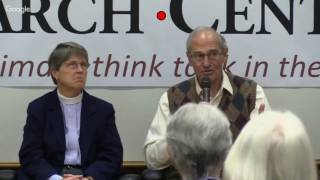
A panel at Woods Hole Research Center discusses how the 2016 election outcome affects climate policy and the Paris Agreement. Participants include Max Holmes, Bill Moomaw, Phil Duffy, and others exploring what government, business, and faith communities can do next.
Chapters
Welcome, everybody. I'm Max Holmes. I'm the deputy director and senior scientist here at the Woods Hole Research center, and it's my great pleasure to see you all here and to welcome you to this event. Tonight we have a full house. In fact, we have people watching online. So there's a lot of interest in this topic and it's heartening to see a lot of new faces here. So I wanted to just say a couple of words about what we do here at the Woods Hole Research Center. You'll hear more about that as the evening progresses. But fundamentally, we focus on climate change, on the causes and consequences of climate change, doing the fundamental research on that topic and also working really hard to shorten the gap between the foundational science and the application of that science for wise public policy. There's a brochure on one of the tables outside that describes in a bit more detail the research that we do. Now, many of you probably have already gotten it if you've been here before, but if you haven't been here, I'd encourage you to grab one to get more of an overview. I'd also encourage you to grab an extra or two and take them home and share them with your friends. The more people that can hear about what's happening with climate change, what's happening at the Woods Hole Research center on this topic, the better. We just announced this panel, I don't know, three weeks ago or something like that, and we kind of went back and forth. Can we pull this off before the holidays? Everyone's busy, everyone's doing different things. And we're excited to see the. I guess we're not surprised, but we're excited to see how much interest there is. We immediately sold out, filled the seats, had overflow seating upstairs, and again had an online audience as well, that we're hoping many others from around the town, around the state, around the country and around the world will tune in. People are wondering what's going to happen with climate change and climate science and climate policy moving forward? What will the role of the federal government be? What will happen with the Paris climate agreement? These are all questions that we're grappling with here. And I'm excited to sit back in a few minutes and listen to the panel discuss these topics. I wanted to point out one thing. So this is the. The overview brochure that I refer to is on a table outside we produced this spring. I'm going to read from the first page, the bottom of the first page. WHRC has been recognized for two years running as the world's number one ranked independent climate change think tank. If you forget that, you can see that up here. But the area is, it's, that's two years running. This is dated because now it's three years running. I think we'll stick with this copy until next year and hopefully we'll be able to say four years when we, when we retrieve it. Also in your seats, there are, let's see, a couple of other things. There's the program for the discussion tonight. There are also these question cards. So we want participation from the audience. The way we'll get it tonight is by you filling out cards with your questions. We'll do that at the beginning of the evening. That is right now. If you have a question that is on your mind, fill out this question card, pass it this way. They'll be collected. They'll make it to our moderator who will instantly synthesize all those questions. There'll also be another opportunity for you to write down questions midway through as you hear the panel progress. And we'll collect them again midway. We're remarkably fortunate to have pulled together this distinguished panel and, and moderator Heather Goldstone will moderate. She'll briefly introduce the panelists, but you have their bios and materials in the seats. Heather is the science correspondent at wcai, our local NPR station. She also works at wgbh. She does local stories, but she has a national reach. Many of her stories get out nationally and she's done in depth and insightful reporting on climate change. She was at the Paris climate negotiations last year. So she knows this topic in great detail. And we're extremely lucky to have her here. So I think I said what I want to say. Have I forgotten anything? If not, I will turn it over to Heather. Again, welcome to all of you. Thanks for coming. Thanks for being interested in this topic. Talk to your friends. Learn, ask. And thanks.
Because Max is only about a foot and a half taller than I am. Okay, so again, thank you all for being here this evening, for watching online, for watching upstairs. Yeah. This is an incredibly important topic at this particular time. And I'm really honored and excited to be here with such an amazing panel. You do have, as Max said, all of the bios in your brochures there. But just so you know who you're actually looking at and which one is which, we have Bill Muma of the Fletcher School at Tufts University. We have Deb Warner from the Church of Messiah. Right down the road in Woods Hole, we have Dylan Fernandez, our newly elected cape and island state representative. We have Ann Kelly, a senior program director at ceres, which is a Boston based nonprofit that works with businesses on sustainability issues. And then last but certainly not least, we have Phil Duffy, who is president and director here at Woods Hole Research Center. So in addition to reporting on climate change and environmental issues over the past several years, I've also looked into some of the science and there is a remarkable amount of science on how to communicate science and also risk related topics. And one of the really clear messages is start with the good news. So that's where we're going to start tonight. I would like to start by asking each panelist to give us a little bit of maybe not a whole overview, but a glimpse of where we have been making progress in the past five years. Bill, you've done a lot of work with the UN's Intergovernmental Panel on Climate Change, that's the science body at the un. And kind of as a part of that, the climate negotiations. I mean, the obvious is the Paris Agreement, right? But kind of at an international to federal level. Where have you been seeing progress?
Well, obviously the Paris Agreement was a remarkable diplomatic achievement. It comes up a bit short, as we all know. On the other hand, we have never before had a universal buy in from every country in the world. And it entered into force in less than one year after it was negotiated, which believe me, in diplomatic terms, that is lightning fast. I mean, there are treaties which have been hanging around for 35 years to get enough parties to sign on. So that's pretty amazing, the fact that one of those who signed on is the United States. Fortunately, they're more than the minimum number that have signed on in case something should happen in the next year or so and the United States doesn't continue its participation. But the range of contributions, they're not called commitments because if they were commitments, the United States could not have even been a party because we never would have gotten it through the U.S. senate. And a lot of other countries, including China, probably would not have signed on either. So if you look at the contributions, they range all the way from more renewables, more low carbon renewables, more solar, more wind and so forth. It also includes greater efficiency, more energy. The new term that people are using more is energy productivity, getting the same energy service with less energy. And so the productivity of that energy is greater. And that means if we have to use fossil fuels for it, we won't get as many emissions. So there are many, many ways to carry this out. Agriculture, changes in agricultural practices, forests, which is what Woods Hole excels in, the role of forests, the role of forests and soils, the role of other ecosystems both in actively removing carbon dioxide and reducing the amount of emissions from those ecosystems through land use change, whether it's cutting down forests. And in Brazil or in North Carolina, where, by the way, it is greater per capita deforestation in North Carolina right now than in Brazil. And so we have some responsibilities nationally, the actions that we were taking, the Clean Power Plan, even though it still hasn't gone into effect, some 150 coal plants have been shut down, power plants, and there are 50 more this year. I don't see those being reopened, no matter who is president for the next four years.
Phil, I wonder if you could build on that a little. And perhaps in addition to the policy side, what are some of the biggest advances we've made in the science realm and actually understanding what's happening?
Well, okay, thanks for. Well, first of all, I'm glad I'm not going last. I was thinking, well, so all the easy answers. And then by the time it gets to me, what am I going to say? So thank you for leapfrogging these other guys. Well, I have to say the science picture is not, on the whole, a source of cheer. I mean, my general feeling about climate change writ large is that the more we learn about the science, the scarier it gets and the more urgent it gets to see policy action. And until about a month ago, until the election, I would have also said, though, on the other hand, there's never been more happening on the policy front, and I think that's still true. But to get back to the science of a moment, the more we see about the potential consequences, particularly some of the consequences of changes in the Arctic and Antarctic, the scarier it looks. And without going into too much detail, what worries me is the existence of thresholds where if we cross certain thresholds in terms of amounts of greenhouse gases in the atmosphere, in terms of amounts of warming, then irreversible processes are set in motion. And just to give you one example, which is you may may be familiar to you with a little bit more warming, we will probably cross the threshold where the complete melting of the Greenland ice sheet becomes inevitable. Okay, that process will probably take 400 years, but the point beyond which it becomes inevitable may be within a generation. Okay. We don't know exactly where that point is, which is a science problem, but that drives a lot of policy urgency because once that process gets going, it can't be stopped. In terms of the policy, though, besides the Paris Agreement, which I think of the Paris Agreement as a process, not a conclusion. It's the beginning, not the end. But besides that, there has been and still is a lot going on at different levels in government. There's a lot going on in terms of climate action in this country and cities and states and corporations. And Kelly is going to talk about what's going on in the corporate world. She's a real expert in that. But that's very, very heartening. And I have to say a lot of that, some of that is a legacy of the pre Obama days when there wasn't a strong federal policy and the cities and states said, okay, we got, you know, we got to solve this ourselves. And some of it is a product of self interest, where parties see addressing climate change as in their self interest interest, as opposed to a good deed that benefits humanity as a whole, which it certainly does as well. So that, you know, to me, those are the two big things. You know, the science is not particularly encouraging. In fact, the more we learn, the scarier it gets. But on the policy side, there is more and more action. And I'm sure that if the federal government steps back from its leadership role, that we're going to see more and more action on the parts of cities and states and corporations.
Phil, one quick question and we will get to looking forward. But the Clean Power Plan, the linchpin of the contributions that we made as part of the Paris Agreement and really this major part of federal climate policy, where does that stand at this point?
Well, even before the election, it was in somewhat of legal limbo, as I'm sure many of you know. My feeling about it is, and the Clean Power Plan is, as Heather said, it's a key part of the United States commitment under the Paris Agreement. My sense is that regardless of legalities, if the administration does not want to meet its commitment, they will simply stop pushing the actions needed to meet that commitment. And that is the easiest path to slowing progress if that's what they decide they want to do. Not withdrawing from the agreement, not even withdrawing from the UN process, although they could do that, but just simply being passive and doing nothing.
Okay, I'm going to stick with the optimism for a little bit longer. And past five years working with the business community. What kinds of action are you seeing and how widespread is it? Yeah.
Thank you, Heather. I remember being here 18 months ago and it was all about good news. We were looking forward to this place called Paris and this agreement. And so, you know, I'm not going to sugarcoat Anything tonight, but it is good to start on a high note. To build on your last question with Phil, just want to say that the D.C. circuit now has the Clean Power Plan case and we do expect a positive outcome given that bank object judges to have it sometime in the spring. And that will be a moment for activism, celebration, protest messaging. We're going to need a lot of activism, protest messaging and celebration when we get any kind of victory in the next four years. So highlight that because it's important. Yes, There are unfortunately 29 states suing the EPA, and we expect that case may go to the Supreme Court or it may not be necessary if there's strictly a rollback. But the good news in my area, what I've seen in the last five years has been an incredible uptake of renewable energy by the private sector. In particular, the last two years, a huge number of companies have made commitments around renewable energy procurement. 60% of the Fortune 100 companies have a renewable energy goal. This is published in a report we have called Power Forward 2.0. You can Google it. The third edition is coming out in March. We look at the full fortune 543% of which have a renewable energy goal, energy efficiency goal, or both. Why? They've done the math. Does it mean that they're all left leaning? No, not at all. I can say that because we're right here in our tribe. And I gotta say, being here at the number one think tank, this is like a refuge. This is like, oh, it's so cozy and it's so warm and what I'm gonna talk about is so uncomfortable in comparison. But for right now, right here, it's great. You know, wind and solar, the prices have come way down. Companies want certainty in terms of their energy bills. They can sign on to power purchase agreements for wind. The price is predictable. Again, they've done the math. One major company is a tech firm. They've said to me, look, we've got climate deniers in the company. Don't you know that? Yeah, we're committing to going 100% renewable for sure. Done the math. So that is an unstoppable force. And at the moment, I've often said lately that the leading indicator of progress is the private sector leadership. The lagging indicator at this moment is perhaps the law and perhaps the federal government. But I do want to maintain some hope there. I did get to have one meeting with transition team members and I think that there is room for potentially common ground. I think we have to be open to that, even though obviously the current, the latest announcements would not be positive, but I think what we've noticed with the private sector and all of you know that several of the big tech companies met with the new administration last week. We know that those companies were saying, look, we're moving. We're doing renewable. Google has about 2.5 gigawatts of renewable energy. They've invested another 2.5 billion in renewable energy projects. They're not going to turn that back. And actually, they specifically said to me, look, we would have made those goals whether there was a Democrat or a Republican in the White House. So to Bill's point, there are some forces that are unstoppable, inevitable, irreversible, irresistible. Those are the ones we need to talk about.
Dylan, while, yes, for the past 18 months, the message has been largely progress at the federal and international level, before that, we still haven't had really a federal policy, but things have been moving ahead here in Massachusetts quite apace. What are some of the most important state policies that you see working on this issue?
So last summer, Massachusetts passed this really comprehensive energy bill, really terrific piece of legislation that allowed for it called for offshore wind and called for hydro energy. And so right here in our district, we have a new offshore wind project 12 miles south of the Vineyard that's coming in. It's underway. And this is the windiest place in America right here in our district. And so this is really a terrific project, and we're going to see this go underway. Companies are already involved. So this is right in our district, and it's going to be a huge gain for us. Also, there's another exciting project that the town of Edgartown is partnering with a tidal energy group to explore tidal energy. And whether it's viable. Right now, the cost doesn't really make sense for tidal energy. So it's going to need some sort of state incentives, and it's also up against some regulatory hurdles, but we're working with them to see what we can do locally. And in Massachusetts, you know, we've been a real leader on environmental issues. We've been a leader on environmental stewardship. And speaking as a millennial, I think this is the biggest issue facing my generation and facing my children's generation. So we really need to step up here. And in Massachusetts, we have we are rated number six in the nation when it comes to solar energy. I don't think I've seen the sun in like, four days. It is just crazy that we're rated number six. And, you know, we are. I don't Think we even break the top 35 states when it comes to the amount of sun we get. Right? And that's because of some really terrific laws we have here around, around tax incentives. And this is something that was not addressed in the energy bill, was solar. And so we're going to be up against. We already are up against the net metering cap. If I had it my way, I just abolished the cap. So we're going to be up against that. We're going to have to take that up. We're also going to need to be extending our solar tax credits. Also, there's some other legislation that has been pushed. In Massachusetts, there's been a carbon tax that has been pushed. The two different bills have been pushed for a carbon tax. One the most successful one had 40 co sponsors last session, was a revenue neutral carbon tax that might have a chance. Cautiously optimistic about it. But when it comes to a carbon tax, I was talking with Phil about this the other day. It really needs to be. It'd be terrific if Massachusetts was the first and we can lead on this like we've led on other things. But having a countrywide carbon tax is really the solution here. And also there's another bill that's been put forward to block up gas leaks. Right now in our state, there are 25,000 gas leaks. You know who pays for that?
We do.
We foot the bill for that. The ratepayers are basically subsidizing utility companies for their gas leaks. And so this costs, this costs US ratepayers 50 to $100 million a year. And it's estimated it only take about $50 million to plug them. So this is kind of another common sense piece of legislation. And there are others as well. But I think that's kind of a good baseline.
I'm not trying to hang you out to dry here. On Friday afternoon, Governor Baker released some new regulations, emissions reduction regulations that were actually court mandated. The Conservation Law foundation sued the Department of Environmental Protection for failing to live up to Massachusetts law. I don't know if you've had a chance to. I will say right up front, I haven't had a chance to look at them yet. I'm just curious if you've had a chance to look at those regulations and what they look like.
No, I haven't had a chance to look at them yet. But one thing, this reminds me of a similar story. So we passed the Global Warming Solutions act in Massachusetts in 2008 and it basically called for a reduction of emissions by, I believe, 25% by 2020 and then 80% by 2050. And so really kind of aggressive act. And this is what makes me encouraged about kind of my generation and young people's views on this. There was a group of four teenagers and Middlesex, I think they were in Middlesex county, who saw that, that Massachusetts was not gonna meet its goals here, and they brought a case suing the state.
And I believe it was actually. Yeah, those four teenagers.
Yeah.
With the help of conservation.
Yeah. Okay. Okay.
All right, all right.
We're telling the same story.
Yeah, yeah, yeah. And well, and they won. And they won. And, and, and basically the SJC said that the, the DEP needed to take stronger actions to reduce climate change and reduce the impact. So I think that's terrific news and I think that's really encouraging about the next generation.
Excellent, Deb. There's been a lot going on in faith based communities and organizations on this issue. Perhaps one of the biggest areas or one of the groups where you can find the most agreement. Every religion in the world agrees that we need to act on climate change. So for you, what are some of the things you've been involved in in recent years and some of the highlights for you.
Thanks. I'll sort of do A, B, C and D. One is that the church has become much more activist in terms of. And this was actually raised by the papal encyclical. I mean, that document raises the voice of the voiceless. He speaks about the poor and he speaks about our level of consumption and what that's doing in terms of the communities, both in terms of the human community and in terms of the natural world. So it's stepping up the plate in terms of activism. Another piece is also just being part of the table and at the table, having a voice. I don't know how many times clergy are invited and people of faith are invited to this conversation. We have to be part of the conversation. Everybody has a voice in the conversation and a part of the conversation. Dylan, when you talked about the carbon tax, one of the things I'm really proud of is the Diocese of Massachusetts was one went out in terms of one of our resolutions was in terms of passing that. And so as well as divestment that we have done in terms of the diocesan investment portfolio, which was an interesting process because a lot of the people who were involved in controlling the diocesan investment, which is a big fund that churches are invested in, some of which you can have is restricted and some which is unrestricted money to get the unrestricted money to be able to be moved out of the fossil fuel industry and into the industry, into renewables. It neither took an act of Congress nor it took an act of God, but it took an act of faith. Because these guys, and they're all mostly guys, were. You know, they're used to the idea that you make money when you can see it. And we were saying. And they were saying, that's our fiduciary responsibility. And we said, our fiduciary responsibility is not to make money on the backs of people who cannot afford it. So we stood up to that. And there now is an opportunity for parishes in the Episcopal Church. And this is across the board in terms of other denominations, too. I know that United Church of Christ is just. They are way ahead in terms of this. That you have these opportunities for alternative investment. So that's the kind of stuff that the church has been involved in and the faith community has been involved in. And you're absolutely right. This is an opportunity for people of all faiths and no faith at all to come together to talk about what matters.
We have a lot of momentum behind us. Then we hit November 11th, and suddenly we hit a lot of anxiety about what could be coming. Phil, you've advised a president and worked in the White House. Realistically, what do you expect from a Trump administration? What can the president and his Cabinet do in terms of dismantling the progress that we've been talking about to date?
Well, I hate to be unoptimistic, but they can do a lot. And there's starting with executive orders, as, you know, the. You know, the. The Obama climate policy or the set of policies. The Obama climate program was really designed specifically to be the set of things that could be accomplished through executive action without the cooperation of Congress. And again, the key tool in that was executive orders. And they can be undone not necessarily as easily as you might think, but they certainly can do a lot in terms of research. Obviously, they can reduce research budgets, and that's really significant because what that does is it silences the voice of science, and it's a way, frankly, of shooting the messenger. But I think that, unfortunately, that may be a direction that they want to go, that, you know, that science is inconvenient, and the voice of science may be inconvenient. And as you probably know, in fact, there's an ad hoc group of scientists and advocacy groups who are hurriedly backing up federal climate data just in case the worst happens. I mean, I personally think that's a level of paranoia that perhaps is not. Is not warranted. But you know something in that case, if you find out too late that it was warranted, then it is in fact too late. So unfortunately there is quite a bit they can do. I mean, I will say this though, and that is that, you know, the federal bureaucracy, and I did learn this when I was in Washington, the federal bureaucracy is very good at, it has a lot of inertia and it's very good at resisting pushes in any direction. You know, and I like to think I was trying to push them in a productive direction. But there's, they're very good at slowing things down, they're very good at obfuscating. And I've been on the phone with folks who are and in various parts of government who've said, yeah, you know, we're changing the name of this, we're changing the name of that. So they're relabeling things so it doesn't sound like, like climate change. And they are. And you know, it's, it's, it's that simple. And we had, I was acquainted with the expression when I worked in Washington, the expression we bes. And this, these are the bureaucrats who say we be here before you came and we be here when you gone, you know, and you know, the weebies, you know, the weebies could be very frustrating, but I think at this point the weebies may be our best friends.
To that point though, I've actually heard concern that some of the weebies may decide that it's time to become we don'ts or whatever you call them.
Well, no, it's true. And it's a, look, it's a real quandary. I mean, if you're, if you're, if you work in one of these agencies, for one thing, the political appointees are gone by definition, but the career people in these agencies, and again, I've talked to a number of them since the election. It's hard and the basic decision is, look, do I stay and fight this and try to block things and try to obfuscate? And that puts you in a very, very uncomfortable position to be at odds with your, with the top of your chain of command. It's very, very difficult. It's very uncomfortable. It's a day to day nightmare. You know, do I do that or do I just get the hell out? And you know, everybody has to make their own decision. Of course the danger is if those people, you know, get out, then they, they can be replaced with others who will be more cooperative. And, and look, the thing I worry about is I would hate to See the United States become a place like China, for example. I hate to use single out an example where you don't believe the statistics that come out of the government right now. I basically have faith when I read economic statistics, when I read climate data coming out of the federal government, I believe it in the sense that I believe this is the best information that science can provide. But that's not true with a lot of countries. You know, the numbers are cooked. Right. And I would hate to see that happen in the United States. And it's the dedicated bureaucrats who sticking to their posts and fighting who will prevent that from happening.
What do you think are the prospects if the United States withdraws in some form or simply without formally withdrawing steps away from the Paris Agreement. What does that mean for the Paris Agreement?
Well, it certainly won't kill it. I mean, I, you know, I believe, and a lot of people believe that the agreement would not have been possible without U.S. leadership and specifically the, you know, the U.S. china agreement, the joint announcement, which was about a year before the Paris Agreement, US Leadership has been very important. But look, there's no, there's no question that the process will continue. And I think you were in Marrakesh. I was in Marrakesh for about a week after the election and I heard nothing other than, well, we're going to get the job done. We're going to redouble our efforts and get the job done with or without the US And I'm not saying the US Involvement doesn't matter. It does matter, but it certainly won't kill the process.
Bill, I wonder if you could weigh in on those same questions you've been nodding to some of this, maybe not exactly on the same page on others in terms of what you expect in terms of a Trump administration.
Well, when I get up every morning and read the newspaper, it does not look good. The appointments are just about the worst I could imagine if we really wanted to solve the problem of climate change. On the other hand, I'm encouraged that I've heard several Republican senators say that certain of these people are not suited for the positions. And I would suggest we write to those members of the Senate and congratulate them on their leadership and urge them because we only need two or three of them, three of them to make say no. And some of these people will not be appointed. I just want to pick up on a couple of other comments were made here. I do some consulting and I just came back from consulting for major US Manufacturing Corporation and I'm on their external Sustainability Advisory Board. And the statement, there's a changeover from the CEO who set this up and the new one. A week before our meeting, we got questions, which dates next year we're available for the sustainability meeting, a lot of which is about climate change. And we met the new CEO. He said, we're not changing our direction for the sake of one four year term in the White House. And I think you probably have more connection than that through the climate group, which I on the board of, same sort of thing. The corporations there are all saying, we're aboard, we're going to keep doing this. So I think an awful lot is going to happen outside of the federal government. In fact, most of what has happened in the United States to address climate change has happened outside, outside of the federal government. This past year, Iowa, which is not exactly a blue state, got over 30% of its electricity from wind power. And the estimates are that sometime in the early 2000s they will be. Three quarters of their electricity will come from wind power. Texas has more wind power than any state in the United States. I think they got 12 or 13% last year. These kind of changes are taking place because, as you said, they make sense. And I think that's one of the best defenses here is when something is proposed is to argue it in the economic terms, because there's going to be, if you look at the views of the Republican Congress, they're all basically about money, money, money, saving money, not spending money, doing this and that and the other thing. And if we're going to do things, we need to do it in the most economically efficient way possible. And a lot of that falls exactly in line with addressing climate change. So that's not everything, but I think we grab those opportunities and use them in that particular way. And the fact that the states have been doing so much, California's new plan is extraordinary. Massachusetts done quite well. I think the court case was great. I was actually an amicus intervener in that case with the teenagers. They wanted somebody from the scientific community to give it a little credibility. And I was honored that they thought I could do that. And I was ecstatic when it was a unanimous decision by the Supreme Judicial Court delivered by the politically most conservative justice. Now, that is, I think, progress. We know that we are home, at least in this state. So let's just see if we can't keep operating where we can operate. And we will try to prevent the worst from happening, but we will go.
Forward.
In the ways that we can.
I had a comment on the Trump Nominees, I mean, I generally agree with you. I mean, it's hard to bring myself to look at the news because I have to fortify myself first. But I will say, though, that the one who stands out, possibly from the others, is Rex Tillerson, who's the CEO of ExxonMobil. And I never thought I'd hear myself say this, and George Woodwell may disown.
Me, but.
People who know him seem to think that he has integrity. And he has said that he thinks climate change is real. He said he thinks it's serious. He says he supports the UN process and the Paris agreement, and he said he supports a carbon tax. So what the hell, you know. You know, the problem is, of course.
We can't have this, say that statement about supporting a carbon tax, at least in one speech, was qualified.
It was.
Of the options.
Yes, it was, it was. But still, you know, the problem is we cannot have the State Department having one climate policy and the EPA having one. That's completely the opposite, at least as far as I know, we can't have that. Although I don't know what's possible anymore. So I think I, you know, I think something's going to have to give. We'll see. But I, you know, I have a little more hope for him than for the others. I don't know, maybe you want to comment on that.
And, and I wouldn't presume to think that the business community is any monolithic entity. What kinds of responses have you been fielding and hearing from business leaders to Trump's election? I mean, he's a businessman. He ran on a platform of jobs and economics.
Well, there's businessmen and there's good businessmen. Before I go down that very dark path, there's a point of highlight, a positive note. I forgot to mention earlier when Phil said inconvenience, I couldn't help but want to tell you all that you may know. Al Gore has come out with the sequel to An Inconvenient Truth. It's all based on solutions. It's not a downer at all. It's all the good news. And he focuses on Texas as being this incredible wind center. So that will be released, a public release in May. And when they release it, they have a surround sound of positive announcements and commitments around it. It's going to be breakout at Sundance in January. I asked before this session if I could take tell you that and they said yes. So that's good news. The reaction to Trump, I don't want to. I mean, you've all read the reactions I don't think in the business community, they've been really any different. There's extreme concern, extreme regret from a wide range of issues. Many companies actually rely on international trade. And so the loss of the tpp, they just don't see any sense of that. You could say, well, are they acting like kids in a candy store, given the upcoming tax cuts? No comment on that. But there certainly are going to be tax cuts coming. But there's just deep concern about a full range of issues and really a lack of confidence about competent leadership. I think that's a pretty deep concern. The one meeting I had with two members of the transition team, there were CEOs in the room saying, we want to build a bridge. We want to have common ground. The team was suggesting, hasn't it been horrible these last eight years? And they said, no, no, actually, really hasn't. Things have actually kind of worked pretty well. So that was an important bonding moment, I thought. And I saw. But I saw in that conversation the possibility to bridge and the catch word tonight. I mean, it has to be bridging. As I said, this is a wonderful tribe, but, you know, we have to not be red and blue anymore. That's why I'm wearing purple.
Purple top.
I think the hard work of the day, and I really do mean the hard work of the day, is really trying to bridge, build, and come up with solutions, though I am, I tell you, I got to tell you, I'm sitting next to. I am so, so inspired. I'm just feeling the inspiring. Love sitting next to this guy. And at your age, I really compliment you for running for the legislature. And I know you're going to be working 247 after January 4th, so you better party between now and then because we're going to be on you. But I don't think I knew. I mean, you just gave us a great marking. But this is the windiest place in the world. Less hot air, more wind. Go, Massachusetts. Yeah, you got to use that. Yeah.
I mean, is our perfect entree to a big thing we wanted to talk about tonight, which is how do we go forward and not just in terms of action, but how do we begin to build those bridges, Talk about climate in perhaps a new and different way. Dylan, as our. I wouldn't say token, but our single representative of millennials here. I think in the entire.
I'm the token young person wherever I go these days.
I mean, this is, as you said, millennials and young people. This is simply scientific fact, a reality. And the single greatest challenge that you face. How do you begin to spread that message, that vision to other generations and more broadly?
Thank you. Just a quick point before that about Trump's transition. Actually, just two hours ago, signed on a letter with fellow legislature legislators and future legislators, Reps elect, calling on Trump not to bring in Steve Bannon into his administration, not so much because of his views on climate change, just because of more on his like approach to and dismissal of general civil rights and civility. So. And, you know, and the leader in our state against Rex Tillerson has been my former boss, Attorney General Maura Healey, who is really leading the charge against him and also notably has sued. Well, is it suing ExxonMobil to see it has launched an investigation, basically into what they knew about climate change. And then a court in Texas has then been trying to sue the attorney general for looking into Exxon and what they knew, which is just absurd if you think about it. But to strike a more hopeful note, you know, I had, I went to new legislator training in Amherst two weeks ago, and there's, I think there's 10 new freshmen. And of that 10, seven of them are millennials, which I was shocked. I'm not even the youngest, you know, and seven of them are under the age of 35. I thought it was really terrific. And for our generation, this isn't a controversial issue. And if you really want to feel hopeful about the future, go home and Google a map of how people under the age of 35 voted. You'll see about four states are red, and they're the predictable ones. You know, so this is, you know, when it comes to global warming, when it comes to basic LGBT issues and civil rights issues, you know, I'm really hopeful that my generation gets it. And also when it comes to the Massachusetts legislature, which at times, at least in the House, can be a little more conservative, it's certainly a little more conservative than I am. I see this movement and this injection of new young people and progressive people as a really good positive step in the right direction. And for me personally, working on environmental stewardship issues is going to be my top priority once I get up there.
Ann, when you talk about this, you already have changed your messaging or tailored your messaging somewhat because you are often working with perhaps more conservative and a more diverse group of people within the business community. What are some of the messages that work that we can, you know, the stories we can tell or the kinds of actions that we can take that can bridge between liberal and conservative? I mean, there's plenty in addressing climate Change that actually gets right at core conservative values.
Well, there is. And even before the election, we were working with conservatives for clean energy in Michigan and in North Carolina. By the way, the action's gonna be at the states. If it doesn't go without saying we're delighted to be in Massachusetts. There's also many other states where good things are happening and things are less partisan. They're still partisan, but less partisan, less vic. And actually, things get done, decisions get made, which is refreshing. Conservatives for clean energy. I was with them for a full day in Michigan talking about energy issues, about procurement of renewables. The word climate change doesn't come up, and we're told in many states, North Carolina being one of them, just don't mention climate change and don't mention science sitting here. I hate to admit that economics speak louder than science, but to Bill's point, you know, at this particular moment, I am afraid that's the case. And that dollars and cents. And really, this is. This is not the word. Climate change doesn't come up. And we're told in many states, North Carolina being one of them, just don't mention. Don't mention climate change and don't mention science sitting here. I hate to admit that economics speak louder than science, but to Bill's point, you know, at this particular moment, I am afraid that's the case. And the dollars and cents. And really, this is not good. But I think we have to be highly pragmatic and we have to build the bridges, make the bonds. Of course, the whole election, the lesson of the election is that, you know, both sides have a lot more listening to do. Bob Inglis, the conservative Republican from South Carolina, many of you know him, who's from the reddest state and reddest district and the red estate, said two things. Think we should talk about climate change. And I don't dislike, I don't hate President Obama out of office like that. He has told me we need trans tribalism more than anything, that we're in our tribe and they're in their tribe and we have to figure out a way. He also said we needed that liberals had to have grace when we approach conservatives. And I said, okay, I think it needs to be reciprocal, actually. You know, it's like, okay, I'm willing to do that, but obviously a lot of what we've been doing hasn't worked. It's worth looking at Merchants of Doubt again, the film. I know you all remember this, but two weeks ago, at a particular state, during a debate about increasing the renewable Portfolio standard. Those of us who were for it, those advocates in that particular state, along with my colleagues on the House floor, were called socialists and communists. 2016, okay, so that's December 2016. Now in that particular state. The good news is the unfortunate legislature did pass that bad bill, that unfortunate bill, but the Republican governor is going to veto it. That is gonna be one of those causes for celebration. We have the thank you notes written. We've got the newspaper ad by Dunn. Okay, so it's gonna be, thank you, Governor X. You did the right thing. And then the private meeting is. What's the political cover that you need? What do you need from us? So all our private meetings now on Capitol Hill, and to Phil's very good point, by the way, we do know how to slow things down. We know gridlock, as we learned from the pros this last eight years. So can we stop stuff? Oh, yeah, Remember appointees, okay? All those appointees have to go through Senate confirmation processes. Susan Collins, for one, has expressed extreme doubt. Lindsey Graham has expressed extreme doubt. John McCain. These are people we can write to, call, talk to. You can do that privately or publicly. You can do it in a tweet. Well, let's not talk about that. You can do it in a phone call or an email. You can call the staffer. You can talk to your relatives and friends who are in those districts and states. But in particular with the Senate, it's not that hard. We've got about 15 reasonably moderate people you can communicate with. But to Heather's much larger, very important question that that is a much bigger task you're getting at is how do we now, you know, we don't want to be called watermelons. A lot of people in the red states would still call us watermelons. Everybody tell me what that is. Green on the outside, red on the inside. And that's still communists. And when this happened this month, my young staff are saying, why are they calling us communists? Okay? I said, wow. That's the reason is we've not done our work. We've not done our work. We just really haven't.
How much of an ally or tool perhaps can the military be in this kind of work?
Thank you for asking. I should have said that. I talked to the Deputy Secretary of the Navy for the Obama administration. He's now at a private company, but he was the green energy guy and basically said the one thing he was pleased about with Mr. Mattis, I forgot his first name. The appointee is that he really. Excuse me, Mad Dog Mattis. That was it. Thank you. Mad dog.
Of course.
How did I forget that? The one great thing, he's a mad dog about green energy and he really understands this vital link about security and green energy. And the gentleman I was talking to is now at a completely unrelated company. We spent the whole time talking about the army and the Navy and how, you know, with a deep analysis of how important this linkage is. And he said this fellow gets it. So, you know, let's hope so. Let's see how he testifies and let's contact our delegations and make sure that he gets asked the right questions. But I think generally, I think the military can be a real ally because no longer. See, what Bob Inglis told me was the Republicans didn't necessarily trust the DoD messages earlier because somehow there was some myth that Obama was telling them what to say. Well, guess what, they're still saying it. And it's a new administration, so we should definitely leverage that.
All right, it's 6:25. I will be honest with you. I've already got more questions up here than we can possibly address in the next half an hour. But if you have a burning question, please get your cards to the front. We'll see how much we can get through in the, in the time remaining. Bill, the science message about climate change has been out there for decades. The economic message has been out there at least for several years. Is it time to try something totally different? Ethics, morals?
Well, the discussion has been dominated by scientists and economists, and as you point out, it's not actually persuaded a lot of new people to come into the, into the tent. I guess I'm addicted to facts. That's an unfortunate aspect of my upbringing or something. I don't know. I do think that continuing to use facts is important, but I think one of the most refreshing things, and you mentioned this, was the papal encyclical, which for the first time injected ethics and morality. You don't have to be a Catholic to hear what the Pope had to say. By the way, as somebody who's written many IPCC reports and parts of them, I wish we had been as clear as the people who wrote the climate part of the encyclical. It is absolutely clear, short, concise and.
Powerful and references scientific documents.
Yes, I mean, I mean, thank you, Galileo, for working this out a long time ago.
But basically.
Basically he just says flat out, the science is clear and it is accurate. You know, that's basically what he says in clear terms. And then he goes into the moral and ethical. And since he's the Pope. Theological arguments, they all are congruent. They all line up, they're all saying the same thing. And it was just so refreshing to hear that message coming. And then all the. I mean, the past three years I have given more talks at churches and synagogues almost than I've been giving university lectures. I mean, the number of congregations who want to hear about this issue and what they can do is really, it's very encouraging. And for all of these religious groups, it is a basically strong message. Let me just share another dimension of this. My wife Margo and I were in Vietnam for 16 days during the time of the election.
We were with.
23 other Americans. And we were all stunned. And, you know, we went through all the, you know, the grief, the anger, the everything, all the stages one goes through. And we were in the museum, in a history museum in Saigon. And needless to say, the United States has not had a great record with the Vietnamese. What amazed me is we sensed, no, not a sense of hostility the whole time we were there. We found an explanation for this, in a way, from a statement that was in the museum that after the end of the American war, one of the leaders made the following statement. Anger uses an enormous amount of energy that is better spent in moving forward. I found that so powerful and so moving being in that situation. But it occurred to me, I think it applies in our country as well.
Deb, what are some of the. In perhaps, you know, just laying it right out there. What are some of the moral and ethical cases that we can make that do span political views that are kind of universal values based arguments that we can make in this space?
I think it. You could begin with simply, if not now, when? And if not us, who? I mean, I. A few years ago, I was honored by opportunity to take a sabbatical. And one of the places I went to was in. Kate was in South Africa and I went to a township.
And.
It was clear that when I was with that community, it was an Anglican service. There was such an open heart of the people to me. And there was really an exchange of heart of my heart with them and their heart with me. And in a way that that was carried out as I went, was in Paris and was able to sit in on a workshop which was an interfaith conversation about the relationship between environmental justice and violence. Now, this is, of course, right after the terrorist attack in Paris, but there clearly is a connection between what we're doing to our neighbors now and here and now and what we're Doing to the generations to come, to our neighbors down the line in generations to come. We can't afford to not engage in the conversation no matter where we are. I come to this work, to this calling as a parish priest. I said yesterday in the congregation, I've been in parish ministry for 40, for 34 days, 34 years and a day.
So.
And I do that listening to people's stories and list and. And coming as a pastor. And in a way, for me, it's also listening, paying attention to the story of the natural world around me and around us. And it's listening also to the voices of people that are people who were in, you know, in that community in Cape Town and the people who were. That I met at, In Paris that were from. Who were from the Pacific island nations and their whole. Everything's going underwater. I mean, imagine. I mean, Sandy was bad, but. But it's. But imagine just having to pick up and I mean, environmental refugees. It's real. It is happening now. And we have to. That sense of just having to pay attention. So the hopeful part of that is, I think where people are starting to pay attention, they really are. We're crossing boundaries that, you know, I seem, I. When I was ordained, I loudly said, I was ordained to the Protestant Episcopal Church. Well, then. And I never imagined reading the papal encyclical. I mean, I never thought I would do that. But that document is written in such a way that is invitational to people across faith traditions. It really is. And non faith traditions as well. Absolutely. As Bill says.
Phil, I know you've been wanting to.
Jump in here in terms of how do we reach people? I mean, it's definitely true that different messages reach different audiences, but in my opinion, the single most important concept, the single most important message is about solutions. It's not about. And it's not about science. And I'm a climate scientist and I've spent 25 years thinking about it, researching it, discussing with people. But the reluctance to accept climate science has nothing to do with the science, okay? The reluctance to accept the science is because of what comes next. Okay? And what comes next is, well, if I accept that this science is right, that climate change is happening, that humans are causing it, then that means I need to do something about it, okay? And that's the part people have a hard time accepting. And they have a hard time accepting it because they've been told that doing something about it means sacrifice, that you can't have a car, you can't, you know, you have to live in a Cold cabin or something, you can't heat your house. And they've been told that deliberately by people who are the same people who propagate myths about the science, okay? So I think the most important message that we need is that we can address climate change without economic disruption and without sacrifice. And look, sacrifice doesn't sell in the United States of America, okay? A message of sacrifice, forget it, it's not going to fly. And I truly believe that as well. And one of the things that's really interesting now in the academic sphere to me had nothing to do with science actually, but is the fact that we actually now in the world are starting to gain significant experience with climate policies, with cap and trade systems, with carbon taxes. The number of jurisdictions who have these policies in place is amazingly large. Larger than I knew, probably larger than you, you know. And we're starting to get a body of experience with how do these policies work and what are their economic consequences. And it's really interesting to read that literature and what the literature shows, in fact, the economic, to the extent that we can discern it and it's, the picture is still starting to emerge. But to the extent that we can see it, the economic consequences of climate policies like carbon tax, like cap and trade systems, are either undetectably small or positive, actually helping the economy. And that's a key message because if that holds up, if that turns out to be generally true, and I believe it's true for well designed policies, if that turns out to be true and if we can get that message across, then how can you argue against addressing climate change if it actually helps the economy or at least doesn't hurt it?
Absolutely.
So I come from, I come with a background of working in politics and worked on Elizabeth Warren's campaign, was, worked on a few other campaigns, was Maura Healey's political director on her campaign. So have a lot of experience of communicating to voters. And so I mean, if you're commuting to a Democratic electorate, you know, you're hammering in on, you know, some, you're talking about climate change, talking about kind of civil rights, and hammering in on some like really kind of red meat issues that gets the Democratic base fired up. If you're talking to an independent or someone who's just not interested, they care about their pocketbook. So those are the issues that you talk about. They care about, you know, the health care, their health care costs. They care about kind of their job and their wages. They care about the money that's affecting them on a daily basis. And so I think when messaging for climate change, we need to be coming up with incentives that have these people who frankly could care less about climate change buy into the system. A great example of that is our solar tax credits here in Massachusetts. I know a whole lot of Republicans who could care less about global warming that have solar panels on their roofs because it's saving them on their energy bill and they're getting tax credits. So as a policymaker, we need to be thinking about ways to get people who don't care if the sea levels are going to rise or don't care about global warming to buy into our system of trying to create change here.
Ann and Phil, we've got a lot of people here looking for some pretty concrete guidance. What are in terms of technological advances, research and development, Are there one or two areas that you can highlight that we really need to be pushing on? And is one of those a new generation of nuclear energy?
Okay, you know, look, this is. My opinion about this generally is not. Well, you often hear it said that we need an Apollo program for renewable energy to develop new ways of generating clean energy. And I think that's exactly wrong. And I think it's exactly wrong for two reasons. And one is that we have solutions, clean energy solutions at work and wind and solar and Woods Hole Research center right here. We get most of our power from wind and solar. And it's great. It's cheap, it's totally safe, and it's incredibly abundant. I think that's more or less a solved problem. I think we do need better transmission grid, we do need better storage. Those are important components. But in terms of the basic technology to generate renewable energy, we already have it. And the other reason that the Apollo program to generate new technology is wrong is that we don't have time. You know, even if you had a, you know, if I had a great idea now for some new way to generate clean energy, it would take 50 years for me to develop that and test it and bring it to market at a large scale. And we don't have 50 years. So I think it's too late for new ideas. I think in terms of renewal, in terms of clean energy, what we need to do is just deploy the solutions that we already have, and they're good and they're safe and they're abundant and they're cheap. The problem that I think really is a big. And I'll answer your question about nuclear, but. Well, let me answer that question first. You know, nuclear power. And again, George is going to disown me here. But, you know, I think in principle it's actually not a bad idea. And in the sense that, you know, the safety record of nuclear power in the United States is, is essentially perfect. I mean, there have been zero. In the whole history of the United States use of nuclear power, there have been zero fatalities from nuclear power. I don't think you can say that about any energy source, I'm sure, not even solar. I'm sure someone's died falling off a roof installing a solar panel. But look, I do think the reality of nuclear power is whether I like it or not, it's very expensive. And it's very expensive because, because of, largely because of regulatory issues and some of those are very appropriate. So I think as a practical matter, it's not going to happen. Utilities who are looking to install new capacity renewable is much more appealing because it's cheaper. I'll say one more thing and I'll let Ann comment if you want to. And that is the problem that I, the technical problem that I really think is important and is largely unsolved is how do we remove somewhere between 100 and 300 billion tons of carbon from the atmosphere? Because that's what we need to do to control climate change at an acceptable level. We need to remove an enormous amount of carbon from the atmosphere and put it somewhere. And that is really an unsolved problem. If you read our newsletter and so on, you know that climate smart land management, like reforestation, like climate smart agriculture, is one way to do that. In fact, it's the only way to do that at anything approaching the scale that we need. But it may not be enough. So that's certainly an area where we need new ideas.
Yeah, I can just completely agree with Phil. We need to modernize the grid as well and have an intelligent grid instead of a dumb one. And the only tragedy is that again with the federal government, the cuts in funding for research and development are going to be highly unfortunate and something we need to also push back against.
Dylan, as a legislator, policymaker, are there science questions at a local to regional level that you think we need to answer? Things that perhaps Woods Hole Research center or Woods Hole Oceanographic Institution down the street could answer for us to help us make more headway, figure out what our plan is here in Massachusetts?
Yeah, I think, I mean, one of. So I was at, I was at, I actually toured fisheries earlier today down in noaa, which, and they were thinking about leaving, but it looks like they're going to be staying here in Woods Hole. Well, okay. Not Too preliminary. We still have some work to do, but it's more encouraging. You know, Woods Hole is home to the most terrific world recognized scientific institutions in the world. We're sitting in the institution that's rated number one globally for its research on climate change. Right. These are institutions that if you go anywhere in the world, people know about them. But oddly enough, in Massachusetts, if you went out to Worcester and said, hey, have you heard about the Woods Hole Research center or WHOI or wherever, they're going to say no, Right? So I think our state. I think we need to do a better job as a state as recognizing these terrific resources that we have here, not only as environmental resources, but also as core economic driver to our region. And we talk about, you know, especially locally, we talk about a dearth of economic opportunities, especially for young people. Well, you know, I got to tour the Woods Hole Research center the other day, and Phil is a young guy, and, you know, these are really terrific jobs here locally. And we as a state need to be more supportive and it needs to get greater recognition. And I was also talking with Representative David Viera today, who's my counterpart in Falmouth, a Republican, but a good guy and really cares about local issues. And we were talking about. He had a meeting with folks at HUI recently, and he asked them, you know, is there. Is there kind of a forum or some sort of group from all. With heads from all the different agencies that meet together to talk about kind of the different issues that are coming up and what they can do to act together or where they're overlapping. And he said that the people at HUI said that there weren't. And so I think there wasn't this group. So I think one. One good thing that could come out of this is having all the research centers locally work together and at least have some sort of conversation about what's. About who's doing what? Because there's an ocean acidification bill that Tim Madden filed last session that I plan on filing again this session. And Noah studying it. But some people are telling me that WHOI is also studying it. And so getting information as a policymaker and not knowing kind of where people are on the same page can be a challenge. I think one potential fix to that is having the agencies talk a little more with each other. But also I would like to see the state step up and recognize these institutions that we have here and hopefully supply them with more funding.
I would like to end by going down the line here. So many questions here. What land use changes do I make how do I promote a carbon tax or other local legislation? What do I say to my neighbor to refute what they're hearing from the administration? A real hunger for concrete advice about an action that can be taken tonight, tomorrow, whenever the opportunity arises, take your pick on what area. But one concrete action that people can take. Yeah, we'll start with you.
All right. I think we can all start with what we touch. We touch our homes, we touch our, our vehicles, we touch our purchases, whether it's food or whether it's items of stuff. Actually stuff has more carbon intensity per capita than anything else we do. But we. So our choices are important in our homes. I mean, George and Catherine developed their unique solar technology many, many years ago. I can't remember how many years ago it was George, but it inspired me. When they built the Woods Hole Resource center, look what they did. This is the 10th year that our zero net energy house has been functioning in the Berkshires. Anything you can do to reduce your emissions and it means thinking about it. So it's not just that the technology exists. Does the concept exist in your own mind? What can I do? And let me tell you, when you do it, when you put the solar panels on your roof, what was unthinkable in your neighborhood suddenly becomes a fad. And that's what we need. This all has to be the cool thing that we all do. So anything you can do to be an example for others as well as meet your own needs. And by the way, it will pay you in dividends extraordinaire. Investing in solar panels in 2006 and seven was the best investment I ever made because in 2008 my retirement was reduced from a 401 to a 301 retirement fund. But I still kept getting the same return on my solar panels for the whole time. It's great.
I would say spend time with someone in your family or a friend and find a child. Child would. Might be even the best. But anyone and, and ask them what go to tell them. Ask, ask, tell each other what is a favorite place, why and why is that important? Or, or what is a favorite animal and why is that important? It's a very simple thing to do. But I am convinced that the way into the conversation we sort of have different windows in. But one of them is to see, to look in the eyes of another person and to say this is what matters to me, what matters to you in terms of this conversation. The other is that Sally McFay, who's an theologian, who's written about Environmental concerns for about 45 years now has a wonderful metaphor. She says, are we going to treat the world like a home or a hotel? If it's a hotel, there's so much that's disposable. You know, you, you use the, you know, the shampoo and the this and the that, and you just toss it away. But a home, we don't do that with. So it's really, it's doing both those things. It's, it's, it's spending time with someone you care about and finding out why, what it is that matters to them. And then in terms of our own consumption levels, are we going to see the world as a home or a hotel?
I would say take action. Woods Hole Research center does the research, but there are groups out there that take direct political action because of the way that they're structured. The Environmental League of Massachusetts is a terrific organization in our state that lobbies legislators, puts pressure on the legislature. It helps people like me get elected. They endorse me because of my views on the environment. And also there's the Sierra Club of Massachusetts, another terrific advocacy group that gets involved. They make phone calls, they knock on doors, they can't donate, but, you know, they, they do the volunteer work to get people who have really strong views on the environment elected. And that's really important, right? That's why this panel is here, is because we elected someone who doesn't believe climate change. And now we're kind of thinking about, you know, how do we address this? The elections are extremely important, but also the time between them is even more important. So, and that's why, that's why the people in this room really need to step up and get involved, take action in really meaningful ways. And so calling legislators, you can call me, I, I guarantee we're on the same page. But more importantly, call your friend who lives in Hanover, Massachusetts, that has a legislator that's a Republican or has a legislator that's not keyed into environmental issues, and have them call their legislator and think about that. Think about what you can do across the country to put pressure on legislators. Because as a, as a soon to be state rep, if I get three calls on an issue like, wow, this is a serious issue, you know, people are really fired up about this. That's three phone calls, right? I haven't gotten, I mean, I'm not in there yet, but I haven't gotten three phone calls on anything yet. And if you, if I did, you bet I'd be paying attention to it. So direct advocacy from constituents is incredibly powerful. And too often people in our state, locally, and in our country think that their voice does not matter, that their voice is not a part of the political process. That couldn't be more wrong. And so I just urge you to take action, put pressure on legislators, and don't think of elections as the time to act, but think about the time between elections as the time to act.
Well, Heather asked us what to do, and I want to make some suggestions, but first talk about how we do. These were all three really good suggestions. And I think how we have to do things now is with a vim and vigor that we never had before. I woke up with no voice. I said to my husband, honey, I'm not going down to Woods Hole today because I have no voices. What do you mean you're not going to go? You're not going to show up?
No.
I'm making you a hot toddy. Whiskey, honey, Lemon, you're going. So I'm here. There he is. He brought me here.
Okay, we know where she gets her vim.
Invigoration. Yeah.
It's all, I'm Irish. I'm just telling the truth. It's the only reason I'm speaking right now. I say that because I know my parents were big Vietnam war activists, and there was a time there where every week and they didn't know what protest they were going to next. It was like, we're going get in the station wagon. We're going to D.C. from Michigan. There was a sense of urgency that I know people in the civil rights movement have felt. And of course, they did this all without the Internet. So lucky us. Lucky us. We have all these resources. We live in Massachusetts. We have an amazing center like this to come to. We have no excuse to whom much is given. So great suggestions. Love, Bill Mumas. You know, when you get the solar panels on the roof, do the cocktail party and show them off. Roof envy is a great thing. And, you know, try to invite people that, you know, voted for either their Republican representative or congressperson or for Trump and just start to have that conversation. And, you know, it. It's not fisting the air. It's to help us understand what motivated you. And then I think we have to listen and listen and listen and then get out your utility bills, plaster them up on the wall. I really agree with Deb also, and I would recommend that conversation with a child because I'm getting very concerned about nature deficit disorder and making sure that that child takes you to a place and not a screen I want to build on what Dylan said. And of course, you know, I'm going to call for political action as well. And at the federal level, I Hope everyone's in D.C. on January 21st. All those confirmation appointments deserve your pushback. We got to pay close attention to moves on defense. There's many, many efforts around saving the Paris Agreement. I have one happy to share with you later that's going to bust out on January 13th just before the inauguration. Also need to push for those fuel efficiency standards and cars. We don't want to push back on Cathay. Super important. And I think that, you know, it is really important to be active on Beacon Hill. So I know we're all going to sign up for Dylan's newsletter and he's going to tell us, you know, when we can show up, when we can speak up, when we can really make things happen here. I think we can pass a carbon tax in Massachusetts, and we need to do that. I'm active at the federal level. That is happening, too, if you're interested. You're right. It does need to be federal. But there's so much that we can do here. I think we need to rest up, have a good holiday, and then come back after the New Year, you know, really, really ready to roll.
Before you hand the microphone away.
How.
Can consumers vote with their dollars? You're a representative from the business industry here. Are there tools? How do you even know what it would mean to vote with your dollars as a consumer?
Well, Bill made a good point about stuff. And there's a great quote from the sustainability director of Ikea that said, we've reached peak stuff in America. Peak stuff. And this is a guy who sells stuff. Okay, but leave it to our beloved Swedes. They completely get it. So then the NPR interviewer said, well, then what's going to happen to your business? We're going to go into other markets, but in the U.S. yeah, peak stuff. So there's nothing like a consignment shop, a secondhand store. There's nothing like looking at the label of where your stuff is being made and say, do I want to watch this being made? Because if I don't, I probably don't want to buy it. I mean, is this not a Yankee crowd? I mean, I think that this crowd completely gets it and has for a long time teaching our children, obviously, you know, to buy fewer things. But in terms of, okay, now you do have to go to a place and buy a thing, and you're asking, what's the more responsible entity there Is a lot written about this. You know, if I think asking when you're making a purchase for a sustainability profile from the clerk. I do this at Starbucks all the time. Remind me why you grocery coffee now? Where's your sustainability package? And I was buying an oriental rug a while ago and I said, you know, excuse me, I didn't see the label about no child labor on this one. Do you have it on this rug? Because otherwise don't buy it. It's a really effective thing to do. You get all the way up to the counter and then you say oh. You pretend like you really wanted to buy it. Say, oh, so you mean you can't tell me that there's no child labor in this and that it was powered by 100% renewable energy. Okay, I don't want to make the purchase. Reverse purchasing, phantom shopping. It really does work because all the big brands pay attention to this. No, I'm telling you the truth. Other than that, Buy Less Patagonia is the best. Ask a lot of questions and try to look at the renewable energy profile of the company just to get right into climate. Of course child labor is important to me, but really on the climate change issue, on all their websites now, you can find their renewable energy commitments. If you don't find one, then you need to go to the store and say, excuse me, before I make that purchase, can you just remind me of your renewable energy commitment? And guess what? You're most likely to get a clerk that's about Dylan's age. What does that mean? They want to answer you. Okay, Dylan's exactly right about young elected officials. Who knows? The youngest woman ever elected to Congress, 32 years old. Elise Stefanik, upstate New York. Pure Republican. She said, of course I get climate change. Of course we're going to solve this thing. I'm 32 years old. Carlos Cobello, 36, South Florida. They have formed the bipartisan Climate Solutions Caucus. There are young moderate Republicans now. We hope they don't get whipped by the party, but post election they have said they're willing to work. Those people need cover, they need political cover, they need friends. So sorry to go on so long, Phil.
Sure. Well, but that was great. I'm glad to hear that we're reaching peak stuff because I'm running out of room in my basement. So a lot of great, a lot of really excellent and thoughtful suggestions and you did leave me till last this time. But I'll just emphasize what I think. The importance of connecting to nature and showing your kids and grandkids the value of nature. And you know, on some level I think that is the basis of everything in the sense that if more people understood that nature and a functioning natural system, a functioning biosphere is essential to life and prosperity, then we wouldn't have the environmental problems that we have to begin with. And you know, I think on some level that's, that's what it boils down to is folks don't get it that we actually need nature. It's not just something pretty you go look at on a weekend that we actually, we actually depend on it. And that understanding comes with exposure and understanding. So, you know, take your kids out and grandkids out in the woods and it's therapeutic anyway. But, but I really think that may be one of the best things you can do for them.
Thank you all so much for a wonderful almost hour and a half that flew by and thank you to everyone for your amazing questions.
More from Tod










WHRC's Sustainable Science Speaker Series - Dr. Toby McGrath speaks on Sustainable Fisheries
