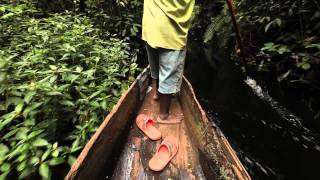
Scientists work in the Congo Basin, one of the world's largest watersheds and still 99% forested, despite armed escorts and disease risks. They're sampling water that ranges from crystal clear to dark tea, measuring dissolved organic carbon to understand a region that has barely been studied.
Questions this video answers
About 1%.
Chapters
Congo river forest is a best thing of God. Busy river give us development, transportation. We take the fish to eat, take the water to drink. Our life is on Busi River. The Congo represents the world's second largest watershed, the most pristine tropical rainforest left in the world. Current estimates are about 1% deforested. So it's a much more pristine system than the Amazon, the Orinoco and most of the tropical rivers. And so we've got a unique opportunity right now to examine what's going on then to see how this changes into the future. We've had to sample sites where we've had military presence, usually armed, in fact always armed. Every evening we set up a mosquito net over the bed. These mosquitoes carry a whole host of tropical diseases. To access a lot of these rivers, we've had to go in small boats down very, very small rivers. Where as you sit in your wooden pirogue, which is about as wide as you, the river is about as wide as the pirogue, you have branches smashing you in the face. The bottom of the pirogues leak. Again, it's a challenging environment. So we're interested in actually what's in the water, the particulate phase bits that you can see if you like. We're also interested in the dissolve phase, so the things you can't see but often impart colour to the water. To separate out the water, we filter it through different types of membranes that we have with us. This is very similar to when you make coffee at home. You'd use a coffee filter and it keeps the coffee grains from the actual coffee itself. So you could say the coffee grains are like the particulates, the sediments that we have and the coffee itself is the liquids that have the dissolved phase in them.
Probably a thousand times during this trip, we jokingly said what could possibly go wrong because anywhere you look there are potential roadblocks. But we got all the samples we wanted and anybody in the world, if they looked at the samples, could see that these came from very different sorts of rivers. Some of them are crystal clear, just like the water you might get in a bottle of water or in your bathtub and other looks like the darkest tea you've ever seen. And what we're looking at are different dissolved organic carbon concentrations and forms of desired organic carbon. So it's really exciting just to see the contrast.
We know so little about this region really. Due to political factors, instability in the region, problems with logistics. The Congo has been historically under sampled. The work we're trying to do now and moving forward into the future is, in many cases the first time these sort of studies have taken place in this region. And so really, it's opening up a new frontier for science within Central Africa and fundamentally improving our knowledge of this region and hopefully the way these sorts of systems work and their relevance to the wider world.