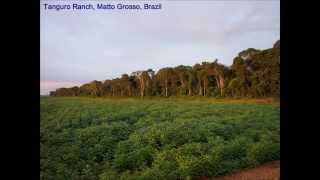
Water cycles through evaporation, condensation, and precipitation, but deforestation and soy farming in the Brazilian Amazon disrupt the flow. Field footage from Tanguro Ranch shows how clearing forest reduces transpiration and changes where water goes, with potential impacts on local climate and water supplies.
Chapters
All life on Earth is linked to and depends upon water, and hence is dependent upon the hydrological cycle. The hydrological cycle begins with the evaporation of water, be it from the surface of the ocean or the land. As moist air is lifted, it cools and the water vapor condenses to form clouds. When clouds become heavier with condensed water, precipitation occurs. Once the water reaches the ground, one of two processes may occur. Some of the water may evaporate back into the atmosphere, or the water may penetrate or infiltrate the surface and become groundwater. Groundwater either seeps its way to the oceans, rivers and streams, or is released back into the atmosphere through transpiration. Transpiration is the evaporation of water from leaves and stems of plants and trees. The balance of water that remains on land surface is runoff. This empties into lakes, rivers and streams and is carried back to the oceans. In the Brazilian Amazon, the Woods Hole Research center conducts studies on the effects deforestation and conversion to aquaculture have on the hydrological cycle.
We're here on Tangura Ranch in Mato Grosso State, Brazil, and my job here is all related to the water cycle of this landscape. We're in the middle of a soy field about the size of Cape cod. It's about 80,000 hectares. And this was all forest about 30, 35 years ago. Now a substantial portion of it has been cleared originally for pasture. Now it's under soy. But a lot of forest has been left standing. And in one of these forests, which we're sitting in right now, we've been conducting a fire experiment for the last seven years. This forest where we are has been burned seven times. And what we're doing is we're comparing the way water moves through the soil and through the trees in this forest, in an intact forest to our east, and in the soy field to our north. What we're looking at is the difference in how water is transported up or moves down through the soil. In a natural forest, the roots of the soil will pull the water back up. Will it transpired into the atmosphere, contributes to the regional climate. In a damaged forest, that's happening a little less because we've opened the canopy, there's not as much leaf cover, we've killed a lot of trees, a lot less roots here to pull water out. In a soy forest or in a soy field, you have very shallow roots due to the soy crop, but there's no other natural drawing of water up out of the soil. So you can you get a lot more water transported down through the soil and less of it cycled back up into the atmosphere.
The piece of land was cleared, so there was a forest in here. And many years ago, it was converted into pasture. And four years ago, the farm converted into a soil field. And as you can see, we don't have much vegetation or green vegetation, which means that there's no photosynthesis here. And no exchange of water between the soil and atmosphere. So there's nothing converting, bringing this water in the soil into the atmosphere for most of the year. And as opposed to the forest that you have these very active trees Pumping water from the soil into the atmosphere for most of the year. So it has. So this opening of these big fields can have major effects to the local climate.
For the grand scheme of things for this landscape, one of the most important ecological services that comes from this landscape Is the hydrological cycle that the farmers who have cleared this depend on for their crops. If too much deforestation results in a change in the way water moves through the soil, moves out through the streams and rivers, the system could be altered to the point where they can't depend on. Depend on that system to water their crops. And therefore, the deforestation that was already done here might be for nothing, as well as whether the system would continue to support forests the way that it has for thousands of years.
Deforestation and conversion of tropical forest to agriculture has profound impacts on the hydrological cycle. In the Brazilian Amazon, however, work is underway to develop an effective land stewardship program. That could avoid or minimize these negative consequences of deforestation by promoting sustainable management practices.