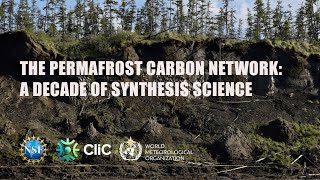
The Permafrost Carbon Network spent a decade measuring how much carbon could escape from frozen ground as the planet warms. Permafrost holds over 60% of global soil carbon. Warming experiments show the active layer deepened 400%, and researchers estimate 5-15% of that carbon could release by 2100 as CO2 and methane.
Questions this video answers
24% of the land area in the north.
Permafrost contains more than 60% of soil organic matter (as stated).
By the year 2100, between 5% and 15% of permafrost carbon (estimated).
Initial meeting: about 45 scientists; grew to more than 400 participants.
The active layer was increased by 400% in the described warming experiment.
Chapters
Changing Arctic ecosystems can influence climate because of the carbon cycle. The total amount of carbon stored in northern ecosystems is quite large. We're talking about billions of tons of carbon stored in the soil, frozen in permafrost. The real question is, how big an effect will these Arctic ecosystems have on climate change? These are the questions we're trying to answer with a permafrost carbon network. We knew the question was urgent about permafrost carbon and its effect on climate, and we really wanted to answer that. Of course, that simple question is made up of many different, smaller questions across the whole permafrost region. And so we knew it was going to be a big job.
The Pemmerhurst Carbon Network has been operating for over a decade now. We started out with a small meeting of 45 scientists from across the world. Then we grew to a network of more than 400 ecologists, biogeochemists, modelers, early career scientists, graduate students, more experienced and even retired scientists. Collectively, we are working towards answering the question of how much carbon is being released from permafrost and how it contributes to climate change.
Welcome to the Cold Regions Research and Engineering Laboratory's Permafrost tunnel. We study engineering ecology, hydrology, and a variety of other biogeochemical problems in permafrost. This section of the tunnel is about 18,000 years old, and you can see a horn from a longhorn steppe bison sticking out of the wall right here.
Much of the permafrost is found in the northern high latitudes, so 24% of the land area in the north is underlain by permafrost ground. It's in this permafrost region, but we can't see it directly. We have to dig or look below ground. And so it makes it something that's out of sight and hard to know about.
Permafrost is an earth material, so bedrock, organic matter, ice, frozen soils. In this section of the tunnel, you can see some frozen silt, which looks and sounds like rock.
One of the interesting things about permafrost to me is the amount of organic carbon that's in the soil frozen in permafrost.
Above us, you can see we've got some green grass. This is about 24,000 years old. It froze and never thawed again. And this is also part of that permafrost record.
Permafrost contains more than 60% of soil organic matter of the world, and it's significantly larger than any carbon pool that we have on the planet.
Organic carbon comes from ecosystems in the past so it's animals, plants, microbes that lived and died, and now they're stored in the soil, frozen in permafrost.
The active layer is the top part of the soil that thaws seasonally. In the spring, the top layer starts to thaw and microbes that live in the soil decompose the organic material.
As the microbes are kind of consuming that organic matter, they are producing main greenhouse gases such as carbon dioxide, methane. And all of these greenhouse gases can lead to more global warming.
Now, permafrost carbon isn't bigger than fossil fuels. That's still the main driver of climate change. But we think that if humans continue to warm the planet as they are now, between 5 and 15% of all of the permafrost carbon will also end up in the atmosphere. By the year 2100, it's going to be released in the form of carbon dioxide and methane, these heat trapping gases that add to the climate change problem.
The amount of greenhouse gases that will be released from permafrost is about of the same order of magnitude as what is occurring through deforestation and land use change. And we expect that number to increase with more warming. So if there is more warming happening in the Arctic, the amount of greenhouse gases that is released is also much higher.
Permafrost has an amplifying feedback on climate change, meaning that the more it gets warm because of climate change, the more permafrost will thaw. And the more permafrost thaw, the more greenhouse gas emissions we will have, and that will lead to more warming again, and this cycle will just repeat itself and just get worse and worse.
That means it really matters how much we accelerate climate change. With additional combustion of fossil fuels, we can keep a lot of the carbon in the soil and a lot of the permafrost frozen. If we reduce our human caused emissions very rapidly.
The amount of carbon that enters the atmosphere, how fast that happens, over years or decades, and whether the carbon is released as carbon dioxide or methane, all determine influence on climate.
One goal of the permafrost carbon network is to use existing data that has been collected from individual experiments, for example, and combine them to a regional response. And then we come up with a summary for the entire Arctic.
At my research site, we actually do experiments in the tundra. We have warming plots and we have contrast control plots that are the ambient conditions. Here we've been warming the tundra for the last 10 years and we've changed the active layer, which is the summer thaw, by 400%. And in doing so, we've released carbon that's been stored in permafrost to the atmosphere, and we've accelerated climate change. The way we're warming the tundra is twofold. We do this soil warming, where we have drifts of snow in the winter that we shovel off, and that actually warms the permafrost. We also warm the air with these small greenhouses. And these greenhouses both keep the air warmer, but they allow us to measure the movement of carbon gases. So lids lower and raise on these boxes, and we can measure the carbon dioxide concentration as we do that. In that way, we can measure the exchange of carbon between the tundra and the atmosphere. One of the measurements we make is the total amount of carbon stored in plants and soils. I think it was right here in the field. We cut out quadrats of vegetation and we bring these quadrats back to the lab in order to separate all the plants that live there and the soil that's in the permafrost. We separate these plants by species to understand which plants are growing there, what plant communities are, and how these plants might change over time.
In the Arctic, the plants are relatively short, and they are used to cold conditions. When it gets warmer, the plants enjoy the warmer temperatures and grow faster, and they grow taller. And by doing that, they absorb carbon from the atmosphere. And that means in a warmer Arctic, the vegetation takes up carbon, and it can compensate to some degree, the carbon release from microbial decomposition.
That will take up some carbon, but it won't be enough to offset the carbon being released from the soil. We still don't know right now if the Arctic carbon feedback is already happening. That very question is likely to be the next decade of synthesis science. The permafrost carbon network is interested in how not only this site changes, but sites across the Arctic. What's happening to their carbon balance. In total, it's the response of all these places that determines the feedback from permafrost to the climate system.
What I really hope to see from the permafrost carbon network is to include more policymakers, indigenous communities, and like general public, because I think it is really well positioned to bring all of those communities together and connect the science with the people so they can provide more practical solutions to the climate change.
We want to share it beyond science, really. We want to tell society what we know. And I think the details are important, but really the big picture, how the world is changing, the one that we're all living in, is really important to me.