Webinar: Can Tapirs Restore Amazon Rainforest?
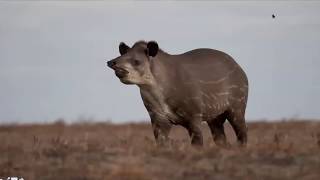
Researchers at Tanguru Ranch in the southern Amazon studied whether tapirs help restore degraded forest by dispersing seeds. Tapirs spread nearly 9,800 seeds per hectare yearly in burned areas versus 2,900 in undisturbed forest. The Amazon stores 15 years of global emissions, and 20% is already lost.
Questions this video answers
April 9, 2020.
Approximately 9,800 seeds per hectare per year.
Approximately 2,900 seeds per hectare per year.
About 3–4 feet high and up to ~800 pounds.
Vulnerable, with a decreasing population trend.
Chapters
I am Heather Goldstone. I am the Chief Communications Officer for Woods Hole Research center, and I'm really happy to be welcoming you here today. And I should note that, of course, since we are all working from home at this point, that instead of welcoming you to Woods Hole Research center, as we might do for other events, I'm happy to be welcoming you into our homes, really. We have three panelists, a presenter and a couple of panelists with us today who you'll be hearing from and you should be able to see them as we go through our presentations. I have turned off video and audio for you, our participants, but we do have a number of ways we're going to ask you to participate and interact with us today, and we'll get to those in just a moment. But first, I wanted to just introduce Woods Hole Research Center a little bit. If you're new to us, we're an organization of about 70 people located in Woods Hole, Massachusetts, on Cape Cod. And for a small organization, we have quite a bit of impact. We've been rated the number one climate change think tank. And as great as that is, I think that doesn't even really encompass who we are and what we do. We have scientists who are working everywhere from the Arctic to, as you'll hear about today, the Amazon, the Congo, right here in the United States, studying all sorts of important questions about our climate system, but then not just stopping there, actually making sure that that science gets into the hands both of the public and of policymakers and change makers who can use that science and actually drive solutions to climate change change. So thank you for coming to our webinar. Thank you also to the KNAB family for their generous support of our outreach efforts and this webinar series. We're so appreciative of that. And if you enjoy the webinar today, we'd like to stay in touch with you. So we invite you to find us on social media. There were a couple of icons on that last slide I showed, and I can pull that up again at the end. But if you look for Woods Hole Research center on Facebook, on Twitter, on Instagram, you can easily find us there and keep in touch with us. So this webinar series was in part an adaptation to the situation we all now find ourselves in as a result of COVID 19 and being unable to have in person events. But we're really excited to be doing them because it also offers us an opportunity to completely free ourselves from the constraints of geography and be able to talk to people everywhere and hopefully reach out to some new people. And in that vein, I would love to be able to ask you a few questions. This will also help everybody get familiar with some of the features of zoom. But just to get to know you, our audience, a little bit better today. So I'm going to launch a poll here that should pop up a question on your screen and don't worry, an easy question that hopefully you know the answer to. We're just curious how old you are. We know we have a lot of students at home and for that matter, a lot of folks who would normally be at work, who may be at home and looking for something meaningful to do. So we'd like to get to know a little bit about you. And let's see here, we've got almost three quarters of you have voted, so you guys are doing really well on the zoom part of the test. You figured out polling and how to answer, so we got that far. And I'm going to. Looks like incoming votes are slowing down. A couple of last ones here. Go ahead and wrap this up and show you the results. So we do have folks all the way from students all the way up, and we are happy to have you all with us. I want to ask you another question because today's topic probably everybody's heard of climate change, but today's topic is a particularly fun one, but it involves an animal that maybe not as familiar. So we'd love to get a sense of how familiar you are with tapirs, the animal that we're going to be talking about today. You can let us know if you've ever heard of them, if you know a little bit about them, or if tapirs are one of your favorite things. As the votes are coming in here, I'm pretty impressed. We've got a lot of you actually saying you could write a paragraph about a taper. And I think that's something I would have been hard pressed to do not very long ago. So we also have a few people still wondering what is a taper? So we will answer that question. Don't worry. We're really excited to be able to offer these webinars for everybody. All familiarity levels with climate science, but here we go. Most of you have heard of tapirs, but maybe don't know a lot beyond that. Some of you could write a paragraph. A few of you out there are really into tapirs and some of you not so sure what tapirs are. So you are all in for a treat. We're going to dive into our presentation here pretty soon with one last question for you guys and then a little bit of information about how things are going to flow here today. So, last request is down at the bottom of your screen. You should have an option to raise your hand. And I would love to see a show of hands from those who have never attended a Woods Hole Research center event, those who are new to Woods Hole Research center. And I love seeing these hands go up. I'm so glad that we've got new people in the audience. We do, definitely at least a couple of dozen of you who are new to Woods Hole Research Center. So thank you so much for joining us today. Now, about today's flow, how things are going to go from here on out. I'll stop talking soon and turn this over to our presenter, Dave McGlinchey. And after he does his presentation, we are actually going to have two of the scientists involved in the tapir research that you'll hear about for a little bit of a panel discussion. And then after that, we'll open it up to your questions. We already have an audience question sitting in the Q and A section ready for us to ask a little bit later. But if you do have a question that comes up during the presentation or after, there's a little Q and A feature down at the bottom of your screen, you can tap on that, type in your question, and I'll be looking at those and asking some of those questions to our presenter and our panelists later on. So without further ado, I would like to introduce our presenter today, Dave McGlinchey. Dave is our Chief of External affairs at Woods Hole Research Center. That is a position he is relatively new to, having also been with the center in a communications role. He comes to Woods Hole Research center with a depth of experience as a journalist and a lawyer, and for that matter, the author of a book about the impacts of climate change on birds and birding. Dave, with that, take it away here, let me just make sure that everybody can can see you there. If you start your your video in your screen share, Dave, you should be good to go.
Great. All right, thank you, Heather, so much. And thank you everyone for joining us today. I hope you're all safe and healthy out there. I'm very glad we could gather here to talk about tapirs, to talk about climate change, and also to connect. This is obviously a weird time where we're all distant and separated, so it's nice to be able to come together. As Heather said, I'm the Chief of External affairs at the Woods Hole Research Center. I manage our policy and our partnerships. And in that role, I collaborate with the Amazon Environmental Research Institute, more commonly known by its Portuguese acronym, epom. You'll see the logo for EPAM in the top right there of the screen and. Oops, sorry. Figuring out Zoom along with the rest of the country, EPOM is ipams, pronounced epom, and we work closely with them. We've worked closely with them for years to study climate change impacts in the Amazon and to develop policy solutions alongside them. The work that I'm going to talk about today was all done in close collaboration with our great friends at epom, and they're an amazing partner to be able to work with. I want to start by talking about the importance of the Amazon. And for those of you who were all tapirs all the time, I promise we're going to get to those before not too long. Bear with me as we set. As we set the stage. So, first of all, the Amazon is huge. It extends into nine countries. The rainforest extends into nine countries and covers more than 2 million square miles. That's about two thirds the size of the continental United States. These numbers sound big, and it looks enormous on a map, certainly. But I had an opportunity to travel to our research station on the southern edge of the Amazon last year with a crew from CBS News. And I will say that I didn't fully grasp the size of the forest until we flew over it in a small plane. We flew for hours and hours over completely unbroken forest. It was beautiful, it was breathtaking, and the scale was truly hard to process seen up close. It's also an area of remarkable biodiversity. Colleagues of mine often say that there are more insect species on one tree in the Amazon than there are in all of England. This is also something. The biodiversity, the diversity of species, is something that is more powerful to take in in person. Walking through the forest last year, during my visit, there were sights and sounds and movement and life in every direction. It was an amazing experience. The Amazon, though, is not an uninhabited nature preserve, as we all know. It is home to Many, many people, 30 million people, including hundreds of indigenous groups and communities. Research from the Woods Hole Research center and EPAM has shown, in fact, that these forests, the ones that are controlled and protected by, you know, I'm told my video is now starting. Let me try to start that. I'll finish my presentation and then I'll move over to my video. Sorry. There we go. The forests and the territories controlled by indigenous populations are, in fact, healthier. And the forests contain more carbon than elsewhere. That is critically important because of Course, the Amazon stores an enormous amount of carbon. So if we just back up a step. Trees, through the process of photosynthesis, pull carbon dioxide out of the atmosphere, out of the air, and they store it. It's a remarkably efficient process, and more efficient than anything that humans have been able to create mechanically. According to Woods Hole Research center science, in particular from Doctors Wayne Walker and Mike Koh, carbon stored in the Amazon forest is equal to approximately 15 years worth of global emissions. But we've already lost about 20% of the Amazon, and we need to keep that carbon and that forest in place if we want to maintain a stable climate. And so that's the context for our work and for this talk. There's more carbon dioxide in the atmosphere right now than there has been at any point during the past 800,000 years. So we need to stop adding carbon to the atmosphere through fossil fuel use and deforestation. And ideally, we really need to pull carbon out using natural solutions like trees and like soils. But as I've said, we've lost about 20% of the Amazon. And these risks to the forests continue. It comes from a variety of sources. There is a large amount of land in the Amazon that is undesignated and vulnerable to exploitation and land grabbing. Even the areas that have formal protection are not being well protected these days. There is mining, there is logging, both legal and illegal. And the biggest driver of deforestation is expanding agriculture. Many of you might also have seen news coverage last year about wildfires in the Amazon. It's important to understand that fires do not naturally occur in this ecosystem. They are set largely after trees are cleared for agriculture and then burned. But the Amazon is hotter and drier than ever before, and those fires are now able to spread more aggressively than ever before. And last year, in fact, when we saw viral videos spreading about the sky going dark in Sao Paulo during the day from nearby fires, was not a drought year. It was not a particularly dry year. It's just that the trends and the amount of human caused burning have increased so much towards hotter and drier that this is the direction we're going in the Amazon. So it's important to remember there's no viable solution to climate change. I got a step ahead of myself. So, as we've seen, these trends have caused a recent spike in deforestation. And this is a look at the last 10 years. But in fact, if you go back, if you go back previous to this, we saw rates of deforestation falling. Brazil's government had put in place some very effective conservation laws and this had looked like a success story, but the trends have reversed and we're seeing more deforestation, in particular a spike in recent years. So what I was about to say was it's important to remember that without the Amazon, there is no viable solution to the climate crisis. The first step must be conservation. For a healthy and intact Amazon forest, we need to keep what we have in place. The second, however, ideally would be restoration. How can we reforest the areas that we've lost? And the challenge there is that reforestation is expensive, is labor intensive, and even then there's no guarantee of success. But EPOM and WHRC scientists might have found an unlikely solution, and that is lowland tapirs. So tapirs, for those who weighed in earlier in the poll and were not familiar at all with tapirs, they are large herbivores, about 3 to 4ft high and weighing as much as 800 pounds. They look, as you can see, kind of like pigs with long snouts. But they're actually most closely related to horses and rhinoceroses. Don't ask me to go too in depth on that connection. I don't have that available. They're listed as vulnerable with a decreasing population. And that's largely because, again, as you see, there's a lot of meat there on the tapir, and they are hunted for their meat. Interestingly, that largely happens on smaller farms and smaller properties. We work, as I'm going to show you in a moment, on a large piece of land, a large agricultural facility in the southern Amazon where that hunting does not take place as often and therefore we see more tapirs and are able to study them more closely. So let me set the state take a moment and set the stage for you. The research on this took place at Tanguru Ranch, which is at the southern edge of the Amazon in Mato Grosso State. As I mentioned, last year I traveled to Tangaroo with a crew from CBS News, and our chief cartographer Greg Fisk, created this map, this animated map showing a direct flight from our headquarters on Cape Cod to Tangaroo. In fact, this flight does not exist. Traditionally one flies to Brasilia and then takes a overnight bus from Brasilia to the ranch. I did take a video of our approach to Tenguru in a small plane from Brasilia. So again, it's a working ranch and it's huge. The ranch itself is approximately the size of Cape Cod. It produces soy and corn. And the owners of the ranch, the corporation that runs it, has welcomed us to conduct our research there for years. As you can See both from the video and here, then again from this aerial photo. It's a patchwork of agriculture, forests, and it allows us to study both of those and then critically the intersection between agriculture and forest, how they affect each other, how they interplay. There are also flux towers at Tengaroo. Oh, wait, I'm going to got ahead of myself, sorry. I have some photos of some of our scientists, Hilary and Kathy Joe, here at our lab at Tengaru. And here's Leonardo taking from epam, taking water samples, studying the effect of agriculture on nearby hydrological systems. And then the flux towers I was mentioning, they measure the amount of carbon dioxide and water going from the forest to the atmosphere and vice versa. This screenshot here is from the CBS news report that I mentioned. Dr. Paolo Brando on the left is being interviewed by CBS correspondent Vladimir Dutier. I also took some photos of Vladimir and Paulo climbing the tower, just to give you a sense of the scale and height. And then, for some reason somewhat unclear, I decided to climb the tower myself. And I took to. I took a selfie to prove it, even though I was absolutely certain I was going to drop my phone. I also took a photo straight down on the right there, just to allow myself to remember how absolutely terrifying the height was. The other thing we study there is wildlife, and that's because a healthy forest depends on healthy animal populations and vice versa. So I've included a few photos here of animals from Tenguru. Several of these photos are by our scientists and several are from Chris Linder, a longtime collaborator and photographer who we worked with. These are horned owls at the ranch. These are rheas, which, on my visit there were everywhere. I was kind of amazed by how prevalent they were, often seen out in the fields. Monkeys. I didn't see as many of these, but I heard them all the time. Maned wolf, armadillos, capybaras, my personal favorite. This is a picture of a rhinoceros beetle that I saw right near our water quality experiment. Not a picture. This is a rhinoceros beetle I saw right near our water quality experiment. It was remarkably big, maybe, you know, half the size of your hand, size wise. And then this was one of my favorite wildlife experiences. It rained heavily and then we went back out to photograph and filmed some field work they were doing and saw these puma tracks and then kind of connected the dots fairly quickly. Actually, Leonardo, pictured earlier in this, connected the dots for us and pointed out that with the heavy rain, that meant the puma had passed this way probably within the last Hour, which is very intense and exciting moment. But pumas are there, jaguars are there, intense wildlife. And then, of course, the stars of this show, the tapirs, captured here on a camera trap by our colleagues at epom. And I'll let it run through one more time just so we can see the tapir baby come through. So tapirs, the subject of this talk and the focus here, became the focus of our scientists because, and I don't want to explain Lucas and Marcia's work here, but during the course of other research, they observed the tapirs, they saw them moving around, and they thought to themselves that they could indeed be dispersing seeds. So through a combination of camera traps and field work and analysis of dung piles, they studied what seeds the tapirs were eating, where they were distributing them, and the amounts that were being distributed. And they came out with this fantastic paper about one year ago in Biotropica that focused on seed dispersal by lowland tapirs. And it found that they are taking these seeds, the seeds for large trees, depositing them largely in the areas that we would exactly hope they would be deposited for restoration, which is the degraded fringe areas where the tapirs like to hang out. And they're dropping them, as I think Heather's going to show you later, I hope, in some fairly large dung piles which provide perfect fertilizer right there as they're deposited. The study. Marcia Macedo said this to me the other day. You know, they've done a lot of papers, they've done a lot of research, they published a lot of science from Tenguru. Nothing has quite caught the public's attention the way the tapir study did. It got enormous amounts of media coverage in Brazil and then it got coverage internationally. Story from the Economist here. And then remarkably, it was picked up by Leonardo DiCaprio, who posted it to his 30 million followers on Instagram and gave it an audience unlike any that our research has had in a while. So just before I hand it back to Heather and turn it back to my colleagues to talk more about their research and go more in depth on the science, I just want to bring it back really quickly to why we're focused on this area and why we're talking about this subject. And this is a map of above ground forest carbon that was compiled by Woods Hole Research center scientists and turned into a map by Greg Fisk in which he depicted the more intense forest biomass as topography. Essentially, this is forest. Well, it says it forests as mountains. The more dense the biomass, the higher the mountain. As you can see, the Amazon contains an enormous amount of the world's carbon, enormous amount of the world's forest carbon. If we're talking about climate solutions, if we're talking about maintaining a stable climate, we need to be talking about the Amazon. We need to be thinking about ways to conserve it, and we need to be thinking about ways to restore it. So with that, I will share this one last tapir picture in the aforementioned degraded area and then hand it back to Heather. Thank you all very much.
Great. Thanks so much, Dave. And if all of our panelists could now start their video and make sure your microphones are on, I think everybody can see and hear us now. We are happy to be joined, as Dave said, by a couple of the scientists involved in this work. That's Marcia Macedo of Woods Hole Research center and Lucas Paolucci with our partners IPAM and the Federal University of Vicosa, who was postdoctoral researcher working on this project. And Marcia, I'll start with you. I would just love to get a little bit more. Dave alluded to this came out of previous work, which of course a lot of science does. That's how it works. But what in particular was it that led you and your colleagues to start questioning whether tapirs might be a force for reforestation in the Amazon?
Yeah, so. Well, first of all, welcome everyone. It's not often that I get to welcome close to 200 people into my dining room. So, hi, it's really nice to see all of you and to be here. And to answer your question, Heather, this research goes back really, starting 16 years ago when we started working at Tenguru. And at the time, we were interested in understanding how forests respond to disturbance and how they recover from that disturbance. The two types of disturbance that are most common in this region are fire and droughts. They're both becoming more common with climate change. As Dave alluded to back in 2004, WHRC and EPOM scientists set out to do a fire experiment to understand how it is that fires are interacting with this landscape and affecting these tropical forests. And we went really big. We did a very large scale fire experiment. It's one of two experiments like this in the world in tropical forests. And sorry, the chat here, Heather, if you could go to the next slide really quick. So this experiment, basically what we did was we burned 50 hectare plots at Tangaroo. 50 hectares, to give you a sense, is about 123 acres. And this is a classic sort of ecological design. We had a control plot where we didn't do anything except for measure. All of the trees that were there and keep track of how quickly they grew and what the tree mortality was, so we could understand how a forest would operate in the absence of this disturbance. And then we had one treatment that we burned every year. So from 2004 to 2010, we burned it every year, and another one where we burned it every three years. And there were a lot of surprises, as you can imagine. It was a huge field crew to do this. To do this experiment over seven years. It took a lot of effort. We learned a lot. There were a lot of kind of plot twists. And spoiler alert, I'm going to jump to the end and tell you kind of one of the big results, which is this. The treatment where we burned every three years was the one that saw the biggest impact. And basically, in three fires and one big drought, we were able to flip the system from a forest that looks a lot like that top panel that you see on your screen to something that looks, at first glance, like a savanna more than a forest. Now, any savannah ecologist will tell you that that is a very degraded system, and it doesn't have any of the biodiversity and ecosystem functions that a savannah would have, but a really dramatic change in the landscape in a very short amount of time. And to get back to Heather's question, since 2010, we've been studying that forest to see how it reassembles itself, how the ecosystem kind of starts to get back to where it was, if it does at all. And one of the things that we observed while keeping track of all of those trees and looking at how the regeneration was happening was that there were a lot of tapers moving in this landscape and that they were leaving calling cards in the form of these giant dung piles throughout the landscape. And. And so this research was really born out of being in the field, making an observation, and then having the curiosity to the resources to follow up on that curiosity and try to understand what was going on.
So then you've got this question now about the role that tapirs might be playing. But how do you actually start to answer a question like that? How do you design an experiment to test it? Yeah.
So doing field science is really fun and interesting, but it doesn't have to be overly complicated. In this case, it was actually quite simple. We first put out those camera traps that Dave alluded to so we could get a sense of how these animals are moving through this landscape, how many animals there are, and whether they have any preferences for open areas or more closed canopy areas.
And we actually have a Little bit of that camera trap footage that we can share. Another video, as Dave had showed as well. Let's see if I can.
So, yeah, these animals are actually pretty shy. So even though we kind of encounter them in the forest, I guess the video is not going to run, but they're usually running madly away. And so the cool thing about these camera traps is that we can kind of see. See them, you know, in their natural state, and also get a sense of how many different individuals there are and how often they're kind of moving through this landscape. And so the other thing that we did was to actually map the dung piles, right? So this actually was led by a master's student who did the bulk of the legwork on this, but he and a huge crew of people went through all of the fire plots and basically, you know, took a GPS point every time they encountered a latrine, which is an area where many tapirs will deposit their dung in the same location, or where they encountered just solitary piles of poop. And so in this case, this is that it's a plot of. Of the fire experiment. You can see the three treatments, the control there on the right, and the two burn plots on the left. And every brown dot on that map is a place where we encountered a latrine or a solitary pile. And then, Roger, you had the fun task of sampling that and actually figuring out what was inside those piles.
With that, I'm going to turn to you, Lucas, and ask a little bit more about what it's actually like to do this kind of fieldwork. I mean, Marcia, you've called them latrines and dung piles, but what we're talking about here, to be really clear, is that we've got large animals who are eating lots of plant material and then leaving large piles of poop. And somehow in this research, you're going to be discerning information from that. So, Lucas, give us a little sense of what this was like doing the research on the ground.
First of all, thank you for the invitation. Welcome, everyone. Yes, like Marcia said, the team of scientists walked around our experimental area and looking for this clump, Tapir's dung. They are easily, very easily seen in the field, as you can see. Can you put that we have a photo of me in the field? Yes. It's easy to see because they are quite big, like even bigger than my head with the helmet.
So.
And after finding these clumps, we took the coordinates with the gps, as Marcia said, sampled it, and took to the lab for to weight count and identified the seeds that were contained within these clumps. Additionally, we set some camera traps as well to catch these movements, so we can have a better idea of which areas these tapers were using more often. And with this data, this kind of data in hands, we could identify which areas tapirs were using, so which turns out to be the disturbed forests. And so we could also count how much dung and seeds they were dispersing, and hence estimate how much seeds they can disperse per hectare and per year across this forest. So we found that they disperse about 9,800 seeds per hectare per year in the degraded forests, but took around 2,900 seeds per year per hectare in the unburned undisturbed forest. So it more or less about three times more seeds dispersing in this degraded forest than in the undisturbed forest.
Sorry.
So with this, we suggest that tapirs can actually help to reinforce this burden and degraded forest by this through this mechanism.
That's a great finding, that tapirs are doing so much to spread seeds in exactly the areas where they would be needed to reforest. But of course, not every seed that we drop on the ground actually turns into a plant, as we would hope it would. And these seeds in particular, as Davis already alluded to, have the benefit of being dry in a fertilizer package. But do we know if these actually how many of those thousands of seeds are spread around actually do turn into trees?
Yes, unfortunately, not all of them will germinate this 9,800 seeds per year. They will face some barriers to germinate, for example, competition for light and depredation from animals like rodents or some beetles as well, and some soil conditions that frequently are not optimal for germination. And besides that, besides of these threats, a small part of the seas, they are also damaged during the tapes ingestion, Although from our research we find this proportion was less than 1%. But exactly the next step of this project is to find out which is the proportion of the seeds that are dispersed by tapirs that actually germinates. We still don't know it yet under field conditions, and then can eventually actually contribute for this forest regeneration.
For that.
For doing that quickly, we are planning to isolate some of these tapestry with some fences in the field, and then assess how many of the seedlings actually established. So we can additionally, with this experimental design, we can then additionally assess the influence of other animals that eventually not only prey on the as I mentioned before, but may also disperse the seeds secondarily. But in other words, they disperse seeds again after the first dispersal by tapirs. So seedling establishment is actually essential for forest recovery, not just the dispersal, and certainly is of great interest for us to understand the mechanisms behind the natural recovery of Amazonian forests after forest with this continuum.
And Marcia, if this all bears out, and in fact we are seeing, you know, that tapirs are spreading seeds, that those seeds then do germinate and turn into trees, what does that mean when it actually comes to trying to restore Amazon forests? How would you put this knowledge into action?
Well, as Lucas alluded to, there's a lot that we still need to understand in order to develop optimal methods to facilitate this dispersal. But I see a couple of connections to policy and to sort of a way to scale this up. The first one is that Brazil has made commitments under the Paris Climate Agreement to restore up to 12 million hectares of forests. So that's kind of a national policy that's out there. And if they intend to meet that, a second piece is that a lot of that restoration needs to be happening on private properties in the Amazon. And that's because the Brazilian laws include the forest code, which requires landowners in the Amazon, like the ranch where we work, to maintain 80% of their forests, of their property in forests, and all of the forests along streams and rivers. So that means that landowners have in many cases a large burden to figure out how to restore these areas. And we're trying to help find cost effective mechanisms to do that.
So.
So IPAM actually was originally invited to work at Tengaru because the landowner there was trying to figure out the most cost effective way to restore these areas. And we know what doesn't work at this point, and that is really. Well, it doesn't work without a lot of investment. Right. Moving, planting seeds by hand, planting seedlings by hand, and then fencing off these areas, which is kind of the conventional wisdom of how to do this, to keep cattle out, to keep people out. Seems like it might be counterproductive and overly complicated. And it doesn't, and it's not always that effective. And it's actually potentially keeping some of these natural regeneration pathways, like tapers, moving into those landscapes from happening. So we might be actually fencing out these tapers from the areas where we want to restore. And so.
Right, so we have a couple of questions. I want to go to our audience questions, and we do have a handful of them. If you have other questions, go ahead and type those into the Q and A and we'll try to get through as many of them as we can. We have a couple of questions. Here about whether there are other animals that might be also involved in this process or similar processes that could be involved helping to restore forests in the Amazon. And Lucas, I know that's something that you have an interest in.
Yes, we know some of other animals that are highly abundant as well, that are involved in dispersal of seeds, like birds and ants. But regarding this specific case of tapir's dung, we have these dung beetles which usually feed or nest in dungs. They are preferable dungs or they prefer dungs or vertebral herbivores such as the turpoise. So, and these dung beetles are very, very common in tropical forests. They usually remove the dung from its original site by rolling them and eventually they can also bury them. So by doing this process, they of course also remove the seeds that are contained in these dunks. And some studies have shown that they positively affect the survival of seedlings that emerge, possibly through positive effects on both soil resources like nutrients, water and some physical qualities as well. So all these roles these dung beetles play are called ecosystem functions, which means these dung beetles actually contribute from the proper functioning of ecosystems, including of course, the secondary removal of tapirs dung and their seeds. And an additional next step of this project is to exactly estimate the proportion of seeds within tapirs that are removed by these dungy burials and hence have a higher potential of germination because of this interaction.
Another great question here. Do we have any idea. And Marcia, you alluded to this and Lucas, you also pointed this out in the data that the tapirs seem to prefer these disturbed recently deforest areas. That turns out to be a great boon when you're trying to spread seeds into areas that need to be restored. But do we have any idea why that's the case, why that's what they tend to prefer?
Lucas, do you want to take that?
Yeah, we actually don't know this, but we did speculate the reason in the paper. This might be related to the fact that these areas are more open, of course, and then they are hotter and they allow for greater light penetration. They therefore tend to have a higher proportion of plants that are more from the initial stage of successional like are more palatable, so they are easier to eat and they eventually prefer them to eat. But we didn't actually didn't test this hypothesis. We just suggest it as a possible mechanism.
Some other great questions here. A lot of curiosity about tapirs themselves, of course, people wondering if they live in all areas of the Amazon or only in certain regions, and what's their status. Are they endangered?
Yeah, they originally live Amazon, including, and not only Amazon, they also occur more here where they originally live in Brazil, Southeast Brazil and forests from Inajara as well. But of course they are not very abundant as in the Amazon. I'm not sure about their official state of conservation in ucn, but I know they are threatened or something like that because they have this official status as well. But they are not dealing very good like Dave mentioned in his presentation.
Dave, do you want to jump in there?
Yeah. Just to follow up on that last point by Lucas. The official status with the IUCN is vulnerable and decreasing.
Do we know what the actual size of the tapir population is at this point? Could we put a number on that or even a rough estimate?
I couldn't.
I don't know off the top of my head, they're doing okay. But in a lot of landscapes that, you know, they are vulnerable, as Dave alluded to.
And just a point we actually, this number, nobody actually knows because it's very difficult to accurately sample all these populations because they are within the Amazon and we have some difficulties to sample and et cetera, but we actually don't have this exact number as well.
So a question for Marcia and Dave and I'm going to actually condense a number of questions into one or two questions here, but a number of people really wondering, okay, we're talking about the legal framework and the requirements on landowners in Brazil. What about other countries in the Amazon? Is there a similar requirement to keep for a standing, similar enforcement of those kinds of laws?
I'll take a first stab at it, Dave. So I think Brazil is. So I didn't mention protected areas across the Amazon. About 45 or 50% of the Amazon is actually protected in indigenous lands and protected lands, and that is across all nine countries. Most of the countries have some type of formal protection and those, those forest patches are really important for conserving habitat and they serve as sort of source areas for wildlife. I think Brazil is unique in the world in this requirement that landowners in the Amazon in particular, but this applies to other biomes in Brazil as well, that they maintain such a large proportion of their property in in Forest. So 80% in the Amazon of a private property has to be in forest. And the requirement to maintain forest cover along streams is also unique. It's sort of best practices in a lot of places. But for the most part it's not something that's on the books as an environmental requirement. Of course, it's very hard to enforce. And that's why we're in this position of needing to do some restoration to get kind of up to the intent of the law. But.
And I'll just add that not specifically on forest protection, but following the wildfire season of last year and following the kind of intense international scrutiny that that brought, there was a regional movement to address that as a cause of deforestation. And that, you know, we'll see how that translates into actual action on the ground and protection on the ground. But there is certainly more enthusiasm and appetite for stopping that now than there was a year ago.
Since you mentioned the fire season, we have a question here, Marcia. And I have to say this occurred to me as well when you say that the experiment that came before this tapir experiment was the fire experiment, and where you saw some of the greatest impact was in the plot or the plots where you were burning every three years. Any idea why that would have a greater impact than burning every year?
Yeah, that was a surprise and kind of a shift in the middle of the experiment that caught us by surprise. The answer is really. Well, it's twofold. One is that the catastrophic fire that flipped that system happened during a big drought year. And so what we see is that the fires are much more intense and they do a lot more damage when it's, when it's dry. You know, they can carry overnight, they kill a lot more trees. So there's that, that aspect. The other, the other thing is that the plot that was burned every year actually had less fuel in that drought year. And so it didn't, you know, the fine fuel that kind of carries a fire was, was being kind of burned away every year. And it meant that it wasn't kind of set up for a catastrophic fire like the three year plot. So.
A question here, Lucas, Back to some of the basic biology of tapirs. How long do they live?
I don't know. I really don't know because I, I'm actually not tapir specialist and specialists on these interactions, especially animals removing and dispersing seeds. So tapirs were we used as a model. As Marcia explained, they are very abundant in our experimental area and they disperse seeds. So that's why, that's why I'm interested on them. So specific aspects of tapir's biology, like how long they live, but I'm sure we can find in Google.
So, yeah, just my interest stemming from this paper. I'm also not a tapir specialist, but I thought Lucas paper and Marcia's paper and this research is so fascinating. I have done reading about them since then and the estimates I've seen are between 20 and 30 years in the wild.
Wow.
A couple of people here on our Q and A have kind of drawn, I guess, a parallel between tapirs and cows and are wondering if humans are a major predator of tapirs. Do we eat tapir? And also, are there other predators of tapirs?
In some places, people do eat tapirs on these private properties. No, I mean, for the most part. That's an interesting thing that, you know, for the most part, hunting. And hunting is prohibited on these lands, and so they can actually act as a safe. A safe place for this wildlife to move around, which is cool. I forgot the other question, Heather.
Are there other.
Oh, other predators? Jaguars? Yes. I mean, yes, there are jaguars. Maybe pumas and jaguars. Yeah, but that's really the only. The only one. So, I mean, you know, they might be taken out by a poisonous snake or something, but for the most part, jaguars and pumas are the only ones, and there's a lot more tapirs than there are jaguars. So.
Yeah, we definitely have some tapir enthusiasts and quick learners on our Q and A who've started answering each other's questions. Perhaps tapir experts who have joined us. I'm not sure. I don't want to be disparaging anyone's expertise. I'm not seeing who these fabulous comments are coming from, but an estimate of 25 to 30 years for the lifespan. And somebody chimed in with jaguars as a predator. So we're doing well. You know, we're making our way through a lot of these audience questions. And I think one of the last ones that we kind of haven't addressed that's come up a couple of times in the Q and A is whether the Bolsonaro administration has changed the policies and whether we've seen a significant change in forest conservation and meeting those reforestation or restoration goals that you were mentioning, Marcia, under the Bolsonaro administration, I have a feeling all three of you would maybe have thoughts on this and could weigh in on this. Dave, do you want to start?
I don't want to jump ahead of my colleagues who spend more time in Brazil, but should I. I mean, if.
You have thoughts, go for it.
So the crux of the question is the effect of the Bolsonaro administration. I think the biggest concern is the enforcement of existing laws. We can get more nuanced than that, but different administrations set different priorities. And what we've seen so far from the Bolsonaro administration is perhaps that they don't prioritize enforcing conservation laws or environmental laws. And you also see priorities manifested by who or, you know, the people who are appointed to senior roles in leadership. And I think that also has not shown that conservation is a key, key priority. So there is a potential, I mean, as we saw last year after the wildfires, there was international pressure that really did, international and domestic pressure, to be honest, that did push the Bolsonaro administration to take the threat more seriously. But we'll see if that extends beyond wildfires.
Since we have just a couple minutes left, maybe I'll actually pivot and ask one more question of Marcia and Lucas that just came up in the chat. But I think we've seen a couple of versions of this in the Q and A, which is kind of asking about the broader, not to say that the Amazon isn't big enough in and of itself, but geographically, perhaps the broader implications of this research that you've done. Are there equivalent animals in the Congo, in North American forests and other forests that we might be looking to as potential forest restoration solutions?
I would venture to say yes. I think in North America, I'd say we've lost a lot of the very large natural herbivores that moved through this landscape. So we have a lot of seeds that would have been dispersed that don't have their natural dispersers anymore. The tapir in this research is really an interesting example because it is, it's one of the only large bodied herbivores, frugivores that can actually eat big seeds and move them around the landscape in addition to small seeds. But I don't know that much about the Congo, but I would venture that there are also other species that move around these landscapes in similar ways.
And it's.
A really interesting thing to try to understand how animal movement works. Right. And how different animals actually connect these patches of forests and help to recreate ecological connections that might have been broken. So I think, yeah, that's why this kind of research is really interesting. But I don't have anything specific to say about the Congo.
And Lucas, you mentioned that that interaction and that process is really what you're interested in. To your knowledge, are there other examples of this or is there other research going on to figure out if there are other examples of this?
As tapirs are the last representants of the megafauna in South America, I would say a new representative of this megaphone and other cultures, continents may play a similar role as a seed disperser, as a Casey disperser. But one important thing from this is that, as Dave said, it's vulnerable now. And other species that are big and are aimed for hunt should be in other continents as well. So during this time we call usually as Anthropocene this hunt and the species distinctions increase. So consequently other groups that I mentioned increase in their importance for seed dispersal. I would highlight invertebrates especially like ants and dandy beetles for example. So with this loss for this megafauna, both in Brazil, South America or in Congo, even North America, I would say that these invertebrates will play increasing important roles in this interaction.
Well, thank you Dave, Marcia and Lucas for sharing your knowledge with us. Thank you everybody for joining us on this webinar. We hope you'll join us again next week, same time, Wednesday at 2:30 Eastern Time. We will be joined by Woods Hole Research Center Senior Scientist and Deputy Director Max Holmes Holmes talking about the stories that rivers can tell us. And he does have river stories from all around the globe to share and also some great stories of communities getting involved in doing that science. So we hope you'll join us next week for that webinar. Find us on social media. Tell your friends about our webinars. And I would also just like to leave you with the thought that much of the research that we do at Woods Hole Research center is supported by donors. And so if this intrigues you, if you've enjoyed the two webinars that we've done so far and learning about Woods Hole Research center and might be in a position to make a gift to support our research, that's as important, more important than ever right now with the COVID 19 crisis. And so we would love to hear from you. Thank you all so much for coming and have a great evening.
More from Tod










WHRC's Sustainable Science Speaker Series - Dr. Toby McGrath speaks on Sustainable Fisheries
