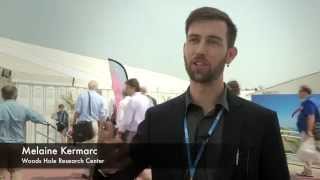
A Woods Hole Research Center pilot project in the Democratic Republic of the Congo tests ways to reduce deforestation through forest protection, better farming practices, and improved stoves. The work aims to inform Congo's national climate policy while addressing local poverty and land disputes in a region with minimal infrastructure.
Questions this video answers
Justin Cadenosa, reporting from the UN Climate Summit in Lima, Peru.
94%.
Chapters
Hi, I'm Justin Cadenosa reporting from the UN Climate Summit from Lima, Peru. You know, climate change and global warming is such a huge international problem that it takes the coordinated efforts of all the nations on Earth to figure out how to reduce the carbon emissions so we can get a grip on global warming. But sometimes a single person can weigh in and can move the needle, even if it's just a little bit. I think I met such a person, a scientist, earlier this week. He's a Frenchman who works for the Woods Hole Research center in Massachusetts, and he's doing a pilot project in the Democratic Republic of the Congo, which is a huge country in the middle of Africa. We want to tell you about his story.
Woods Hole Research center is a center that works on the ecology of climate change and trying to use the science to inform policy making in Congo. We work for the Ministry of Environment of the Congo and we basically making a big project, a pilot project, which is a big experiment trying to inform the national redd policy.
The UN's REDD program stands for reducing emissions from deforestation and forest degradation. It emphasizes that tropical forests, like those in the Congo, play a vital role in the fight against climate change by absorbing and storing greenhouse gases in their leaves, limbs and trunks. The REDD program is designed for large polluting nations to pay tropical countries like Congo to keep their forests intact instead of tearing them down for mining or agriculture, and to develop sustainable forest management plans. That's a big part of Kramark's goal.
In the Congo, we work with local organizations, so we don't implement the work ourselves. The goal is to build local capacity to be able to implement those projects.
Woods Hole has the will to help the population. This is why Woods Hole went to where the population is and where the project is being implemented. The first thing is to have the will and have a precise objective of what you are trying to achieve. And for the RED projects, it will be necessary to go and meet the population where they live.
The Democratic Republic of Congo is a very difficult context because of its history. It's coming out of about 20 years of civil war. It's the poorest country in the world. The infrastructure is almost inexistent. It is known for corruption. The province we work in is actually the definition of what you would call a failed state. It's the poorest province in Congo. You have 94% of the population living below $1.25 a day. You know, those people don't have electricity, they don't have gas, they don't have any other source of energy than fuel would. So the idea is to help them manage their natural resour. So plant some few wood, introduce improved stoves, for example, change the agricultural method, because right now we're looking at slash and burn agriculture. They use large plots of land and the productivity is very low with the density of population, basically the forest is under more and more pressure. So the idea is to maintain the swamp forest, so the primary forest that's there, and try to rehabilitate part of the forest that has been destroyed and then sedentarize their agriculture on the secondary forest.
The project is really a great hope for us because in our country we did not have the philosophy of managing the earth. With the REDD project there is this idea of managing the environment to achieve a sustainable development. This means landscape planning and land tenure. And with the RED project there is this idea of resolving land right issues. And the project can help us resolve this issue and hopefully bring a more sustainable development.
It goes beyond border. As human beings, we have a responsibility to care for our planet and our forest. The forest is a very important part of it. Now, when you look at the equatorial Rand forest, it's the least studied forest, it's the least protected forest. DRC is a very difficult country, so nobody wants to go there. And I feel that if we can manage to do something there, we could do it anywhere. And I can really prove people that it is possible to do something about climate change and about development and those communities deserve a better life like anybody else. Sam.