
Eco-ish Podcast #02: askBelynda - The Chrome plugin to make sustainable shopping easy
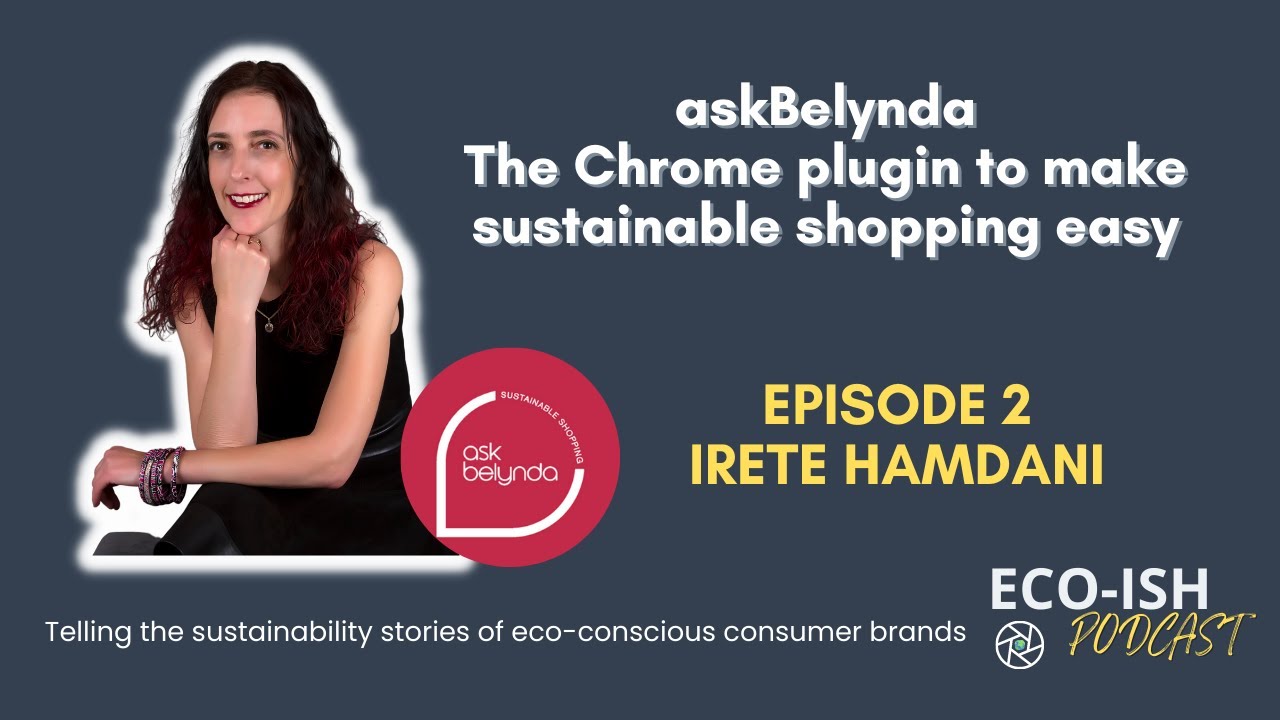
In this episode of the Eco‑ish Podcast, host Tracy Lydiatt interviews Irit Hamdani, founder of the green‑tech startup Ask Belinda. Ask Belinda offers a free Google Chrome extension that surfaces sustainable product recommendations while users shop online, primarily on Amazon. The conversation covers the founder’s personal motivation—being a consumer who struggled to identify truly sustainable products—and the “eco‑ish” philosophy of imperfect, incremental progress rather than perfection. Irit explains the comprehensive vetting process, which evaluates manufacturing, ingredients, shipping, packaging, employee treatment, diversity, and certifications, relying on a sustainability expert and a distributed team of freelancers. They discuss trade‑offs in sustainability, the nuanced role of Amazon’s logistics, and the balance between convenience and environmental impact. The episode highlights community engagement through a Facebook group, live sessions, and upcoming content, as well as future roadmap items such as expanding beyond Amazon, adding new product categories (e.g., toys), and growing the team while keeping the company small. Practical advice is offered for listeners on how to adopt eco‑ish habits step‑by‑step, avoid green‑washing, and make informed purchasing decisions. The interview concludes with details on how listeners can connect with Ask Belinda across various social platforms.
Chapters
Hello listeners and welcome to the Eco-ish Podcast. I'm Tracy Lydiatt, sustainability expert and founder of Sustainable Living School, and I am your host today. The purpose of the Eco-ish Podcast is to illuminate the good work towards sustainability that companies are doing, honestly discuss trade-offs they may wrestle with, and share their interesting stories, all with the purpose to help listeners like you Make informed choices. Eco-ish podcast honors the imperfect journey towards creating an eco-friendly brand in an unsustainable world. Today on our episode of Eco-ish, we welcome Irit Hamdani, who is a female solopreneur and founder of Ask Belinda, a green tech startup helping reduce our carbon footprint. Irit has a Master of Science in Computer Science and Honors from Tel Aviv University and is an AWS Certified Associate Developer and Computer Science and Solutions Architect. She believes in a greener future with the expansion of sustainable consumer goods and has used her 25 years of tech experience to develop Ask Belinda. Ask Belinda offers a Google Chrome extension that recommends sustainable products to consumers while they're shopping online and works seamlessly on amazon.com to provide consumers with recommendations for sustainable products. Ask Belinda is on a mission to reduce our global carbon footprint by shifting consumer spending to environmentally friendly products. Welcome, Aireet.
I'm going to need to edit now.
Welcome to the Ecoish podcast, Aireet. How are you today?
Great, great. Happy to be here.
Thanks for being with us. I've been really excited to talk to you. So if you're okay, I'd love to just jump into our interview. Okay, so my first question is, could you start us off by telling us in your own words what your company Ask Belinda does?
Yes, absolutely. So Ask Belinda is kind of your personal assistant, your friend. She helps you find sustainable products while you're shopping online. The way it works is consumers download it for free, and then while they're shopping on Amazon, it pops up and suggests sustainable products. Not only does it suggest and recommend products, it also explains all the reasons behind why these products were considered sustainable, what the company's certifications are, what their values are, and, you know, when we look at vetting the products, we look at a very wide set of criteria, not only at the manufacturing process, the ingredients, the shipping, the packaging. We also look into how these companies treat their employees, how committed they are to diversity and inclusion. And all this information is included within the extension to make it as simple and as easy as possible to confidently buy sustainable products.
Wow.
Okay. So you just touched on like a whole bunch of the questions that I had that I think that the listeners would be really interested in. And I know I was personally interested to find out. And so my first thought is that sounds like a very holistic and robust approach to that. And I would— I really am so excited to learn more and dive a little bit deeper into this because I feel like this is one of the biggest things that consumers are challenged with. Like, A, I think they're, they're challenged with the fact that they have to be consumers. Um, you know, we talk about this a lot, and you and I were just talking about this before we hit the record button, about how people feel really nervous about the fact that they have to buy things. And so therefore, because of their passion, they're really focused on getting it right. And so I love the fact that you've touched on a whole bunch of major, um, areas. So I'd love to double-click in that. And, um, but, but before we get in there, I just also would love to ask, as the founder, um, I just would really also like to understand in your words, what was inspiration or spark? Like, this sounds like an awesome idea, and I'm always curious to hear how founders thought of these things. What was that spark for you?
Yeah, so I, I would— I'm not a serial startup founder. This is my first startup. I was working at a large corporate, very great high-tech job, and I actually am my— like, I am, I am my customer, right? So I was looking for sustainable products. We've been kind of replacing the products that we're using around the house. We started with our laundry detergents, dish soap, all the things that we're using. We start— we slowly started to replace it a few years ago. And I found as a consumer that it's really hard to figure out what is sustainable, what is not, what is greenwashing, what is— and also what products are, you know, have like our high-quality products. So because you don't want to buy, you know, 100% green product, but then it doesn't really work, right? So I saw how difficult it was, and then I started kind of interviewing people and talking to them and realized that there's something here, there's something that a lot of people would like. I was telling you before we started recording that I really like the name of the podcast, Eco-ish, because I think it, you know, and recently I talked to someone who mentioned a concept called imperfect warrior, right?
Yeah.
I love the concept that, you know, it's not all or nothing. It's not that we have to like ditch it all and, you know, grow our own food and live in, you know, in the middle of nature, although that's nice, but we don't have to be extremist, right? There's, there's the middle ground. There's the— you live your life. It is easy and fast to buy things on Amazon, right? Um, and it's also, it's debatable, you know, if, if a, if an Amazon truck bringing 50 packages to a neighborhood is more harmful to the environment versus 50 people getting in their cars and driving to a shopping mall to get those same products, you know. So there's not— it's not all, you know, black or white, right? There's a lot of gray area in between. So there is a lot of people who care about the environment but don't have the time, the energy, the resources, the knowledge to go and research everything before they buy it. And and they care, and, and I don't want them to feel like overwhelmed, like if they don't do everything perfectly then they, then, then they're killing off the polar bears, you know. It's not, it's not that like all or nothing. So, um, I really like the, the eco-ish, right? So just do the best you can, um, like, so that's why Ask Linda helps people, right? It gives them the information as fast as possible, reliably, sustainable products gives all the reasons so that they know why they're buying that and not something else. And that's, that's really what we're aiming for.
Well, I love that. That's such, um, I hear you saying that, you know, you are the customer and that in the process of your own substitution and switching out products, um, which is such a great low-hanging place to start for people, like if they're If listeners are feeling like, I care about this, but I don't even know where to start, you mentioned a great strategy, which is using things up that are in your house and then substituting them. And so you're very correct. A lot of us are so crunched for time, and especially when you're first starting to learn about sustainability, it can be really, really confusing. And we get into that area that I refer to as trade-offs, where, you know, consumers might be, well, I need something that's, that's going to work. I need to spend my money on something I know that's knows it's going to work, but also maybe has these criteria that are important to them. Maybe it's a plant-based formula or something that's, um, not made with child labor, or you could just go on and on and on. So I love the fact that you built something and used your technology prowess, um, and built something to help consumers like yourself. So that's so inspiring to me that you took action that way and Thank you for the props on the name of the podcast. I actually view sustainability as a state, and it's, um, it's a process to get there. And it's— I wanted the podcast to acknowledge that we are in progress. Like, our whole society, um, has millions and millions of people working on these— on this area in so many different places. And slowly, where I feel we're moving our society towards the state of sustainability, which is a place where, you know, we're not, um, we're not pressuring ecosystems and we're not drawing faster than they can replenish things. We're not poisoning our system. Um, we're— and also we're taking care of people. So I wanted Ecoish to be something that also imbues that feeling of like, hey, it's okay to not get it perfect, and the fact that you're trying is really important. So I just want to say thank you for that. So I really love to double-click on the ways in which you feel your company is helping helping consumers make eco-friendly choices. And previously you mentioned that you have a really robust vetting process, which was one of my questions about how you find the brands. So would you like to talk a little bit more about that process?
Sure, sure. So, so first of all, the types of products that we're recommending are, I'd say they're like basic necessity products or a little bit more than that, but they're not— we're not promoting consumerism, right? So we have household products like, you know, paper towels, toilet paper, and we have personal care products like shampoos, soaps, conditioners, things that people need to buy anyway. We also have clothing, basic t-shirts, pants, shoes, basic items that people are going to buy anyway. And so, you know, shifting their spending towards more eco-friendly products is something that they benefit from, the planet benefits from, and all that. So I have on my team a sustainability expert. She, um, she She actually majored in fashion and sustainable fashion, but she's, um, very, uh, kind of knowledgeable and very enthusiastic about the, um, the whole concept of sustainability. So she worked with me and we put together a very, very thorough vetting process, and I outsourced it to several people that I've, that I trust and I've worked with. So there's a, there's a whole list of criteria, and they need to not only, you know, mark if it, if it passes that criteria or not, but also, you know, where they got the information, what other site beyond the site of the, of the company itself they kind of cross-checked and got that information. And we also obviously look at all the certifications, and we've also gone in and read about the certifications because there are, there are some certifications that are more trustworthy than others. So we only take the certifications that we believe do like a very thorough vetting process themselves. Um, and so that's how we do the vetting. Now initially, when we, when we pick, uh, companies to vet, I'd say most of our companies, if not all, are companies that from the beginning started out with sustainability in mind. So we're not looking at, you know, large corporations that at some point decided to become more sustainable. That's totally fine, there are products like that, but The majority of the products are smaller companies that, that, you know, wanted to do something different, that came up with a formula or a technology or something different. And, and, and that already puts them at a higher place, right? Uh, again, we vet them very thoroughly and, uh, and we put all the information out there so everyone understands what we looked at and what we covered. Um, and yeah, it's very important for us to, to be trustworthy. So we put a lot of that at it.
Um, I really appreciate how much time it sounds like that you have spent, and what a huge benefit for consumers. Um, because one of the things I was going to mention earlier is that sometimes that information, if you don't know the right language to, to, to put— literally put in the Google search— you might have a really hard time actually finding that information, even if you you know, had the time and space to actually do that work. It's— I equate it to like learning a new language around like, say you're learning to become an engineer. There's always all these acronyms and it's the same thing with sustainability, I think, is that if you don't know the right words to search, you might really feel blocked in finding the information you need. So it's amazing that Ask Belinda does that background research for folks. So that's really exciting. And I also— I mean, we could really go down the rabbit hole of consumerism and greenwashing and Amazon and the pros and cons of Amazon. And you did mention that earlier, so I would love to chat a little bit about that. And before we hop in, my comment about it is I was a producer at one point in time and as a small business, and I love that you're focusing on helping small businesses. Amazon was actually a very efficient distribution hub for me as a small business. Because I was actually able to ship my products directly to the fulfillment center instead of going through a variety of sales reps and different distributors. And it was honestly a nightmare at times. And so I'd love to chat a little bit about that, um, and what you feel about helping smaller consumer, those smaller businesses. Have you had feedback from them about how it's helped them?
Um, not directly. We, we try— so we try to be impartial, so we don't have a very, um, tight relationship with the, with the, um, manufacturers of the products, right? They know about Ask Belinda, but we try— we want it to be very impartial, so we don't—
that's fair—
too much. Uh, and, and some of these, what I'm calling small businesses, have grown over time, right? So there's, there's a lot of large businesses already that, that started out with ability in mind. But yeah, Amazon, there's a lot of things that you can say for better or for worse about it. And actually, we are working towards putting out a version of the extension that not work— that doesn't only work with Amazon, but also can link you up to those producers directly. And so that will come out in a few months. That's on the roadmap.
Oh, that's incredible.
And then you could decide because it is really convenient for some people. And, you know, especially in the US, people are so used to getting things, you know, the same day or the day after and the tracking and everything. People are used to convenience. There's amazing websites out there where you know that everything, like, you know, they're curated storefront, you know that everything they're providing is is eco-friendly, but it may take you a few weeks, and some people, you know, just don't have that time or, or don't want to wait that long. Um, so I don't think Amazon is, you know, all this or all that. I think there's good things there, and, uh, you just need to use it the right way.
Yeah, I agree. And what comes to mind too is rural people that live in rural areas. It might be more efficient, for example, to find those stores on Amazon and shop so it all— it cuts down on their amount of driving as well. So I haven't done a carbon analysis of that, but that would actually be interesting. Maybe I'll have to find another guest to see if they've done those types of analyses. And then the other thing that comes to mind that is a positive for a service like Amazon is people with mobility issues. It makes it easier for them, for example, to get the basic necessities that they need in their, in their daily life to run their households, things like that. So they can spend more time, you know, doing things that are positive for their health and mental well-being. So yeah, and like I said, rabbit hole, we could go.
And one more point that you mentioned is also, you know, for reasons of their own profitability, they are extremely efficient, right? Like you were saying, their network of warehouses, when you're shipping things between them, as long as it's more or less locally produced, right, in North America, and you're not shipping it overseas or something, they're very efficient and for sure they're cutting down emissions versus, you know, smaller businesses sending it directly to you. That network of warehouses, I would believe, would be very efficient.
Yeah, I feel like this part of the conversation really just highlights that again, that you as an individual can do the best that you can in your own, in your own context. And there shouldn't be a lot of judgment because I think judgment is very— it's a, it's a hindering force towards making good choices as a consumer. And again, there's always room for improvement. And as you said, some of these companies have grown and it's just exciting to see the support for eco-friendly products growing in general. So Speaking of which, it sounds like you've got some growth plans. Excuse me, I've got a frog in my throat. I would love to hear from a business perspective, we can put our business hats on for a second. I'd love to hear about what some of your, you feel are some of your biggest wins to date within your business and sustainability. So maybe some impacts you've had or something that you're really proud of.
So first of all, I love like the direct connection sometimes that I have with people that are using the extension, people I don't know, right, that they have our, they're are on our mailing list, they send me back emails. I love their feedback, and I love it when they find some product that they haven't, you know, that they didn't know about, or some technology, some different type of, you know, I get really excited about these products, right? I'll tell you a few examples. There's, you know, a few years ago when I was doing this swap, do you know about all those laundry detergent sheets that are sold by several companies, right?
Yeah.
That instead of, you know, those big plastic containers with tons of like toxic pods in them, you get this small envelope of laundry soap.
Yeah.
Laundry sheets that just, they, you know, they just melt or whatever. I'm missing the word in the laundry and, you know, and they're very, very like not harmful for the environment. So that's, you know, a product that I got excited about when I discovered it. And also all those products that, you know, all-purpose cleaners, for example, where they ship you the container and then they ship you tablets from then on because why ship the water? You have water, you open up your faucet, you put the tablet, you open up your faucet, you fill it up, and there you have all-purpose cleaner. It's so, it's so efficient. So I get excited about these products, but also people that are using the extension, some of them report back to me and they get excited about the products that they're recommending. And back to the kind of business hat you were talking about, what has been so amazing on this journey is the startup world is what I found is very, very helpful and very, very collaborative. I'm getting— I'm networking with so many people and getting connections and advice, and it's truly amazing. People really want to help. I, I'm very humbled by this process. It's amazing.
Oh, wow. That's something I think that's unique. Sometimes I work a lot in textiles, and sometimes the textile industry can be quite secretive and not helpful. So I'm really happy to hear And I feel like Ask Belinda is at such a, um, a really amazing interface where I think it would help, it would be of benefit to many companies to support you. So I'm glad to hear because as you grow, their reach grows, for example. So, and yeah, you highlighted a really exciting point about shifting our mindsets. Um, some of those laundry strips, well, one of the company True Earth is actually from the same province that I'm in, which is British Columbia.
And it's—
what an amazing concept. Like, shipping water is so inefficient. Makes me think of wine, actually. I'm like, huh, is there a way to do that? As all the wine people in the world scream, no, we can't do powderized wine.
But I think, I think I saw a company that does, uh, powderized sodas. I'm not sure, but they're not, they're not on our list, but I think I saw that somewhere. Yeah. Yeah.
It's such a— oh, sorry, I didn't mean to cut you off. It's such an interesting two-degree shift, isn't it, in thinking? So on the flip side of that, from a business perspective, I'm so curious if you've had the experience of trade-offs, which we were talking a little bit about offline. And so for a listener's benefit, a trade-off in sustainability, a perfect example would be um, let's see, a company that makes eco-friendly, let's say, snacks that are all organic and all the ingredients are sourced from, uh, organic sources or fair trade sugar, chocolate, things like that, but they can't afford to wrap their product in a fully biodegradable package because the price of the package would completely price out their product on the retail shelves, meaning that that if you compared the biodegradable wrapper with a traditional plastic foil wrapper, let's say the biodegradable one is 7 or 8 times the price. So by the time that that chocolate bar or snack made it through the distributors and the markups required to make it to a retail shelf, um, that snack maybe would cost $10 instead of $2. That's an example of a really, um, common trade-off. And so I was curious to hear your thoughts about from your perspective, because you're a tech platform, if you come across that conundrum?
Yeah, absolutely. Look, you know, it goes back to eco-ish and being kind of imperfect, but doing the best you can, right? The good thing is that technology is getting better and better. And what now may result as a $10 markup for that candy bar in a few years might— there might be some other type of material, some other way of packaging it that would reduce the cost. And I would assume that company, because it's important to them, will go and get that, you know, wrapping instead, in that example. So yeah, we do see all the time, like, being perfect means not buying anything, right? And growing all your food at home. And even then, there's still— there's always going to be harm to the environment. By anything that you do, right? The idea is to minimize the harm as much as you can, right, within your control. When you were—
oh, sorry.
No, I was just thinking about— so the sustainability expert I mentioned before, she also does Facebook Lives on our Facebook Live group every other Monday, and she dives into just what she suggests. She like really gives gives advice for one thing at a time. Look at this, look at that, try to do this instead of that, and really simple tips that are obvious, but it sometimes helps when someone like spells it out. And, and then, you know, I think if you, if you put— especially now when we're talking about like New Year's resolutions and everything— if you put on your kind of your, um, you plan to do just a little bit at a time, and every maybe week add something else to what you're doing already, okay? I know you weren't composting till now. Add that to something that you want to do. You weren't washing the bottles before you put them in the recycle. Add that like, but bite-sized and over time and not all at once. And, and she also touches, for example, some people get into the sustainability journey and are like, okay, I'm getting rid of everything that's like toxic or, or not eco-friendly in my house and I'm throwing everything away and starting anew. But that in itself is harmful, right? You have clothes, I don't know, containers, you have things around the house that you're using. Yes, you wouldn't buy them now, but no need to throw them out. Just, you know, use them till they, you know, end their life cycle naturally and then get, you know, bamboo products instead, or whatever is, uh, on that list. But you see what I'm saying? You don't have to go and throw everything out at once. That's that's, that's harmful in itself.
Yeah, that's such a good point. And, um, I feel like probably a lot of listeners and a lot of us have resisted the urge to clear house, um, when we realize like, oh my gosh, like I could do better here, here, here, and here and here. And, uh, again, it's the reality of budget and lifestyle. And in engineering there's something called embodied energy, and I always think about that. Um, so in say you have clothing that you are like, oh my gosh, this is all polyester, I need to chuck it all out. Well, you're actually wasting the embodied energy within that shirt because if you held on to it, for example, it might last you for like another 5 or 10 years, which is going to provide you more value and less impact on the earth overall than if you just cleared house because you're trying to be really perfect. So I guess back to the eco-ish And I also feel like people that are super passionate about it struggle with the moral compass of everything. And so I love that we're having this conversation about do what's again, what's totally available to you in your context. And I really heard you say and support you in the point of pick things that are important to you as a priority in your own life. And focus on those and take little baby steps, because those little baby steps lead to bigger and, uh, more momentum.
Absolutely.
Yeah. Um, so I wanted to ask you before we wrap up here a couple of, um, final questions.
Do you—
where are you going in the direction with Ask Belinda that you're excited about? You kind of hinted at some expansion plans. Would you like to share anything further?
Uh, so there are some things I can share and some things that I, I don't want to just yet because, uh, there's, there's really some exciting things. So for now, it's just, um, more and more vetting of companies, more products, more product, um, lines. Uh, we're thinking getting into toys at some point. Um, there's, there's some, you know, different domains that we want to cover as well. My team, it's very interesting. I don't have full-time employees. I have a lot of like part-time freelancers, interns. I have like a team that's made up of so many amazing people and they're all over the world. So I have someone who's doing vetting for companies who lives in Germany and she writes company spotlights. Blog posts based on the, the research that she does. So she always finds very interesting, unique aspects of whatever company she's looking at, and her articles are super interesting. And I mentioned our sustainability expert that does the lives that I really like as well. And, um, so more, more of that kind of content is coming out on our website, and, um, that, that should be interesting to anyone who would want to read more about about any topic on, on that has to do with living more sustainable.
Oh, fantastic. So it sounds like expansion is the theme for 2023. Um, I love that you mentioned the Facebook group, so I will link that in the show notes below as well for listeners. Um, it sounds like it's an open invitation, anybody on Facebook can join, is that correct?
Uh, there's a really short questionnaire Just to say that, um, of course, for, for caring and, uh, and yeah, it's—
yeah, and curating a community, uh, with guidelines. Amazing. Um, and then the other thing I wanted to ask you about is what, um, if there are companies out there that are listening, for example, is there a process in which they can— I know you're trying to keep a kind of an arm's length distance, but is there a process in which companies can ask to be vetted?
Absolutely. Yes, absolutely. It's on our website.
Okay.
info@askmelinda.com is the email. They can send us out an email that they're interested in. We'll be in contact with them. And absolutely, if, if they want to provide some of the information and we just double-check it, that's absolutely possible for sure.
Okay, that's great. That's great news. And so one of my final questions I always like to ask guests is what's your ideal future for your company? For Ask Belinda?
Huh, um, I'm just hesitating because it comes and goes. Because there's something about startups that are like— there's a path with startups, right? They, they, they get funding and they grow and they become huge, and like everyone's like aiming towards unicorns and that. And I kind of want to keep the company small, like I want it to be 50 full-time employees. I don't want it to be larger than that. I mean, I might, I might change my mind further along the line, but I want it to be like, you know, a family. Um, uh, that, and also, like I mentioned, there's, there's plans beyond, uh, the extension, absolutely, and plans beyond, um, direct-to-consumer. Uh, so I would want those to materialize in the next, uh, I'd say 2 to 3 years.
Oh, wonderful. Well, I really look forward to seeing— I know you can't disclose them, and that's a-okay, and I really look forward to following your journey as, as Ask Belinda grows and progresses. And what I really appreciate about you and what you just shared is that you have, um, I feel very strongly from you the feeling of care and caution and growing with with, um, with conscience, I think, is probably what really comes across to me.
I really appreciate that. Thank you.
You're welcome. I, uh, I feel it. I feel it, um, all the way from Israel. So my final question is, how can listeners connect with you?
So we're all over the place. So first of all, I would encourage, uh, users to download the extension and use it, and we're always open We have some great functionality, personalization functionality that's coming out, and that was actually suggested by one of our users. So we love listening to feedback from, from our people who use the extension. So I would really recommend to use the extension. We have a Facebook group, we have a Facebook page, Instagram, we just opened up a TikTok channel. So I'll provide you all those links. Links, um, and, uh, and you can share them, of course.
Okay, that's so exciting. Um, all the platforms. I'm personally a little still scared of TikTok, so good for you. I look forward to diving in as Ecoish grows, so maybe I can learn a little bit from you as well.
Yeah, I, I got a market research back that said that's kind of where my target audience is, so Yeah, I don't say I can like fully— I don't fully understand it, but I mean, it's pretty simple to use.
So yeah, learning, learning and growing. And, you know, hence why we're here today. I just learned a whole bunch from you and I'm really, really grateful for your time spent with Eco-ish. And I hope that the listeners have also found this really interesting. And again, I'll put all the show notes below as far as how to be in touch with you. And I, I'm looking forward to tuning into a Facebook group live, uh, with Ask Belinda and your sustainability expert. I sure always have got lots to learn. So thank you. Thank you so much again for being with us. And, um, I look forward to following on your journey.
Thanks. Thanks so much. I really enjoyed talking to you, Tracy Lydiatt.
Hey listener, thank you so much for tuning in to this latest episode of Eco-ish Podcast. We're very excited to bring you new content every other Wednesday throughout the year. You can follow along at Instagram @eco.ish.podcast. If you'd like to find out more about the Sustainable Living School, which produces this podcast, you can look at the website sustainableliving.school. You'll find information about courses and a free guide that you can download to learn more about sustainable living and how to get started. The Sustainable Living School is also partnered with Your Healthiest Self on a 5-day free Sustainable Living Made Easy Challenge. You can register at any time by going to the website sustainablelivingmadeeasychallenge.com.
Thank you again, and we hope you'll tune in again soon.
Bye for now!
More from Tracy

Episode 17: Investing with Purpose: A Deep Dive into Responsible Investing in Canada




Episode 13: Get Mouthy Dental Care Box - The Hidden Truths about Toxins in Your Dental Care Products

Episode 12: Waste Knot Weddings - How to Easily Plan Environmentally Conscious Weddings

Episode 11: Rachel and Jesse - Kooshoo: Leading the way for zero-waste hair accessories

Episode 10: Brad Scott - Transmutation: Innovations in Plastic Recycling from Rural Australia


Episode 08: Sonja Picard - Recycling Old Jewelry within an Ethical Luxury Jewelry Brand
