
Episode 05: Bosnal - Palm Leaf Plates as Disposable Plate Alternatives
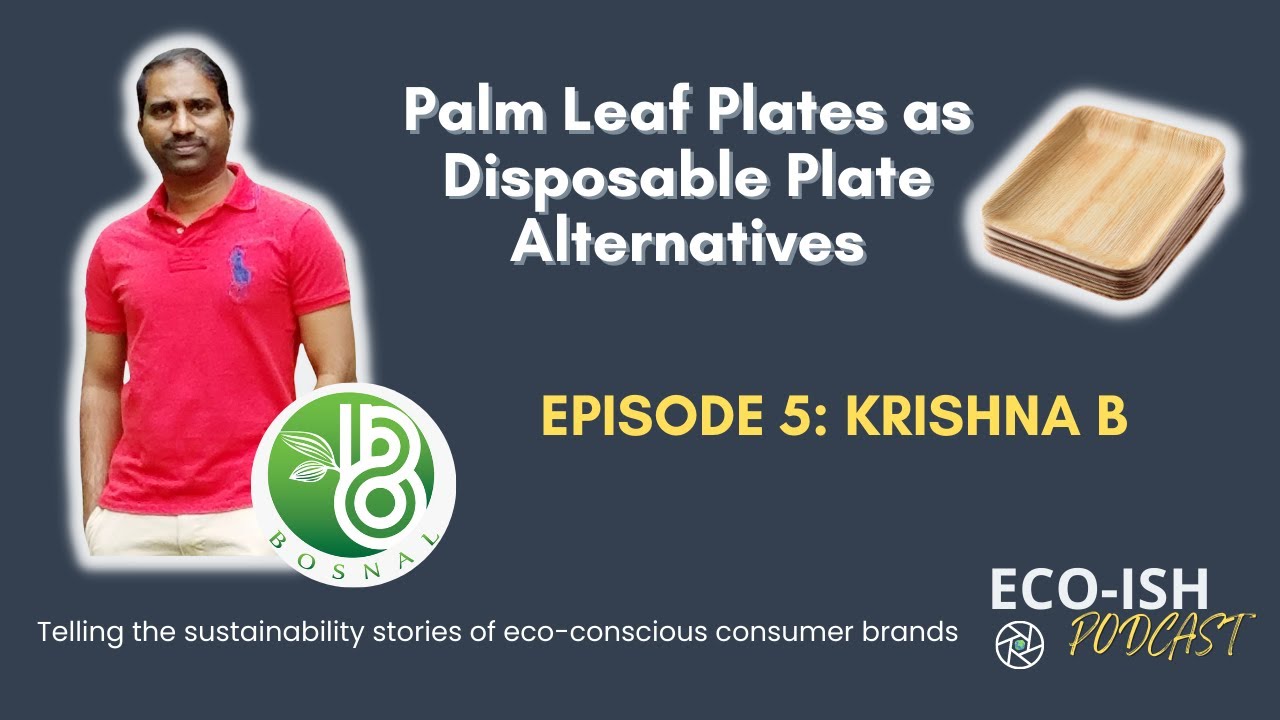
In this Eco‑ish Podcast episode, host Tracy Lydiatt interviews Krishna Bamidju, founder of Bosnal, an Indian‑origin eco‑entrepreneur who creates 100 % compostable dinnerware from fallen palm leaves. The conversation covers the personal spark that led Krishna to start the business (his son’s question about trash), the environmental advantages of using waste palm leaves instead of virgin wood, paper, or plastic (no tree cutting, no chemicals, 45‑60 day composting that enriches soil, and an estimated 1.2‑1.5 million tons of ocean‑bound waste avoided every three months). Krishna explains the low‑tech production process—collecting fallen leaves, pressure‑washing, heat‑press molding, microwave sterilisation, and shrink‑wrap packaging—highlighting the absence of glues or synthetic binders. The interview delves into social impact: rural women and families gain livelihoods, women’s empowerment, and community development. Trade‑offs are discussed, notably the use of shrink‑wrap plastic and the financial burden of selling on Amazon and Walmart, which affect price points and visibility. Krishna describes marketing challenges, the difficulty of competing with large corporations, and the need for continuous outreach. Consumer guidance is provided: plates can be composted in backyard gardens or municipal organic bins and are unique in appearance, adding a natural aesthetic to events. Durability is limited to a few days for wet foods but reusable for dry snacks. Future plans include expanding the product line to sugarcane‑pulp items and sourcing materials responsibly from multiple countries while maintaining direct relationships with suppliers. The brand name combines family names, reflecting a family‑oriented, values‑driven mission. The episode ends with calls to action for listeners to visit bosnal.com and follow Bosnal’s social channels.
Chapters
Hello listeners and welcome to the Eco-ish Podcast. I'm Tracy Lydiatt, founder of Sustainable Living School and your host today. The purpose of Eco-ish Podcast is to illuminate the good work towards sustainability that companies are doing, honestly discuss trade-offs they may wrestle with, and to share their interesting stories to help listeners like you make informed choices. Ecoish Podcast honors the imperfect journey towards creating an eco-friendly brand in an unsustainable society. On today's episode of Ecoish Podcast, we are pleased to introduce listeners to the founder of Bosnal, Krishna Bamidju. Krishna is an environmentalist with a strong desire to reform various forms of waste that are being thrown into the environment, especially the oceans. To address this waste, Krishna came up with a beautiful concept of using palm leaf dinnerware. To accomplish his ideas, he became an eco-entrepreneur and established a palm leaf dinnerware company and named it Bosnal. Within a short span of 2 years, this eco-friendly company has been able to reduce ocean waste by 1.2 to 1.5 million tons every 3 months. And they do this by helping reduce plastic waste that is being discharged into the ocean. Bosnal creates fully biodegradable and compostable plates and bowls, which are made in India from fallen palm leaves. The dinnerware made of palm leaf also creates nutrition after decomposing, and as a result, this decomposed waste can be used for plantation purposes, and it enhances the growth of plants. The bamboo look is stylish, but it's also sturdy and supportive for all foods and easy to clean up. And it's a great alternative to disposable plates made out of paper or plastic. And it's something that you can buy with confidence knowing that you're choosing eco-friendly, sustainable products that are good for you and the planet too. Hi Krishna, it's so great to have you here with us today. I'm really excited to learn about Bosnal and what you're up to. You, and I would love to ask you where you're calling in from today.
Thanks for inviting me to this podcast. I'm calling in from Atlanta, Georgia, USA.
Wonderful. And I detect an accent. Would you be willing to share where you're from originally if it's not Georgia?
I'm born and brought up in India, so it's been my 14 years I'm living in the US.
I love it. Thank you so much. I really enjoy learning about where people are from because I think it really forms a better picture of our background and our interests and, you know, the cultural perspectives we bring in, which I know is interwoven into your business. So I'm really looking forward to diving in about this with you. So what I always like to start off with our podcast is asking our guests if you can tell us in your own words, what does your company Bosnal do?
Bosnal is a eco-friendly product company. So we usually try to promote eco-friendly products to our consumers and throughout the world. So right now, Bosnel is based on producing fallen palm leaf plates and bowls and also wooden cutlery, which are good for environment and which are 100% compostable, which doesn't leave any traces of pollution or any damages to the planet.
Wonderful. I am so excited to dive in further. I just love this concept and palm leaf, palm leaf plates have been something that I saw on the market a while ago and actually I'm like really interested to nerd out with you a little bit about how they're made. And, but before we dive in there, I also really like to start out asking the question, what was the driving factor or is there a particular inspiration or spark spark that, um, ignited you to start your business?
Yes, uh, the main driving factor or the change of our lifestyle is because of my older son who was like 7 years old that time asked me a question. Like when we were cleaning up, he was helping me to clean up an after-party like in our house, like a gathering. So he asked me like an innocent question, like what this trash going to end up. I said it's going to go into the landfill. And he asked me like, can you do something? Like, uh, it's gonna pollute the environment, damages to the earth, and the soil gonna be spoiled and everything like that. So that sparked an idea into us, and we started doing some kind of research, talking to people in our back home country where, like, from my older generation, my mom, dad, and something like that, and from the age group And then the evolution of Boston will come into picture.
Wow, that's a beautiful story. Thank you so much for sharing that. And, um, I love young minds for that. They don't really have those filters, do they? Um, it could have been a confrontational question, and I really applaud you for listening to him.
He's my proofreader, and he helps me a lot in the routine day life of all the business going.
Oh, does he? So he's a little, a burgeoning eco-entrepreneur. How old is your son now?
He's 11 now.
Okay. And what did— what sort of things does he help you with that he enjoys?
When we set up an event at the shows, like a vendor events, he takes care of all the talking. I have to be just monitoring him doing the talking, and I just need to come in the end of the conversation you have, if they have— the customer have any more questions, so I can able to answer them. So most of the talking part, he will do it. So he knows, to be very honest, he knows a little bit more than me, I guess, because he reads a lot of books and other stuff.
I love him already and I haven't even met him. How fantastic. Uh, obviously he's really passionate about it and is helping connect customers with alternatives, I'd like to talk a little bit about how you feel your company is helping customers make those eco-friendly choices. And when we first connected, I thought about how many backyard barbecues or events or birthday parties, like all kinds of different events where we gather a lot of people. And if you're hosting, I know when I'm hosting, like one of the things that I really am not excited to do is dishes. And that I think that's why the culture of disposable disposable plates and cutlery came in because it's just really fast and easy cleanup. And your son is so right about landfills because when we bury these things, they don't ever really go away. And so I'd love to just hear more about your ethos and leading into the palm leaf production.
Basically what happens when you use a plastic or else the paper plates, it has to end up in a landfill. Field, and it's end up like a ton of wastage, and it will be staying there for a couple of years or more than 100 years. So plastic gonna stay 100 of years. So if you look at the worldwide statistics, there were like 2.12 billion tons of trash and seen only in the landfill. We are not talking about the ocean and other places. It's only an average, an average idea. And when you're talking about U.S. itself, it in self-contributes 139.6 million tons a year. Wow. If you fill them all in a truck, the whole US will be filled. If you fill them in a truck and stand them on a road, the whole US will be covered.
It's so— it's enormous, isn't it? Like, it's actually mind-boggling.
And like, normal people, like, everybody don't even think about that extent.
That's such a great point is like lots of times we don't think— I was talking about this with another guest is like oftentimes when we think about waste, the furthest our mind might go is, is my waste like what day is my trash pickup or is the garbage truck coming? And we don't think about it. And I feel like it might be fun actually to sort of pull apart those two things and have a little discussion about that too, because I could hear some folks saying like, well, it's paper plates. I know we do a lot of camping in Canada, and lots of times the paper plates would be used in the campfire, for example, and like, what's so wrong with that? Versus also the plastic cutlery. And so I'd love to pull those apart a little bit and get your thoughts about, about the source of those materials and their impacts as well.
When you're talking about the paper, The trees has to cut down to make a paper plate. Am I right? It's 100% right. So when you're talking about plastic, the plastic has to melt down and it has a process where the chemicals are involved in it. So it is a catastrophic disaster when we keep using these kind of products for a very longer time. The difference between the palm leaf plates is that we need not to cut any trees because these leaves are fallen naturally from the tree. So then only it is useful. So there is no tree damage done in the production of palm leaf plates. So it's all natural. So the leaf has to fall on its own, then only the rural people will collect it, and the product what we are getting as a palm leaf plate into— come into picture.
Oh, I love it.
We are, we are, we are, uh, we are achieving a point there where we are not cutting down the trees, and also We are not spoiling the environment after the uses of this product.
Yeah, that's a wonderful point. Thank you for sharing that. And for listeners, from a sustainability perspective, when you, when we talk about where we're sourcing materials, I just wanted to share that I'd like to point out what you're sharing with us is that you are sourcing your materials, not from a raw process, which is I'm cutting down a growing tree. You're actually sourcing your materials from what would be considered a waste product. And one of the challenges from a sustainability perspective at a very root cause is that we constantly as a society are drawing too much and too quickly from those raw resources. So using one of your plates actually shifts the pressure off of taking those resources from a raw state and using waste instead, which kudos and bravo to you. It's a, it's a wonderful way of substituting where those raw materials come from. And I only bring this up I bring this up because I feel like some people would have the thought in their mind like, well, it's no big deal. It's, you know, a tree, it'll grow back. So we do need to think about how fast that takes, how long it takes, and how much we're doing it. And I love the plastic point as well, because I've seen a lot of folks in camping situations where they'll just throw everything in the fire. And they don't think about the fact that there's chemicals in those plastics. And when they're burnt, for example, they go back up into the atmosphere where they actually really shouldn't be. And this, I think, also applies to developing nations that might not have the same waste collection systems that more developed countries would and would typically burn their garbage. So yeah, big—
That's what we are doing right now, everybody.
Yeah, big issues. So can we— can you tell me about how you actually make those plates? I've been so curious. About how the production happens.
Basically, the process starts when a palm leaf— shred a couple of leaves every year, and those were almost falling on the ground. So instead of burying them in the ground or going for waste, the rural people in India or in other countries, they collect those leaves. And we have a small process to make it. We don't have any chemicals, glues used in the process. What they do is they pressure wash with the fresh water.
Okay.
And they do have a heating machine like a heat press, like a— just like your iron press, which is have a form of a mold where it is called as shape of a plate, bowl, or something like that. And they usually press that under that small handheld machine. It's not like an electricity-consuming machine. So later on, the edges has taken care by trimming the edges to make it like the Edgeshop, uh, smoother. And they process that in the form, uh, they keep that plates, the finished plates, in for a couple of seconds to 1 or 30 seconds in a microwave where there is any leftover bacteria or anything will die over there. And then it will come to a shrink wrap packing. A lot of people just might think like why they use shrink wrap packing because this is a naturally formed leaf and we are not using any chemicals or like a glues to make it more attractive or keep it tight, right? So we use a shrink wrap to intact the plates in one place. Like if you're packing like 25 plates, we just use that shrink wrap to pack it properly, and then it goes to a box, and then it comes to the customer. So the entire process, there would be less complexity or else less manpower used and which also generates a livelihood for the rural people.
Okay, wow, thank you for sharing. I've been so curious and you've satisfied a lot of my questions because one of the things I was wondering about is how do the palm leaves actually stick together? So what I'm hearing you say is there's no chemicals and that it's purely because you're heating up the fibers with a press and that they just decide to stick together. Is that correct?
Yes, pretty much. If you look at this box, this is our eco-friendly box. Just I'm trying to explain you here.
Yeah.
So I demonstrated a small plate for you.
Sure.
A few plates here. So this is one of the plate. So what we do is once we have a flat leaf, and once you have a fat leaf, we have a small machine that I was talking about. We press that in that and then we follow the same procedure what I had discussed before and just make it into a plate. And once these come together, we stack all of them in one place.
Yep.
And just make a tight shrink wrap to it to keep them more— anything going inside of the packing.
Yep. You know, it's interesting. I wonder, a lot of folks— I have two questions. The first one is, have you considered using not a plastic wrap around the plates?
It's still working on that. We never quit on finding an alternative, but that's the only part we use a wrap to make it more secure for the people. And that too, we use very less density of the plastic where it can be recycled easily.
Yes, that's so, um, it's One of those things that we refer to as trade-offs, and the example that I give is, uh, say you have like a really nutritionally dense snack cookie or a granola bar and it's made with all organic ingredients, but you can't afford to wrap it as a company in the biodegradable wraps. You have to use the other wraps just to make it competitive on the market. And so what I'm hearing you say is that's a a growth area for your company that you're looking at alternatives, and this is a trade-off that you're wrestling with right now.
And we are still trying to find alternatives and more eco-friendly shrink wraps we can get our hands on so that we can replace it very quickly.
Oh, wonderful. Well, we all know this is an unsustainable world, and that's the exact reason why I decided to do this podcast. So if any listeners out there have biodegradable, a plastic alternative shrink wrap, get in touch with Krishna. He wants to hear from you. The other question I had was around, I really loved what you said about being in a rural area. And I think it's in any country, it's a challenge to have economic development in rural areas and typically manufacturing, it can sometimes be a challenge to set up in a rural area. So did you do this on your own? I'm really curious how you had the success with setting this up.
What we did is we visited those places and we found people who are economically challenged, facing challenges to have a decent lifestyle, and we work with those people instead of working with big companies who has multi-million dollars in their assets. So we try to provide more, uh, revenue and more lifestyle for them, because if they will stop migrating to urban areas where there is already too much population around. So we, uh, Bosnal is also working out with some regional charitable trusts and other places where they provide a woman empowerment where the women are get to work like as men, because that's not a big factor in our countries like US and Canada, but it would be a factor in some countries. Yes, most of the, most of the work is done by the people.
I love that so much. It just makes my heart sing. Thank you for sharing that. I think it's a really, really important aspect of sustainability, which is the social side of sustainability. And one of the things that we reference all the time is that the social sustainability is like a gas pedal So for example, if you can't feed yourself or keep your family safe or have a safe place to live and make a decent income, you really don't have the capacity to think about anything else. And when I'm hearing you say that you work with— in a rural area, you work with charities that are helping get equitable work for women, um, all the hair on my body just stands up straight. I'm so excited to hear that. And from a listener's perspective, I feel like that would be so comforting and exciting for them to know that they're supporting that work in the production of your product when they choose to use that instead of a paper plate.
Yeah, that's the good thing about, uh, by using this product, you're not only protecting the environment for your future generation and by yourself, and also you are giving independent, like, economical freedom for the women who are in this work style, like who are making their livelihood with this work.
It's wonderful. Congratulations on building that layer into your work. So important. I'm curious, could we talk also a little bit about the consumer side? So, for example, I have a big party, I'm celebrating my birthday, I buy your product. What is your recommendation for getting that product into its biodegradable environment? What do you suggest customers do?
Everybody in US and Canada and other countries mostly have a backyard and where they have an access to the trees. So once you're done using that, just take up the food, even though if it is food on the plates. What you can do is the better, the good advantage of these plates is you don't need a commercial compost bin.
Okay.
So you can just compost in your backyard if you have a flower garden or vegetable garden, you can just compost these plates in your backyard, which is 100% safe and which will degrade in the soil in 45 to 60 days based on the weather condition of that location.
Okay, that's—
and also it gives nutrition to the soil because it's a leaf and it gives nutrition to the soil.
So true. And this is something, a hot buzzword right now in sustainability world, is circularity. And I believe that your product demonstrates that so clearly because you're taking a waste product from a tree. You're not hurting the tree. You're collecting the leaves off the ground, putting them through the process to form your plates and sterilize everything. And then what I heard you just say is that the folks at the end of that process, me having a party or a listener using them, can just really just put it in their garden, put it in their compost. And I'm curious, if you live in a city, for example, can— will those city collections accept them for the composting?
Yes, the city collections accept them because you can do it in a bucket, then the city should not have any problem taking them with you, or else you can just put it in any of your flower beds.
Wonderful. Yeah. And I was just thinking, if you, for example, are in an apartment building and you have a green bin system that takes all your organics, you can just pop it in there is what I'm hearing you say. Yes.
And the good thing about— other thing to attract your guests, these plates are uniquely made and the greens, whatever it has come out, it has naturally forms. So if you look at the plates, if you have a set of 25 plates, Those 25 plates don't look alike. Every plate has a different texture and different, uh, color. Means it's naturally formed on the leaf. So there's no more fighting like everybody got the same plate. See, for example, I can show you if it is okay. I can show you.
Sure.
These are the two plates from the same packet I opened. You see the difference?
Yes, I love it. So for those that are listening only, one of the plates is a creamy white color and then the other plate has darker stripes through it that are more brown, but they look exactly the same shape. And yeah, everyone has a different character. So what you're saying is no one's gonna steal my piece of chocolate cake. Yes.
Yeah, that's what the hot topic when we have guests coming in with the kids, and they will try to figure out who has more grains in their plate and who has less.
Oh, fun! That's a great differentiator. I know folks do that with wine glasses, they put little tags on them.
So especially with the birthday parties when the kids are around, I have to just make sure that they get a— each get a different, different one so that they can compare after the— after the party. They can discuss how many grains they have, how much wooden texture they have. That's a topic in my house all the time.
Oh, no way! That's a great idea. So you try and weave in the educational component of talking about that as well.
Go to some local schools and try to educate the younger generation about not only palm leaves or other products which are economically and eco-friendly, so that they can start using on a daily basis.
Oh, that's so wonderful. I think education is so important, especially for the young minds. And so it sounds like maybe your son even has the opportunity to engage.
So he gets the leads from the school. So he talks to his friends, and that's how the teachers invite us to talk on this topic. So we often go to the schools. But as, as per the school policy, we cannot record because there were like kids around, so we cannot record that. So I cannot show it around to the audience.
Of course. Well, thank you for sharing that. That's something also that you do, charitable work and education work. To help educate young minds about this. I love it. One of the note— one of the things I noticed in your write-up was the durability of these plates. Is that something that, for example, if a customer doesn't mind reusing these plates, is that a possibility? Or is that something that you don't recommend?
We don't— we do recommend it, but if it is the same person using on a dry snack he can just wipe out with a, uh, damp cloth and, uh, just reuse it because this can stay for at least a couple of days.
Okay. Yes. But if you're having a big sloppy meal like chili or something that's saucy, probably— Yes.
Basically these are made up of leaves, right? So over a period of time when the liquid interacts with the leaves, so the leaves automatically will slowly try to lose his texture. It doesn't mean that it is not safe, but it is safe, but you may not have the steadiness of the plate, right?
Which, uh, I believe durability— thank you for sharing that— durability is a fantastic sustainability strategy. We talk a lot about that with, say, thrifting clothing or buying secondhand purses or shoes, like furniture, even a lot of those products have lots of long-term durability in them. So we should try and make those products last as long, which is where my question was coming from. And so really, I think it's up to the listener's tolerance of how they want to do that. And just before we move on, I did want to go back and talk briefly about the uniformity that customers expect and I feel like are slowly starting to break away from. And a perfect example is your plates, where they're both functional even though they look different. And I also feel like this is where this comes up a lot with food and how everything has to be so perfect and uniform, and that's not really nature. So I really want to thank you for bringing, bringing that forward and showing us that, that things can still be useful and functional even if they have slight color changes or different looks to them.
Yeah, because it gives like a natural wooden texture. So that would be unique to hosting, using them in your parties or events or on a regular basis. So using a paper plate, you will see it everywhere. When you use a palm leaf plate, that makes you unique, stand out in your party.
That's wonderful and embraces what nature is, which is not uniform, has so much variety and diversity. It's wonderful.
Uh, so I—
one of the things I would love to ask you, um, besides the plastic packaging, the shrink wrapping that you're working to find an alternative for, are there any other hurdles or trade-offs that you've had to struggle with as you've developed your business?
Right now we are facing a lot of visibility, the visibility of the people, awareness among the people. So it's like a not a day process, right? It is a continuous effort that we need to bring these kind of eco-friendly products in front of the people. So as a small business owner, as a family business owner, it is a challenging part for us to reach more people.
Right.
Whereas when you compare with the corporate companies, they have their own marketing agencies and a budget to spend to reach it to more people. Whereas that you don't need— like you have hundreds of thousands advertisements of plastic, paper and all, right? They are billion-dollar companies, they can spend that kind of money to attract people. Like where we are talking about small businesses and family businesses where who want to promote eco-friendly life and also have a conscious of plan protecting the planet. It's quite challenging for us to reach to the people.
Okay, so I heard visibility is one of the biggest challenges, which is very legitimate and super valid. And I know that a lot of listeners of this podcast have the same values I know that you do and I do, which is I always seek to support local. I always try to, um, support small businesses, especially family-run or women-run or people from marginalized, um, populations of our general populace. So I love that you've shared that challenge because I, I also don't think that's only your burden alone to carry that. So thanks for sharing that. And I'm— I noticed that you sell on Amazon, and I'm wondering if you can talk a little bit about how that's been for you as a small business and if it's a help or a hindrance to getting more visibility and reach.
Regarding the visibility, it's kind of a help. Based on the economical, like a financial part, it would be a hurdle because Amazon is a one of the leading e-commerce platforms. So to— in order to get our visibility, we have to place our product in a way where there would be more visibility. So Amazon, I have no— nothing better about Amazon. I'm just to be honest with you, because their structure of shipping and all logistics, it takes most of the financial part, whatever that we are generating, it takes most of the part to Amazon and Walmart.com. We do have our presence in Walmart.com, so we have to bear that in mind how we have priced out at those places. So usually we can less price at our store or directly purchase from us. In order to cover their expenses, we have to a little bit on the price point, we have to be go up on that one, right?
So what I'm hearing you say is the distribute— you probably have distributors and potentially sales reps that have helped you make those placements. And of course, there's a big difference between a retail price point and a wholesale price point. And the trade-off for the wholesale is that you get the distribution, the larger distribution network, say in a Walmart, for example. And that's a, that's a big deal.
Yes. And moreover, like in-store availability, we are trying to get into more in-store purchases. Like, it's a corporate thing and we have to go through a lot of red tapes to get in our product into the shelf. Like, Kroger, Publix, everybody has their own criteria to meet. So we are working towards that to make this product more available to the customer so that we can reduce the cost and get it more available to the people so that they can start using it often.
One— yeah, wonderful point. Um, I, I did a little bit of this in the food industry. And when I started sharing about how difficult it is to get through that corporate red tape, and even just— not even that it's red tape, but just get through their systems, because every corporation has specifications about how your packaging should look and where the barcode is and what your price point is and what kind of promotions you're going to be involved in. It's, it's a heck of a journey, and it can take up to 24 months in some cases. So I think it's wonderful that you're such a young company and you're already working with a corporation like Walmart. And one of the things that I don't like shying away from is talking about money and talking about making money, because what you're doing is so important because you're providing an alternative to the market. It's really important that you make money and that you're sustainable and that you can like continue to live and have this as a career.
So when we come up the part of the money, when we are talking, it's not only the companies making the money, it's the majority goes to the people who are working in the background, like the rural women and rural women empowerment. That's what we're going to spend that money on so that they can have more options.
I love it. You're living your values true to heart. Thank you for what you're doing. For the world. I wish everybody thinking about a backyard party or a camping trip would find your product instead. And, uh, so this is part of the reason why I'm excited to have you on the podcast and get some more reach out there. So we talked a little bit about challenges and I'd love to flip the switch and talk about something positive. And what are some wins or things that you're excited about? The first thing I'd like to mention is just congratulations for the amount of waste offset that I shared in your introduction. And beyond that, I'd love to hear what your plans are for the future and what you're excited about.
Yes, when you're talking about the growth, uh, we don't want to grow like a big multi-million company. We just want to have more people aware about the products and start using eco-friendly products. We have Palm leaf plate is one of the starting products we had introduced. We are having plans to introduce sugarcane products made up of sugarcane pulp, and we do have like 5-6 eco-friendly products which are 100% natural and where the trees are not being damaged. And it also, after compost, it will provide nutrition to the soil. That is the reason we are just working towards, and as a small business, we do have challenges So the first thing is we started with one product. So as we grow, we gonna introduce more products and more eco— all the eco-friendly products. So in no point of time, we are not thinking adding any other than eco-friendly products under our brand category.
I love it. I love it so much. Um, and it's probably a really interesting and creative journey to expand from your original product and incorporate more. So with the sugarcane, is that also going to be sourced from India? Or is that some from a different country?
We do get, we do get from different countries, and whichever works for us, we will plan to get that from that country where we often, when we go to like a product launch, we personally visit the country. I said I myself visit the country and talk to the people over there and try to understand there how the things are working. And we don't want to do like multi big companies, just give them an order and you get it on the next day. We just want to change the lives of the people who are living in a rural places in those countries. It's not only my country.
Oh, that's fabulous. And something potentially some listeners aren't fully aware of from a supply chain perspective, as your company grows, a lot of times you can get a lot of distance between you and the source of where your materials come from. And I really love that you just shared that that's a way that you operate your business by going to those places and actually meeting the suppliers. So you continue to live the values that you've shared earlier. So I really love that. Um, thank you for sharing about the expansion plans, and I'm really looking forward to hearing how that goes for you. Maybe we can book a second podcast and have an update at some point in time and hear how that's all going, if you're interested.
So, uh, I just want to point out, like, uh, maybe, uh, how the Bosnal name got into the other brand name. Yes. Yeah, Bosnal is mostly combination of my family names. So it's not like we figured out from ourselves. It's a company because we want to have a family business, at the same time helping the other families. So we want to incorporate our brand name with our family name so that we can join other families and help them out in the same way.
Oh, that's beautiful. Thank you for taking the time to share that. And I believe that's the true definition of legacy, that as you rise, you're pulling other people along with you. And I believe that's what a true leader does. So congrats, congratulations. I really see you and acknowledge you for that. If you could pick up a paintbrush or a magic wand and paint your ideal picture of a future outcome for Bosnal, what would that look like?
I would only imagine if people just come across Bosnal, they should think it's a trustworthy brand who only produce eco-friendly products, not anything else. That's what we are aiming to do.
Awesome. I love it. That's your goal— trustworthy and eco-friendly, family-oriented, and values-centered. Yeah, that's what I'm hoping to So as we wrap up the podcast, I wanted to invite you to share how listeners can connect with you if they're interested in purchasing your product or finding out more information.
The listeners or whoever come across this podcast, they can always check our website. It's on www.bosnal.com. And we do have a Facebook, Instagram, and all other social medias. It's as Bosnal USA. So those are our social media pages. Please do share, subscribe us, and follow us on those pages. You will get latest updates, podcasts, blogs, and the pictures how we are trying to eradicate plastic out of this world.
Wonderful. Thank you for that. And for listeners, I will also put all of that information in the show notes so you can have easy access to it. Thank you again so much, Krishna. It's been a deep pleasure talking to you.
Inviting us and giving us an opportunity to talk about the stories, and often a small business owner who is trying to accomplish something by going into eco-friendly lifestyle.
Hey listener, thank you so much for tuning in to this latest episode of Eco-ish podcast. We're very excited to bring you new content every other Wednesday throughout the year. You can follow along at Instagram at eco.ish fish.podcast. If you'd like to find out more about the Sustainable Living School, which produces this podcast, you can look at the website sustainableliving.school. You'll find information about courses and a free guide that you can download to learn more about sustainable living and how to get started. The Sustainable Living School is also partnered with Your Healthiest yourself on a 5-day free Sustainable Living Made Easy Challenge. You can register at any time by going to the website sustainablelivingmadeeasychallenge.com. Thank you again, and we hope you'll tune in again soon. Bye for now!
More from Tracy

Episode 17: Investing with Purpose: A Deep Dive into Responsible Investing in Canada




Episode 13: Get Mouthy Dental Care Box - The Hidden Truths about Toxins in Your Dental Care Products

Episode 12: Waste Knot Weddings - How to Easily Plan Environmentally Conscious Weddings

Episode 11: Rachel and Jesse - Kooshoo: Leading the way for zero-waste hair accessories

Episode 10: Brad Scott - Transmutation: Innovations in Plastic Recycling from Rural Australia


Episode 08: Sonja Picard - Recycling Old Jewelry within an Ethical Luxury Jewelry Brand
