How to value your billion dollar idea
Jason Kraus, CEO of Prepare for VC, teaches founders four ways to value a startup: cost to rebuild it, comparing to similar companies, applying revenue multiples, and back-solving from a projected exit. He warns against overvaluing early-stage companies and explains how to present traction through user metrics when revenue is still minimal.
Chapters
This conference will now be recorded. Thanks everyone for joining here today. This is a presentation to the Found Something group. Today we're going to be talking about the art of startup valuations. And how much is— oh, hi.
Hi. Sorry.
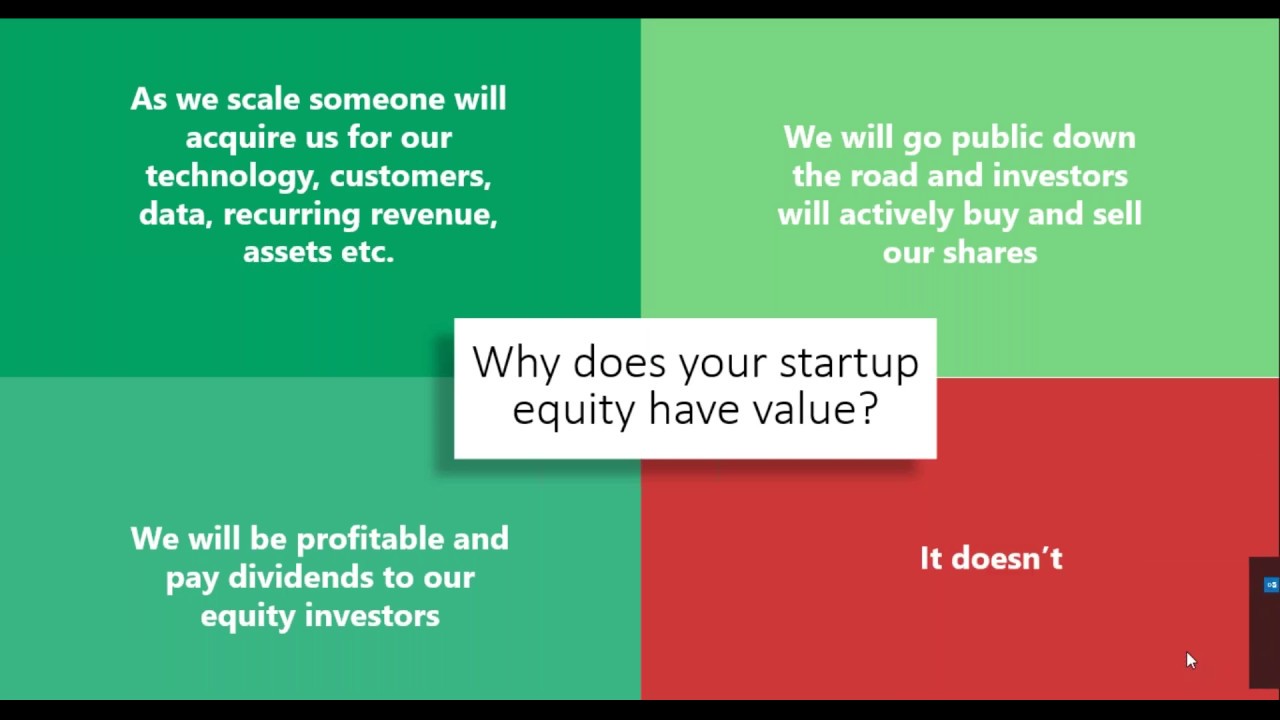
Yeah, we're gonna be talking about the art of startup valuations and how much is your billion-dollar idea really worth. I'm Jason Kraus, the CEO of Prepare for VC. We're a startup consulting firm that helps companies through the fundraising process, building out pitch decks, business plans, and your overall fundraising strategy. as well as other resources to help you along the way. Love being involved in this Found Something group. It's a great resource to connect with people from a variety of backgrounds to help with everything from funding, prototyping, legal aspects, business ethics, and more. And yeah, if you're not in this and you're seeing it on YouTube, just feel free to reach out to me and I'll be happy to introduce you to the group. So the first— where I wanted to start with is just why does your startup have equity have value to begin with? So basically the equity stake or the stock in your company, you know, it has a few different reasons why it can have value. One way seen here on the upper left, basically you're expecting that as you scale your company, the equity— a larger company will acquire you. It could be a corporation or a larger startup, even a private equity firm. Just somebody is going to buy you because either the technology you built Really benefits their business. They're gaining the customers and revenue you've built up over the years. The access to the data and assets are extremely valuable for them. They're just really— you have something they built that if they, if they started it themselves, it would take a long time to get to where you are, and you're adding a lot more value by just being an acquisition target to them. So the equity in your company at the point where you sell them, everybody that came in now and participates in the growth is going to benefit from a sale down the road. Another option, you're building up equity to go public. That's an IPO or just, yeah, basically going on the stock— going on any of the stock exchanges. where investors can actively buy and sell shares, and the value in your equity is, you know, will become sort of a market value where people, you know, can actively participate in trading your company and benefit on the growth of your startup. And, you know, as when you have good months, they'll make gains. And when you have bad months, or yeah, depreciation of your assets, there'll be some losses. So yeah, the other way is, you know, maybe, maybe you're not aiming to be either go public, be an acquisition target. You're just looking to be a profitable company, sort of more of a long-term play, and you have the potential to also offer dividends and returns to your investors along the way. And, you know, maybe sometimes it also might not have any equity value. This could either be, you know, you are the company, it's a consulting business or, you know, a solo venture. that somebody requires that you, you know, basically they're just hiring you. So you're not, or, you know, it could just be, maybe it's a great, it's a short-term play, like you're solving a problem that'll exist over a few years and, you know, it could be great financially along the way, but not— not a lot of value in the equity of the company itself. And that doesn't mean it's not a good business, it's just not as investable for, for the equity investors. So when you look at valuations, there's a few different methods. One of them we look at is the cost to duplicate. So that would be If I want to get— if I'm another company, I want to get to where you are today, what will it take monetarily to get there? So that includes finding and hiring an equally competent management team. You need basically everyone with the same skill sets and backgrounds you have. Even if it's a small pool, you still have to convince them both to leave their current position and take the same— Decreased salary you're taking over the next, you know, versus your market rate because you have equity in the company. So you're assuming, you know, this is— in this situation, you want to fully fund it, or what would it cost if you were fully funding it and operating the same way without giving up any equity? So Yeah, acquiring, that's a cost of additional manpower, technology you've developed to bring it to the current stage rapidly. And yeah, basically almost immediately or as immediately as possible. Same thing with building the equal brand recognition you've built up and achieving the same level of ongoing sales rapidly. So, you know, as you're a small, you know, a newer stage company, it might take— if a large corporation did this, maybe it takes them $2 million and a month to get to where you are today. As you're— if you're looking to replicate, you know, an Uber, it'll take billions of dollars to get to where they are. Yeah, and a lot of manpower, marketing, technology around that to get to there as rapidly as possible. So that's, yeah, that's sort of one method. And throughout these, they're sort of all areas you focus on in terms of valuing your company, but don't necessarily choose one versus another. You sort of take the mix of, of what's most important to your company and to the investors and come up with the best solution and valuation for your firm. Another one is just feedback into the valuation. So you project out a realistic exit potential in 5 to 7 years. You can use this by, you know, projecting out sales, the costs associated with those, Look at some market trends and the potential to just figure out, you know, this is our year 5, year 7 revenues that are realistically possible for our company. Companies in our industry sell for 4, 6, whatever the multiple is, times that revenue or profit. Then you find out your exit potential. You also need to figure out the investment needed along the way from outside investors, whether it's angels, VCs, family offices, to get to the place where you'll be able to exit. And yeah, sort of back into the The amount, basically the amount of growth in the company you'll be facing outside of that future investment. So if you think you're going to be, for instance, if you're going to be a $100 million company in 5 years, but you need $20 million to get there, you're basically an $80 million you'll be an $80 million pre-money company before that investment. Then you find that what risk multiples apply to your stage. So if you're looking at mostly seed stage investors, you're looking for— they're probably looking for a 20 times return or more. Series A with a lot more traction and revenues could be looking more towards a 10x multiple later as you're within— or smaller amounts when you're within a year or 2 of exit and have a lot more growth to show from that. So basically, and you're finding the current equity valuation investors would need to hit the desired returns. So, you know, in that scenario, we're saying it's a $4 million company we've built up today. We're gonna need— basically, we're gonna exit for $100 million and take $20 million of equity down the road. Our investors are still getting about a 20x return. You know, it's great if you can show— use some of these other scenarios and also show, yeah, they're getting, you know, much more than expected, and there's a little bit of wiggle room in terms of, for— in terms of, you know, any unknown circumstances that come up that might affect, you know, how much you need to raise or the valuations you're giving up shares at along the way. There's— sorry, one second. Yeah, so one other Or what I meant to talk about in the middle is using industry comparables. So this will be different than the one that's shown on here. Basically, comparables are just saying my company is pretty similar to these 3 other firms that are out there. And based on the valuations they were at either right now or right before Basically, yeah, either right now or when they were earlier, earlier on in their development stage, they were receiving a $5 million valuation or they were receiving $10 million valuations and we're going to be even better than they are. So just using industry comparables is another way to sort of showcase your value and where you fit in the investment marketplace. The 4th method is just using revenue multiples or industry multiples. Usually this is a little later stage for startups, you know, once they're up and running, have consistent revenues. Basically, you know, you're going to have big growth, or ideally you'll have You know, growth patterns that are, um, pretty large. So what you're gonna do is, uh, you know, you're not gonna take the full, um, like a full year snapshot of returns. You'll take how much you're making each month and sort of annualize, um, your most recent sales out for the year to say, you know, maybe we made $100,000 last month, that means we're going to be making at least $12 million for the year. So you multiply— or sorry, $1.2 million for the year. You're going to multiply that by the industry standard revenue multiples that companies get acquired at. And if you're a little earlier on, you might adjust a little bit upwards for the growth trajectory. If you're— around like, you know, a Series A to B level or later, you might keep it consistent with that revenue multiple. And just basically in this method, investors are betting purely on the growth of the company. So, you know, if they come in paying valuing your company at 4 times your revenues and they think you can sell for 4 times your revenues. They're just, they basically make money dependent on the growth of the revenues in your company, which is, you know, a pretty fair position for both sides and puts them in line with, with the founders in terms of the goals of the company. So some major things to consider here are investor returns. You want to make sure basically anything you present, you know, the investors are going to be happy with their position in the company. So that's basically Making sure, you know, they're— a lot of times, you know, they can add a lot of value besides, besides their investment, whether it's connections in the industry or just advice on situations they faced with other, other companies themselves or investments of their own. So, you know, making sure they have enough incentive to focus on your venture over their other, um, other portfolio companies. And that's not as much of an issue because, I mean, that sort of determines whether or not they go into the deal in the first place. But it's just something to consider when you're, um, scoping out the, uh, yeah, investment, um, investors to join your deal. Um, the founder incentives are pretty critical here. Um, you know, as much as investors want to have a lot of equity in the companies they're investing in. They never want to have too much equity that the founder feels disincentivized to stay there, work, and put all their effort into the company. So, you know, if basically, yeah, even, you know, most investors don't want to take, yeah, basically a large enough large enough percentage in the company where they feel that down the road the founder is going to be, you know, owning 10% of the stock by the time it exits and, you know, isn't really going to be as passionate about working there, might be looking on to the next thing. They really want to make sure It's structured in a way that everybody on both sides is going to benefit, benefit along with the growth of the company and be working together towards that. Future dilution. This is more crucial at an earlier-on stage, especially for companies that will need large infusions of capital, usually. Basically, you know, companies that need to produce a high growth trajectory in order to be first to market or capture, capture a particular space. So in dilution, basically, if you're coming in as, you know, as an early investor, maybe you put in Maybe you put in $50,000, $100,000 as an angel and you got a pretty good, or what you thought were good terms, but then a VC comes in and they put $100,000 or they put, say it's a VC puts in $100,000 million dollars of capital into the company, your percentage ownership, yeah, really dwindles down. And, you know, you're going to need to have the valuation of the company scale with the investment amount to really capitalize on exit potential there. So there's a few ways to account for dilution, including Basically, you know, some caps on— or convertible notes can be a method giving you the same terms as larger investors in the next round. Basically some other anti-dilution metrics that let you, you know, more for smaller VC rounds that follow, that would let you re-up your same percentage in the company and sort of follow on with— to keep your investment percentage in the company. There's some other metrics, there are other ways of getting into that as well. We had a question about what a SAFE is. So that's also Basically another— so in terms of ways investors can invest in the company, they can go into equity, basically, or they can do a common stock, which is sort of the same pool of shares the founders are getting. They'll be basically the last ones to be paid back at an exit, but they'll get basically all the remaining value of the equity in the company. It's usually the same as like the founders pool common stock of shares. There's preferred— most common term of— or most common equity for For investments are called convertible preferred equity. That's basically there's a certain percentage return you're expected to get as an investor, and then you can convert that, you can convert that into common stock as, as the company, you know, prepares for an exit and you're expecting Larger percentage of the company. So the main thing about preferred stock is it's paid back earlier on. It gives investors some incentive to join, or basically protection on the downside if the company fails and needs to have— if it goes bankrupt, basically preferred shares get paid back right after all the debt that's owed on the company. So yeah, it's just a protection, more of a protection most investors like to receive. Then there's convertible notes and SAFEs. Convertible notes are technically debt at the point of time you invest in them. It's basically saying we're loaning company To your money. We're loaning money, we're loaning capital to your company at a future— usually standard terms are, you know, we'll be loaning this capital to your company, getting 6 to 10% interest. And at the point where you raise the next round or there's a qualified financing, which can be, you know, a certain amount of capital that comes into the company. We'll have the option to convert all of that initial debt plus any interest we earned into equity or into the same terms as the investors in the next round get. But because we came in earlier, We're going to get that the 20% discount or basically 20% more equity than that next round of investors gets. There's also ways to cap it. So, you know, there's a minimum or— Yeah, minimum amount of— or a minimum percentage of equity or valuation cap that those investors that came in earlier on get, and they're more incentivized to come in Earlier versus waiting, um, to do a next round when the capital isn't as urgent as it is right now. Um, a SAFE sort of taken, um, some of the aspects of the convertible note except for the main fact that it's not considered debt. It's just a simple agreement for future equity. So basically you're saying, um, you know, we're gonna get this We're going to get the terms. We're going to get basically future equity at a discount to what the next investors put in. We might even get a valuation cap on our investment, but it's not going to be considered debt. We won't be paid back as a debt holder if the company went bankrupt right now. We're just going to be purely— Investing for that future equity will get in your company. And, um, you know, it saves— it's the least costly form to set up legally. So, you know, one of the main benefits— it started out in Silicon Valley. It was a way to, to say like, or basically to invest quickly. No real— there's a minimal amount of legal work required to Offer a SAFE, you can get financed quickly, grow your company, and sort of come back and raise the next round and convert those SAFE holders into equity holders with that benefit you offered them originally. One other aspect I wanted to mention is just closing doors. So this means Obviously, there is some negotiation, especially in finding your lead investor. If you walk in and do say your valuation is something enormously high that investors feel like they're not even close to where you are in the company, you might close those doors, not even have them come in and follow up for a conversation where they would have otherwise. So you want to make sure you value the company well enough that it benefits— you're happy with it, benefits everyone involved, but you're not coming in and saying, this is a $30 million company I'm about to start development on. There's no real traction yet. I just— yeah, it has to be somewhat in line with basically all those areas I mentioned, the comparable companies, the valuation potential, and sort of the traction revenue of the business so far. Just making sure everything lines up. And, you know, there is some room to negotiate, but yeah, generally, you know, it's got to be pretty close to where you come in, where it's going to be pretty close to where you come in as a startup founder, and might be some terms that are negotiated or a small change in the valuation from there. And with that, yeah, happy to open it up to any other questions or, you know, wrap it up. And we can also, yeah, take any comments. I'm going to post this video on our Trello channel for the Found Something group as well as YouTube for people to comment and ask additional questions there.
Hey, Jason, good morning.
Hey, how's it going?
I'm good. How you doing?
Good.
Uh, thanks for the, uh, presentation. Uh, very informative, uh, quote window, those, uh, 4 different ways to determine the valuation, and just trying to figure out, you know, which, which one would best fit, uh, my company. Um, I know every, you know, situation is unique and very complicated to figure out a proper valuation. Um, you know, is it based on, um, traction that you have? Is it only based on MRR? Um, or on, you know, future, uh, hopefully, you know, future growth and future revenue? Um, so I have some traction but don't really have, um, uh, monthly recurring revenue. Um, I think the company I'm starting is in Um, a unique position where it's not like a traditional business, it's more of a, like, a photo sharing app. I think we had spoken a couple of months ago. Yeah, uh, on what, what my exact company is, but how would I determine an appropriate valuation in that situation?
Right, so, um, yeah, these are more guidelines. I mean, there is, um, basically in your presentation, you know, Basically, like in doing the projection model, for example, from your starting point, you're going to be including some of those partnerships, other traction methods. Even if it's not revenue, you're going to be including that both in your deck and in any projections you develop. by determining the value of your company. So, I mean, maybe you value them as sort of assets of your company that you have now and will help you scale, or maybe it just is another way to showcase that these projections are realistic because you already have a bunch of interest lined up and Maybe they haven't converted into sales yet, but there's a good chance they will based on the interest you've received already.
Okay.
Yeah, yeah. And they're more— yeah, I wanted to present a few guidelines that you can use, but obviously there'd probably be 100 different ways to sort of value each company. You know, yeah, some are going to be— even some will be, you know, on the projection part, companies get bought based on the amount of users they have versus, you know, the amount of revenue coming in, or, you know, the value of the data they've collected over the years. So, you know, that's important to consider what your most important metrics are and project those out as well to showcase to investors.
Okay, thanks. Um, so what, what's the difference between, like, uh, let's say method 1 and method 3, like, uh, the cost to duplicate versus, like, comparables?
Yeah, so the comparables is basically, um, I want to say, uh, I'm looking at if I'm starting a— or if I started a ridesharing company, for example, and I have a platform launched in 2 cities and I want to raise some funding to scale it from there, I'm going to look at what the valuation was of Uber, Lyft, Fasten, some of the other competitors at the same point when they were in 2 cities as well and looking to scale versus the first method of how much it is to duplicate would be, you know, if I'm another person that wants to go out and start this from scratch, what would it cost to hire a whole team of developers, hire myself as the CEO and the rest of my team around me to basically go out, create this as quickly as possible, and get to the same place, the same amount of, you know, do enough marketing to get it to the same place that this company is that's coming in to pitch.
Okay, and you said hire yourself, so as you're going into a funding round, Um, it is perfectly acceptable to include, um, you know, a salary for yourself, or do investors prefer to see you hold that off until you're making serious revenue?
Yeah, it's acceptable. Um, as long as you're, you know, um, yeah, basically if you're, you know, coming in full-time on the company, um, even if you weren't before, yeah, it's acceptable to include a salary for yourself. Generally, you know, generally, yeah, and I mean, they want you committed. Yeah, committed to the opportunity and, you know, being able to dedicate the full time to it. So yeah, it's definitely acceptable. And, you know, it might be less than what you'd be making if you were you know, working at, um, at a position elsewhere. But, um, yeah, you're sort of incentivized by also having that equity stake in the company.
Okay, thank you. And, uh, going back to like, uh, the founder incentives, um, you know, you don't want to give away too much, you know, where the founder isn't into the project anymore. He had to give away so much to, to get funding, what would be an appropriate amount to give away? And, you know, how much should a founder hold on to?
Yeah, so again, this is— it's more dependent on— I mean, you have to look at the big picture of What you're aiming to grow this to. So if you're, you know, if this is a company, maybe you can raise $1 million, $2 million, scale it up to, you know, $20, $40, $50 million exit. You know, you'll be— you'll want to have a good percentage in that, and you'll be happy with the exit potential there. If this is a company you're going to need A lot more capital, but it could be that billion-dollar idea, billion-dollar company. Maybe you own a small percentage by the end of it, but you're sort of betting on this becoming a worldwide or nationwide company. So Yeah, I mean, the most important thing I'd say is like at the early stage, you know, you want to maintain enough equity that you have flexibility in the direction where you can take the company and, yeah, still be safe to go in either direction as the company changes.
Okay. All right, thanks a lot, Jason. I don't think I have any more questions at the moment, but I appreciate it. Thank you so much.
All right, thanks. Uh, yeah, thanks for joining, and, um, yeah, excited to follow up with you. And yeah, we can, we can catch up, uh, catch up for a call sometime soon as well.
That's awesome. I appreciate it. I will, uh, I'll shoot you an email.
All right, thanks.
All right, thanks a lot, Jason.
Thanks. And yeah, thanks everyone for joining. Yeah, you can check out my website at prepareforvc.com or feel free to message me to connect further. Thanks.