"Iran Is Playing the Long Game": What to Expect from Protracted War in Middle East
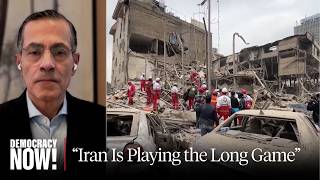
Iranian-American scholar Vali Nasr explains Iran's strategy of absorbing strikes and retaliating through low-level attacks on Gulf energy infrastructure. He argues the U.S. underestimates Iran's capacity for protracted conflict and that assassinations of senior officials have radicalized rather than weakened the regime.
Chapters
In a major escalation in the U.S.-Israeli war on Iran, Israel bombed Iran's South Pars gas field, the largest known natural gas reserve in the world. Iran responded by attacking key energy infrastructure in Qatar, Saudi Arabia, Kuwait and the United Arab Emirates. Iran launched two attacks in Qatar on Ras Laffan, the largest liquefied natural gas production facility in the world.
Israel's attack on South Pars comes days after Israel assassinated 3 more top Iranian figures: Iran's security chief, Ali Larijani; Iran's intelligence chief, Esmail Khatib; and the head of the besieged military, Qolombeza Soleimani. In the latest sign the war on Iran could be just beginning, Reuters is reporting President Trump's considering deploying thousands of more U.S. troops to the Middle East. The Pentagon has also asked for $200 billion from Congress. We're joined now by Vali Nasr, an Iranian-American professor of international affairs and Middle East studies at Johns Hopkins School of Advanced International Studies, SAIS. He's the author of Iran's Grand Strategy: A Political History. His recent piece for The Financial Times is headlined "Iran is playing a long game." He's joining us from Washington, D.C. Thank you so much for being with us, Professor. If you can start off by saying exactly what you mean, I think something that people in the United States hear very little of, what is Iran's long game. Tell us about who you believe the leadership is right now in Iran and what they are doing.
Iran is following a strategy that was conceived after the June war, the 12-day war they had with Israel. And it's being implemented systematically by commanders, decision makers in government and in the military. It's not dependent on one decision maker, as we saw that Israel killed Iran's the supreme leader, and yet Iran was immediately able to retaliate and engage in the war. Iran has established a way of governing and fighting which is called mosaic military strategy, mosaic government management, which is not dependent on one person. And it understood that it's going against much more powerful militaries, Israel and the United States, and it's not going to fight their war. It's going to fight the war that it wants. It's willing to absorb the hits that it's getting from Israel and the United States. And he thinks the longer that the war goes on, the less Israel and the United States would be able to defend against Iranian missiles because they're going to run out of interceptors. They had calculated the war would be quick. They have plenty of offensive bombs, but they don't have sufficient defenses. And we're seeing that more and more of Iran's deadly missiles are landing in Israel. They're landing in the Gulf. And also, Iran decided to wage a longer war on global energy and the global markets using drones, mines, low-level ammunition, not necessarily ballistic missiles, to attack the Gulf economies across their energy fields, as well as trade. And it calculated that the longer that this war goes, the less prepared the United States is for the consequences. President Trump calculated on a short war. He said he was surprised Iran attacked the Arab countries. He was not prepared to be 3 weeks into the war, and perhaps much longer. The longer this war goes on, the more Iran is building leverage and the more the strategic calculations of Israel and the United States appear to be falling short.
Professor Nasser, if you could comment on the fact that the U.S. has deployed now, or is in the process of deploying, 2,500 Marines to the region, because, of course, you've mentioned Iran's war, essentially, on the global economy, in a way, to impact both America and Israel, who have much larger militaries. So, in this asymmetric warfare, the Strait of Hormuz is a central question, its effective closure. But now, with these 2,500 Marines in the region, who will reportedly be tasked with working towards reopening the strait, how does that— change the equation for Iran, if at all?
Well, it's not very clear what 2,000 Marines can do. And they cannot arrive in the region immediately, at any rate. It takes them 10 days to 2 weeks to be there. Perhaps the president was calculating that either there's a scenario in which that they could attack the northern shores of the Persian Gulf, the shore where Iran is sitting on top of the Straits of Hormuz, or capture some Iranian islands, either the Kharg Island, where Iran exports more most of its oil from and the US has already attacked, or other islands. But I think after the United States and Israel tried to put pressure on Iran by attacking its gas field, and then we saw how Iran retaliated, this whole strategy may no longer be working. In fact, we saw President Trump in a posting on Truth Social back away from taking responsibility for Israel's attack on the Iranian gas field and saying Israel will not do it anymore. 'Will not do it anymore' means that the US is probably having second thoughts about very aggressive attacks on Iran in the Gulf as well, because it now understands that Iran can escalate in ways that the United States cannot defend against. You know, the way Iran attacked the Qatari gas field and refinery could also be visited on Saudi oil facilities on a much larger scale, UAE at ports that send oil around the world. And so, U.S. is finding itself in a situation where it's threatening Iran, it wants to threaten escalation and escalate, but it's not able to prevent Iran's counter-escalation and be able to account for the costs of that counter-escalation.
Professor Nasseri, you did mention earlier that the Iranian regime is not dependent on one individual, so Khamenei's assassination has made very little difference. On the other hand, now, there have been so many high-profile assassinations. High-level assassinations, including Ali Lajjani, top security official in Iran, the head of the paramilitary force, Basij force, among others. I mean, do you think that if this continues, Israeli and U.S.-targeted assassinations, whether that might make a difference? And also, where is Mojtaba Khamenei? What has the significance been of his ascension to power? And many people comment that he's scarcely been seen. There are rumors that he's in fact recovering. In a hospital in Moscow because he was also injured in the attack that killed not only his father, but also his wife?
Yes, he's been severely— it is believed that he was injured. But I also think that the Iranians are trying to take precaution that he will not be assassinated as well, fully well knowing that he is a target. Of course, these assassinations do matter. There are important people who are taken out. For instance, the killing of Ali Larijani was not only killing a very significant node in Iran's power structure, but it was also killing somebody who was most likely to be a potential interlocutor for the US if the point came for a negotiated off-ramp. But, but what we are seeing is that Iran's system is designed not to collapse easily. It doesn't mean that it will not collapse at some point, but the point of collapse clearly is far further down the road than US and Israel anticipated. So maybe President Trump thought that the Iran war would be only 2 2, 3 days, if you kill the Supreme Leader and a few other major commanders, that the system would collapse, or like Venezuela, it would come to its knees and come to terms with the US. And now we're 3 weeks into the war. The killings of Iranian leaders continues, but Iran doesn't seem to either have changed course, nor is it actually looking like it's about to collapse. The attack yesterday on Qatar, the way in which Iran is escalating suggests that there's a coherent decision-making, at least at the military level in Iran. But one thing the Israeli decapitation of Iran's leader has achieved is that it actually has elevated a far more hardline and aggressive second-tier leadership to the top. In other words, Iran's version of restrainers, people who may have been more prudent, people who may have not reacted as aggressively, have been removed, and they are being replaced by people who are far more aggressive. And also that the Revolutionary Guard is now de facto has taken over all of Iran. And then Mojtaba, in a way, is— was the choice of the Revolutionary Guard, is very close to the Revolutionary Guard. So the initial achievement of the decapitation has not been to force the regime to collapse, but is actually to radicalize the regime and produce a much worse version of the Islamic Republic than the one that was there before the war started.
On Wednesday, the director of national intelligence, Tulsi Gabbard, testified before the Senate Intelligence Committee. Now, ahead of the hearing, she submitted written testimony that asserted last year's U.S. and Israeli attacks on Iran had, quote, "obliterated" Iran's nuclear enrichment program and that Iran had made, quote, "no efforts to rebuild it." But during her opening remarks, Gabbard skipped over those sections. She was questioned by Democratic Senator George—of Georgia—Jon Ossoff. Was it the assessment of the intelligence community that there was a, quote, "imminent nuclear threat" posed by the Iranian regime, yes or no? Senator, the only person who can determine what is and is not an imminent threat is the president. False. This is the worldwide— False, said Senator Ossoff, that it was not just President Trump, that she's supposed to be making recommendations. So, Professor Nasr, you were an adviser to the State Department during the Obama presidency. There while President Obama worked out that nuclear deal with Iran that President Trump pulled out of. Talk about the significance of this and the lesson the rest of the world learned, from Pakistan to India, to whether you should engage in agreements with the United States around nuclear weapons.
I think the whole saga around the Iran nuclear deal has sapped the world of trust in dealing with the United States, and particularly with dealing with President President Trump. I mean, the United States entered into a deal that it signed, and the, the other party implemented fully what, what was agreed to. And then yet it decided that it didn't like the deal, and, and, and, and, and not only it came out of it, but it, but it actually punished the other side, punished Iran with maximum pressure sanctions, largely for actually having been, having abided by the deal, and then demanded that it wanted a different deal. It wanted a new deal. So that raises questions about whether you could trust making a deal with the United States. And then fast forward to the fact that President Trump engaged twice with Iran in nuclear negotiations, and then in the middle of negotiations allowed Israel to start a war with Iran, in a way using negotiations as subterfuge for actually going to war. And the way that the war has been waged on Iran, the way that there's been decapitation of leadership in Iran, the way that the United States and Israel have made regime change the objective of war, combined with what's happened in Venezuela and what's happening in Cuba, I think will give a lot of countries around the world great incentive to actually go nuclear, because the ultimate— they need the ultimate deterrence. The United States has taken upon itself to sign deals, shred deals, enter into negotiations, upend them by military attack. Attacks, and then dictate what leader it wants in what country. And this actually has sent a shockwave through the world. And of course, one can always say, okay, Iran is a regime that's been antagonistic to the US, and you can characterize it as a rogue regime, try to justify things. Whereas some European leader, German chancellor, has said that international law doesn't apply to Iran. But the rules that are being established around Iran Iran, starting with abandoning the nuclear deal to the military attack today, will ultimately become or being seen around the world as the new rules that govern the world. So the Iran rules are becoming world rules. And if that's the case, if we're entering a rule of the jungle, or the rule that the United States will decide when to go to war and who can lead whatever country, —then countries are going to try to find ways to defend against that. Some will enter into military pacts. Some will go under China and Russia's umbrella. But a lot of them will take now going back to having nuclear weapons very, very seriously.
Professor Nasser, I want to go back to a point you made earlier, namely, that the regime change—well, within the regime, the people who have been appointed are more radical than the people that they replaced. You know, some people have commented that it took the U.S. 20 years to go from one Taliban government to another Taliban government, which, indeed, is far more radical than the one that came to power in 1996 in Afghanistan, and that it's taken 8 days to go from one Khamenei to another Khamenei in Iran. So, if you could, first of all, comment on that? And also, what do we know about the effects of that, and, indeed, of the war, on people inside Iran?
I mean, first of all, you know, the supreme leader that was killed, the older Khamenei, was obviously viewed in the West as a radical, as anti-American, as antagonistic to the US, and all of that is true. But at the same time, he was much more cautious than his son and the generation that is coming up. He, for instance, did not allow over 20 years for Iran to build nuclear weapons. In fact, he issued a fatwa against it, which was to shut down the conversation inside Iran about it. Revolutionary Guards to build missiles beyond 2,000 kilometres to reach deep into Europe. Every time the United States attacked Iran in a major way, by first starting by the killing of General Soleimani in 2020 to bombing Iran's nuclear sites, he chose to react symbolically and not to draw blood. And he got some criticism about that. The generation that is coming up believes that the only way in which Iran could establish deterrence against the United States is to to be far more aggressive than the older Khamenei was willing to go. And the counterattack against Qatar for Israel's attack on Iran's gas fields is indicative of the new attitude in Tehran. In other words, not only we won't react symbolically, but we will attack much more viciously than we were attacked. And now domestically, for now, I think the Iranian people are caught between a stone and a hard place. They've been traumatized first with the June war, then they're traumatized by the massive protests and the very bloody crackdown that killed thousands of Iranians in January. They had barely, you know, taken stock of that tragedy in January that they are in the middle of a war. At the beginning, the war was marketed to them by United States and Israel that it would be a war of liberation, that it would be only precision bombing against regime targets. Targets, but increasingly they're seeing their country and their cities being destroyed. The infrastructure of the country is being destroyed. So when Israel attacks petrochemical installations, when it attacks gas fields that actually heat up Iranian homes, provide electricity, provide cooking oil, etc., Iranians are realizing that the war is on the country, not on them. And they are, as I said, this is a population that is very traumatized. 3.2 million Iranians have have been displaced already by this war. Now, how the regime would behave towards them, I would say that it's likely to be incredibly intolerant of dissent. It's going to be repressive. And there's not going to be an opening for the Iranian public after the war. And so I don't see a positive outcome here. I mean, the United States All it's achieved, along with Israel, all they've achieved so far is actually to worsen the situation for the Iranian public, destroy their cities, the country's infrastructure, subject them to war and transform the regime that they were already fighting against into a worse version of what had been there.
Vali Nasr, before we go, we just have a minute. If you could say, how do you think this might end?
There's always a possibility that the Iranian regime will collapse, that there might be a tipping point, that it will collapse, or that something very significant happens, that it becomes willing to surrender or come to terms. But more likely is that this war could go on longer, and either the United States decides to escalate in a major way, which at some point may mean boots on the ground. You know, wars, you could start with assumptions that they would be short and you have an exit, but then they have their their own rules. Or ultimately, President Trump will realize that this war is getting too costly and he cannot force his will on Iran, and there has to be a negotiated settlement to this war. And Iran already has outlined what it's expecting when that point comes, that it doesn't want a ceasefire, it wants a true end to the war between Iran and the United States, not only on this front, but also in Lebanon and in Yemen. And it wants guarantees that war would not return. And he wants a significant change in Iran's economic situation, lifting of sanctions, perhaps some kind of compensation for the war. I mean, that's their asking initial demands. It suggests that they are quite confident that they could at least get some of that. And so at some point, President Trump may have to accept the fact that he started a war that is not going to give him what he expected. And he has to settle for an exit in order to be able to go back to the agenda that it had before. Otherwise, what we may actually really witness is that after close to 2 decades and 3 presidents saying that the United States does not want to get entangled in wars in the Middle East, we want to pivot to Asia, our priority is China, that we will end up doing exactly the opposite. Opposite. Are we going to get ensnared in a long war in the Middle East? We're going to take our eyes off of everything else, and China will be, in the end, the winner of this American folly.
Thanks for watching Democracy Now! on YouTube. Subscribe to the channel and turn on notifications to make sure you never miss a video. And for more of our audience-supported journalism, go to democracynow.org, where you can download our news app, sign up for our newsletter, subscribe to the daily podcast, and so much more.
More from Vali
Trump has no easy solution for Iran's chokehold on global markets, says Vali Nasr
Why This War Could Be a “Turning Point” for the Global Order - Vali Nasr | Endgame #261
Iran Is Playing the Long Game to Exhaust the U.S. — So Far It’s Working | Vali Nasr



Middle East Crossroads: Is Turkey the next target? | Exclusive with Prof. Vali Nasr