Trump has no easy solution for Iran's chokehold on global markets, says Vali Nasr
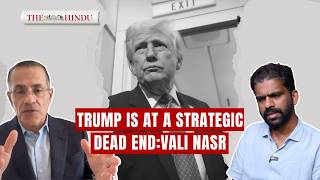
Vali Nasr, an Iran scholar and former State Department adviser, tells Stanley Johny that Trump faces three bad options: costly escalation, difficult diplomacy, or abandoning the war while Iran controls the Strait of Hormuz. The US entered unprepared for a prolonged Gulf confrontation and underestimated Iran's strategic leverage at the chokepoint.
Chapters
Hello and welcome back. This is Stanley Johnny, The Hindu's Foreign Affairs Editor. The US-Israel war on Iran has entered its second month. US President Donald Trump has repeatedly claimed that a deal with Iran is possible. Yet there is no clear end in sight. The Strait of Hormuz remains closed. Iran's government doesn't face any imminent threat of collapse, the US and Israel continue to pound Iran, but Iran also keeps hitting Israel and American bases in the Persian Gulf region. To discuss the different dimensions of the conflict, I am today joined by Professor Vali Nasr, Professor of International Affairs at the Johns Hopkins School of Advanced International Studies in Washington, DC, and a former Senior State Department advisor. His latest book, Iran's Grand Strategy, offers deep insights into Tehran's strategic thinking. Thanks for joining us, Professor Nasr. How do you look at— how do you make sense of Trump's recent statements? I mean, I was just looking at the statement he made yesterday on March 30th when he said that he was going to bomb Iran's civilian infrastructure if the Iranians were not making a deal shortly. And this morning in the Washington Times, Trump said that— I mean, he was practically saying that Strait of Hormuz is not his responsibility. He's asking his allies to go there and get the oil or buy oil from America. And I also saw that story in Wall Street Journal this morning saying that Trump would even end the war with the Strait of Hormuz remaining closed. How do you make sense of what Trump is trying to say? Is he signaling that he can't reopen the Strait of Hormuz, he has already met his objectives, and he wants to wrap up the war, or he's planning to do something more?
I think the way I look at it is that he's at a strategic dead end. He's like a chess player who has been checked. And has very few moves in front of him. I mean, the entire Iranian ability to close the Strait of Hormuz, to put pressure on global energy markets, to put pressure on global trade, took the United States by surprise. It was unprepared for it and has no solution to it. And yes, the United States can escalate by either bombing Iran's infrastructure or try to invade an island and capture an island, But it cannot prevent Iran from escalating further in the Persian Gulf. Iran could hit energy infrastructure, could attack more targets in Gulf countries, and that would even increase the pressure on the global economy. And even if Trump was to attack an Iranian island, it would only prolong the war. Iran would retaliate. Energy prices would go even further, and perhaps it would become even more difficult to get the global economy back to normal. So in a way, he started a war anticipating that it would be quick, there would be quick victory, either the Islamic Republic would fall, or that the Islamic Republic post-Khamenei would be something like Venezuela. A new leadership would come to terms with America. He had not anticipated this war. And right now, he has no solution for the chokehold that Iran is putting on global markets. So either he has to sit down and— either he can escalate at the great risk, or he can sit down and negotiate with Iran, which is not going to be easy, or that he can just basically abandon the war, which in which case it still does not relieve pressure on the global markets, and it leaves the Strait of Hormuz in Iran's hands. So I think he's thinking aloud, if you would, but all of it reflects somebody whose game plan is not working and he's thinking aloud about ways that he can get out of it.
So you said the Americans were not prepared for this kind of a prolonged conflict, but they were not prepared for Strait of Hormuz being closed at all? Because I am asking this because the Iranians had repeatedly warned this is what will happen. I remember statements issued by the Iranian leaders before the war began on February 28th, that if you are going to launch the war, we are going to attack your bases in the Persian Gulf region. And the Iranian scholars had repeatedly said that they would shut down Strait of Hormuz. Even someone like us, students, younger, young observers of politics in West Asia, in the Middle East, we anticipated that the Iranians would try to do this. So the United States did not prepare itself for this outcome at all?
Apparently not. I mean, it's very clear the way that they prepared by bringing aircraft carriers to the Gulf, USS Abraham Lincoln and the USS Gerald Ford to the Mediterranean, was that they brought those in order to protect Israel against what would be missile attacks directed at Israel. So the US military never made preparations for actually defending not only the Strait of Hormuz, but their own bases and the GCC countries. So it's very clear that it wasn't part of their war planning. And President Trump personally perhaps was told about it, he dismissed it, perhaps He was never told about it. Perhaps they didn't grasp it, but it's very clear that his conception of the war was short, decisive, and that the killing of Khamenei, the Supreme Leader, would basically pivot Iran in a different direction. So the US essentially, we're now 30 days into the war, which is far longer than Trump and the US military planned for, and the war is actually most difficult for the United States on a battlefront that it had not calculated on at all, which is the Persian Gulf as a whole. So the Strait of Hormuz is a tip of it, but it is bigger than the Strait of Hormuz because Iran has the ability to hit oil and gas infrastructure military bases across the Gulf from Saudi Arabia to UAE, Oman, Bahrain, Qatar, Kuwait. And according to New York Times, 13 U.S. military bases have become basically uninhabitable. So the U.S. never prepared for this. And now it has very few options other than either escalate the bombing of Iran, but that doesn't necessarily mean that Iran will open the straits, or try to invade Iran using the Marines to capture an island. But again, what the United States cannot do right now is prevent Iran from horizontally escalating the war across the global economy. It just does not have the ability to prevent Iran from hitting targets across the Gulf, and at some point for the Houthis to also enter the war and put pressure on the Bab el-Mandeb and the traffic through the Red Sea.
I want to come back to the possibility of an invasion, but before that, how do you look at Iran's response? I'm asking this because you recently wrote a book, Iran's Grand Strategy. I was reading your book along with Scott Anderson's book about Iran earlier this year before the war broke out. And you basically say that, I mean, you have argued that how Iran's strategic thinking works, how it is shaped by history, historical developments, and how Iran looks at the world and the region. Were you surprised by the way Iran responded to the American attack?
No, I may have been surprised by the tactics they used and how effectively they used it, but not by by the way they're responding, because everything about the war since the attack on Iran in June of 2025 by Israel and the US to now only confirms the way in which Iran has looked at its situation since the revolution and what I outline in the book. In other words, that the Islamic Revolution saw itself liberating Iran from American imperialism. That was the grand narrative of the revolution. I know we're very focused on the Islamic dimension always. And yes, it was an Islamic revolution, but the worldview of the Islamic Republic and its anti-Americanism comes from the fact that they believe that in the 19th century, Iran was under the thumb of imperialism, much like China, much like India. And then in the 20th century, the Pahlavi monarchies were captured by the United States and that the Islamic Republic truly liberated Iran, and it has been in a struggle with America to protect that liberation. And so they see the wars in June and this war essentially as a determined US effort to subjugate Iran again, right? And so their response is very much like the response they've had over the past 4 decades. To the US, except that in the past 4 decades, there was never a live military confrontation with the US, and it now has become that. And they see Israel essentially as an extension of the US in the region. So for them, the entire sort of grand drama that is in the worldview of the Islamic Revolution, that Iran's, for the past 200, 300 years, Iran has been basically, has lacked genuine independence. Its sovereignty has been under pressure or compromised altogether by foreign powers. It's like this grand drama is kind of like the, you know, you know, major things in Iranian Indian history, sort of a Ramayana, you know, level, sort of the grand epic battle is actually this war very much fits into that world.
So many people say that the United States doesn't have a strategy here, but Israel has a strategy, Iran has a strategy. That is one argument that I saw. The Israelis clearly want regime change in Iran. They had repeatedly said that they wanted regime change in Iran. You pointed out that Trump either expected that there would be a rapid collapse of the Iranian state, Iranian government, or a new leadership, new crop of leadership would emerge who would be ready to do business with him. So that didn't happen either. So do you think that the push for regime change, which the Israelis had always tried, that effort has failed here? Or if I put it differently, has the Islamic Republic survived the current wave of attacks aimed at regime collapse?
Right. So I would call regime change and state collapse, which are two different things. Essentially as objectives of the war. So for Israel, yes, the objective is not just regime change. I think it's actually more state collapse in Iran. In other words, Israel does not want a better version of the Islamic Republic come to power like Putin's Russia is a reconstituted communist Russia with the same instruments, military, intelligence, people, or that Deng Xiaoping was a reinvention of the same communist state but with a different mantra, because then Iran would maintain all of its capabilities to be a big player in the Middle East, maybe not as much of a menace, but still a big player. I mean, Israel doesn't want Iran to become Turkey. It already is growling at Turkey too, so it doesn't want Iran to just basically become open So Turkey, Iran becoming Turkey may be acceptable to the US, but it may not be acceptable to Israel. So Israel's goal has been, in the least, to break the Islamic Republic, cause the Islamic Republic to collapse, and perhaps even further, to diminish Iran as a regional power, right? I think the ideal for Israel might be that Iran, even with a change of regime, would be something like Syria. A country that's divided internally, does not have the capacity to threaten Israel. And Israel, the moment that Assad fell, destroyed Syria's military infrastructure, right? So it's toothless. It's a toothless, basically weak state. But, and to that end, I think just as was the case in the June war, in this war, Israel has not achieved its goals. The Islamic Republic is still there. Its missiles are still there. A lot of its capacity is still there. And in a way, what this war has done, it has made the Islamic Republic both much more assertive, risk-taking, and dangerous because a whole new generation of IRGC commanders have now come to the fore. Which are perhaps much more aggressive than the ones Israel killed, and that the state has now pretty much been taken by IRGC. Like every civilian leader you eliminate has been replaced by IRGC. And but at the same time, also, Iran's missile capability is still there. Its drone capability is still there. And now it also has found a new strategic tool, which is called the Strait of Hormuz, which is in Iran's hands. So in a way, you have battered Iran, but you have not achieved the goal of either toppling the regime or making Iran a toothless, internally broken entity. And so For Israel, the goals are not there. Trump perhaps entered this war with different conceptions that he didn't want to break the Iranian state. He wanted the Iranian state like Venezuela to sort of get, once Khamenei was out of the way, come forward and say, okay, we're ready to make a deal, to live and let live, right? And the longer this war goes, the more he's contemplating cutting a deal with the Islamic Republic. Like, the definition of victory for Trump has gone from end of the Islamic Republic to opening the Strait of Hormuz, which was open before the war, right? And so there is a divergence, if you would, in what victory means here right now between Israel and the US.
If he really expected Venezuela, like, outcome in Iran, that is a very poor understanding of the Islamic Republic, isn't it?
Well, for him, yes. But you see, you have a president now for the first time that is not fed by intelligence and policy coming from below and then making a final decision about how to address a problem that the system has identified and analyzed. It is rather the other way around. Based on what he hears talking to world leaders or billionaire friends, he makes decisions that then the system has to implement. So I don't think he had a firm understanding of Iran, nor did he care to find out a firm understanding of Iran, right? And he basically decided that he's going to go to war. This is the first time that the reason for war was not explained to the Americans. There was not a period of time spent to explain to allies, to the media, to the people, what is the problem you're trying to solve, why is it urgent, and why is war the solution to it. I mean, even under George Bush, although the excuse that Iraq was building nuclear weapons proved to be false, but nevertheless, a problem was identified: Iraq's nuclear program. Then, you know, there was an argument made that the only solution for it was war, and this is how we're going to do it. And there's a lot of time was spent socializing this to the United Nations, to allies, to countries around the world, to the American public. And so then a case for war was built. A war started. And then after the war started, President Trump tried to explain what was the reason for the war. And there was a shifting argument. The war started because Iran was weeks away from building a nuclear bomb capability, because Iran has ICBMs that could reach the United States, all of which are actually not true, because this is payback for 47 years of Iranian bad behavior. But then why right now? I mean, a whole host of arguments were put forward, none of which had been actually put forward before the war. So one way or the other, maybe under the influence of Prime Minister Netanyahu, maybe for his own ego reasons, he decided that we're going to do this. And so he ordered the US military to just prepare for war without actually having thought through about what are the objectives and what's the strategy here. So I'm not surprised that he didn't quite understand the complexity of Iran's program. I mean, one of the key issues here is, at least Israel probably is different, but between US and Iran, Iranians learned the— took the lessons of the June 2025 war and prepared themselves for the next war. The US learned nothing from that war, right? I mean, if you had looked at Iran and the fact that it didn't collapse in that war, yeah, yeah, you might have thought differently. But Trump learned nothing from that war.
So if you look at the options Trump has, you yourself pointed out that Trump doesn't have any easy options now. One is, of course, to declare victory and then retreat, but that would be seen as defeat, as a strategic defeat. And the second option is to make a deal with the Iranians. And the third, as you pointed out, is escalation. Let's look at the second option. So we've been reading a lot about the possibility of an agreement. Trump kept saying that a deal is possible. He is talking to the Iranians. They gave me a big gift. Etc., etc. But, you know, Israeli media reported that there was a 15-point plan. The Iranians said that they have a 5-point plan. Clearly, we know that there is no convergence, there is no common ground between these two positions. Even Marco Rubio listed out his 3 points yesterday. So do you think it's practically possible for both sides to reach an agreement at this point of time to shut down this war? And if so, what are the possibilities?
Well, I think it's going to be difficult, but that does not mean that it is impossible. I mean, it's a question of how far they might move towards one another at one point. And so I think the 15-point that the US gave to Iran, I think likely through Pakistan, was a non-starter. Because these were kind of issues that the US was peddling before the war in Geneva. And even then, you know, they were not a given that the Iranians would agree to it or agree to all of it. So they basically were asking for Iran to surrender as if the war had not happened. The Iranian position is that they're looking for firm guarantees that the war would not be repeated, that there will be no mowing of the lawn, as Israel calls it, every 6 months. That they would get genuine economic relief, that they would remain in control of the Strait of Hormuz, both as a source of revenue, but also as deterrence against future attacks. And I mean, there are other things they were asking for, but these are the most important ones. And I think the Iranian calculation is that the US may think that it can escalate either the bombing or attack territory and that would give it leverage to go to the table. But I don't think even President Trump is sure that that's going to be the case. That's why he's beginning to murmur about, "I may just leave." But the problem for President Trump is that now he's set the goal of opening the Strait of Hormuz as a victory, right? So there might be circumstances under which he could arrive at that agreement with the Iranians. But that actually requires him to get serious with diplomacy. So I think there is a lot of conversations are happening between Ankara, Islamabad, and Washington at a high level. And very importantly, the Pakistani foreign minister went to China because the kind of guarantees that Iran wants only China can provide in a way.
I saw your post last night.
I mean, you know, end of the day, Pakistan or Turkey or Egypt are great interlocutors. They have a channel to the White House, but they are not in a position to give Iran any kind of guarantees. They cannot provide any kind of a guarantee that there's not going to be a future attack on Iran by Israel or by the US. Not that such a guarantee is absolutely possible, but if there's one country that Iran trusts that could play that role is China. I don't know what is China's appetite I learned that they did issue a statement, a joint statement with Pakistan, which at least is indicative that that was the conversation in Beijing. That if they issued a joint statement, which is sort of some principles about how this war ends, perhaps the Chinese are laying out some rules for them entering in. So there's going to be sort of this jockeying between various sides until they arrive at a point. And you know what, with negotiations during a war, they could always collapse, right? And there's going to be more fighting, and each side tries to get an upper hand. But I think we're getting to a point where I think President Trump is really understanding that there's no easy victory here, and the costs from here on could mount exponentially higher for the global economy and for the US. And so he might be becoming more serious about exploring the diplomatic angle.
So let's say that for the sake of an argument, if Trump decides to escalate it or send ground troops to Iran or to the Persian Gulf, because there were reports that he is already sending Marines and more combat troops to the region. When I look at the numbers, no, these are very limited numbers. He's not sending tens of thousands of combat troops, which also tells us that he may not be planning to launch an Iraq-style or an Afghanistan-style ground operation aimed at regime change. It could be a limited strike, you never know. But what is your understanding? I mean, there were some reports, for example, Senator Lindsey Graham or others, uh, in the United States, they keep saying that the US has to take over the Karg Island or some other islands in the Persian Gulf. So is it possible to take over these islands, or even if the Americans seize these islands? Will they be able to hold them? Because they might come under— they will come under fire from the Iranians. What do you think about the possibilities of a ground intervention?
Well, a ground intervention that is kind of like Iraq or Afghanistan post-9/11, the United States would need 500,000-600,000 troops because of the size of Iran and how difficult it would be. So it literally has to go to conscription. It does not even have enough troops to do that. So I see that as far more improbable. Yes, it can try to capture an island, let us say Kharg Island or another island, and then it will have an issue of two things. How does it hold it under Iranian fire? And what might be the Iranian response, which might be escalation in the Gulf. So the problem there is not only that you might have Americans getting killed, but also the problem you are trying to solve can actually become more difficult. If your problem that you are trying to solve is to open the Strait of Hormuz and bring down the price of oil and facilitate trade, it actually may be counterproductive. Iranians may hit oil infrastructure in the Gulf. Now, another 2 months of Marines fighting with Iranians, getting killed, the US threatening, et cetera, is not going to actually bring down the price of oil. It's not going to address the problem. So in a very narrow way, people like Senator Graham who are advocating this, they're hoping to get to a position where an invasion of Iran would become inevitable. Right. He actually is asking for total war on Iran. So you go to Kharg Island, Marines get killed. Then he's going to make an argument. Now you have to basically go to Tehran.
Yeah.
So, and I'm not sure that Trump is actually supportive of that view. So those who are advocating, yes, go ahead, take Kharg Island and do all of these things. Sometimes they really have a larger agenda. It's not that Harg Island will solve things. It's rather Harg Island is a step up to something much, much bigger. But definitely, I think one of the challenges for Trump is that capturing Harg Island may not solve anything in terms of ending the war. It actually would make it now impossible for him to just even declare victory and walk away. Then he's stuck there. He has to hold on to it. He cannot withdraw. He has to absorb what casualties that it happens, and he also has to absorb whatever retaliation Iran may carry out against any number of Gulf targets.
So everything started with Iran's nuclear program. I mean, the Israelis and Americans kept talking about the nuclear program. Trump, in June, he had declared that he had obliterated Iran's nuclear program, but on February 28th, he launched the war again. Uh, so, uh, my question is, do you think that once this war is settled, now that Iran was bombed twice, do you think Iran's nuclear posture would change, or Iran would make a— I mean, Iran would be open to make a final deal with the United States about its nuclear program? Once more. They did it in 2015, but yeah, once more.
No, I think they would, but it has to be part of a larger deal. I mean, yes, Iran would not want to give up the right to enrich. Just, you know, the Iranian pride about these things, one country understands is India. You know, these are kind of national issues that, you know, you just won't give up. It's ingrained. But they might agree not to have a de facto nuclear program. You know, even in Geneva, they agreed that they would not stockpile, zero stockpile. If you're not stockpiling anything, you're de facto not enriching because there's no point in— I mean, the point of enrichment is to build a stockpile of material. If you have zero stockpile, it doesn't matter if your centrifuges are turning because you immediately will hand over whatever you produce. You know, it's very clear that the nuclear program did not protect Iran militarily. Unless Iran, like, ends up with a bomb, it's not going to protect Iran. And secondly, has invited all kinds of sanctions on Iran. I think Iranians, as they were in Geneva, are open to giving it up. And it can be part of a larger deal if Iran gets guarantees of no war and Iran gets real genuine economic relief. And there's guarantee that that economic relief that is promised at the table will actually be implemented, then yes, I would see that as being given up. Where the Iranians are not going to, I think, negotiate at all is on their missiles and on the Strait of Hormuz, because those are now Iran's real deterrence. Nuclear program is a prize that Israel and the United States want, particularly the 400 kilograms of 60% enriched uranium. But what they need to pay for that, because it's very clear they can't get that by war despite what they say, what they need to pay for that with is a larger deal that Iran is going to ask for, which is no more war and economic relief.
Yeah. So the other war that is also going on at this time is Lebanon. So Israel From 2023, from October 2023 onwards, Israel has been fighting several countries. Israel is now occupying parts of Lebanon. It has bombed several countries in the region. So even in the United States, there is this discussion about Israel leading the United States into this war. So how do you look at Israel's strategy, Israel's response, Israel's military?
Well, Israel is also trying to sort of finish, if you would, the situation in Lebanon altogether. And on the other hand, the Iranians don't want to also be seen to be just basically abandoning Hezbollah. So I think that they may ask for that ceasefire in Lebanon be part of the conversation, etc., and they may not get it. But you know, they have a feeling that Hezbollah came in as a consequence of Israel's war on Iran, so, and the Lebanese Shia and Hezbollah is paying a very heavy price, so Iran may try to also help end that war as well. Israel may not agree, most likely will not agree to that. So, I think that war then will have its own gestation going forward.
Israel would like to take over southern Lebanon. That's what they are saying.
Southern Lebanon, I mean, there are many people in the region who think that Israel ultimately wants to keep that territory, much like it wants to keep territory within Syria. I mean, Iran is not in a position to force Israel to leave. But, and so I think, you know, if there is ceasefire, genuine ceasefire between US and Iran on the Gulf front, between Iran and the United States, most that Iran can get is Israel would also agree to a ceasefire with Iran as well. But I think for Iran to be able to dictate an outcome in Lebanon, right now is a bridge too far.
Yeah, one last question, Professor. This is about the Arab countries' response, because the US bases in the Persian Gulf monarchies have long been seen as an added layer of protection and security for these countries. But all these countries, at least their US bases, came under attack. In the case of Qatar, their largest gas terminal came under attack. Oil refineries in Kuwait and Saudi Arabia came under attack, and we saw this. The closure of Strait of Hormuz is also impacting these countries financially, and we don't know what the future is going to be, the future status of the Strait of Hormuz. And yesterday I found an interesting statement from the White House saying that President Trump is interested in asking the Arab countries to pay for the cost of the war. So they are in a very difficult spot when I look at it. But what do you understand? How do you look at their response to the whole conflict?
Well, I mean, they were also caught off guard and are shocked at what's happened. And I think, you know, they've paid very heavily for this war. Their economies have been ruined. Iran has attacked them directly. The US has not been able to protect them. US's war strategy was all based on protecting Israel, not protecting these states. And in some ways, it's very difficult to see how their economies will go back to where they were. Yes, oil might ultimately flow, but a lot of the economies of particularly UAE and Qatar, more so than Kuwait or Saudi, was based on this idea of being the global hub for varieties of kinds of services. And so it— and all of that was built on trust and peace for investment to come in, expats to come in, you know, tourists, etc. So it's going to take a lot for going back to that level of trust in those economies. And yet right now they are angry, very understandably. They're very angry at Iran for attacking them, violating their sovereignty. All of it is very well understandable. There's also anger at the US for not defending them and for having brought the war onto them, for not having listened to them before the war when they were trying to say, don't go there, that's not really beneficial. But let's say when the war ends, anger and everything aside, countries ultimately have to look at their interests. So if you're Gulf countries, you're going to assess, Is the United States' bases really a value add to their security? Clearly, that is open to question. Having those bases invited Iranian missiles, and some of their reactions are, you know, you should not have started the war, but now that you started the war, you need to finish the Islamic Republic off. But based on what you were saying from Trump's statements, it doesn't look like Trump actually is interested in that level of investment in a war to remove the Islamic Republic. So now if Islamic Republic is going to be there, you know, these countries have to really look again about their overall security. Is the United States a source of threat or is it security? Now, it's now very clear that the US is either unwilling or unable to protect them. You know, in 2019, 2020, the US failed to protect Saudi Arabia when Iran attacked Saudi oil facilities. And now the United States is proven incapable of defending its own bases and defending these countries. So I think, you know, my sense is that once the war is over, the Gulf countries will, as every country, assess where their national interest is and what's their national security priority and how to protect it. And it's also conceivable that there won't be a single answer. I mean, we are already seeing that Oman and Qatar have decided to distance themselves from the war and to be much more conciliatory towards Iran than UAE, Bahrain are. And Saudi Arabia and Kuwait are are somewhere between the two, more towards UAE and Bahrain, but not quite in the same place. So we may also end up with very different responses. And Iran's, I think, attitude, for instance, is most hostile towards Bahrain and UAE. And its attitude towards Oman and Qatar and Kuwait is that we really don't have an issue with you, it's just that the bases are there. Or that if we're going to put pressure on the global energy markets, we would have to attack you as well. But with UAE and Bahrain, Iran is actually viewing them as hostile countries. And so even the— so there is no one-size-fits-all going forward. So I think this will be one of the consequences of this war is that the is that the security architecture of the Gulf will change as a whole.
So once the war is over, the countries in the region will be forced to take an honest look at the security architecture of the region. Thanks for joining The Hindu, Professor Nasr. It's glad to have—
Thank you very much. It was very good being with you. Thank you.
More from Vali


Why This War Could Be a “Turning Point” for the Global Order - Vali Nasr | Endgame #261
Iran Is Playing the Long Game to Exhaust the U.S. — So Far It’s Working | Vali Nasr
"Iran Is Playing the Long Game": What to Expect from Protracted War in Middle East



Middle East Crossroads: Is Turkey the next target? | Exclusive with Prof. Vali Nasr