Episode 117: Options Trading, Risk Management & Financial Discipline with Jeff McAllister
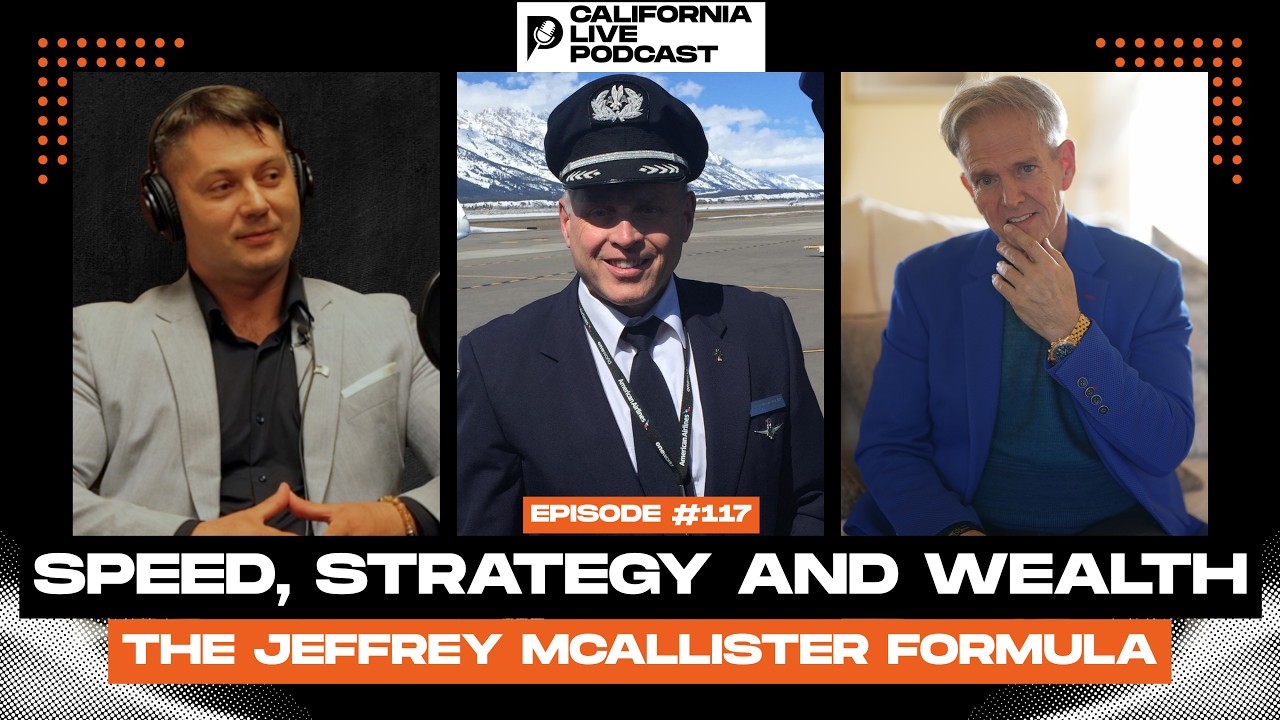
This content was created by Victor Migalchan. This content was uploaded by Victor Migalchan. This is a YouTube podcast episode titled "Episode 117: Options Trading, Risk Management & Financial Discipline with Jeff McAllister" (published 2026-08-05 UTC). It contains an English multi-speaker interview in which host Victor Migalchan and co-host Robert Cody welcome guest Jeff McAllister. The conversation spans Jeff's background as a pilot and racer (engines, car/plane racing, watches), his work teaching options trading (Options Animal curriculum, methodology, risk management, secondary exits), and practical guidance for beginners interested in options and investing.
Chapters
Welcome back to California Life Podcast. Today I'm joined again by my business partner and co-host, Mr. Robert Cody, and today we have a very special guest. Um, I would start with a brief introduction myself, and then, Mr. Cody, I will let you do it more in-depth. Captain Jack McAllister, or Mr. Jack McAllister as I used to call, uh, this brilliant gentleman. Captain of American Airlines in the past. Right now, Mr. Jeff is flying luxury jets around the world. Great intelligent investor, creator of Options Animal University. Mr. Jeff, thank you so much for joining us today with your crazy busy schedule.
My pleasure to be here. Thank you.
And Mr. Robert.
Sure. I'm telling you, uh, for our California live, you viewers, you know that I, I'm bringing you nothing but the best of the best in the investment world. And I'm so excited. This man Jeff is hard to get a hold of, and you're gonna understand why. There is no busier man, uh, than, than Jeff. Uh, he's brilliant. That's the category I put him in. I mean, can you imagine? Uh, I get excited by SEC Documents, right? Jeff's an expert. My God, you know, now I can just go right into these documents. And Victor, these are documents where, you know, you need to know what a company's debts are, and they have to disclose them. And oh my God, those documents used to drive me crazy. Well, not anymore, thanks to Jeff. And Jeff makes it fun, right?
You know, try.
Well, you know, smart people, great, they're smart, but can they teach you? Holy cow, Jeff's one of those. So, uh, we're gonna have a lot of fun with Jeff. I can see this as a multi-part, uh, series if Jeff allows us, uh, and yeah, you're gonna learn a lot. I mean, his background, come on, uh, he's gonna tell us about his, uh, history in the Navy. And then we're going to go into— he's captain of American Airlines, and I fly American Airlines all the time. I'm working on my 3 million miles. I always look for if Jeff's in the cockpit when I'm traveling. But yeah, I never got to see you there. But, uh, no, his— and he likes to race cars. He likes engines. Uh, uh, and he's gonna be a little modest. I hope I can draw this out of him, but He helped put together a, uh, a really detailed curriculum on options, uh, and, and it's like 1 through 7 level, and it's a whole course that I'm involved in. And that's how I met Jeff, uh, but, uh, yeah, so I, I'm excited today to have you, Jeff. And thank you. Yeah. And I'm gonna let, uh, Victor— you'd like to go ahead and start us off
with Yes, I do have tons of questions, and I know that, you know, we have to be also smart with delivering content so the viewers are involved and engaged from the first minute till the last minute. I would keep getting into your backstory, your childhood, how you grew up, for our next episodes. Today I'm really excited to ask you about your love to the engines. racing, flying planes. I do share this passion with you. To build my own car is in my nearest future goals, one of them. What brought your interest to technology, to mechanical engineering in a way, in cars, in planes, in that field?
Uh, you broke up a little bit, I'm sorry, on, on part of that. The, the what?
My question is, what brought your interest to engines in planes, in cars in general?
It was just there from, from birth, from, from the time I was a, a young child. You know, given the choice of what toys I would play with, my earliest recollections were playing with trucks and cars and model airplanes, uh, and a fascination, uh, with, with racing and with cars. And I remember, you know, as a youngster, every Memorial Day or whenever the Indy 500, you know, was, my best friend and I would get together and we would watch the entire race, and we would, we would take over the living room And we'd load it up with junk food, which I wouldn't eat anymore. But back then when we were young kids, we didn't know better. And we were just fascinated by it and just watched the race. Lime Rock Park, Connecticut wasn't too far away. And back when I was young, Paul Newman was back racing. And that was everything to us. We'd go there and just— I don't know if it was the sound, the feeling that you get, the sensations that come through these engines that are not muffled and just straight pipes. Whether it was the fact that these cars are right on the edge of adhesion and just the smallest thing could upset that balance and send them off the track. I can't specifically pin it, Victor, to anything other than to say it was inherent. I was born with this love of these sort of things. For flying, I didn't really know that that was going to be a passion until I was a youngster. And my mom worked part-time at a nursery school, and so she was off from that when we would come home from school. So it was a good relationship for her. But she started babysitting a youngster who's probably a year younger than I am. Wow. And his mom was a professor at Dartmouth, and she was single, and she started dating, and she dated this gentleman who owned an airplane. And I think it was a Mooney Chaparral or Ranger. I can't remember which now. It was a long time ago. And they would take me with them kind of to keep him content in the back seat so that they could have their date. But I just took to it. And I don't know why other than it just, it was just a sense of feeling. It was just the awe of flight. Right. And the very first time leaving the ground Not in the back of an airplane, but— well, it was the back of an airplane, but not an airliner, you know, just a little airplane with your face glued to the window and watching the trees and the houses and everything gets smaller but going by quickly. It just bit me. And it's just, it's just grown ever since then. And so, you know, I don't, I don't think that there's any one particular event that happened as much as I was predisposed to a fascination with, with movement and power and flight. If that makes sense.
Definitely, definitely. Um, which of the racing cars did you race and which would be your favorite?
Well, it would be more of a class of, of racing, and I think, uh, IndyCars were first for me. I respect NASCARs, but I used to really, uh, discount that they were racing because all they did were left-hand turns. they go round and round and round and round. And that didn't really grab my interest until, till later in life, which, which it did. And I have a great deal of respect, uh, for NASCAR and that type of racing now, uh, that I've, I've grown up and understand the technology and the skill sets that, that actually goes into it. But it really kind of started off as, as being, uh, IndyCars and Formula 1, uh, of course. And then it sort of morphed more into road cars. And that's where I ended up spending most of my time on track, was road tracks all over pretty much the eastern half of the United States. And just the beauty of these cars going as fast as they can, maintaining adhesion through vertical changes and all kinds of different types of turns with changing radius. And just that the art of it is the skill set of, of really driving. It's, it's, it's a lot like flying. It really is. You know, when, when I, when I started getting serious or, or became serious about flying through— it was Air Force. I know, uh, there's some confusion there about Navy or Air Force, but it was Air Force. One of the things that, that I will never forget, and, and it still boils up, so to speak, in my, my memory, is when I was first in, uh, Air Force pilot training, T-37s, a tweet. Not a very fast airplane, straight wing, but it was a jet. But we would go up and we would fly 2-ship, 2 aircraft. And it was West Texas. And on days where you would have these sort of puffy clouds, we would chase each other. And you would, you would actually follow the, the curves of the clouds and you would look for holes in the clouds. And, you know, so what if the hole ends, right? It's a cloud. You're just going to blast through it. It's not like it was cumulogranite. Or something, but just that sensation of being able to just either just roll in and either following the guy in front of you and chasing him, or being the lead through that was just— that was a lot like driving. So like my favorite road course that I've ever driven, and there are 2 that are my favorite. Watkins Glen is my absolute favorite because of the flow of that particular track, the full track, not the shorter version that NASCAR uses. But also Virginia International Raceway, another phenomenal racetrack. Where there's just this flow, there's this symmetry, this balance. And even Lime Rock, being a shorter track, has that same sort of sensation of flow that you have. It's just really fun. I think I strayed off a little bit here, didn't
I? No, you're fine. You have such a passion for this. I can't wait to have you with me and Victor at an F1 Great. So yeah, you'd be great. You and Victor can just talk about engines all you want. But yeah, I'll love talking to you about the technical side of it. Yeah. Have you been to an F1?
Well, I have been that close. Monaco last year, I flew the aircraft over. We landed in Nice. Which is another whole story. The niece is very, very, very fussy about noise and APUs. And we stayed at Cannes, and then I took the train to go up to Monaco. I went to Monaco, and I thought, you know what, I'm pretty resourceful. I'll figure out a way that I can get a vantage point and watch the race. Not a chance. No way. I could not believe how well Monaco has everything controlled. The police and the sanctioning authorities and everybody involved with the management of human beings at that race. There's no way you could get off that train and go anywhere except where they wanted you to go. I tried and it just wasn't possible. I got pretty close and it was deafening. I mean, I wished I had brought hearing protection. I didn't. And it was absolutely deafening because everything echoes so much at Monaco. I had hoped to go to Vegas. That might happen. The owner that I'm flying with right now is talking about we may go over to Europe for one of the F1 events. We'll see. I hope to, but I haven't at this point. I have not, not yet.
Yeah, it would be great to meet you in Las Vegas. If you decide to come, please let us know.
I will, I will.
I've been to—
I'm actually heading out to California on Thursday. Uh, we're going to a race in, um, Laguna— Monterey. Yeah, so we're going up Thursday, Friday's qualification, and then Saturday is the race. And then after the race, we'll, we'll fly back to the East Coast.
What, what are you driving?
I'm not, I'm flying the airplane. So the owner's son is in the Michelin Pilot Series and he drives a Toyota Supra Evo 2, something else. He's really growing. He's a strong driver. He's really, really good.
Yeah, I love it.
I love it. The, uh, your luxury jets and, uh, the owners are flying you to some coolest places. I, I didn't realize that.
Yeah, it's, it's really fun. You know, I enjoyed I'm sorry, go ahead. I'm
just gonna say me and you are the same age. We're both into the extreme. I'm in the extreme with Victor on a feature film and now look at what you're doing. You're the coolest. I'm learning all new stuff. Well,
anyway.
Talking about extreme, we were filming some materials for our film promotion and myself and Mr. Robert, we drove a Porsche 911. Uh, racing tracks, so we didn't maximize the power. But yeah, Mr., Mr. Robert definitely, uh, has the passion for pushing the, the, the engine to the limits.
Was it, uh, was it a, a straight 911, street legal, normal 911, or was it track setup?
Legal, legal, yes.
So you should try it. If we ever get— if you ever come east, you should try driving my car. I mean, I know it says it's a Corvette, but everything about it was custom built. It's unbelievable. It is so fast and it handles so incredibly well. Massive brakes on this thing. Uh,
I, I
know you get a kick out of it.
I know he's gonna be there. He's gonna be there, Jeff.
Okay, well, I'm just finishing up. I'm pulling off all the injectors when I get home. I want to clean all the injectors. I had the whole driveline out of the car, uh, rebuilding it because it, it had racing clutch and I'm making it a little bit more street comfortable. But, uh, right now I'm finishing up the top end of the engine, and I want to take all the injectors off and bench check them and clean them all up and get everything back together. But it's— it is a blast to drive. It's crude, you know, it's rough, but that's what a race car is.
Yeah, I'm building my Cayman. Uh, to me, it's a little bit more stable, and I'm preparing for HPDE Um, program. And, uh, for
you,
I feel, I feel, yeah, I was told, maybe if you could correct me if that's wrong, but I was told that it's the way into racing, uh, to go through HPDE 1, 2, 3,
4. So we're getting this kind of, and I don't know which end it's on, but I'm almost getting a little bit of an echo double feedback kind of thing here when, when you, either one of you speak. Are you getting that with me?
No,
I'm wondering, because I didn't get it right there, Bob. All right, so back to you. You, you were asking about an HPDE for your, your Cayman?
Yes, I'm saying that I'm building a Cayman to go into HPDE programs.
That'll be fun. If you do it a long time, you might end up getting bored and wanting to start actually going wheel-to-wheel racing, because after a while in an HPDE format You know, you have to give point buys and it just gets, it gets to a point after you know the track really well, you need to take it to the next level and that's when you start going racing or you do what I did and, you know, back it down. So, but good, you'll, you'll, you'll love it. It's so much fun and you're hanging out with a bunch of people who love cars and you get to see all kinds of cars and it really is fun.
Definitely. Before we transition into the topic of investment. I have one last question. Besides cars and planes and other engines, we all probably share one more love to watches. Mr. Robert is proudly wearing a Breitling, which is a pilot watch. I know that Rolex built the GMT for pilots back in the days, but you as a professional pilot, What kind of watch do you use for your work?
Well, that's interesting because I have all 3 of those. I have a Breitling, I have a Rolex, and actually the other watch that I use for flying is just an Apple Watch. Nothing fancy. You know, I love my Rolex. I've had it. I got it when I was in the Air Force. I was supposed to separate and start at American. And, uh, Desert Storm started up the first, and the Air Force stopped. They called it Operation Stop Loss, and anybody who was supposed to separate any pilot was stopped. Did you hear that thunder?
No.
That's funny timing. Anyhow, uh, so
I
heard— we ended up buying— my wife and I ended up buying each other Rolex watches. At that point. So yeah, I have one. The Breitling I have is a lovely watch. I don't wear it a lot when I'm flying, just sort of keeping it for, you know, investment purposes in the future. It's just going up in value. And then the Apple Watch is just very utilitarian. You know, at this point in time, it used to be that a watch was a really important piece in flying, and that was actually already going away by the time I became a professional pilot, which was really 1983, 1984. And you, it, you just didn't need one as much as, as we used to. Uh, the instrumentation that we have in the aircraft has become so incredibly sophisticated and so advanced. It's just about the only time anybody looks at their watch to see who's texting them.
Yeah, yeah. Well, my way, uh, an Apple Watch is more of a cry for help than a watch, but It definitely has its convenience. Mr. Robert, you had a comment.
I was just gonna say my Breitling's in the safe. It's 18-karat gold and it's a Crosswinds. They don't make them anymore, but pilots would literally come up and want to try on a watch. They just know Breitling. It's like, it's like their thing. So
yeah, yeah, it has an aviation history.
Yeah.
And, you know, they make that Breitling where they pull it. You know, if you're— let's say I'm on a boat, middle of the ocean, I get into trouble, you can just pull this cord on one of the Breitlings and it'll send a helicopter. It knows your coordinates. But every time you pull that cord, I think it's like $25,000. So I think I'd rather pay $25,000 than, you know, get a big shark after. All right, well, thanks for sharing.
That sounds reasonable.
Yeah, back at you, Victor.
Um, um, Mr. Jeff, if you don't mind sharing, which, uh, Breitling and Rolex do you, uh, do you have, do you use, do you keep?
I have a Rolex GMT-Master II.
Which one?
And so it's, uh, it's the black, black face with the gold bezel, and it has the presidential wristband. It's a nice watch. I really like it. It has the original crystal, and I wear it a lot, and there isn't a single scratch on it. It's amazing how well that holds up. Uh, the Breitling, I don't remember which model it is. Uh, it has several chronographs on it, but it's not as nice as, as yours, Bob. It's, it's the stainless Or it's probably, I don't know, was it titanium or platinum? But it's not, it's not gold, and it's not as valuable as the Rolex. Then my Apple Watch is pretty much just an Apple Watch.
Well,
that's a great combination. All right, gentlemen, let's transition into a very interesting and unknown for so many people topic, which is investment. Mr. Robert briefed me, and he told me that you are specializing in options. Many of the viewers might not know what it is. Um, Mr. Robert, I'll let you handle this side of the—
Sure. So, you know, that, that's how I, I met Jeff. He was my, uh, and still is my, uh, options coach. And, uh, I said this briefly, yes, uh, Jeff has a brilliant mindset, a real passion for, for options, but Uh, can they teach? Can they motivate you? And that's what Jeff does. And let me tell you how cool this guy is. So before you get into his live class, he has a passion for rock and roll music. I mean, it's okay, like, we could have a whole session about rock and roll with him. Yeah. So you hear that, and so, you know, you're all motivated, like, why? Who does this? You know, uh, I thought he was the coolest the first time, and And then, then he ends the session with, uh, hey, I want to play this. And then we all, uh, and these are pretty advanced, uh, users that I'm with. And, uh, yeah. So, uh, Jeff, I mean, why don't you explain to our California viewers, because there's a lot that are watching that I don't think they realize that, you know, if they're just trading stock, that's just one-dimensional. But as we all know, stocks go in different directions, but options give you that ability to rent out your stock. You know, let's just keep it simple for, for just a minute where you can actually, uh, bring back the, the value, increase the value of your holdings. So a few words about that and your passion for options.
Well, first off, an option— I'll briefly describe an option for any of the viewers who might not be familiar what they are. Options are nothing more than a contract between 2 parties, and the basis of that contract is where's the stock's price going to be at some point in the future. Options are, are very flexible. There are a lot of choices of things that you can do. There are basically 2 types of contracts that you can buy or sell, and you can choose to be on, on either side of that contract depending upon what your expectation is and, and where you think the underlying equity, the stock or the ETF, whatever it might be, is likely to be at some point in the future. And to, to Bob's point about them being very versatile, it isn't necessarily directional. When you trade a stock in order to make money on the valuation of the stock, stock has to go up. You can certainly buy stocks for the dividends that they pay as well, but ultimately most people invest in stocks because they have an expectation that the underlying equity is going to go up in value on the stock market, and at some point they will be able to realize a profit by selling the position at a greater value than what they had originally purchased it for. Options are, are very, very interesting in that They can still be directional like that, but they don't have to be. They can take, uh, they can take a stock that's going nowhere, sideways, just goes on and on at the same price virtually forever, and still make money. They can, uh, create a position in your portfolio where if the stock declines in value, you make money, which most people would equate to someone who's short. a stock position, meaning that they would sell it for X number of dollars. They would owe the broker that stock. It would show up as a negative on their portfolio. And their expectation is the stock would go lower in value. And they had already been paid the higher value. So they have the dollars to now buy that stock back at the lower value, offsetting their negative stock position that they had. And then they keep the difference. That's short selling. But we can make money in any direction. And that's really the thing that makes options so wonderful. But before anybody goes, this is great, I need to, I need to do this because, you know, I go up, down, sideways, there are a lot of nuances that you need to understand. And Options Animal, uh, came about years ago before I became an instructor there and ultimately the vice president of education. But it was there to try to help people understand how options work. And over the years, and to your point, Bob, you know, I rewrote the curriculum. It went from 5 levels to 8 levels and a lot more detail. We didn't, we didn't used to study the Greeks. The Greeks are just mathematical terms that are used to describe mathematically the behavior of options as different input variables change. But it takes a while to really learn all this stuff. And can you go ask ChatGPT or any AI? for information on? Absolutely you can. But what you don't get is you don't get mentorship, you don't get feedback, you don't have someone right there who can clarify a concept for you. I mean, if medical school could be done through AI, we would no longer have medical schools. But you can't, you know, it's just, it's just too much practical application that's required. And options are the same way for us. So You're right, I have a passion for it. I, I didn't expect to. This was not in my wheelhouse, so to speak, um, but I might as well explain to you how it happened.
Yeah,
as an airline pilot back in the early 2000s, uh, right around the time 9/11 hit, most of the major airlines were declaring bankruptcy. And in bankruptcy, all of the airlines were pretty much abdicating any sort of retirement plans, particularly defined benefits, A plans. So I thought, well, you know what, American is not in bankruptcy, but Delta and Northwest just went through it. I better start looking around because the writing's on the wall. American's not immune from this either. And I had a big position in a company called SanDisk. They make memory. You've probably heard of them. Everybody's probably heard of them.
Company.
Uh, yeah, big company, big memory company. And I was concerned because we were moving into earnings and SanDisk, uh, notoriously had a violent reaction after earnings. And so I was in Yahoo Finance and, uh, there was a chat for specifically for SanDisk, and I typed in and asked if anybody had any sort of strategies that they were using going into earnings. And somebody said, well, if you're worried about it, do a collar trade. I'm like, a collar trade? What, what is that? And the guy, rather than explain it to me, this guy shoots me a link. And go to the link, and the link is Yahoo Options definitions. So it said what a collar trade was, and long stock, short call, long put. I still didn't know what that meant. And do you remember back, back in the '90s and early 2000s, companies would buy banner ads down the sides of a web page? Well, there was one there that said No Fear Investing, 1-hour free class. And I looked at that, I thought, what's the worst that they can do, right? Call me, I hang up on them, I don't answer the phone. It's not like they're next door, they're not coming over. So I clicked and I attended that class, and it was a company called Spread Trade Systems, which is the company that eventually ceased to exist and Options Animal became. And I was fascinated by what they were doing. And the individual who was explaining the collar trade explained it clearly enough to me, who have no experience with options or any sort of education with options, that it made sense. And so I did that. I followed the class. And when they called, they were not pushy. They waited till the next day. They said, look, not everybody Uh, is cut out for this. We actually have an admission process and you have to apply. Um, what information would you like? And I was kind of shocked by that. I really was expecting a hard sell, which I never got. So I ended up doing my due diligence and ended up becoming a lifetime member, as you did, Bob. Yeah. And that's how it all started. And then I just— the very first live event And for your viewers, one of the things that this company does is they host live events around the country that students don't have to pay for. They just show up. But when I went to my first live event, it happened to be in Salt Lake City, and I met all of the instructors and the Jensens. I was hooked. I mean, these people were really helping other people, and they were not charging exorbitant sums of money to do it, and they were legit. And it was, uh, it was just something that I felt like I could get behind. And that's how, you know, I ended up being so active. A couple years later, maybe it was a year later, they, they said that they needed to hire an instructor, and I asked if I could be considered for it. They said, well, we're gonna, we're gonna select 5 or 6 people that we'll, we'll put through a process, uh, to see whether or not, you know, they're going to be the next instructor. I ultimately ended up getting selected. And I, I'll address any other questions that you want, you know, as, as we go along, but I, I don't want to bore anybody too much on On the same question.
No, I, I just want to say that, uh, and for viewers, uh, you realize I, I bring you the best of the best and I only bring you honest companies, uh, and Options Animal is a totally honest company. I was blown away, uh, some of the first sessions. And like, if you're in Jeff's live class, you know, he'll ask questions. You can also ask him questions after class. These guys get back to you. They really care. They really want you to do well. So, and then to go to the live conference, I've met just some amazing people. I don't know how Greg attracts all these. Some are CEOs and list goes on and on. My friends that I've met. So, and you're right, I, no time at all. I just had to have a lifetime membership. So. Yeah, please. Yeah, the other instructors, of course, and Karen and Charn. Charn would have loved me and Victor the other night because we celebrated after casting call. We went to— help me out, Victor— Montecito, Caesars, and we had cigars. I don't smoke cigars, but I'm smoking a cigar and I keep thinking about Charn because I know he likes cigars. So, uh, anyway,
yeah, well, you also had a glass of whiskey.
I— yeah, it took me forever to drink that too. Uh, but, uh, yeah, that was a great evening. Uh, you have to try that. Have you ever smoked a cigar, Jeff?
Uh, yes, I, I have. It's not for me.
Well, I didn't think it was for me either, but, uh, yeah, in the smoking room you don't even feel the effect of the cigar. It's just Uh, well, I, I think we're $60 cigars, whatever it was. Uh, yeah, but yeah, that was fun. But, uh, getting back to Options Animal, uh, yeah, what a great company. Now there's no hard sells. It's not like that at all. So yeah, I couldn't be— it's one of my favorite, uh, times. Uh, I, I know I'm in a live class. I try to do it like 3 times a week, and then on Fridays Jeff, we had the best time, right? Talking about the overall market. We usually have 3 instructors. You know, it's a lot of fun. So, um, yeah, I, I, uh, and you're being modest about the time that you spent putting the, uh— I mean, it's really like going to Harvard for options is the way I feel. And, and, uh, if I'm asking Jeff a question, he'll go, well, what level are you? And I'll say, uh, 6.2. Well, he automatically knows what I know and what I don't know. And that's what's so cool. Uh, he can effectively answer your questions that way. Uh, yeah, but, uh, you might touch base, uh, just briefly. There's a whole system, uh, right, the, uh, 7 or 8 step process. And you don't have to go into all of it, but I mean, there's really a, a great mindset for tackling options. Can you talk a little bit about that?
Oh, sure. Yeah, there— it's, it's a systematic approach. You know, there's no— actually, I'm not sure that I like the word system all that much because it implies that you can approach a trade the same way every time, and you can't. You know, the— because of the future, because the uncertainty about events and how they're going to impact the market's opinion about whether or not a company is going to make profits going forward, you need a methodology. You know, if it were as simple as if this, then that, then every algorithm would already be written and, you know, money would be made. But it isn't. And as much as algorithm trading is very active and very present, it's constantly, constantly under a process of review and refinement. It has to be. So for an investor, a private investor as we are, you need an approach, you need a methodology. And so for us, the very first step, the first thing that you need to do is start to determine the direction that you think the underlying equity is likely to trend. That involves the process that you were, you were alluding to earlier, Bob, about, you know, going to the SEC, the Securities and Exchange Commission, and looking at source documents, 10-Ks and 10-Qs. One of the things that I am emphatic about, and I will always believe this, is that it's very important that you get source Documents and not somebody else's opinion. Definitely not something from Motley Fool or any of the other websites where anybody can contribute information and it'll get published. That's like that's like believing Facebook material is factual. I mean, maybe sometimes it is, but most of the time it's rather inflammatory and somebody has some sort of an agenda. Well, that's no different on Yahoo Finance or CNBC or. Or Bloomberg or anybody else. They, they all have an agenda. And as long as you're reading financial documents through somebody else's agenda, you're not getting the straight information that you need to make important decisions on your own. So, you know, the part that, that, that Bob was laughing about is that, yeah, I spend a lot of time teaching our students how to go through 10-Ks and 10-Qs, the financial documents that corporations in the United States or that are traded in the United States are required to file and what the important things are to look for. There's a lot of information. And can they be sandbagging it? Yes, they can be sandbagging it a little bit. Ever since Sarbanes-Oxley, which was a law that was passed after Tyco and Enron and Global Crossings and all these other companies who really just had fictitious balance sheets and income statements, The chief officers of the corporation are now personally responsible, and there have been some who've been sent to jail for posting or recording false information. But that is about the best data that we can get. So yes, we go and we look at direction, and it's not just fundamental. Fundamental is important for the long term. Short term is much more dependent upon technical analysis, sort of that herd mentality. What are people doing? And so we look at technical analysis. And when we look at patterns and we look at, at different methods of determining whether something is bullish, bearish, stagnant, in order to help us get to a point where we can start to articulate why we think a stock is going to do what it's going to do. Because you can't build a trade around an entity until you've got that, that done. So that's your first step— fundamental, technical, and sentimental analysis— which we haven't really discussed right now, but we can save that for another day. Then you're gonna start looking at, well, okay, based on this, what are some of the choices that I have? And here's where I take a left turn. And one of my favorite expressions is— oh, it's actually a poem that was written by Robert Frost years ago. It says, I came upon a fork in the road, and I took the path less traveled, and that's made all the difference. I would suggest to all of our students that they take that less traveled path. And that less traveled path is the one where rather than going, okay, I know how to do this credit spread, or I know how to do this calendar spread, where can I find an entity that fits that? I would say to you, what's your expectation? Once you have that expectation, how can you take these options instruments that we have? And there are 4 instruments. There are 2 contracts. Each one has a long and a short position. 2 times 2 is 4. You've got 4 options instruments. How can I put them together in such a manner that it supports my expectation? So you become a musician, you become a chef, you become someone who has an idea at 2 o'clock in the morning and then figures out a way to make it work rather than what most people do with trading options is go, well, I just do credit spreads. Yeah. I just, I take a point 10 delta on the SPX, and I put my bull put there, and I put a bear call up above that, and, you know, and I just— 35 days till expiration and blah blah blah. And there have been times that I've done that sort of trading too, but that's not the art form. That's not where real money is made, and that's not where somebody really becomes a master of the options instrument. So once they start doing that, you know, and they start moving into this creative phase Then they really unleash the potential of what you can do with options. And the other benefit that most people don't realize is that when you have articulated and created a trade by yourself and you're monitoring it, once you've already deployed it into your portfolio, you will notice very early if it's not working the way you intended, because as an inventor, you become very aware of all the different elements that are in your creation. I love the analogy of Doc. Right, in all the Back to the Future movies and the flux capacitor. And, you know, he would hear something that nobody else would hear because he is the creator of that. And it's the same way with anything else. It's the reason the conductor can hear that that individual on the flute missed the note or slightly off-key, because they are so involved with the actual product that they understand it. Because otherwise, you're just along for the ride. So you structure the trade, you deploy the trade. Yeah, before you deploy the trade— sorry, this is a really important step in the telling— we always determine what are you going to do if the trade does not conform to what your expectations are. Happens all the time. 50% of the time, the stock does not do what you're going to expect it to do, even though you went through all these hard steps. You articulate that beforehand, just like in flight. Everything that I've ever flown, from, from little Cessna 172s up to DC-10s, we always had a plan. What are you gonna do if we're halfway across the Pacific and we lose an engine? What are we going to do? Because if you haven't thought about that in advance, then you're not adequately prepared. And when that event does occur If you needed more fuel and it's not in the airplane, you got a problem. So if you don't leave the resources to, to adjust a trade, then you don't have any sort of adjustment, and your only option is to exit the trade at a loss. So we plan that out, we evaluate that, we decide, hey, can I follow through? Do I have the resources? Do I have the expertise and skill to follow through on those secondary exits? If yes, then you can move on and place a trade. If no, then don't place a trade. Opportunity loss is always preferable to capital loss. Not that I haven't lost. I have. I've lost plenty. Just ask my wife. She'll tell you. But you can prevent and minimize, you know, those losses. And that really is sort of the process. You know, once you've executed the trade, we say that you monitor, adjust, and close as necessary. So long-winded expression. You got the entire methodology. The OA methodology of how to approach trading. I think it's a smart one. I did not create it. It was here, you know, when I learned this as a student. But I think it's really wise in its approach.
Yeah, thank you. Thank you, Jeff. You know, one thing that's really valuable that I learned is that secondary exit, and that's where you can make your money. And for our viewers, let me just step back just for a second. It may seem a little complex. You can see how passionate Jeff is. Once when you get into options and you just learn the basics and what's a put, what's a call, each of them have a right and an obligation. Okay, I didn't, I didn't say anything too complex there, but once when you understand that, and that takes a little while for you to get that through your head, then all this starts to make sense. So don't be afraid to Look at look at options. So I just want to, and and for my viewers, if you haven't already noticed, Jeff has an incredible mindset, right? He's so detailed. He's so passionate about details with flying and instruments, and thank God he went into the options world because I see there's so much similarities to that. And, uh, and I know, uh, one thing that's going to happen is Victor's going to be hounding me about options now. Uh, let me, let me tell you.
Well, I do have a few questions, um, for more of beginners in investments. Um, I did work for this bank, um, a little while ago, but my area was foreign exchange and commodities, then a little bit of ETFs. I did not work with, uh, the options. And probably for our viewers— and, um, mainly our viewers are small business owners— um, it could be interesting to learn how to start getting into it. What do we need? How much money do we need to start?
You don't have to have a lot of money to start. It makes it more difficult because options are contracts, and a contract defines the number of shares of stock that it represents. So by convention and, and rule, uh, one options contract is equivalent to 100 shares of stock. So you can start with, with $5,000, but it limits what you can and cannot— well, it limits what you can do because One of the things that we, we teach a lot as, as your secondary exit, you know, when they— when the— if the trade is not working, it may involve actually purchasing the stock itself. And so you would have to buy 100 shares of whatever that underlying entity is. And that's actually an important point, and we, we try to make sure the students really understand that. as they get deeper and deeper into the curriculum, because it can be very easy to establish a position with a smaller account where you could not possibly follow through. I did it, you know, when I was, uh, new to this shortly after graduation. I made 17% in my first month on a $20,000 account, and I thought, you know, I just started doing the math of, of 17% every month. And so the next month I did something really foolish. I set up the portfolio to do that same thing the following month, putting basically the entire portfolio to work. And unfortunately, the SEC came out and announced an investigation of the company that— it was Apple that, that I had this position on. And Apple stock fell through the floor, and my stock, my, my options positions went from black to severely red, and I panicked. And I basically, the next morning at the start of the day, I closed that position and I lost half of the account. Went from $20 grand down— well, which was more like $30 at that point— down to about $15,000 overnight because I did not follow the principles of understanding what secondary exits really are and what they're for. Now, that was Long before I rewrote the curriculum. And, and to be fair, because some of the people who were ahead of me wrote a lot of the curriculum that I ended up rewriting, I don't want it to sound like, you know, that I came up with all this creatively on my own. I didn't. I came up with a lot of it, but not all of it. Uh, there has to be some credit to, to those folks who were ahead of me who taught me. But that message became incorporated into our curriculum, and I'm sure Bob knows it well because he's been through all, all 8 levels of our curriculum. Uh, you can start with a small account, but you have to understand the obligations that you're incurring with certain positions that you establish, because they're real. And per law, you will be expected to fulfill any obligations that are, are actually, uh, activated by the individual who owns the right to do things. So it was a bitter pill to swallow. I'm glad I learned it though on a smaller account. So you can start small. I would say it's a lot easier if you start with at least $50,000 in your account. It's even better if you could start with $100,000 in your account or $200,000, because then you have the ability to buy the underlying equity as your secondary exit. And we don't want to get real complicated here in discussing those sort of strategies, but it's a very viable secondary exit, one that I invoke all the time. Uh, with fantastic results.
Yeah, I just, I just want to add too, Victor, that, uh, with, uh, Options Animal is really advanced. We, we have Mr. Eric Hell who, uh, actually created a, uh, a, a, uh, a way that we can, uh, you can, you can just simulate, uh, your trades too. I mean, you don't have to trade for real, but it gives you your cost basis real time, and, and the graphic interface is amazing. There's nothing like it. It's called Trader Oasis, and Jeff knows exactly what I'm talking about. And it's really been, uh, redefined. So, uh, I, you know, for all of our new viewers, uh, you don't actually have to trade dollars. Just, you can go in and, and set up an account and, uh, just just, uh, trade, you know, uh, not real money, but, uh, you can follow your trades, and that's a great way, uh, to learn. So, uh, I
think it's amazing.
It's amazing though. I mean, we've all paper traded, but it's, it's amazing when you bring in the real money, the emotions, the emotions change. When you're, when you're paper trading, you don't feel the emotions. Yeah, you know, and, and I think it was Tony Robbins who kind of popularized that we will go to extensive measures to avoid pain. And the pain of loss is significantly greater than the joy of gain for the same dollar amounts. It's, it's, it's amazing. So when you're paper trading, keep in mind that just hitting the reset button and going back to $100,000 on your paper trading account Isn't what it feels like in the real world when you lose.
Yeah, that's a good point. Yeah,
that's very true. I do have one more question which consists of, uh, 2 parts. Um, in, let's say, mainstream media and, and this mainstream world, um, civilians, uh, know about the investment world from film— Wolf of Wall Street, other films created based on some sort of true stories. Um, my first part of the question would be if you have any films of this sort that you like. And the second question, um, is, uh, to many people including me, um, options or stock, it feels like hazy, not something physical that you hold in your hands. Um, why did you choose to trade, to invest in options or this world instead of let's be real estate or real commodities, cash-flowing businesses. Uh, what is the difference for you?
Robert, do you want to start that?
Oh, well, Victor was first asking about, uh, films. You know, we're in the film industry. Uh, you know, there's a number of films. He even got Michael, uh, Burry You know, his crazy, uh, films, uh, and then Wall Street. And are these films realistic? Do you have some, uh, have you, have you watched any films that relate to investing that you can, you enjoyed?
Or, you know, they're, they're, they're entertainment. They're definitely interesting. The Big Short was, was so well done. I was very impressed with the movie. I had read the book beforehand. I really enjoyed the movie, the cutaways that they had, and some of the characterizations that they use were really entertaining. But it is entertainment. And, you know, The Wolf of Wall Street, while parts of that are based on some true stories, it's entertainment. And, you know, Leonardo was great. I mean, it was— and Margot, it was a really keep you, uh, glued. See, it's a movie I've watched several times. Uh, Wolf of Wall Street. Let's see, um, forgot what were the names of the other ones with, um, Michael Douglas.
Yeah, DiCaprio had some pretty good films.
Yeah, I mean, they're, they're good. I, and I can't speak to institutional side, which all of those really focused on institutional trading, so I don't have any experience. I, I did Uh, I did take a, a, um, I did become licensed for a while and was trading for other people. I didn't enjoy it. I take, I take it too seriously, and I have a hard time just accepting that they have a loss. It just, it really bothered me, and, and I didn't like it. You have to have, in order to trade for other people, to be a broker, to be a fund manager for, for other people, that you, you deal with the people on a daily basis. I think you have to be able to disassociate some of your emotions, uh, from gains and losses. And I just didn't like to see when the market— I was there, you know, in, in 2009, 2008, 2009, when we had that big pullback. And I was one, probably at the height of, of my own firm at the time, and it was really upsetting. In fact, we were in San Francisco, uh, at an Options Animals, uh, event when that was really hitting. I remember landing and, and the Dow was off 2.5% or 3%, and NASDAQ was down like 3.5%. I remember landing in San Francisco and it was just a bad feeling, you know. And of course I'm fielding calls from, from other people, so To get back to your question, you know, I don't— can't say that I have any experience with the larger institutions to know whether or not there's any sort of basis in reality. I've, I've read, uh, there's another book out there called Monkey Business, which is about a lot of graduate students who start off in Goldman and other firms like that. And, and I don't know how true those stories are either, but it sounds pretty rough. It doesn't sound like anything that I would be very interested in. And then I think the other part of your question, Victor, correct me if I'm wrong, was, you know, how it is tangibly trading something that's not really a tangible asset, that there's nothing really to buy. I mean, you are trading around a stock. And so there are those sort of tangible assets there, but it's not like you're trading gold or any sort of agricultural futures. I never went into futures. I looked at it. at one point. I don't have enough bandwidth to feel like I would get to the level of understanding that I want to be, you know, whether it's flying airplanes or trading options. There's a certain level that I have to at least achieve before I feel that it's safe to do so. And I just didn't have the bandwidth to go in. And certainly those offers come all the time, you know, learn to trade Forex and futures, commodities, and all these other things. I just don't have the bandwidth to do it. So I haven't, I haven't really vent or forge down those particular paths.
Yeah, I mean, one, one thing we do, uh, Victor, in Options Animals, we talk about due diligence and portfolio management. So we can touch base on those. Uh, but, uh, Jeff's right on about the, uh, training mindset. And, uh, Jeff, uh, I'm gonna have some, uh, another podcast that I'll be doing in a couple of weeks, and She's, she's just— her name is Julie Mantz, and she's just brilliant at teaching, uh, the trading mindset. And, uh, so I look, look forward to having Julie on. But, uh, and, and, uh, yeah, I, uh, I'll just throw it back to, uh, how we, how we doing on time, uh, Victor?
Timing is great. Um, I have one last question for today. Um, before we get into a series of podcasts with you, Mr. Jeff, um, for the viewers who are watching us, what would be your, um, let's say, 3 best advice, uh, system on how to start well with the options?
Well, educating first. Get smart. Paper trade for at least 6 months, which probably sounds disappointing to people, but if you just do it for a month, you haven't seen enough of the market to gain experience. You know, they, they say that wisdom comes from good judgment, and good judgment comes from bad experiences. And if you're only trading for a month or two in a paper trading account, you just haven't seen enough. You know, it's the same principle that applies to flying. You know, I'm flying this particular company I'm at. They have some 24, 25, 26-year-olds, and they just have not had enough time in an airplane to experience all the things that I have, you know, over 45 years of flying professionally. And it does affect your performance and how you handle situations that come up where sometimes you have to operate outside the box. So education, uh, experience, and then lastly I would say is that you, you have to have some sort of methodology that you trade by, whether it's a very strict adherence to rules-based trading or, as I like, a little bit looser, uh, with a methodology. You need to have something because if you keep flipping back and forth, you're never going to master anything.
Yeah, Victor, one of the, one of the things I, I learned from Jeff is, uh, I would, I would actually, uh, throw out a, uh, a trade, uh, to Jeff. Just a, uh, not trading, just a paper trade. And he'll go, why would you trade that? Look at the bid-ask spread. No liquidity. Okay, so we'll talk about liquidity another time. That is so critical. And these are basics that you really want to understand just going So those are the kind of things that Jeff teaches, and Jeff's an expert at fundamental analysis. I, I hope our stocks get, get to that point, Jeff, where we can get back to true fundamental analysis. But one last question for me is, where do you see the market if we can get the oil to go below $100? So You know, we don't have to worry about inflation. Uh, what, what's some of the hurdles, or what's going to give us that bright spot to where the market could take off from here? What do you think?
Well, the market, you know, the market historically has been up— what's it, 8% for the last 100 years on an annualized basis? And in the last 15, it's like 10% a year. The path of least resistance is higher. For a number of reasons. Part of it's inflation, part of it's technology. AI, and I know everybody's talking about it, AI is going to make a dramatic impact on the efficiency of corporations in every facet of their operations. Any sort of efficiency becomes higher profits, higher margins, higher margins, higher profits. The stock becomes more valuable. Because it's producing greater retained income. So stocks will continue to go higher. We'll have our hiccups. We'll— there will be issues. But by and large, if you step back and you look at the market, it is just a straight line that goes up at about a 15-degree angle, and it's going to continue to do that. The only thing that I could ever see that would sort of derail that is if, you know, the entire world ended up going into nuclear war and we basically just blasted ourselves out of existence. There is not a stronger economy at this point in time, and I don't see it changing in the foreseeable future here than the United States. And we continue to have the largest gross domestic product. If you travel around, you see just how many people there are. Keep in mind that there is always a minimum level of economic activity in order for people just to eat. And to close themselves. Technology, every time that we've had some sort of a depression or any sort of economic recessions, pullbacks, it's been technology and improvements in technology that has started the pump, so to speak, primed the pump again by increasing efficiency. And AI is doing that, and it is doing it at a faster speed than we've ever seen it before. So, you know, you, we, we all got to witness over the last 2 and a half months with, uh, with the, the Middle East unrest, the market taking a big pullback, and then it's already recovered and going back to highs. There is no other economic vehicle at this point in time, no other financial vehicle that can provide the same kinds of returns on such a large scale. And unless there's something else that comes along that can do that, uh, this market will continue to perpetuate itself higher.
More from Victor


Episode 99: The Jeweler of the People: Mahmud Sharif’s Story of Legacy, Grit, and Community

Episode 95: Excellence, Innovation & Impact with King Lei, Founder of Punch King World


Episode 67 with Denny Seybert: Depths of Real Estate Investing & Perspectives of Las Vegas Market