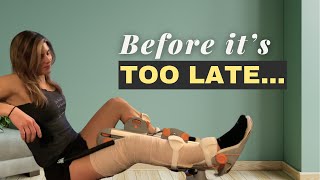
In this YouTube video, fitness creator Victoria S. Dorsano addresses the common "weekend warrior"—people who engage in intense, unfamiliar physical activities on weekends with insufficient preparation—and shares the three key strategies that have kept her injury‑free for the past five years after a history of severe injuries (ACL rupture, patella fracture, calf strains, low‑back strain). The first strategy is building a strong posterior chain (glutes, hamstrings, calves, back extensors) through targeted lifts such as Romanian deadlifts, Nordic curls, hip thrusts, reverse hypers, and even backward‑pedaling on a portable elliptical (sponsored by Merak). The second strategy focuses on joint and connective‑tissue resilience by incorporating low‑load isometric holds, controlled eccentrics, and full‑range movements (e.g., plank holds, paused squats, knees‑over‑toes squats, Cossack squats, banded pullovers) and by following the ATG system, which she credits for her post‑ACL recovery. The third strategy recommends using a wearable recovery tracker (Whoop, Fitbit, Garmin, Apple Watch) to monitor sleep, strain, and recovery, helping her modulate training intensity and avoid over‑reaching. Throughout, she blends personal anecdotes, practical exercise prescriptions, and sponsor mentions, concluding with a call‑to‑action for a PDF guide and channel subscription.
Chapters
When I say weekend warrior, what comes to mind? You might be thinking about that guy in the office who you've never actually seen go to the gym, but somehow is planning to do a Spartan race in the next 2 weeks, or your buddy who is absolutely salivating at the chance to relive his high school football glory days at this weekend's upcoming flag football match, despite not having worked out more than 2 times in the past 3 months. And you'd certainly be right. These types of people definitely fall into the category of a weekend warrior. And I used to be one of them. Yes, even though I did work out 5 to 6 times a week, I still wrecked my body on the weekends, really just by overloading it with new types of activities and going too hard, too fast with too little recovery. Basically thinking I'm invincible, 'cause isn't that what your youth is about? Until you learn you're not. A weekend warrior is really just somebody who dives into new activities unprepared and goes too hard. And 4 to 5 years ago, that was absolutely me. And it got me an ACL rupture, a patella fracture, 2 calf strains, and a low back strain. Yikes. Not to mention all those happened within 1 year. But hey, despite all those injuries, being somebody who likes to challenge themselves physically and really push their body to the limit is just part of who I am. And since you're watching this video, you can probably relate to that. So that's why I want to share with you guys the top 3 things that have helped me, your crazy weekend warrior friend, injury-free these past 5 years, because I've learned to adapt quite a few things and I wanna share it with you guys. All right, so the first tip I have for you guys is posterior chain strength training. I've talked about this in some of my other videos, but it is so important. You can look it up. It is one of the key components to staying injury-free if you are an active person or an athlete, period, but especially if you are a weekend warrior, because let's be honest, the posterior chain, it's usually not the showy muscles that we're working on. If you are somebody that is actively going to the gym 5 days a week, you might not be working these muscles because they're they're not the showy muscles. Your posterior chain is essentially all the muscles along the back side of your body. So you got your glutes, your calves, your hamstrings, your back extensors, all that good stuff. And it's usually left undertrained in comparison to your anterior chain, except the glutes. People do tend to train the glutes a lot these days because who doesn't want a dump truck, you know what I mean? But having an undertrained posterior chain in comparison to our overtrained anterior chain can leave us very, very susceptible to injuries. And that's because different components of the posterior chain act dynamic stabilizers to really important joints in the body, especially when we're talking about the knees and the ACL. And y'all know I do not want another ACL injury, and you guys probably don't want one either. Undertraining certain aspects of your posterior chain, especially like your hamstrings, can put more strain on the knee joints and lead to IT band syndrome and even runner's and jumper's knee. So having powerful glutes and hamstrings can also do a really good job at protecting the back because these muscles can take a ton of load off of the lower back during explosive movements. Especially if you're talking about like cleans or snatches or even explosive movements you might be doing if you are doing a Spartan race or some other type of crazy warrior race where you end up getting electrocuted and all that crazy stuff. Like, have you guys heard of a Tough Mudder? I'm crazy, but I don't really feel like I want to get electrocuted on my Saturday afternoon because yes, quite literally one of the obstacle courses as part of that race has like live electrical wires. Anyways, I think you guys get the point. Strong posterior chain, good for preventing injuries, especially if you're a weekend warrior who doesn't necessarily prepare their body well for activities ahead of time. If anything, incorporate some posterior chain exercises a couple times a week. We're talking RDLs, Nordic curls, the eccentrics especially, 45-degree back extensions, reverse hypers, QL raises, hip thrusters, you know, all that good stuff. And don't forget your calves because nobody likes skimpy calves. Speaking of posterior chain, did you know that you can work on strengthening your posterior chain doing an elliptical, especially if you're going backwards? Well, thankfully today's sponsor, Merak, makes it easy to do that even at home. Now, if you've watched my channel before, you guys know I'm a huge fan of fitness equipment that is easily able to fit within my apartment. So finding efficient and effective equipment that is able to fit seamlessly into my space is a must-have, which is why the new E19 elliptical from Merock is amazing. It's a small, portable, and light elliptical that can easily fit into your home space. Crafted with high-density carbon steel, this elliptical trainer delivers rock-solid stability, supporting users up to 330 pounds with ease. And with a 15-pound flywheel and 16 levels of adjustable magnetic resistance, you can seamlessly transition from a leisurely stride to an intense calorie-crushing work. And yes, you can even reverse your stride and get that posterior chain warm-up. Another cool feature about this elliptical is that you can connect to the Merok or Kinomap app via Bluetooth and experience real-time resistance synchronization, transforming your living room into basically a virtual fitness playground. And with its ultra-silent operation, you can conquer your goals without disturbing your surroundings. But performance aside, this this elliptical caters to convenience too. Arriving 90% pre-assembled, you'll be up and running in just 15 minutes. Oh, and I cannot forget to mention the awesome resistance band cables that come along with this machine that attach on so you can do upper body exercises while you're on the elliptical at the same time. Or of course, you can do them on their own too. Link is down in the description if you want to learn more and check it out for yourself. And thanks again, Maroc, for sponsoring today's video. Tip number 2 for staying injury-free as a crazy weekend warrior like me— and this one is especially important for those of us me, who like for our joints to take a beating by doing high-impact sports like volleyball, basketball, tennis, anything that requires a lot of like hard pounding on the joints. You know, all my favorite sports to play. Over time, this repetitive pounding really takes a toll on the joint if you're not working on really strengthening and stabilizing all the ligaments and tendons and muscles around each joint. Strong and flexible tendons and ligaments kind of act as like reinforcing rods for the joints, giving your joints the ability to withstand higher forces and ultimately bounce back from your weekend warrior adventures more quickly. But if these connective tissues are weak and stiff, then you definitely have a much higher chance of things like sprains and strains and overuse injuries. So what are some ways to build up your tendon and ligament resilience? First, you're going to want to work on low-load isometric exercises that work the joints through full ranges of motion, like controlled eccentric movements and isometric holds. These create the ideal environment for strengthening connective tissue without creating excessive strain. A few really simple examples would be holding a plank for 30 to 60 seconds, which would help to work the connective tissue around the shoulders, hips, and core. Another simple example would be like pausing at the bottom of a squat and holding that isometric squat hold there. This can do a really great job at strengthening the connective tissues of the knees, hips, and ankles. You can also utilize various resistance training methods like cables or bands, as these provide continuous tension throughout a movement, which then gives the tendons and ligaments a workout as the the force curve changes throughout the rep. But ideally, think of movements that would specifically allow you to do the activities that you're really chomping at the bit to do. For me, that's volleyball, roller skating, tennis, maybe Ninja Warrior classes again. But if we're talking about volleyball, I'm constantly landing in a forward motion like this into my knees, and all this forward pressure and tension is going anteriorly, shearing into my knees when I stop in this motion. Or sometimes I'm even rotating the hips like this and the knees like this. So for me, something like full range knees over toes squats or Cossack squats would be great. Now, if we're talking about upper body movements, something like a cross bench pullover with a dumbbell or a resistance band can be excellent for the tendons and ligaments of the shoulder joint, which can then be applicable for like volleyball, basketball, any kind of throwing sports. But this would help to train resilience into the joint. Now I get it, I'm telling you all these things to do and you're probably like, how do I put these together in a training program and how do I even make time for these? I've personally found that the ATG system has been really, really good for training joint resiliency and the posterior chain. Hello Nordic girls. So if you're interested, I'll put the link down in the description where you can sign up and try your first month half off. It's been an absolute game changer. Truly, it's one of the main reasons why I recovered so well from my ACL surgery. So thanks, ATG. And just to note, building joint resilience takes time, more time that you're probably used to. It takes longer for the tendons and ligaments to adapt to the changes that you're trying to train into them versus muscle tissue, which tends to respond a lot more quickly. So don't be surprised if it it takes a little bit longer to adapt and to get better at some of these movements. Building joint resilience does not happen overnight, but I'm telling you, it is so rewarding once you do make it a consistent part of your training. All right, so tip number 3 for staying injury-free as a weekend warrior is to consider a wearable. For example, something like the Whoop, a Fitbit, Garmin watch, something with a reliable algorithm. I know there's a lot of folks that like Apple Watches do. But this tip came out of a place where after my series of injuries, my husband was like, hey, Victoria, I think you're pushing your body a lot harder than you think. And just because you have a high threshold for pain and discomfort does not mean that you need to push your body there every single day. And I rolled my eyes at that. I didn't think I was training that hard. I wasn't crazy sore or anything. My muscles were well trained, but I didn't realize that my nervous system and connective tissues and all that good stuff needed recovery. And what I really needed was to learn a more nurturing mind-body connection, really to just get a better idea of what kind of recovery and sleep my body actually needed, because I had been so used to pushing my body as an athlete that I really had no good sense of what recovery was needed for myself. I opted for the Whoop band because I heard the algorithm was really accurate and a lot of athletes had been using it. I looked into it and it seemed pretty affordable. And honestly, it doesn't have a watch face, which I hate any kind of tracker with a watch face. It drives me crazy. So this is really nice. It doesn't distract me throughout the day, which is great. And the other bonus is because it doesn't have a watch face, the battery life lasts forever. And while I don't think that a wearable is something that you need to use as like a rigid rule to follow as a part of your training, I have utilized it to learn my body better and to use it as kind of like a suggestion. I tend to engage in activities a little bit more cautiously when I see that I have a bad recovery. And I've also learned how to utilize things like zone 2 cardio to still get some activity in, but in a way that's going to again help my body recover and be better prepared for more activities in following days. It's helped me be able to sense a little bit more of what actually feels like stress and pushing myself too hard in my body. And again, if you're an athlete, maybe you can relate to that because we're always taught to push our bodies to a certain limit. So it's hard to turn that off and actually learn that that doesn't need to be every single time and there needs to be a buffer of recovery in that push. So there you have it, my fellow weekend warriors. Those are the 3 pro tips that I have for you that have really just revolutionized my training in the past 5 years and kept me from having injuries in that timeframe, which has been amazing. And I'm still able to do all the activities that I love doing and try new adventurous things that my friends think I'm crazy for. So again, just to recap, building a bulletproof posterior chain, working on your joint resilience, and considering a piece of wearable tech or fitness tracker to get a better hold on your recovery can make all the world of difference in staying injury-free and still enjoying your adventurous activities. And guys, these are only 3 tips, but I do have more in a full PDF guide that I will link down below if you're interested in getting a copy for yourself. And guys, as always, if you liked this video, give it a thumbs up, please subscribe to the channel, and I will see you guys next time. Bye.