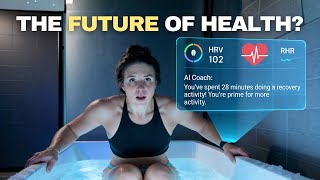
In this video, Victoria S. Dorsano shares five health trends she predicts will dominate in 2026, based on three months of research across the internet. The first trend is a shift toward sleep optimization, with wearables that track deep and REM sleep, circadian rhythm management using bright morning light and amber evening light, and temperature‑controlling sleep surfaces like the Chili Pad or Eight Sleep. The second trend emphasizes recovery as an essential part of training, highlighting modalities such as red‑light therapy, cold‑plunge/contrast therapy, and massage (including a sponsored EasyBack Prime back massager). The third trend is a move toward longevity‑focused training, prioritizing mobility, joint stability, and intelligent bone loading to stay strong and pain‑free over decades. The fourth trend forecasts AI integration into health and fitness wearables, turning devices like Whoop, Oura, and Garmin into personalized coaches that translate raw data into actionable daily recommendations. The final trend predicts a boom in direct‑to‑consumer biomarker testing, with platforms like Function Health, Vitality Blueprint, InsideTracker, and WellnessFX offering comprehensive panels for lipids, inflammation, hormones, metabolism, and nutrients, enabling proactive health optimization despite higher costs. Dorsano concludes with a recap, encourages viewers to adopt any of the trends that resonate, and offers free discovery calls for personalized integration, while also prompting likes, subscriptions, and a sponsor discount code.
Chapters
I've spent the past 3 months studying health trends on the internet, and there's a lot of noise. Contrast therapy, peptides, red light therapy, whatever random supplement is trending this week. But in looking through all these corners of the internet, I've been noticing some trends, and I'm going to make 5 predictions for 2026 of things that are going to be the top trends in health. Trend number 1: sleep becoming the foundational priority, and in particular, just sleep optimization. Many years, supplements, macros, and workouts have taken precedent over sleep. In 2026, I think the script is going to flip, and sleep is going to be the priority. And like I said, more in particular, people getting serious about optimizing it, not just getting enough of it. So what does that actually mean? Well, in 2026, I think more people are going to be wearing these wearable tech devices that are more geared towards optimizing their sleep rather than their fitness. In particular, using them to monitor their deep sleep, their REM sleep cycles, how many times they're waking up in the middle of the night. Again, not just tracking hours, but the quality of sleep they're getting. I also think this sleep focus is going to come with a heavy dose of circadian rhythm optimization. More and more people are starting to focus on prioritizing using bright light exposure first thing in the morning to really tune their bodies into the fact that it's daytime, we can wake up now, and getting their circadian rhythm set on a good groove. Along with that, I think a lot of people are also using like red and amber lights in the evening to help tune their bodies into the fact that it's time to wind down and prime the body to release melatonin. And lastly, in the sleep optimization trend, I also think people are going to be more focused on different devices and things to help optimize their sleep environment to increase quality as well. Things like mattresses and mattress toppers that help control your body temperature as you're sleeping, making sure you don't get too hot, like the Chili Pad or Eight Sleep. Again, people focusing on sleep isn't anything new, but it's just becoming more and more of a priority for a lot of people who notice that when they get better quality of sleep and they really tune into that, that they feel so much better and they perform better in their workouts. They're able to make better choices in their nutrition and take care of their health in a much different way. The second thing that I see trending into 2026 and continuing to be more popular is people taking recovery as a very serious part of their training regimen. I've been seeing a lot of discussion about people prioritizing recovery just as much as they would be prioritizing their training days, because here's the thing: people are starting to realize that your body doesn't necessarily become stronger during your workout. It's becoming stronger when you're repairing after your workout, AKA during your recovery from your workout. So how you prioritize your recovery can make all the difference in how your training affects your body. And whether you're getting stronger or if you're just breaking down your tissue and not allowing yourself to repair. Now, what does focusing on recovery actually look like? Well, I've been seeing a heavy focus on a lot of different modalities lately, including things like red light therapy to manage inflammation, help with tissue repair, and help optimize sleep. Cold plunge and contrast therapy for nervous system regulation. And prioritizing things like massage therapy, whether that's going to a professional or incorporating massage tools at home. Personally, that is one I've been leaning into a lot more lately. Sometimes getting to a massage therapist can just take a lot of time in your day, so So incorporating different massage tools has been a game changer for me. One particular tool that I've been coming back to over and over again lately has been the EasyBack Prime back massager from Bob and Brad, who happen to be this video sponsor. Oh my God, this is amazing. So if you don't know, Bob and Brad are physical therapists on YouTube. They're like the OG physical therapists on YouTube, by the way. They've been around forever. They have 6 million subscribers. And as an athlete, I've learned a lot from them about repairing my own body and getting through ACL rehab. As I was saying, finding time to get a massage can sometimes be hard, especially if you're in the middle of a busy season like I am. We're in the middle of launching a brand new program called Reignite, and there is just a ton of work to do. So to make time to go to get a massage, not realistic for me. But what I can do is I put this nice easy back massager on my chair, and I'm able to still work, be on calls, and I'm getting this amazing massage into my low and upper back. And you can even use it for your neck, for your leg. It is fantastic. But man, I have never been as glad to have it around this week because I had max deadlift days race the other day, and my back is so sore, and this has been a godsend. Not only does the EasyBack Prime back massager have this nice kneading function, it also can heat up, and that feels incredible. And with the massage features and the heat, it's helping to increase circulation and promote that healing repair of the muscle tissue. Exactly what we were talking about— prioritizing recovery so you can come back and train stronger. It makes a really good gift too. So if you're looking for a gift for the holidays or a birthday or really any event for that special someone who is a health and wellness junkie, then this is gonna be an amazing gift for them. Check it out down below, link is in the description, and you can use the code EASYBACKPRIME for 10% off. All right, so health trend number 3 that I see really emerging more in 2026 is this intention of training for longevity and not just performance or aesthetics. For decades, fitness has been about how much can you lift, how fast can you run, how shredded can you get. But training with the purpose of longevity asks a different question: how do I stay strong, mobile, and pain-free as I age? Age in the next 30, 40, or 50 years. So with this focus on training for longevity, I think that's going to bring a light upon a couple of new things in the fitness industry. One is a larger focus on mobility, meaning being able to move a joint through the full range of motion with good stability and strength. Secondly, I think there's going to be a bigger focus on intelligent joint and bone loading, meaning how to preserve and optimize muscle mass and bone density as we age without degrading the joint. And this isn't about giving up performance. It's about training smart so you can perform for decades, not just a few years. Trend number 4 that I'm predicting for the health space in 2026 is going to be the AI integration into health and fitness wearables, translating data into personalized actionable insights. Now this process has already started to happen in 2025 with Whoop integrating its AI coach, Oura starting to do the same, and other different wearables starting to integrate their own AI into their systems. But I think in 2026 this is going to become a lot more mainstream and there's going to be a lot more personalization to it. I think there's still a concept of wearables just being data, and with this new AI integration, there's a lot more insight you're able to get from the data to be able to better take action on it. You know, in the past, thinking about what these wearables used to be, you'd get some sleep data, you would get your recovery data, you'd get your fitness data. Sometimes these would even be coming from separate devices if you were wearing an Apple Watch or a Fitbit. Point is, you'd be getting a lot of segmented data from different areas and really have no idea what to do with it. For example, your wearable device sees that you slept like crap last night, so it automatically suggests that you do a lower intensity workout today. And let's say over time it starts to understand that on Wednesday nights you tend to get worse sleep than any other night of the week. So I'm predicting that this is just gonna get even more personalized and more extensive and be able to automatically adjust plans accordingly that you're working on, whether that's fitness-wise, sleep-wise, recovery-wise, and just be able to give you better insights in general. Essentially, these platforms like Whoop, Oura and Garmin no longer are just fitness trackers. They're essentially like whole body coaches. They're giving you feedback and adjustments to your training and your goals depending on your data. Speaking of your unique data, this brings me to trend number 5 that I'm predicting for 2026 health trends, and that is an increase in direct-to-consumer biomarker testing. And I'm predicting that this just explodes in 2026, cuz I'm already seeing a lot of this happening more towards the end of 2025. And more and more of these companies are starting to pop up. I think two big things are continuing to drive this into 2026. Most people nowadays are wanting to thrive, not just avoid disease. They don't want to wait until something is wrong to get their lab work done. They want to see what they can optimize now before symptoms show up. Number two, the healthcare system in the US is just broken. Health insurance costs are at an all-time high, and even with insurance, it's still so hard to see a provider when you actually need to. And with the way things are heading, they're pretty convinced that it won't be there in the future when they definitely need it. So they're doing their best to get proactive to prevent really needing to lean on our current broken medical system. And direct-to-consumer testing platforms allow you to order these labs without needing a doctor to be involved. Now, some platforms do include oversight by a trained medical professional, and some of them use AI to help make sense of your lab work. Function Health, Vitality Blueprint, InsideTracker, WellnessFX. These platforms all help to be able to test things like lipid panels, inflammatory markers, hormone levels, metabolic health, and different nutrient deficiencies. Most of the markers your doctor would never test for unless something was already going wrong. Now here's the kicker: unfortunately, these things aren't cheap. Comprehensive panels can run somewhere between $300 to $500. But for people who are serious about optimization and have the money to spend, then yeah, it makes sense. And I think we're going to see a lot more people in 2026 starting to get those advanced insights and data. So those are the 5 trends. All right, so here's a quick recap of those top 5 health trend predictions for 2026. We got sleep optimization as number 1, people focusing on the quality of sleep, not just quantity, and really getting granular about how they can improve their sleep quality. Number 2, focusing on recovery as a key aspect of training, not just an afterthought. And in particular, incorporating different recovery modalities like red light therapy, cold plunge, massagers, all that good stuff. Number 3, a shift to longevity-based training. So really focusing on mobility and preserving joint health. Number 4, AI integration into wearable technology for more personalized and actionable insights. And number 5, direct-to-consumer biomarker lab testing. Now don't feel like you have to take on all 5 of these things in 2026. But if one of them intrigues you, maybe start there and see where it takes you. Or if you want help actually integrating any of this into your lifestyle, your sleep data, your training, your testing, all into one coherent plan, well, that's what I do. I work with people who are serious about their health optimization but don't want to do it all on their own. I do free discovery calls, and I'll put my link down in the description. And as always, if you found this video helpful, give it a thumbs up, subscribe to the channel. I greatly appreciate each and every one of you, and I'll catch you on the next one. Bye! You.