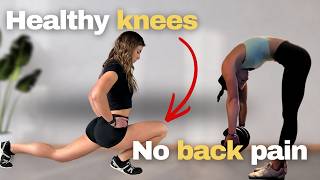
In this instructional video, Victoria S. Dorsano presents five research-backed exercises designed to improve mobility, strength, and injury resilience for athletes and everyday movers. She begins by explaining that stiffness and loss of springy movement often stem from insufficient strength in functional ranges rather than a lack of stretching. The five movements are: (1) Deep Squat Rotations, which simultaneously target ankle dorsiflexion, hip opening, and thoracic spine rotation; (2) Incline Pigeon, a hip external rotation with flexion exercise that reduces knee valgus during landing; (3) ATG Split Squat, a deep knee‑over‑toe lunge that strengthens the patellar and quad tendons and counters outdated myths about knee safety; (4) Cossack Squat, a lateral lunge that builds adductor strength and lateral hip mobility, lowering groin and knee injury risk; and (5) Jefferson Curl, a controlled spinal flexion drill that restores segmental vertebral control and spinal tissue tolerance. For each exercise, Dorsano provides execution cues, set/rep schemes, progression tips, and cites scientific findings linking the movement to reduced injury risk. She also emphasizes recovery nutrition, recommending Legion whey protein with a discount code, and stresses the importance of proper form and gradual loading. The video concludes with a call to action for viewers to try the routine 2–3 times per week, comment on their mobility challenges, and engage with the channel.
Chapters
If you feel stiff getting out of bed, or your hips lock up after sitting, or you've lost that springy athletic feel that you used to have, you probably don't need more stretching, and you actually just might need strength in the ranges that you're losing. So that's why I want to share with you the 5 science-backed exercises that a lot of high-level athletes use to stay mobile and explosive, and that I personally use to stay injury-free. Let's kick off the list with one of my favorite movements: deep squat rotations. Now, I love this exercise because you're hitting 3 key areas at once: your ankles, your hips, and your thoracic spine. Basically what this looks like is you get into a deep squat. I like to personally press my hands together in the center so I can dig my elbows into the insides of my knees. And for me, this just kind of helps widen my stance and really get into the hips a little bit. And then from there, you just rotate a little bit side to side, lifting one heel off, then the other, kind of twisting into that motion, finding a movement that feels good there but controlled. So little by little over time, you're starting to get more mobility into the hips, more mobility into the ankles, and you'll start to notice you get a greater range of motion there. Research shows that deep squat ability is one of the greatest predictors of overall mobility and injury risk. Spend 1 to 2 minutes on this daily and you'll start to notice over time some big improvements. Next exercise on the list I'm sure will be appreciated by all you ATG and Ben Patrick and Knees Over Toes fans because it is the incline pigeon. The incline pigeon is great because it addresses hip external rotation with hip flexion, the exact kind of range of motion that gets locked up from sitting. This is done by using a bench or an elevated surface, and then you put your front shin across it and your back leg extended behind it. What I like about this is that once you're in this position, there's a few different options that you can do for the mobility portion. You can work on pushing through that external hip and glute and do some very gentle slow pulses, or you can work the range of motion a little bit differently by leaning forward and coming back up. Studies show that by improving this specific range reduces knee valgus during landing. You know, that like knee knock position, which is the number one movement pattern that leads to ACL injuries. Moving into the next exercise, which is another ATG fan favorite, the ATG split squat. This is the signature move of ATG training, and for a good reason. This movement has kind of become legendary for knee health, and personally, I use it as a cornerstone throughout my ACL recovery process. Now, it takes some time to kind of play around with figuring out what's the ideal stance for you, because ideally you want your knee to go fully over your toe but to have good hamstring over calf coverage, meaning the hamstring and the calf kind of fully meet together. Now, if you're unfamiliar with this movement, start with an elevated surface. So the front leg is going to go on an elevated surface, and little by little, you can start to lower that surface height because there's going to be a few main limiting factors in here. It could be your hip flexor that's feeling too tight, it could be your ankle mobility, or it could be your knee stopping you. Because this movement is a little bit more advanced, it might take a little bit more time to get to that full range. But once you are down in that full range, you're going to come back up. And basically you want to do multiple reps of this, so I usually like to do 10 per side and then repeat through that a few times. The reason why this movement is so cool is that because for years many athletes were told you should not put your knee over your toe when you are doing any sort of squat or lunge movement, and it was known universally to kind of like be bad that you're going to wear down your knees that way. But research has completely debunked that and now has shown that training your knee through that full range of motion into deep flexion really strengthens the tissues around the knee, making them more resilient and preventing you from getting injured, particularly through your patellar tendon and your quad tendon that really have to stretch through those ranges of motion. So this is a great one for rebuilding knee strength after an injury, preventing an injury in the first place, and just overall maintenance. And like I mentioned, 3 sets of 8 to 12 per leg, maybe twice a week. Is going to be great. If you're training hard to build mobility and strength like we're talking about in today's video, then your recovery really matters. Your body needs quality protein to rebuild tissues and adapt to training. Now, whole food sources of protein are great, but let's be honest, we live in a busy, busy world. So my next go-to in the lineup is Legion's whey protein powder. Not only are all their supplements third-party tested, but there's no proprietary blends, so you know exactly what you're getting in each product. No junk, just clean, well-absorbed protein that will help you with your athletic recovery. If you want to try them out, you can use code Victoria for 50% off your first order. And if returning customer and need restock, you can still use that code and get 10% rewards back. Also, since I've tried so many flavors, my top 3 ones right now that I'm digging are strawberry cheesecake, cookies and cream, and the peanut butter fudge is unreal. But don't take my word for it, you can try them yourself. Link is down in the description. The fourth exercise that's going to help your hips, back, and knees feel amazing is the Cossack squat. All the exercises so far up to this point have been dealing with like forward and back planes of motion. We're going to be talking about lateral for this one. The Cossack squat helps to build a lot of mobility and lateral strength into the hip, which a lot of people often ignore. In a Cossack squat, you're going to take a nice wide stance, and then you're going to shift your weight from one side to the other, sinking into a deep side lunge while keeping the other leg straight. And if this is one of the first times that you're doing this, you may realize at some point that you feel like you have zero control in that range of motion, and that's okay. That's why you're going to start doing this now. Your adductors, which are your inner thigh muscles, are usually pretty weak when they're loaded at length. Yet this is the exact kind of position we put our adductors in when we have to cut really quickly to change direction, or when you reach down to one side to pick something up, or if you laterally have to step really quickly to catch your balance. Research shows that athletes with better adductor strength have significantly lower chances of having groin or knee injuries. Again, if you can catch the pattern here, this isn't just mobility to feel good, it's also injury prevention. This one's another great one to add in maybe twice a week, 3 sets, 8 to 10 per side should be great. All right, let's move to number 5 on the list, which in my opinion is probably the best and also maybe the most controversial. I'd say it's probably like the black sheep of the mobility family. It's just a little misunderstood. And that would be the Jefferson Curl. The Jefferson Curl trains controlled spinal flexion under light load. For the Jefferson Curl, you're gonna wanna stand on an elevated surface with very lightweight starting somewhere between like 5 and 25 pounds and slowly round your spine one vertebrae at a time, starting with your cervical spine, moving thoracic, then lumbar. Take your time. This takes like 5 to 10 seconds to get all the way down to the bottom. You're going to pause at the bottom of the range of motion and then reverse that slowly, vertebrae by vertebrae, all the way up. Now I encourage you for this exercise specifically, but even for the other ones earlier in this video, if you have never done these before, you might want to look at a more detailed form breakdown before jumping into these. Do not just take this brief demo I gave you. You should go into an in-depth video. I can link one down below for you, but it is very important to have proper form for this type of exercise. You might also see some variations where people have their feet inclined, essentially, like their toes inclined. And that also just helps to get into the hamstrings a little bit and make this also a hamstring mobility exercise. I know many of us have been told to never round your spine, especially when lifting weight, so this kind of goes against all those principles. Modern spine research says that spinal flexion in itself is not dangerous. What's dangerous is fast flexion under heavy load, especially when your body might be already fatigued. Progressive loading through controlled range builds tissue tolerance and resilience. What it helps to do is restore segmental spinal control, essentially the ability for each vertebrae to move independently. So again, the keys here are lightweight, slow tempo, very controlled. If it hurts, you're probably doing it wrong. And if you have acute disc issues or severe back pain, then this one is probably one to hold off to the side until you talk to a physical therapist. It's definitely the most advanced movement on this list, but nonetheless important to do for most people who do not have disc issues like that. So there you go, guys. Those are your 5 exercises. And as you can tell, they all have something in common. They're not just passive stretches. Every one of them builds strength and length through a range of motion that our bodies tend to lose over time. And that's really the secret to staying mobile and athletic as you age. It's not about getting more flexible. It's about building strength and control in ranges of motion that matter for how you actually move. So if you feel like your body needs some TLC and you want to hit some of the most important joints in the body, then try some of these. 3 or 2 times a week, see how your body adapts and go from there. Now I will say this is a fairly general list, but I tried to pick the most research-backed movements that hit the main body parts that we tend to have the most issues with. But I want to hear from you guys. Is there a particular body part that you find is more nagging or stiff or just prevents just good athletic movement for you? Is it your hips, your knees, your ankles? Drop a comment below because I want to make content based on what you guys actually need and find helpful. And as always, guys, if this video was helpful, please give it a thumbs up, subscribe to the channel, leave a comment for the algorithm. I greatly appreciate it, and I will catch you guys on the next one. Bye.