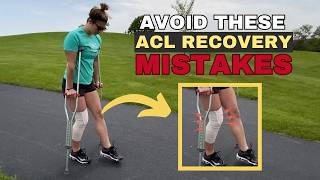
In this video, Victoria S. Dorsano shares her personal post‑ACL‑surgery experience and warns viewers about hidden compensation patterns that can develop after the procedure. She frames the body as a sports team whose “coach” (the nervous system) over‑protects the injured knee, benching some muscles and over‑working others. After a brief disclaimer that the advice is based on her own rehab journey and not a substitute for professional care, she outlines five of the most frequent compensations: 1. Quadriceps avoidance – weak or under‑firing quads cause a backward weight shift, straighter knee, heel‑heavy gait, and can lead to chronic quad weakness, low‑back pain, hip stress, non‑surgical‑knee overload, and patellar tracking issues. Detection: mirror or side‑view video of standing, stair navigation, gait analysis. 2. Hip‑dominant pattern – the hips over‑compensate for quad avoidance, resulting in excessive glute activation, hip‑hinge movement preference, and a reduced knee bend during squats. Risks include hip impingement, low‑back strain, and sacroiliac joint problems. Detection: feeling tight/over‑worked hips, noticing hip‑hinge squat form, hip‑back push. 3. Lateral weight shift – habitually loading the healthy leg more than the surgical leg, often stemming from early post‑op weight‑bearing habits. Consequences: IT‑band syndrome, hip bursitis, knee pain on the good side, ankle issues. Detection: observe standing weight distribution, notice which leg bears most load. 4. Shortened stride length – a protective shortening of the step on the surgical side, leading to hip‑flexor pain, low‑back discomfort, and calf overload on the opposite leg. Detection: asymmetrical walking/running rhythm, audio cue of uneven footfall, side‑view video of stride. 5. Altered landing mechanics – especially in jump‑sports, the surgical leg lands stiffer or with hesitancy, shifting load to the opposite leg and increasing risk of patellar tendonitis, jumper’s knee, Achilles tendinopathy, or calf strain. Detection: film jumps/landings in normal and slow motion, look for hip shift, knee asymmetry, hip drop. After describing each pattern, Dorsano emphasizes a three‑step self‑check for any exercise: (1) know the intended primary muscle, (2) feel where the work is actually happening, and (3) if intent and sensation mismatch, modify the movement (scale back, slow down, focus on proper muscle activation). She likens the body’s compensations to teammates covering for a benched player—effective short‑term but unsustainable long‑term. She stresses that quality of movement outweighs quantity, and that a qualified physical therapist is essential for personalized assessment and program design. The video concludes with a call‑to‑action to subscribe, like, and optionally book a health‑optimization call with her.
Chapters
Since my ACL surgery in 2020, I've struggled with calf pain, back pain, hip pain, and Achilles pain. And I'm not just saying that because I want to scare you guys, but more as like a cautionary tale of what happens when you aren't aware of, or in my case, ignore your body's compensation patterns after ACL surgery. So if you're not sure what I'm talking about in regards to compensations in the body, let me give you something that will help you visualize it a little bit better. Think of your body as a sports team. When one player ends up getting benched and there's nobody on the roster to fill in, then inevitably the other players on the team have to pick up the slack. So now think of your nervous system as the coach that directs your muscles of your body to work together as a team. After something like ACL surgery, that coach becomes way overprotective of your injured knee, and it starts benching certain muscles and making others work overtime to compensate. So essentially, your body creates these things called compensations, which are these protective patterns to compensate for a weakness in another part of your body, which in this case is of course your ACL and the affected tissues around the knee. So that's why today I wanted to share the 5 most common compensations that you might notice within your body after you've had ACL surgery so that you can better be able to course correct before another injury happens. Before we dive into these patterns, I just want to share a quick disclaimer that everything that I'm going to share in this video is from my personal experience from experiencing some of these injuries after my ACL surgery and going through the rehab process and all that good stuff. If you have any personal personal questions or something that you're personally concerned about, please consult your own healthcare provider or your own physical therapist. Consider this video more of a general guide to help you have more educated conversations with your healthcare team. Okay, so the first compensation pattern I want to talk about is the quadriceps avoidance pattern. This is probably the most common one. If you've had ACL surgery, which chances are if you're watching this video you most likely have, you know that getting the quad back in action after ACL surgery is a lot. It requires a lot of time and care and attention. When your quad is weak and not necessarily firing appropriately, your body tries to compensate by shifting your weight backwards while walking, essentially reducing how much your knee bends. So you might notice that you tend to keep one knee straighter when walking or using the stairs, and your body might stay more on the heel of that leg rather than moving through the whole foot during your walking gait. Ultimately, this compensation pattern can lead to a lot of different issues. You can end up developing some chronic quad weakness, lower back pain from compensated posture, hip joint stress from altered movement patterns, increased stress on your non-surgical knee, and there can also be potential kneecap tracking issues. So if you're concerned that this might be a pattern that you might be using to compensate in your movements, here's how you can check that. Watch yourself in a mirror as you're standing. Are you locking your knee back and avoiding being in a standing position with a slightly bent knee? As you're going up and down the stairs, are you noticing one knee bending more fluidly than the other? Try filming yourself even walking from the side view and notice how your gait looks. That way you can see if you're slightly leaning back and not necessarily engaging the quad in a normal walking gait. Moving on to another compensation pattern that is quite common after ACL surgery, and that is a hip dominant pattern. So with a lot of these compensations, sometimes they'll happen in pairs, or one will cause another will cause another. So you're going to start to notice that pattern because that can be the case, especially with quad avoidance causing hip dominance. So when your quad's not necessarily pulling its weight, your body starts to get creative. And at this point, the muscles of the hips start to become the stabilizing factor. You might notice that your glutes are engaging more in certain movements than maybe they should be. And again, you might be limiting your knee bend when doing motions like squatting and things like that for a favored hip hinge motion because your hip muscles are more strong than your quad. So again, this usually follows the quad avoidance pattern because those two kind of go hand in hand. If you let the quad avoidance compensation pattern go long enough, you eventually start to become hip dominant, and then the hip dominance can lead to other issues like hip impingements, low back strain from altered mechanics, and even like SI joint issues. So how might this be something that you detect in your body? Well, if your glutes and hips are feeling constantly tight and overworked, that might be a good sign. Also, for certain movements like squats, you might notice that you are getting into a more hip-hinged movement than a knee bend movement, and again, that can show some preferential hip dominance over, you know, engaging the quads. Another thing you can check to see is if you are pushing your hips back in a squat motion more than you typically would have pre-surgery, because that can definitely show that you're preferring a hip hinge over engaging the quads. The next compensation pattern is going to seem pretty obvious, and that's just a lateral weight shift. Remember those early days when you just started weight-bearing after surgery and you obviously preferred your good leg over your bad leg and you very gingerly put weight on your bad leg? Well, that can definitely become a compensation pattern too, and you can become over-reliant on shifting your weight on your good leg. Really, this compensation can develop just out of habit from your early stages of weight-bearing post-op, all the way to developing from an ongoing quad weakness on your surgical side, therefore preferring to weight-bear more on the good side. And of course, this can cause some irritation on your previously good leg and start to make it a not-so-good leg because you are creating issues on it. Things like IT band syndrome, hip bursitis from ongoing uneven loading on that side, knee stress and knee pain on that side as well. And even some potential ankle issues. Really just anything that's related to putting most of your weight on one side of your body. And you can imagine that can cause a litany of different things. So something to just notice is if you are tending to prefer shifting your weight to your good leg when you're standing, when you're just standing and waiting around, do you tend to load on the good side? Another common compensation pattern is shortened stride length. You might actually think you're walking normally, but in reality you might be taking a shorter step on your surgical side. Think about, especially when you were again, weight-bearing early on, or maybe using crutches to walk initially, or your brace, you would usually take a full step with your non-injured side, and then with your injured or surgical side, it would be a shorter step, right? So it's normal and natural when you are fresh out of surgery to have that leg feel vulnerable. Therefore, you're not necessarily going to bring it far outside of your body in a full step's length, because if you think about it, anything that elongates outside of our body by simple physics is going to be more vulnerable to forces outside of our center of gravity. So we inherently know to correct that by shortening things and keeping things close to our center of gravity. And that's what happens with our shortened stride length. I know personally, this was something for me that has been one of the bigger compensation patterns that has sneakily kept creeping in if I'm not attuned to it and has caused several different issues. Like in my case, it can cause hip flexor pain. Low back pain, and calf overload on your non-surgical side. Something that helped me really tune into this was my asymmetrical running and walking rhythm. So I noticed this only when I actually was recording myself running and I could hear my steps when I was running, and it was not quite like a normal doo doo doo doo. It was like doo doo doo doo doo, so it didn't sound quite even. And when I was watching it back, I started to see, oh my gosh, I actually am taking a much shorter stride on one leg. So that's something you can look out for too, is noticing when you're running or walking if you are hearing that abnormal rhythm. Okay, so the last compensation pattern that I want to go over is altered landing mechanics, and this happens for mostly athletes that are involved in jumping sports like basketball and volleyball and any other sport that involves jumping and landing. Landing mechanics are like your body's shock absorbers. When one side isn't working appropriately, the other side is bound to have some issues. So this might show up as landing from a jump much stiffer on your surgical side. You might end up shifting more weight to your non-surgical leg from the jump and the land, and you might even feel some hesitancy when you are landing, especially if you have to land one-legged on your surgical leg. You might notice some of that hesitancy coming up. And when you have improper landing mechanics, then you can get things like patellar tendonitis or jumper's knee. You can get Achilles tendinopathy like I had, or calf strain issues. So the best way to detect this is to film yourself while you are jumping and landing. You can do this at regular speed as well as in slow motion. Both can help you pinpoint different things. Start to just notice any differences in your landing mechanics from side to side. If there's a hip shift, if you're bending in one knee versus the other, if you were dropping one hip when you land, different things like that you're going to want to pay attention to. Now I know this is a lot of information. You might be wondering like, what do I do with all this exactly? So let's tie it all together. The key to identifying and fixing these problems as soon as they happen or even before they happen comes down to one crucial concept: knowing what you should be feeling during certain exercises. For example, if you are doing a squat and you are noticing your back fatiguing more than your quads or glutes, then you're probably compensating in some way. Here's why this is important: your body is incredibly efficient in finding the best way to get things done, and to your body's logic, the best way isn't necessarily like the correct way. It just means the way to get it done the fastest and to keep up with the demands that you're placing on your body. To bring it full circle, it's like the teammates that had to take on the workload of that one teammate who was benched. They're going to be fine for a little bit, but eventually they're going to tire out. Okay, so let's make this practical. During your recovery process, for any exercise you're doing, first know the intent of that exercise. Ask yourself what muscle should be doing the work in this particular movement. Second, pay attention to where you were feeling the muscles work the most while doing that exercise. And third, if those two things do not match up between the intent of the exercise and what it's supposed to work and what you were actually feeling, then that's a signal to probably modify the movement because your body is compensating in some way. And that's where a lot of people go wrong. They push through with compensated form just for the sake of getting the exercise done. Instead, if you catch yourself compensating, you should scale back the difficulty, slow down the movement, really focus on feeling the right muscles engage, and then build back up and progress that exercise gradually. Remember, your body developed these patterns to protect you initially. Now it's about retaining those movement patterns in the right way. Quality always, always, always beats quantity in recovery. Now again, I'm sharing these compensation patterns based on A) what's most common, and B) based on my own recovery journey and the injuries that I experienced from compensations after my ACL surgery. While these compensation patterns are common, the way that they show up in your body might be different. This is exactly why working with a physical therapist is so important. They can assess your movements and create a targeted plan for you specifically. So again, just think of this video as your roadmap to awareness of these compensation patterns and what they could look like, and use it to have more effective conversations and bring up great questions with your PT. So again, I'm not trying to bum you guys out. I just thought that this would be an interesting video to make given that I've experienced a lot of these compensations and they've showed up for me many years after my ACL surgery and have led to just discovering more and more things about these common compensation patterns. So I felt like it would be worth sharing with you guys since I know a lot of you have followed me along with my ACL journey, and I feel like this could be something helpful. And if you're interested in exploring other areas to improve your health in addition to improving your fitness, then I would love to chat with you. If you don't know, I help people to create sustainable, action-oriented plans to help them improve their nutrition, their fitness, and their lifestyle, optimize their health and improve their quality of life. So if you're wanting to take control of your health journey beyond just fitness, then I'll put my link down in the description below where you can book a call with me and we can chat. And as always, guys, if you found this video helpful, please give this video a thumbs up and subscribe to the channel. I always appreciate it. Thank you so much, and I will catch you guys in the next video. Bye!