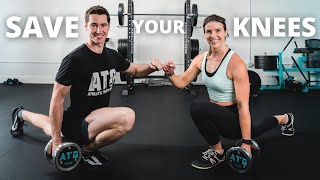
In this video, Victoria S. Dorsano explains why anterior cruciate ligament (ACL) injuries are so common, especially among female athletes, and how improper training mechanics—particularly the avoidance of letting the knees travel over the toes—contribute to the problem. She outlines biological and anatomical risk factors for women, such as hormonal influences and a tendency to rely on quadriceps over hamstrings, which leave the ACL vulnerable. Dorsano then introduces the Knees Over Toes (ATG) program created by Ben Patrick, describing how its bottom‑up, full‑range‑of‑motion approach targets the entire kinetic chain—from foot and ankle work to deep knee flexion and hamstring strengthening—to both prevent ACL tears and aid post‑surgical rehabilitation. She details specific exercises (reverse sled pulls, ATG squats, Nordics, calf raises, split/VMO squats, good mornings, RDLs) and shares her personal journey: a 2020 ACL rupture, surgery, traditional PT, lingering pain, and eventual recovery after adopting the ATG program. Dorsano emphasizes the program’s scientific backing, the supportive community, and the availability of live coaching via the ATG app, urging athletes—especially women—to adopt this methodology to protect their knees and return to sport pain‑free.
Chapters
Going through an ACL injury is incredibly tough for any athlete and sometimes even devastating or career-ending. The ACL is one of the most commonly injured ligaments in the knee, and there's even between 100,000 to 200,000 cases of ruptured ACLs happening each year in the US alone. And that number is still probably underreported because there's a lot of people that tear their ACLs and don't necessarily have the means to seek the help of a doctor or just flat out don't go to see the doctor at all. If you don't know what an ACL is, it's basically the ligament that connects the femur, which is your thigh bone, to your tibia, which if you think about it is your shin bone, and connects the upper leg to the lower leg and stabilizes the knee. That ligament also helps to prevent the tibia from moving forward over the femur. If you've seen any of the other videos on my channel, then you know that I had my own ACL rupture back in February of 2020 and had surgery in May. It was a whole long process, guys, and I highly do not recommend rupturing your ACL if you can avoid it. And I think I have the program that can actually help you avoid it. But if you've already done a number on your knee and have had ACL surgery and are struggling to get back to 100% and feeling pain-free, then this program can also help you get there. But before I talk about the program that literally has saved my knees and gotten them pain-free after my surgery, and I'm pretty sure is going to bulletproof my whole body and make sure that I don't get injured for a while now, um, before I dive into that, I want to talk a little bit as to why are ACL injuries so common? Why are these happening greater and greater numbers each year. And if you're a female athlete watching this, you're especially going to want to tune in and pay attention to this. So first and foremost, there's a lot of issues with improper mechanics still being taught in youth sports, high school sports, and even collegiate sports and onward. A lot of the times athletes are still not taught to, you know, have their knees go over their toes, which a lot of that is being disproven and shown to be really effective when you can have your knees go over your toes and work a full range of motion of flexion. And same with other joints and making making sure you're getting a full range of motion and building strength through not only the musculature supporting that joint, but the ligaments and tendons and all that good stuff. And unfortunately, it takes a while for the textbooks to catch up to common knowledge and what's actually working for people. So I'd predict maybe in 20, 30 years, hopefully, uh, people will be incorporating this stuff into common textbooks about human anatomy and physiology and, uh, what works for human performance. However, it hasn't yet, but there are some people that are promoting it like Ben Patrick of the ATG program. But yeah, going back to the point I was making before I get into talking about the program, really these improper mechanics aren't helping to stabilize the knee through a full range of motion. And if you think about it, it's really necessary to train, especially your knees, in a full range of motion, especially if you're trying to protect your ACLs. Because if you think about most sports, a lot of the times we are in a position where our knee is over our toes, where we are moving forward or decelerating or sprinting or changing positions or landing from a jump, you know, or taking off into a jump, a lot of the times our knees are moving over our toes naturally in the way that our bodies move and how we preferentially recruit muscles. So why aren't we training through that full range of motion? That doesn't happen like it needs to in, again, youth sports, high school sports, and collegiate sports to prepare an athlete to have a long career if that's the route they want to go. But even just a long, healthy career of maintaining their body, because it sucks to be injured, flat out. And the second reason I want to touch on as to why these ACL injuries are happening in larger and larger numbers is particularly particularly pertaining to women. And that's simply because more and more women since Title IX being passed have been, you know, playing a higher level of competitive sports. And, you know, decade over decade since Title IX passing, more and more women have, have started to play at a higher level of sport. And unfortunately, women are at a much higher risk for tearing their ACLs. And there are several reasons behind that, that some of them have a little bit more evidence behind than others. You know, some reasons might be hormonal levels and how estrogen has— and progesterone have different effects on the laxity of ligaments, and some are even about the anatomical shape and ratio of the hip to the knee and how that creates a little bit more force into the ACL. But the main reason that they're finding that this is a huge issue for female athletes is because women tend to preferentially recruit their quads over their hamstrings. Women tend to have weaker hamstrings, and the hamstrings do a really great job at protecting the ACL joint, especially in decelerating motions or motions where the knee has to go over the toe, which is a lot of sports, right? So if women are preferentially recruiting their quads and their hamstrings are weak, and, you know, traditional programs aren't necessarily prioritizing training the hamstrings and getting them as strong as their quads, they're at a much higher risk for tearing their ACLs in their sport. And as somebody who has gone through that, I highly do not recommend tearing your ACL. It is not a fun experience. But if you have, no worries. I'm going to share with you guys finally about the program that has literally saved my knees after going through my ACL surgery and going through PT and then still having pain and all of that. One of the best ways to prevent ACL injuries is to make sure that there are no weak links from the bottom up as you are training. And that is what I think Ben Patrick and the folks over at the ATD Program have really done super well, is create a series of programs that helps you train literally from the bottom up, building your body from, you know, your foot to your ankle to your calf to your knee to your quad, hamstring. All of it is covered, even your upper body, even your your neck and your grip strength. It is all covered in the variety of programs that they offer. But I kid you not, when I jumped into the ATG program, I was about a year and a half, uh, post-op. I'd gone through physical therapy for X amount of months. I had gone through additional strength and conditioning, um, through a traditional ACL bridge program, is what they call it, to get you ready for your sport. And I was still having pain, and it was so frustrating that I couldn't get back to where I wanted to be. Somebody mentioned Ben Patrick, Knees Over Toes guy. Have you heard of him? I was like, that's interesting. I've always heard to keep my knees behind my toes. Why is this guy saying go forward, go out, put your knees over your toes? This is interesting. And then I started listening to this stuff and his material. And if you haven't checked out his, um, his YouTube, his Instagram, his TikTok, check it out. The educational material there is amazing. And furthermore, when you decide to join the ATG family and start the program, you get access to exclusive training content and even more educational materials, and it is just really heavily loaded in the science and evidence and a lot of references pulled into it, which I appreciate as somebody coming from a science background. Okay, so how is the ATG program the program that's going to help you prevent your ACL injury or help you if you've gone through ACL surgery and you're just struggling after going the normal route of PT and are feeling like you still have pain and weakness in your legs and you just need something more? How is it going to help you? Well, this is what it did for me. It really helped me to address all the weak links in my body from the ground up. So moving from my feet to my ankles to my calves, you know, doing things like the reverse sled pull, which really helps to warm up the lower body first and to activate the muscles in the feet, the muscles of the calves, the tibialis, the quads, all that good stuff to get some blood flow and good movement into the knees. And then it really works on training the calves too. So you're doing your KOT, or knees over toes calf raises. You're doing your FHL calf raises, you're doing your tibialis raises. So you're working the lower body and the ankles, and then you're moving on up and doing things like the ATG squat, which is going to work a lot of the quads, right? You're doing things like the Nordics, which are fantastic for the hamstrings. So if you're a female athlete looking to prevent an ACL injury in specific, or have had an ACL injury and are, you know, past your PT point and have gotten cleared but they're still feeling a little weak, do Nordics. Try to do Nordics, but first do the ATG Zero program, but incorporate Nordics. Try to incorporate some Nordics and some RDLs to really strengthen your hamstrings. It's going to make a world of difference for you as a female athlete to help protect your ACL. But this program incorporates that, and then it incorporates things like good mornings, which are going to work on— or seated good mornings, which are going to work on your hip mobility and your glute engagement at same time. And then, you know, even throughout the musculature you're working, there's other exercises that specifically target full range of motion into the knee joint itself, like the ATG split squat, like the VMO squat, those types of deep flexion movements which are really going to build some tensile strength into the connective tissues of the knee, into the patellar tendon, into, again, you know, all the, the ligaments around the knee too. The more you can get into that deep flexion and work strength through that range of motion, the more tensile strength you're going to build in those connective tissues and the less likely you're going to be to injure or reinjure your ACL. So again, I highly recommend this program if you're somebody that is looking to prevent an ACL injury. But even if you've gone through ACL reconstruction and, you know, have gone through PT and are still struggling with feeling like you can't get back to 100%, give this program a shot, you guys. It has changed my life. And I even got a chance to go down and visit Ben Patrick's gym, meet him, meet the team, the other coaches there. Um, they're just amazing, and their dedication to what they do and to helping as many people feel pain-free as possible, it's just so admirable, especially in a world where I think there's a lot of people out there with programs just trying to make a quick buck. And you can tell that these guys really, really care about what they're doing, and they really do truly want to make a difference. And they are elated when somebody tells them a story about how they are back to playing their sport again or how they have rehabbed themselves and, you know, using this program and have felt 100% better and all those things, you can just tell that they really care. And watching the dedication that everybody had there to, you know, just continue to serve as many people as possible, again, super admirable. Thanks again, Ben Patrick and the team for letting me hang out and do a workout with you guys for a little bit. Super cool what you guys are doing. And again, if any— if you guys are watching this and you're curious about the program that I've done, um, and getting help through the app— they have live coaching through the app, which is incredible— definitely check that out. It's atgonlinecoaching.com. I'll put the link down in the description. Um, it's just amazing stuff, you guys. And again, as a female athlete who is particularly careful about protecting her ACLs now this is going to be my go-to program for a long, long, long time. Thanks again to all y'all at ATG. You guys are awesome. And I hope this video was helpful for any of you guys watching this. I hope this provides some insight, a little bit of personal details to what I've gone through, how I've rehabbed my knee, how I'm doing what I'm doing now. It's all thanks to the people over at ATG. Highly recommend checking them out. Again, links down in the description. And if you like this video, if you found this helpful, please give it a thumbs up. Subscribe to my channel. I would greatly appreciate it, you guys. And I will see you guys next time. Bye!