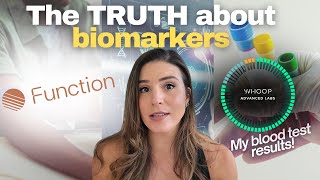
In this evidence‑based YouTube video, health coach Victoria S. Dorsano (biology and bioinformatics background) examines the surge of direct‑to‑consumer biomarker testing. She explains what biomarkers are, why they have become widely accessible, and argues that a routine annual physical with basic labs should precede any $500‑plus advanced panel. Drawing on her own $500 Vitality Blueprint test (≈85 biomarkers), she describes how the platform presents data—ratios, functional categories, normal vs. optimal ranges—and shares concrete findings (e.g., hemoglobin A1C at the high end of normal, magnesium low despite supplementation). She outlines the situations where advanced testing can add value (performance athletes, unexplained fatigue, already‑optimized basics) and cautions against using it as a shortcut for poor lifestyle habits. Dorsano then compares four major testing providers—Vitality Blueprint, Function Health, Whoop Advanced Labs, InsideTracker—highlighting their focus, biomarker count, pricing, and integration features. Finally, she stresses that biomarker results are snapshots influenced by hydration, sleep, menstrual cycle, recent training, and that optimal ranges differ per individual. She advises baseline tracking, repeat testing, and using results to guide lifestyle, nutrition, or supplement adjustments rather than expecting a cure‑all. The video ends with a free guide, a call to action for her coaching services, and a request for viewer engagement.
Chapters
If you've been on social media lately, then you've probably heard everybody talking about biomarker testing. Whoop just launched their blood testing platform in September. Function Health has over 100,000 members, and suddenly everybody wants to know what's happening inside their body. So this begs the question, is doing testing like this even worth it? So I spent $500 to test close to 100 different biomarkers to find out. And hello, for those of you guys that don't know me, I'm Victoria, a health coach with a degree in biology and bioinformatics, and I literally used to run statistical analysis on research lab data. So I really fine-tuned how to tell signal from noise in the health data space, which is why I went wanted to give you guys the real evidence-based breakdown of what's going on with biomarker testing. So what even are biomarkers? Simply put, they're just measurable indicators of what's happening in your body. Things like cholesterol levels, blood sugar, hormone levels, even inflammation markers. They're not new technology, but what is new is the access to them by an average consumer. Until recently, getting comprehensive biomarker testing meant trying to convince your doctor to order dozens of tests, which often required a lot of pushing for insurance approval and oftentimes getting a lot of pushback from insurance companies unless you had a specific medical medical condition that indicated the necessity for those labs. But now direct-to-consumer companies are making it possible for people to order 50, 100, or even 150+ different biomarkers without a referral from a doctor. For example, the fitness tracker company Whoop just launched their Advanced Labs feature that integrates blood biomarkers with your wearable data. Function Health, which is backed by Dr. Mark Hyman, has a waitlist of over 200,000 people. And then there's Vitality Blueprint, created by exercise scientist Dr. Andy Galpin, which focuses more on performance optimization for athletes. So biomarker testing is clearly hitting a stride here, but here's what nobody's talking about: do you actually need this? In order to suss that out, let's talk a little bit about what you should be doing before spending $500 to do advanced biomarker testing. So here's my honest take: if you haven't had a comprehensive physical in the last year, then start there, not with a $500 panel. Just start with your average blood work that you'd get covered by your insurance. A typical annual physical that you would have with your doctor is going to include about 20 different biomarkers, and that's going to cover over the most important and actionable basics. Within that, you're getting something called a CBC, or complete blood count. That includes your red blood cells, white blood cells, hemoglobin, etc. Then you'll get a metabolic panel, which will cover over your blood sugar, electrolytes, kidney function, etc. And then lastly, you'll get something like a lipid panel, which will do your LDL, HDL, triglycerides, and of course cholesterol. Now, if your doctor tells you based on your physical that your cholesterol is borderline high, but you haven't changed your diet, you haven't started exercising consistently, and you haven't optimized your sleep, then advanced biomarker testing is not going to help you. You already have actionable information that you're not using. I see this all the time with coaching clients. They want more data because data feels like progress, but data without action is just expensive information. So step 1, go get your annual physical, get those basic 20 biomarkers done, and review them with your doctor. Now, if everything there is truly optimized and you're still having issues like unexplained fatigue, a lot of mental brain fog, performance plateaus if you're an athlete, then we can talk about going deeper. Now, with that foundation in place, let me show you what advanced biomarker testing actually can do. So I tried Vitality Blueprint's standard panel, which is about 85 different biomarkers that you're getting tested for around $500. And I'll be honest, I really wasn't expecting to learn too much. I'm a health and nutrition coach. I'm an athlete. I track my habits. I generally feel pretty good. But here's what surprised me. First of all, Vitality's dashboard uses an algorithm to look not only at the biomarkers themselves, but at different patterns emerging depending on how those biomarkers might interact with each other. And then they also calculate out different ratios. They also use those different biomarkers to categorize them into different functional areas, so you can start to understand how different biomarkers fit into things like sleep or stress or cellular health or cardiovascular health. Now, while all my biomarkers were within a normal range, and some of them being within like a performance range, so kind of that optimal area you'd like them to be in, some of my ratios were out of whack. Now, if I saw that on its own in isolation, it would have me really worried, but the platform helped me to understand that that makes sense given that I was currently supplementing with creatine and had a very high protein diet at the time that I had this blood drawn. Then they factored that alongside with my other indicators for kidney and liver function, and everything was fine. So like with any biomarker, context matters. Secondly, I loved being able to see what the difference between a normal range of testing and an optimal range of testing for a certain biomarker would be. For example, my hemoglobin A1C was still within a normal range but was definitely at the higher end of the normal range and had a lot of work to get back into the performance range. So it really gave me something concrete to work on to get that more into an optimal performance range. Another thing this testing did for me is that it helped me to really solidify some of the supplements that I was taking are in fact needed for my body. Despite taking magnesium nightly, my magnesium levels were still middle to low end range. For me, that was just really a good confirmation that this is a supplement that is really needed for me and that I'm not just wasting money on like expensive pee. Lastly, the platform also gave me specific recommendations for different biomarkers I wanted to target and improve on that were lifestyle-based, food-based, or supplement-based. So I could choose if I wanted to try to modify something from a lifestyle basis and work on sleep hygiene or, you know, exercise versus just popping another supplement, which I really liked the variability. Overall, I think it was worth it for me. It gave me peace of mind on most things and then some really great actionable insights on some other things to improve. But did I actually need it? No, but it did give me a clear idea of what optimization looks like beyond just feeling good. But when does advanced testing make sense for other people? Well, I'd say there's a couple categories. If you're like me and you're a performance-based athlete and marginal gains matter to you, then yeah, getting some of these advanced insights might be helpful. Like I mentioned earlier, if you have unexplained symptoms but have pretty normal annual labs, then it might help you dive a little bit deeper. If you've already optimized and worked on the basics but you just want to get to the next level and see if there's anything else you can fine-tune, then yeah, it might make sense for you too. And most critical, this only should be for you if you can afford it without the financial stress. And if you can't, but you think some advanced testing might benefit you, then really push for that with your doctor and see if they can get it covered under your insurance. Doing advanced biomarker testing is not going to be for you if you're somebody who is not already optimizing your basic annual physical results. If you're expecting it to solve your health problems for you, it won't. It's just data. It's just giving you specific insights so that you can go and take action on those things. Now let's talk about the main companies that are offering this type of testing. There's 4 main players in this industry right now, and they're all doing things slightly different. The first one is Vitality Blueprint, which is the one that I personally did and talked about earlier, and this is the one that I use with my coaching clients. And I'd say this is really performance-focused for the athletes out there. Next we have Function Health, which is probably one of the most well-known options out there. Function Health tests around 160 different biomarkers and comes in at around $499 for the year. This one is very comprehensive, includes things like heavy metal screening, cancer screening, and I'd say overall it's more longevity focused. Next one is Whoop Advanced Labs, which just recently launched. This one's really interesting because it integrates that data with your Whoop, so you can see how your blood work correlates with your sleep, your recovery, your strain, all the data that you're already tracking with your Whoop. Pricing comes in at around $199 for a single test and then $599 if you want to get 4 tests done in a year. If you're already a Whoop user, it's obviously really convenient, so this might be for you. But I will say they also allow you to upload testing from other platforms, from your doctor, from other biomarker platforms. For example, I'm a Whoop user. I was able to upload my testing from Vitality Blueprint into Whoop and get similar outcome data. Lastly, we have InsideTracker, which their basic testing includes about 48 different biomarkers, and their pricing is around $489 for the single test and membership to their platform for a year. I'd say this kind of falls as like a good middle ground option, maybe not as comprehensive as Function Health, but certainly more than you'd get with your standard physical. They've been around for a bit actually, and their algorithm, from what I hear, is pretty sophisticated and does a great job. Bottom line is these companies are all pretty legitimate. They're not scams. They're all measuring real biomarkers, which can be important to know. The difference really comes in what they emphasize, how they present their data, and what kind of recommendations they give you. None of them are magic. They're all just different tools. Now, here's the part that nobody talks about. And honestly, I think it's one of the most important things to discuss when we talk about advanced testing like this. A lot of people think that the biggest risk with biomarker data is that they test and don't do anything with the results. And yes, that's of course a risk, but in my opinion, the biggest risk I see out there is that people don't understand that biomarker testing is just a snapshot in time. Biomarkers fluctuate. Your hydration status, your sleep quality the night before you tested. If you're a female, where you're at in your menstrual cycle. If you're an athlete, what your training load looked like that week or the week prior, what you ate the day before. All of this can affect your results. So if something comes back out of range in one of your categories, it doesn't automatically mean that you have a chronic condition or a major issue on your hand. That's oftentimes why having baseline blood work and historical data that you can upload to these platforms can be really important, as well as getting retested in 6 more months. That way you can start to be able to identify patterns, which can be more important than getting just a single snapshot. The other thing to understand is that optimal range and normal range are different philosophies. Normal range is based on population averages. It's the range where most people fall. Optimal range is where you might function best, but optimal for a 25-year-old endurance athlete is going to be different than a 65-year-old executive. These platforms are just tools, they're not diagnostic. So if something looks seriously wrong when you get one of these back, then this is a conversation to be had with your doctor. But if something's just slightly out of range, then take a breath, understand the context, and maybe retest in a couple of months. And finally, biomarker optimization is not a substitute for working on the fundamentals. If you're not sleeping 7 to 8 hours, if you're chronically stressed, if you're eating mostly highly processed foods, if you're not moving your body, no amount of supplement fine-tuning is going to fix that. You cannot out-supplement a bad lifestyle. At the end of the day, data, it is powerful, but it's just data. What really matters is what you decide to do with it. So by the end of watching this, if you're still not clear if biomarker testing is for you, then I've created a free guide you can download below, which is just basically the essentials of biomarker testing and really helping you to figure out which markers matter in which situations and which ones are often unnecessary and how to interpret your results without panicking. And look, if you're a busy professional or an athlete who wants help understanding their health data and really combing through it and then creating an action plan that fits your lifestyle. That's exactly what I do in my coaching practice. So if you're curious at all what that looks like, you can book a call with me down below in the description. I'll also link it somewhere above here. All right guys, I hope this helped provide a little bit more insight about biomarkers, what they are for, why you might need advanced biomarker testing, why you might not, and just help clarify some different options out there. And if this was helpful, let me know in the comments. I'd love to hear from you. Give this video a thumbs up and subscribe to the channel for more evidence-based health content. All right guys, that's about it for now. I hope you guys enjoy the video and I'll catch you guys in the next one. Bye.