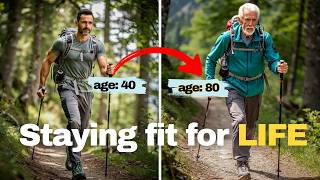
In this instructional video, certified health coach Victoria S. Dorsano addresses active adults in their 40s‑60s who want to stay capable into their 80s and beyond. She identifies three common mistakes that undermine longevity: (1) mistaking general activity for strength development, (2) engaging in random, unprogrammed fitness without progression, and (3) ignoring mobility, recovery, and subtle body signals (including water quality). To counter these errors, she presents a five‑component longevity framework: (1) Foundational Strength – progressive, compound movements (hip hinges, squats, presses, pulls, carries) performed 2‑3 times weekly; (2) Movement Quality – targeted mobility and stability work for hips, shoulders, ankles, thoracic spine, and core, 10‑15 minutes 2‑3 times weekly; (3) Activity‑Specific Preparation – aligning training with the specific sport or hobby (hiking, skiing, golf, pickleball) to ensure safe performance; (4) Recovery Protocols – adequate sleep, strategic rest days, active recovery, nutrition (protein, calories, carbs) and high‑quality hydration, highlighted by a sponsored Bluevia reverse‑osmosis countertop water filter; (5) Progressive Adaptation – gradually increasing load and volume at a pace appropriate for aging bodies, integrating all prior components. She outlines a sample weekly schedule, promotes a downloadable “Longevity Blueprint” with sample workouts, and invites viewers to book personalized coaching. The video includes a sponsorship plug for the Bluevia water filter with a discount code (Victoria15).
Chapters
So if you're in your 40s, 50s, or 60s right now and you're wondering how much longer you have to continue to do the things that you love, like hiking and skiing, playing golf or pickleball, the answer to that question pretty much depends on how you are training right now. I see that most active adults make 3 key mistakes that pretty much guarantee that their body will not hold up in their later years. And I wanted to make this video today because I am seeing this consistently with people who are coming to me in their 40s, 50s, and 60s, want to be really active into their older years and have been trying to stay in shape, but they just end up feeling exhausted and injured and just less capable every year. And it doesn't have to be that way. I'm Victoria S. Dorsano, certified health coach who specializes in training for longevity. And today I'm gonna break down what actually builds a body that lasts. So let's talk about those 3 mistakes that I consistently see with clients who show up. They're in their 40s, 50s, and 60s, and they are just feeling broken. And that goal of being that active person in their 80s feels like it's slipping from their grasp. The first of these 3 mistakes is confusing being active with building strength. They're not the same thing. Walking is movement. Hiking is movement. Yoga is movement. Pickleball is movement. And all of those are good things, but none of them are systematically building the strength that you are going to need to be capable as you age. Let me be specific about what I mean. If I asked you right now, could you get up from the floor without using your hands? Could you carry two really, really heavy bags of groceries up a couple flights of stairs without struggling? Could you catch yourself from a nasty trip without getting injured? Could you safely lift a suitcase into an overhead bin on an airplane? Those are strength demands. And if you can't do them easily right now and they feel like they require a significant amount of effort, then you might be in trouble. Because in 10 years, if you don't actively build strength, these things are going to feel impossible. Being active can maintain your cardiovascular system and to some degree your agility, and of course even flexibility if we're talking about yoga. But strength requires progressive training with resistance. It requires challenging your muscles beyond their current capability, therefore demanding that your body gets stronger over time, not just moving more. Now some of you guys might be thinking, wait, I do strength train, I do HIIT classes on Tuesdays, and I think I lifted some weights last week. And this brings me to mistake number 2: random acts of fitness. You're active, sure, you're doing stuff, yeah, but there's no plan and no progression and no strategy. Monday you might feel good, so you do a hard bike or hard hike. Tuesday a friend invites you to that yoga class, so you decide you'll go. Wednesday, you're feeling a little bit tired, so you skip your activity. Thursday, you might be feeling a little bit guilty that you took a rest on Wednesday, so you do that intense HIIT class that you saw at the gym last week. And then Friday, your back starts to hurt from that HIIT class, so you decide to take a rest. Does this sound familiar? I want to stress that this is good. Something is always better than nothing. Well, most of the times. I mean, it's great that you're doing stuff, you're moving, but it all is reactive and kind of just scattered and based on what you feel like doing at any given point. And the The problem is that randomness doesn't really build capability. It tends to just maintain at best, and at worst it can lead to overuse in some areas and neglect in others, and then there's no actual progress towards strength. To build a body that lasts, you need progressive strategic training. You need to systematically work on building strength week over week. You need to intentionally develop mobility and stability that keeps you injury-free, and you need planned recovery. Most people cannot just random act of fitness their way to being strong and capable in their 80s. And I say most people because of course there's those genetic outliers, but 95 to 99% of people are gonna need a plan with progression and strategy. Okay, so you need strength training, and top of that you need a progressive plan, right? But even if you have those things, mistake number 3 will still take you out: ignoring mobility and recovery and those nagging little issues in your body until they become big ones. For example, your knee has started to feel a little weird after doing long hikes. Eh, I'll just stretch more, you think. Or your shoulder starts to feel tight and pinchy when you're reaching overhead, and you might just think, meh, I'm just getting older. Or you're incredibly sore for 3 days after your workout, and you think, well, that must have been good for me. I definitely got sore from it. It means it's working, right? Those are signals that as you age should not be ignored. Your body is trying to tell you something, and it's wanting your attention. But what I find is a lot of active adults don't often address things proactively. They tend to wait until, for example, the knee pain completely stops them from being able to hike, or the shoulder pain eventually evolves into a tear, or until the recovery problem becomes chronic fatigue. And it's not always just the obvious stuff. It's sometimes small things that you wouldn't even think about, like water quality. Most people think that all filtered water is the same, but the truth is there's a lot of water filters out there that still leave a lot of things like microplastics and heavy metals in the water. And if you're drinking that stuff while your body is trying to recover from hard training, you're just adding stress to a system that's already working overtime. I'll come back to this concept when we talk about recovery protocols later. And then these folks come to me and they say, I just wanna get back to where I was 6 months ago. And I have to tell them, yeah, we can do that, but it's gonna take a little bit longer to work on this now and get you back to where you wanna go than it would've been to just prevent it. And most of us usually only need 1 or 2 of those reminders to keep that in check in the future. The strongest, most capable 70, 80, and 90-year-olds that I know take the small stuff seriously. They don't ignore their body signals. They don't try to push through everything. They train smart and they recover intentionally, and they address small issues before they become big ones. So those are the 3 most common mistakes I see, but I also wanna give you guys a longevity framework to follow that will help you work towards being that active aging adult into your 80s and 90s, being able to do the things that you love. So I call this the 5-component longevity framework. And the reason why it works is because it addresses all the things that your body needs to stay capable in the long term. And not just one piece to the puzzle. So component 1 is foundational strength. Surprise, surprise, this is non-negotiable. You need to systematically be building strength in the movement patterns that matter for life. I'm talking about hip hinge movements like deadlifts, Romanian deadlifts, and kettlebell swings. Squatting patterns like goblet squats and split squats and step-ups. Pushing patterns like chest press and overhead press. Pulling patterns like rows, pulldowns, carries, and then loaded carries for balance, like farmer's carries and suitcase carries. These aren't random exercises. These are fundamental human movement patterns, and you're going to need to progressively get stronger in them over time. Not, oh, I did some squats last week, so I'm good. No, more of, are you actually lifting more weight than you did a few months ago? Are you able to do more reps? Are you getting objectively stronger? That's progressive strength training. For most people, this is going to mean 2 to 3 dedicated strength building sessions with, of course, a clear progression plan. So component 2 is Movement quality. We're talking our mobility, our stability, our ability to stay controlled through that full range of motion. You can be really, really strong and still move like crap. And if you move like crap, you will probably eventually get injured. It's usually just a matter of time. So this is where you really work on things like your hip mobility, so you can squat and hinge well. Our shoulder mobility, so you can reach high without compensating. Our ankle mobility, so you're not blowing out your knees. Even your thoracic spine mobility, so that you're not feeling all hunched over and you're center of gravity is thrown off, and of course core stability so that your spine is protected. This doesn't have to mean doing an hour of yoga every single day, but it does mean like 10 to 15 minutes of targeted mobility work 2 to 3 times a week, and making sure that your strength training is involving full range of motion movements. If you can't get into a position properly, you have no business loading that position heavily with a lot of weight. So making sure movement quality is good is key. All right, so component 3 is activity-specific preparation. This is where you're hiking, skiing, golfing, pickleball— this is where that fits in. But key here is that your activity should not just be your training. Your training prepares you for your activity safely. If you want to be able to ski all day without your legs giving out and being at risk for tearing your ACL, then you're going to need to progressively strength train your legs to be able to handle that capability. Your activities are the fun part, but your training is the preparation that makes that fun part possible in the long term. So in a typical week, yeah, go and do your activity. Make sure you're doing the strength and mobility work that supports it. And a caveat here is that the strength and mobility work may look a little bit different depending on what your activity of choice is. All right, so component 4 is recovery protocols, and this is where I see a lot of active adults just drop the ball. You need to focus on adequate sleep because this is where your body repairs and builds. You need strategic rest days. You need active recovery, easy movement that promotes blood flow without the additional stress. And then of course you need nutrition that supports your recovery, making sure you're getting enough protein, enough calories, enough carbs, and of course proper hydration with good clean water. Actually, I used to think that all filtered water was basically the same. Drink enough of it and you're good. But when you're training hard and you're trying to keep your body capable for the long term, then quality water really matters. So your body is constantly repairing tissue and flushing out metabolic waste and even regulating inflammation. All of those processes require water. But when your tap water is contaminated with things like heavy metals and PFAS or microplastics, you're adding stress to systems that are already working hard to recover. So that's why I wanted to show you guys this. It's my countertop reverse osmosis holy grail water filter from Bluevia. And the reason I personally switched to reverse osmosis unit like this one is because it's the only type of water filter that actually filters out contaminants down to 0.0001 microns in size, including things like fluoride, heavy metals, microplastics, pharmaceuticals that end up in our tap water, but essentially stuff that basic water filter pitchers do not catch. And I can actually verify it's working with something called a total dissolved solids meter on the top of the machine. Chicago tap water runs around 170 parts per million of total dissolved solids. And after I run it through this Bluevia reverse osmosis countertop filter, it comes down to 1. Now, is this going to revolutionize your training completely? Probably not. But when you're stacking all these recovery protocols together, like clean water, good sleep, proper nutrition, and strategic rest, that's what builds a body that recovers well and adapts to training. The nice thing about this system is that it is clearly countertop and it can come with me. I don't have to install and uninstall it under the sink. It can travel with me where I go from apartment to apartment or place to place, and it's super convenient and very nice and sleek looking. But I've been using this baby for over a year and a half now, and I absolutely love it. I can tell the taste of my water is much better, and I just feel really good knowing that it's getting out all the stuff that should not be in my tap water in the first place. So if you're interested in making sure that your water is really clean and pure and always accessible in your home, then you're going to want to check out Bluevia. and I have a code for 15% off. It's Victoria15 at checkout. I'll put that down below along with a link in the description. And if you wanna check out my full review and my water filter journey, you can check that out here and here. All right, now that I'm hydrated, let's get to component number 5, progressive adaptation. This is the piece that really makes everything sustainable. You can't continue to train like you're 25. You probably already know that your body just does not recover that fast anymore. You need more preparation for the activity, more recovery time, and more gradual progression. But you also can't just coast and maintain. Maintenance means slow decline. You need to be getting progressively stronger and more capable over time, just at a pace that your body can handle. That's exactly what we do at Be Victorious Coaching, and we wrap in your nutrition. We wrap in all these other lifestyle components that really help you train and live well and feel well into your later years so that you can continue to kick ass and be the active person that you wanna be as you age. Again, we're building for decades here, not just a month ahead. So we train smart, we progress consistently, and we listen to the feedback that your body's giving you and plan accordingly. So that's the framework. In summary, you wanna incorporate foundational strength that focuses on progressively getting you stronger. You wanna focus on movement quality so you're not just strong, but you're moving with good control and consistency. You want to incorporate activity-specific preparation so you can continue to do all the fun things that you love to do. You wanna integrate recovery protocols and good hydration so your body can consistently adapt. And you want to have progressive adaptation of all of those components over time at a pace that feels sustainable for you. All 5 of those components working together in unison is what builds a body that lasts. Okay, so what does this actually look like in an average training week, right? Well, if you want to take a peek, we have our Longevity Blueprint that we put down below in the description where we've built out a roadmap of what it looks like to integrate these components practically and some sample workouts for you to integrate into your own programming that can help you feel strong and capable as you age. So check out our Longevity Blueprint down below in description. I promise you it is super helpful. Or if you know that you're ready to just step it up and get a personalized longevity plan just for you, then reach out, book a call down below with our call link. And again, a huge thank you to Bluevia for sponsoring today's video and keeping me well hydrated for the past 1.5 years. And if you want to grab one of these yourself, it's Victoria 15 for 15% off. And guys, as always, if you found this video helpful, please give this video a thumbs up and subscribe to the channel. It helps so much, and I appreciate each and every one of you who has done that. All right, I'll catch you on the next one. Bye!