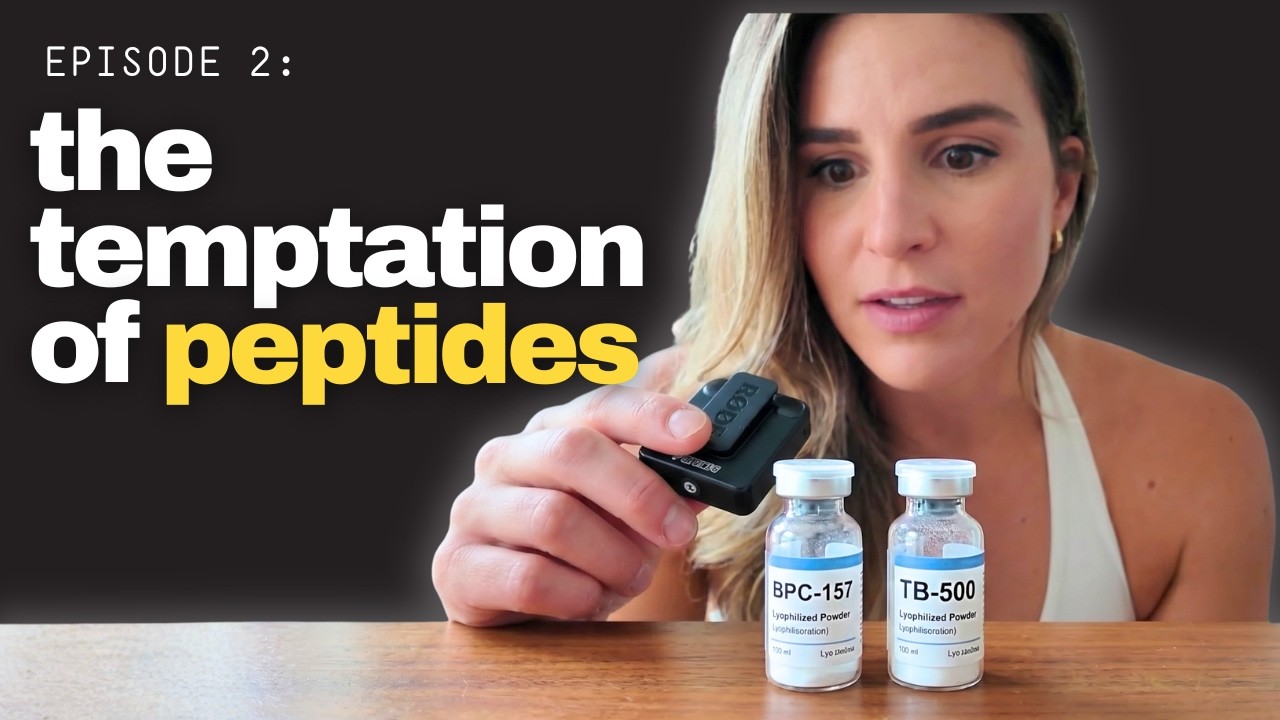
In this second episode of the "Should I Be Taking Peptides" series, health coach Victoria S. Dorsano presents a personal, educational exploration of gray‑market peptides. After a brief disclaimer that she is not a medical professional and that the video is not medical advice, she establishes that peptides are not a fringe concept by highlighting FDA‑approved peptide drugs such as insulin, GLP‑1 agonists, and tesamorelin. She then outlines the main categories of unapproved peptides she is considering: healing/recovery (BPC‑157, TB‑500), growth‑hormone‑enhancing (CJC‑1295, ipamorelin, sermorelin), longevity/cellular health (NAD+, epitalon, MOTS‑C), and newer metabolic agents (retatrutide). Dorsano explains the 2023 FDA restriction that placed many of these compounds on a high‑risk list, effectively pushing their production from licensed compounding pharmacies into an unregulated gray market. She argues that patients turn to this market because the conventional healthcare system can be costly, slow, and dismissive, especially for chronic pain or slow‑healing issues. She further contends that the lack of human data does not prove inefficacy; rather, many peptides cannot be patented, so pharmaceutical companies lack financial incentive to fund large trials. Dorsano introduces the notion of a “responsible” peptide use model, citing examples like Bryan Johnson who employs extensive bloodwork and compounding pharmacies to obtain off‑label, non‑FDA‑approved peptides under physician supervision. She notes an upcoming July 26 hearing that may remove some peptides (e.g., BPC‑157) from the restricted list, suggesting a potential widening of legal access. While she acknowledges that these compounds are not proven safe or effective, she admits the arguments have moved her slightly closer to trying them, but she will present the counter‑argument in the next video. The episode ends with a call to subscribe, like, and comment, inviting viewers to share their own peptide experiences.
Chapters
About 100 years ago, one of the most important peptides ever discovered started keeping people alive. And today, a different group of peptides is being sold in unmarked vials on the internet. Want to lose weight? No worries, there's a peptide for that. Well, the demand for unapproved peptides is booming worldwide, driven by social media trends. People are buying illegal peptides and injecting them into their bodies, and people swear that they're still life-changing. I'm on peptides. I just hopped on a stack of 3 different ones. 30 of the injections that I do are right around— Welcome back to episode 2 of my series called Should I Be Taking Peptides, where I'm personally working through the pros and cons of taking gray market peptides and whether they're actually right for me. Quick but important note, this is of course for personal exploration and educational purposes only. I'm a health coach and not your doctor. Nothing in this video is medical advice, and I'm personally not telling anybody to take or buy anything, just an honest exploration of what's available on the market and whether I should be taking them. So in the last video on this series, I told you that my gut said no to taking peptides. And again, in particular, I'm talking about gray market peptides that are sold on the internet. But as I also mentioned in that video, I think it's lazy for me not to genuinely explore the argument for taking these peptides. So that is what this video is all about, is building the most convincing, honest case for me taking peptides. And in the next video after this one, I'm going to build the case against. So if you're watching the series, I highly recommend you checking out not only this video, but also the case against, and then my final decision video later on in the series. So make sure you subscribe and hit that notification bell if you're interested in following along with my journey. All right, so let's start with some solid ground building here. Peptides in general are not like woo-woo medicine. They're definitely not some fringe internet invention or just hype. Your body actually runs on peptides naturally, and some of the most important medicines of the last century are peptides. Insulin, the life-saving drug for people with diabetes, is a peptide. GLP-1 drugs that so many people are talking about, like Ozempic and Wegovy and Mounjaro. Tesamorlin, something that's prescribed for certain types of fat loss, is also a great peptide. And all of these are also FDA approved. And of course that means that they are highly regulated. So many peptide advocates are proponents because they say, hey, peptides are genuinely helpful molecules. They are used in modern day medicine and they have been shown to be very, very effective. And so much so that they are in FDA approved medicines. We already we know that peptides are very powerful and very effective. So if something like insulin or semaglutide can do what it does, is it really crazy to think that these gray market peptides have real value that just hasn't been formalized yet? That's a fair question, and it's the foundation that everything else in this argument gets built off of. So when I'm talking about gray market peptides in general, I'm referring to a couple of different peptide categories, let's call 'em, or buckets. There's the healing and recovery group of peptides, meaning things like BPC-157 and TB-500, which when used together, people claim that it's called like the Wolverine stack. Then there's the growth hormone group of peptides: CJC-1295, ipamoralin, sermorelin. The pitch being that these are peptides that help nudge your body to really enhance its own growth hormone-producing abilities rather than injecting synthetic growth hormone. And then there's the longevity and cellular healing group that includes things like NAD+, epitalon, and MOTS-C. Those are marketed for, you know, preventing aging and boosting your mitochondria's output. And then of course there's a metabolic newer compounds like retatrutide, which are, you know, chasing the heels of GLP-1s. All of these peptides that I mentioned have one thing in common: none of them are FDA approved, and they have very little human data. So if they're not FDA approved, why are these things even floating around the internet in research vials being sold to consumers on the internet? Why are they not FDA approved? Well, back in 2023, the FDA put about 19 of these peptides on a restricted list that effectively stopped licensed compounding pharmacies from making them. But this didn't necessarily kill the demand overnight. It just pushed it out of a regulated system and into an unregulated one, meaning now there is an entire gray market out there of peptides that are being sold for research purposes only and not for human consumption. So it's unfortunate that the regulation arguably created this gray market demand. Which brings me into one of my main three arguments for peptides. Not only did a lot of these peptides get taken off the list of being able to be compounded by different pharmacies, but think about the medical system at large. And think about more in particular what it takes to deal with a stubborn health problem through the traditional front door. You see your primary care doctor who then refers you to a specialist who then orders maybe an X-ray, an MRI, multiple labs. And of course, you can call your insurance and try to ask them, hey, if I get this thing done and this thing done, what might that end up costing me? Or what's covered in your plan? But who wants to sit on a call for 45 minutes to explain your problem and the possible billing codes you might have? It's just way too complex. At the end of the day, you're waiting weeks weeks to get this thing treated, sometimes months depending on the specialist you need to see. You end up paying a lot of money, insurance or no, and a huge amount of people after going through all of those hoops will still feel dismissed, or they're told that nothing's really wrong, everything looks good, when they know and they can feel that something is off in their body. At the end of the day, many doctors agree that people turn to peptides because they feel like the medical system is failing them and because they feel like conventional treatments for things like slow-healing tendons or chronic pain are pricey and oftentimes don't work in the end, and they just take a long time. So when somebody can just order a vial from somewhere online and easily take that on their own for a fraction of the cost and get it within like 3 to 5 days, for a lot of people that doesn't feel reckless. It feels like a rational response to a system that has been consistently failing them. There are a couple cases that I read about online for people who were even prescribed like normal GLP-1 peptides through their doctor, and they found that it was very expensive of a route to go, even with some insurance coverage. And this patient saw friends taking peptides from the gray market and feeling better and having better results than she was. So she considered it and switched over. It essentially came down to her cost and frustration. So all in all, this gray market peptide boom is simply just a response for people to take this into their own hands. And I don't blame them. I've been through the hoops. I've had different issues that I've gotten tossed around. For honestly years without anybody taking me seriously and have spent thousands of dollars to do that. So I get the allure of these peptides and I understand why this builds a strong case for them. The second point I wanna build in the case for using peptides for myself would be that the concept of we haven't studied it yet doesn't necessarily mean that they're not effective and that they don't work. Most of these peptides can't be patented, and if a drug company can't own something exclusively, it's never gonna spend millions and millions of dollars to test a compound that it can't own and make money off of. So many peptide proponents out there argue that the lack of human evidence doesn't mean that peptides don't work. It's just evidence that companies don't have a financial reason to really regulate and test them. And point number 3 I wanna make when I'm arguing the case for peptides is that the responsible version of this can actually exist, but it's a spectrum. When most people picture this, and I got to be honest, for a long time I pictured this as well. I imagined some guy just injecting some random substance that he got from an Instagram influencer online. But there is a responsible version of this to some degree. For example, Bryan Johnson, the guy who's spending millions of dollars to help reverse his aging, is the poster child of this version. Nothing goes into his body without bloodwork and plenty of data, which then raises the obvious question: how does a physician prescribe something that's not FDA approved? Well, they don't. Not like a normal drug. Historically, they've run these through compounding pharmacies, a licensed pharmacy making a customized preparation for one patient. But compounded is not the same as FDA approved. Think of it as kind of like a legal loophole, essentially. Again, some of those peptides got put on a list in 2023 where they cannot be compounded legally anymore. But there are still plenty of other peptides that are not FDA approved that are still able to be compounded and prescribed under a doctor to a compounding pharmacy for the patient. So yes, I would say a responsible version of this does exist to a degree, a version where you can go see a doctor and have them prescribe a type of peptide that isn't necessarily FDA approved but can be compounded and done so more so off-label, particularly for you. An important note, because this is a very timely discussion around peptides, It's June 30th, the day that I'm recording this video. At the end of July, I believe July 26th, um, there's gonna be a hearing to get some of these other compounds like BPC-157 taken off of like a list, a high-risk list where maybe they can be compounded again. It's a procedural step in the right direction for people who are pro-peptides, but it's still not FDA approval. So I'm saying all that because the window looks like it is broadening for that responsible version of what looks like to have these peptides available to you. So at the end of the day, yes. Did that move me a little closer to the peptide direction? Yes. But notice what I did not say there. I did not say that these are proven. I did not say that these are safe. I didn't even say that these early signals of them being, you know, promising hold up when you really push into them with a larger study group, because we don't know that. And these are genuine components that I'm going to be taking in my next video, which is the argument against peptides. So if you want to hear more about it and better develop balanced perspectives on both sides of the equation, make sure you subscribe, follow along, hit the notification bell so you know when the next episode of this series launches. And as always, guys, please like and comment down below if you enjoyed this video. If you have thoughts on peptides, your personal story, I'd love to hear it down below and hear your guys' experience as well. See you guys in the next one. Bye.