How To Find The Perfect Water Filter For You (Pitcher vs Gravity-fed vs RO System)
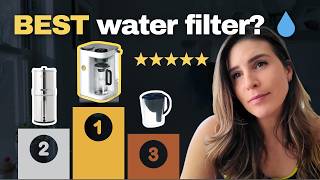
In this video, Victoria S. Dorsano chronicles her multi‑year quest to find the optimal home water‑filtration solution, testing three distinct systems: a basic pitcher with activated‑carbon filters, a gravity‑fed Berkey unit with carbon‑block filters, and a countertop reverse‑osmosis (RO) system (Bluevua Ropott Lite). She explains the underlying technology of each, outlines their strengths and weaknesses (e.g., contaminant removal capabilities, maintenance demands, aesthetic considerations, and verification methods), and provides concrete performance metrics such as pore size (0.2 µm for carbon‑block vs 0.0001 µm for RO) and total dissolved solids (TDS) reduction (from ~130‑180 ppm in tap water to ~1‑2 ppm with the RO unit). Cost analyses over a five‑year horizon compare upfront price, filter replacement expenses, and total spend for each approach. The video concludes that the countertop RO unit offers the best balance of high‑quality filtration, low maintenance, and renter‑friendly installation, and she invites viewers to ask questions, check links, and subscribe.
Chapters
Hydration has gotten really complicated. There's alkaline water, hydrogenated water, adding electrolytes to everything, and it's kind of gotten overwhelming. And I'm personally someone who likes to find the most optimal quality of something at the best price, including my water. So this has led me down a multi-year journey at this point to finding the ideal filtering solution for my tap water. But it took about 3 different tries to get this right. So today I'm going to walk you through my entire water filter journey, comparing my first pitcher filter to a gravity filter I had to a reverse Osmosis countertop unit and why I've stuck with the latter for a year and a half at this point. So like I said, I've tried 3 different water filter systems at this point, and each one has taught me something important about water filtration that helped me make the decision to figure out what actually matters when it comes to clean water. So I'm gonna break down the technology behind each one to ultimately explain why I ended up with the unit that I currently have and why I'm sticking with it. So like most folks, I originally started with a pitcher filter. You know the ones. Pure, Brita, all those brands, they use something called activated carbon filters, which is pretty much the most basic level of filtration you can get. Here's what those pitcher filters actually do. They typically remove chlorine, which helps improve taste, and they can filter out some sediment, and that's about it. The water generally tastes better, and that's why people think that it's working really well. And don't get me wrong, there's been some improvements in that filtration technology, but it's generally not going to be up to par with some of these later models I'm going to talk about. They usually end up missing things like PFAS, fluoride if you're somebody that wants to filter that out, and bacteria. Basically anything that's smaller than the pores of that activated carbon filter. And then personally, there's always the sanitization issue of these water filter pitchers that has always bothered me. You're filtering water through a cartridge that's essentially sitting in water, and that humid environment of the pitcher feels like just a breeding ground for mold and bacteria and If you've ever forgotten to change your pitcher filter one time, then you know what I'm talking about. But here's the thing, I'm a pretty low maintenance person and these pitchers are high maintenance in my book. You have to replace the filter every 2 months or so, and that's just too often for me. Pitchers are cheap upfront, yes, but then you're buying these filters every 2 months to replace. And I not only look at like the dollar for dollar investment in something, but I look at the time investment and the energy investment. So anytime I have to remember to do something or, you know, order something extra or do a task that's related to the thing, that is a time and energy cost for me. So I used the pitcher for about like 6 months before I was like, ooh, I don't like this that much. That's when I decided a few years ago to do some digging and upgrade to the Berkey. Now, if you don't know what a Berkey is, it's one of those big silver things that looks like a bathroom trash can sitting on your counter. Not the best thing to look at, but it does a decent job. Better than the pitcher filters, at least. Now, it's a gravity-fed system with a carbon block filter, a little different than the activated carbon filtration system in the pitcher. Berkey filters can typically remove more like heavy metals, pesticides, and herbicides. They can catch and retain more sediment in those filters versus the pitcher filter. But where these types of filters struggle is that they cannot catch a lot of these smaller dissolved solids. They can generally filter about up to like 0.2 microns to size, but anything smaller than that they tend to struggle with. So here's the cool thing about carbon block filters: it doesn't just catch particles like a screen. The contaminants actually stick to the black filter through a process called adsorption— not absorption, but adsorption. So the filtration is pretty comprehensive and definitely a step up from the pitcher. My water definitely tasted way better with the Berkey, and I felt much better knowing that I was removing more contaminants than I was from the pitcher. But here's where the carbon block filters tend to reach their limits. It doesn't necessarily reduce total dissolved solids or reduce fluoride in the water. Those contaminants are dissolved at a molecular level, and they don't tend to stick to the carbon block like other contaminants do. So overall, my experience with Berkey was mixed. From a purely aesthetic perspective, I did not love the look of it sitting on my counter. It was big, it was bulky, and it took up a lot of space. And the process of Testing and changing the filters was very difficult. You have to do something called priming the filters when you set it up, which was kind of cumbersome, and then you're supposed to clean them periodically. The filtering was also so slow and we were constantly refilling it cuz we drink a lot of water and it was just taking a lot of time to get it to refill. And here's the thing that kept bugging me the most is that I had no way to actually verify it was working other than this like food coloring test they have you do in the initial part of it where you drop a few drops of food coloring in the top container and see if it comes into your water through the bottom container. And if it doesn't, then that means it's working. I don't know, it just seemed kind of weird. I used my Berkey for about a year and a half and it was fine, but it was time to look at another solution. Now that's when I started researching some more and finding that reverse osmosis is really one of the gold standards of water filtration systems. What makes a huge difference with reverse osmosis is that it's able to filter down to 0.0001 microns of a particle size. The technology works through this semi-permeable membrane that only water molecules can pass through. Everything else dissolved or not gets blocked. So all those things that the carbon block filters like Berkey filters out, reverse osmosis does as well. Plus it's able to filter fluoride, dissolved minerals, microplastics, pharmaceutical residues, and literally everything else down to a molecular level. And you might be asking, wait, why are all these things in our treated tap water anyways? Well, I have a video all about that, which you can watch over here. But in short, when our water gets treated at water treatment plants, there are byproducts that end up happening through that that process that pass through the water that typically are safe in certain doses, but certain areas tend to have more of them. And then we have the issue of pipes that leach lead into the water system and, you know, you get a mix of other things. But all that being said, filtering our tap water is important. Reverse osmosis filters are just comprehensive in a way that other filters aren't. The problem with most reverse osmosis filters has always been the installation. Traditionally, you need to install them under the sink, or it's like a whole house setup kind of a deal. And as somebody who is renting an apartment, that's not really an option for me. I'm not gonna drill into the cabinets or like mess with the plumbing here. So that's when I found that there's something that exists that's called a countertop reverse osmosis unit. And in particular, I found the Ropott Lite from Bluevua, and that has been the one I've stuck with for the past year and a half now. I made an initial review of that over here, which you can go watch if you want a deeper dive into that, but I'll to touch on some of the key points here in this video as well, because a lot of you guys have been asking that video, hey, it's been some time, do you still love it? Like, is it still working well? Is it still low maintenance? So I want to take some time to go through that. First of all, it took like zero setup time. It took all of maybe 10 minutes to get up and running. Ridiculously easy. No tools, just like 3 steps. You take it out of the box, fill up the reservoir, do a couple of flush cycles, and it was ready to roll. Aside from the ease of installation and setup, I really loved that it had a TDS meter on the device itself. TDS stands for total dissolved solids, so it's able to tell me like how many dissolved solids are in the water that it's filtering through. The lower the number, the purer your water is coming out. For reference, the tap water here in Chicago typically has a TDS of like 130 to 150, sometimes 180. The Bluevia Ropat Lite can get my TDS down to 2, sometimes 1, and that's counting it in parts per million. The fact that I can actually see the filtration happening and understand the output and how pure the water is coming out just makes me feel better about the process. There's just more transparency there. The way that this particular unit works, being a countertop unit, is that has a 5-stage filtration process, and that's all packed into one filter cartridge. First of all, there's a pre-filter that catches like larger particles, rust, larger pieces of sediment, and then there's a carbon block filter that catches things like chlorine. And some of those those VOCs I was talking about earlier. And then there's a protective layer for the heart of the filtration system, which is the reverse osmosis membrane. And that's the membrane that really filters things down to 0.0001 microns— things like the heavy metals, the fluoride, the bacteria, the microplastics, all that good stuff. And then finally, there is a post-carbon filter to help improve the taste. All that happens in this one compact filter cartridge that you only have to change out once a year, and it is literally the easiest process. You literally untwist the top, pull this filter out, take the new filter, pull it in, twist the top in, you're good to go. Now, does it take up some counter space still? Yes. Does it look like a giant silver trash can? No. Design is much sleeker, much cleaner. I love the clear carafe. There's even an inner carafe where if you want to put like fruit to make it fruit water, you can do that. The daily use is pretty simple. I just fill the reservoir up like maybe 2 times a day, and I'd say it takes about 5 minutes or so to fill up the whole carafe of water. There's a half fill and a full fill feature. So if you're like, hey, I just don't have the time, I just want it to half fill and I'm going to drink that, then you can hit the half fill and it'll only fill it up halfway and you're good to roll. Touchscreen makes it super easy, very simple, only a few buttons, so you're not going to get lost. And then there's a filter meter which shows you where you're at in your filter life, which is also very, very nice. So let's go over the cost of these 3 different filter types, starting with our pitcher filter that can range from, let's say, $30 to $50 initially. Right. And then the replacement filters that you have to do every 2 months are anywhere between $6 and $15. Over the course of 5 years, you're gonna get somewhere between like $300 and $500 that you end up spending, and that's for like mediocrely cleaned water. Then you have the Berkey, which is going to be, again, depending on the size, maybe $300 to $400. Replacement filters are a hefty $150, and they last around 1 to 2 years. So over 5 years, you might be somewhere in the ballpark of, let's call it like $700 to $1,000. Now the Ropot Lite is about $300. Filters for the Ropot Lite are around $80. So over the course of 5 years, you're gonna be somewhere in the ballpark of like $700-ish. I'm generalizing, don't come at me for my exact math, but that's gonna be roughly in the ballpark. So the Berkey actually ends up being one of the more expensive options out there and higher maintenance as far as like being able to install and just slow and and all those things. And the pitcher comes in obviously the cheapest, but you're getting not great filtration. So the Ropott is this nice sweet spot where it's financially accessible to most people and you're getting the highest quality of filtered water. So it's kind of a win-win. Okay, so who might really benefit from a reverse osmosis countertop unit like the Bluevia Ropott Lite, like the one I have? Well, I would say if you're somebody who rents an apartment and doesn't necessarily want to install and uninstall an under-the-sink reverse osmosis unit, not to mention your landlord probably wouldn't be happy about that. Probably a good choice for you if you're somebody who cares about your water quality and making sure to filter your tap water. The Ropod Lite is a great option. Also, if you're somebody who likes to see the data that your water is actually getting cleaned and not just believe, you know, a filter is doing its job on its own, that's also going to be a benefit for you. And if you're somebody who is fairly low maintenance like myself, I do not want to have to think about a filter every 2 months, nor do I want to have to take an hour to prime a Berkey filter. But overall, a year and a half later, I am extremely happy with my Ropod Lite from Bluevua. It has been such a game changer for our water filtration. Taste has been amazing. Process has been amazing. Super low, low effort, and I stand by it. If you wanna check it out for yourself, I put a link down in the description. And if you have any questions about my journey through the water filtration process and ultimately where I've settled with the Ropod Lite, I'm happy to answer any questions down below in the comments, so please leave 'em down below. And if you liked this video and thought it was helpful, please give it a thumbs up, subscribe to the channel, leave a comment. Greatly appreciate each and every one of you guys for being here, and I'll catch you guys on the next one. Cheers.
More from Victoria






3 things you should do to make sure you get the most out of your fish oil #legion
