I Wore a Brain-Reading Headband for 30 Days (Muse S Athena Review)
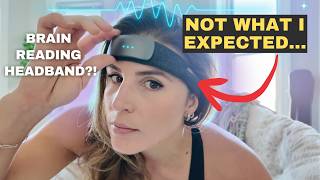
In this 30‑day hands‑on review, Victoria S. Dorsano evaluates the Muse S Athena brain‑sensing headband, detailing its dual‑sensor technology (EEG for brainwaves and fNIRS for prefrontal blood‑flow), the app’s real‑time biofeedback experiences (calm/scattered soundscapes, breathwork, heart‑rate slowing meditations, and the eyes‑open “owl” mental‑strength game), and its sleep‑tracking suite (EEG‑based sleep stages, position tracking, and “digital sleeping pills”). She shares practical usage insights—fit challenges with hair and makeup, discomfort during sleep, a one‑week learning curve, and her favorite sessions—while highlighting cumulative metrics like Alpha Peak and Brain Recharge scores. Dorsano outlines who would benefit most (meditators, data‑driven biohackers, high‑performers, athletes), discusses cost ($475 hardware + $99/year subscription) and return policy, and concludes that the device offers valuable structured feedback and performance data despite some drawbacks. The video ends with a call‑to‑action, discount code, and invitation for viewer comments.
Chapters
Ever wish you could see what your very chaotic brain was doing in real time and how to train that to actually become less chaotic? Think about it. More focus, more clarity, better sleep. Well, I might just be wearing the key to unlocking that. This is the Muse S Athena brain sensing headband, and I've spent the last month wearing it through busy work days, training days, recovery days, and even sleep to share with you what actually worked, what didn't, and who it might be best for. Okay, so I gotta be honest, when Muse first reached out about trying out their headband, I passed. I was like, another wearable and on your head? The filter I'm always trying to look through when I'm trying new pieces of tech or reviewing fitness equipment is, would this actually be something my clients would use? But then I started digging into it a little bit more and understanding that, well, the key differentiator here from other wearables is that it's actually measuring your brain activity, and that seemed really intriguing to me. Because there is a ton of application for how that can improve your focus, your mental clarity, your sleep, and your overall just stress levels throughout the day. And that would be something that not only interests me but would definitely interest my clients. But then after digging into it a little bit more and starting to learn that it actually reads your brain activity and can measure your blood flow to your prefrontal cortex, I started to understand that this isn't just another normal wearable. If that kind of feedback and data could make meditation practices or mindfulness stick or help improve the at which you fall asleep, or your levels of stress, or even your mental performance as an athlete or a high performer in your job, that would be pretty game-changing. So I changed my mind and decided to give it a shot. So before I go into my experience, I want to share a little bit about what is the Muse S Athena headband and what can it actually do. So it's a soft headband that functions on two main systems. It uses EEG technology with small areas of the headband that are receptive to electrical signals of your brain, both on the front and the sides behind your ears. To essentially capture your brainwaves. And this is so that the Muse app that pairs along with the headband can react to your brainwaves in real time. When your mind is calm, the music and the soundscape and the meditation starts to get calmer. When your mind is scattered, the music and the meditation and the soundscape gets louder. And not only are you able to get real-time data, you're also able to get cumulative data towards the end of the session where you can see a full score of how calm your brain was through the whole session. Now let's talk about the second system, which is the fNIR system. This uses near-infrared LEDs at the front of the device to shine a small light into your prefrontal cortex. Now, the core functioning of how this works is all due to the fact that oxygenated and deoxygenated blood absorb light differently. So depending on the feedback that the sensor is getting from the light, Muse is able to detect differences in brain oxygenation levels, thus helping you determine how hard your brain is actually working at any given time, which can translate to focus. This essentially translates into something that Muse calculates as your strength score. Now, together, the EEG and the fNIRS are able to tell a full story, kind of like what state is my brain in and how hard am I working to be there? So all that science stuff aside, how can you actually use the headband? So there's a few cool ways that the headband syncs up with the app. To help take you through different types of real-time training that can actually provide measurable feedback. There is your standard eyes closed biofeedback. These are your mind, heart, body, and breath sessions that are guided by the EEG system. In these particular applications, the Soundscape is responding to how your brain is functioning and adjusting accordingly, providing you that real-time feedback so you can refocus. The goal of these types of programs are focused, calm, lower stress, and better attention overall. At the end of each practice, you're going to get like a calm percent score, a stillness score, and a heart and breath summary. Now the cool thing about the Muse S Athena is that you can also do eyes-open mental strength training, particularly using the fNIRS technology. You are able to do an activity in the app that is quite cool where you're able to make an owl fly with your mind. The more you focus on the owl flying faster and farther, the more it responds on the screen. Okay, so I'm about to do a strength session with Muse, and this is all about trying to make this owl on the app fly with just my thoughts. Okay, so I'm focusing on getting the owl to fly towards that horizon. I'm going so fast. What's happening? Now, if you start to lose focus or your mind starts wandering and the headband senses that there's less blood flow drawn to the prefrontal cortex, your owl starts to drop. Slowly but surely down to the ground. So essentially you're training your brain for sustained levels of effort. And now I have found this particularly helpful before doing times of deep work where I really need to activate my brain. And lastly, another bundle of applications that you can use within the Muse app and the program are their sleep programs or sleep tools. Now most of the benefit in using these sleep tools are going to come from wearing this device overnight. What you'll get when you are able to wear this overnight is you're going to get EEG-powered sleep stages, sleep position tracking, and some programs called digital sleeping pills— essentially audio that fades as you start to fall asleep and nudges you back if you wake. So extracting all the things that you can do, let's talk about what the benefits could actually bring. Naturally, something like a brain tracking headband is going to be great for cognitive performance. It's essentially going to help you to train your brain to focus more easily and for more sustained efforts. Another benefit is being able to use this for active recovery. Some of the breath or body sessions that can help to actually calm your body down, and you can see your heart rate decreasing, and using the breathwork as a biofeedback tool are invaluable. Those can be really great to build between hard training days as an athlete. Now obviously this headband is great for sleep support because it has an entire body of sleep support tools, but this is only going to be for those of you that can fall asleep with something on your head. Okay, so let me get into a little bit about my personal experience and opinion of using it since I've been using it for a little over a month now. First thing I want to mention is that the device is a little finicky with hair, people who have hair on their face, and people who wear makeup. It definitely works best if you are able to completely tie your hair all the way back, all the way, because the sensors that go right behind the ear need a clear pathway for that. Other thing is, again, for those of us that wear makeup, it does still work over makeup, but the connection sometimes is weak and the data hasn't been as strong. So I do feel like it makes a difference and it does work best when you don't have makeup on. So another point of my experience that was a little contentious was using it for sleep. I was really looking forward to using this for sleep, but I don't think I actually practically thought through what this would entail. I already use a Whoop, so I was all hyped up to be able to compare the data back and forth, and I really gave it an honest shot, you guys. But I already wear a big eye mask to bed that goes around my whole head because I'm really, really light sensitive when I'm sleeping, and I'm not willing to take that off. I will not fall asleep well. So I tried to stack the two together, and it just felt like there was so much on my face. It felt a little suffocating and definitely uncomfortable. I could be wrong. Maybe I'm just a really rough sleeper, But I gave it a shot for 2 nights. The first night I made it about an hour into it and got so fed up with the feeling of it on my face that I just took it off. And then the second night I gave it an honest try, tried to keep it on, and must have taken it off in my sleep because I woke up with it next to my bed. So I did not get good sleep data for you guys on that. But here's what I will say. A lot of the calming programs can be used to prep you for sleep, to help gets you into a good sleep state before you go to bed. So aside from that, I will say when you start using the headband, there is a learning curve and you have to be patient with yourself. The first week is going to take a little bit for you to get used to. Set a dedicated time at least once a day to make your like Muse learning time. There is an entire intro to biofeedback program that you're going to want to go through. Muse does a really good job for most of the programs that you go through of adding in some sort of lesson component where they're teaching you about what you're about to do, and then you go do it. So once you get through that first week, you can really find out what are some of your favorite features. For me, I really loved the breathwork and some of the heart rate slowing meditations and programs. Those for me were really useful for a lot of different applications. I use them before going into a big meeting, before going to bed to slow my heart rate down, calming my mind before a big speaking engagement. Now the other section I really loved in the app was doing the mental strength programs where I was that little owl activity and trying to focus on getting that owl to fly. And it was really frustrating the first couple weeks that I was doing it because that owl would keep falling and keep falling, and it was really hard to get him back up in the air and going. And then I felt like I started to catch a groove and I started to get a hang of it, and then my owl started soaring, and that felt really good to see the progress over time. Now, those are some of the programs that I loved because of how either interactive they were or because of of how they made me feel afterwards. But the cool thing about Muse is that it's also collecting cumulative data, like I mentioned, and calculating some scores quietly on the back end. Now, two of those scores are really, really interesting to me. One of them is called Alpha Peak, and this is essentially measuring your brain's peak alpha brainwave frequency, which is known to be a key indicator of overall cognitive performance. The second really cool stat you can look at is your brain's recharge score, and this essentially measures your brain's ability to effectively rest and recover. Then you can use this score to better be able to determine what types of activities you can do in the app that will help boost your brain recharge. And that's what I think it's all about, because if you're not using the data to make better decisions, then you're just getting data. And for me, that's not really worth it. And that leads me to discuss the question of who should really try something like the Muse S Athena. Who would benefit from it most? I think folks who are already really invested in their meditation breathwork and their brain health would really love this tool as an additional, like, level up. Also, if you're somebody who thrives on objective data and metrics in biohacking, then this is probably going to be something that you're going to find fascinating. And lastly, if you're somebody who is constantly finding themselves in high-stress, high-performance arenas, whether that's in athletics or in your business or, you know, in any aspect of life, then this is probably going to be a really valuable tool for you to preserve your mental and cognitive abilities over time. This might not be for you if you're somebody who has a history of finding the new shiny thing and not necessarily following through on it, because it is a bit of an investment. It comes in at around $475 with a $99 subscription yearly. It's something where it's not a small investment, and if you are gonna try it, you should really like commit to trying it. So to summarize, this is better than I thought, but not without some pitfalls. It isn't magic, but it definitely is structure, data, and really great feedback. This I really feel like is gonna be a tool that I'm gonna continue to use for amping up my mental performance, for helping me with my athletic recovery and sports performance, and for just my overall brain health in general. So if you're somebody who is looking to sleep better, optimize their brain performance, and just preserve their cognitive longevity, then check out the link below to grab your Muse headband and use my discount code to save some money. And worst case, if it doesn't end up working out, you can always return it within their 30-day return window. So you really have nothing to lose. Just try it out, see what you think. Just give it a, not a shot of doing it for a couple days in a row. So what do you guys think? Would you end up getting something like the Muse S Athena to track your brainwaves and your mental performance and possibly optimize your sleep? Sleep, or does it all feel a little bit too extra? I'd love to hear your thoughts down below in the comments. And as always, guys, if you liked this video, please give it a thumbs up, subscribe to the channel, and I will see you guys next time. Bye!
More from Victoria






3 things you should do to make sure you get the most out of your fish oil #legion
