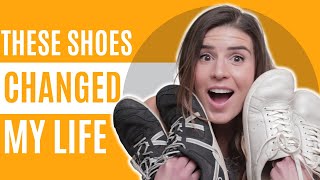
In this April Foot Health Awareness Month vlog, Victoria S. Dorsano explains why foot health matters, outlines foot anatomy (26 bones, 33 joints, 100+ muscles/ligaments) and how fascia links the feet to the rest of the kinetic chain. She shares her personal motivation—joint pains for herself and her husband—and critiques modern footwear that restricts toe spread and over‑relies on orthotics. Victoria introduces the Xero barefoot shoe she chose, describing its wide toe box, zero‑drop, thin flexible sole, and lack of arch support, and recounts her smooth 4‑5‑month transition, noting benefits for her arches and previous plantar fasciitis. She discusses challenges for people with flat or fallen arches, recommends transition programs and specific foot‑strengthening exercises, and highlights corrective tools such as toe spreaders and metatarsal pads used for her husband’s bunion‑prone toes. Throughout she urges viewers to do their own research, consult medical professionals, and provides links to resources, while repeatedly asking for likes and subscriptions.
Chapters
What's up everyone, Victoria S. Dorsano here, and today we are talking about feet. Yes, feet. Some people love them, some people hate them, but today I'm going to talk to you a little bit about why you should definitely care about them. But before I dive into this lovely topic, if you can give this video a thumbs up and subscribe to my channel, I would greatly appreciate it. We are on our way to 1,000 subscribers. Woo! Slowly getting there. Um, so I appreciate every last subscriber, so please take a minute if you haven't yet. It means so much to me. Every subscriber that I see, that number going up, that makes such a big difference for me. So thank you so much for all the support I've gotten so far on this channel. All right, so let's get started. This month of April is Foot Health Awareness Month, and I felt like it would be appropriate to talk about my experience transitioning to barefoot shoes and a little bit about foot health and why our feet are so important. Did you know that we have 26 bones, 33 joints, and over 100 muscles and ligaments in our feet? Like crazy. That is wild to me still. I'm still like thinking about those numbers in my feet. It's just wild. So I really honestly didn't know that much about feet, uh, before diving in in the past few months about feet, foot health, barefoot shoes, all the things that we'll be talking about today. But I just want to share a little bit about what I've learned and why your feet are so important and why we should be absolutely focusing on them as a crucial part of our health. They are literally the foundation that we stand on, and we often don't think about like working them out or keeping those muscles strong. We're kind of like, yeah, they're there, we walk with them, cool. But like, we need to take care of our feet, right? And it's very evident if you've had foot problems, especially like, you know what it can feel like to have foot problems, and it's not fun. But aside from being the foundation, really, they're so important because all those muscles, ligaments, tissues connect to fascia. The fascia connects up to our calves, that connects up to a line in our hamstrings and our quads. So the fascia in our body is all connected. And if something is muscularly imbalanced and not supporting us in our feet, and the fascia can be affected, that can travel up the kinetic chain in the body. So we really want to make sure that the feet are working and firing properly, including all those muscles, and that we are able to move our toes and, you know, squish the ground, raise our arches, all the things that the feet are supposed to be do, but we've kind of lost the ability to do that, at least in the US and a lot of, you know, populations here, because we're constantly shoving our feet into shoes that are either pointy or really thick-soled, or we just can't feel the ground, spread out our feet and allow those muscles to work, or we overly rely on orthotics and, and shoe support to really support our feet instead of allowing our muscles to do it for us. So there's a lot of things that kind of prevent our feet from staying healthy in the long term. And all this stuff I just started to, to learn and really dig into, I'd say in the past 4 to 5 months, as both my husband and I have started to feel different kinds of joint pains. We're getting into our 30s, we play multiple sports, and he is getting some— he had been getting some IT band pain, I had been getting some low back pain. A lot of that was tied into, you know, I think my ACL surgery as well. But we just wanted to make sure that we were doing our due diligence and making sure that we were addressing the source of these issues and really getting down to what's actually going to create a long-lasting change. And every article I started to go into was talking about how the feet were important. I'm like, you know what, that does make sense. Looking at my husband's feet, my feet, like there were just some things that we need to address. My husband, for example, had toes that were curving in, or more so like a bunion, right? Which happens a lot in society when we are wearing shoes that look like this, that squish our toes in, that literally are like pointy. We don't have elf feet. We have toes that are meant to spread out. So these shoes like this and wearing things that are crunching our toes in, especially like heels or things that just kind of have that narrow toe box, can really affect our toes, our ability to use them to balance ourselves, eventually affecting our arches too, especially overrelying, like I said, on shoe inserts. So there's just a lot I was learning. And we started to go down this path and I started to come across more articles about the benefits of barefoot shoes. And immediately I was like, oh no, not the toe shoes. Please don't make me wear the toe shoes. And I was like, I don't want to wear those. No offense if you have those, I'm sure they're great too, and they probably allow you to really grip the ground with your toes and all that good stuff, but it's not my personal style. To my pleasure, they are pretty normal looking shoes for the most part, with a few main differences that you can tell. So bare— this is a barefoot shoe. This is the brand I decided to go with, which is Xero. And for those of you that are following along with my Knees Over Toes videos, you are probably familiar with Ben Patrick. He also wears these shoes. So these Xero shoes have been phenomenal. If you notice, they are shaped like a foot, right? They are wide in the toe box, they don't narrow in, they are shaped like the top of a toe and it slopes down like your foot should slope down, and it gives you adequate space. You'll also notice there's not much sole there, like the, the shoe sole is pretty flat, um, and that there's a zero drop, like there's no foamy pad like in this shoe. Do you see how much foam pad there is at the bottom? This is a zero-drop shoe is what it's called. So it's flat, there's no— it's not like sloping downward or pinching upward. But you will notice, this is the other thing that's cool, these shoes are incredibly flexible. The soles are meant to be thin and flexible so you can feel the ground. So it really is giving your foot so much space in here So your foot's almost naturally barefoot. There's no arch support because it kind of forces your arches to kind of reignite and work those muscles within the arches. And I've just really, really loved these shoes. It just forces my toes to work, forces my arches to work, forces that entire, you know, just all those muscles in my feet to really fire up. And I've had like pretty healthy feet for most of my life, aside from that bout I had with plantar fasciitis. So I will say that that my transition very smoothly from, you know, these kind of foamy shoes to these shoes was pretty easy for me. But I totally acknowledge, and I've talked to plenty of people that have quote unquote flat feet or fallen arches, right? Their arches have collapsed in, which creates some ankle instability, which then can create knee instability and hip instability and kind of moves on up the chain of the body. So there are like transition programs you can do. I can link a few down below that I've found, um, that seem to have really good information in them about how to— different exercises you can do to work the feet. And this is kind of what we've been doing with my husband because he doesn't have as high of arches as I do, and his toes are kind of spread in, or pinched in, I should say. So we're working on spreading his toes out, getting them to activate, and then working on strengthening his arch. And he's transitioned over to barefoot shoes as well. So it is and does take like a transition period for most people, especially if you have a fallen arch. But I highly consider looking into how to better your foot health in this month of National Foot Health Awareness, which is April. So if you have more questions about barefoot shoes, let me know in the comments down below. I'm gonna link some really great resources that I've found about barefoot activities, barefoot shoes, the benefits of strengthening your feet and correcting your feet. 'Cause even if you have things like claw toe or hammer toe or bunions, you can still correct the toes. And there's things like toe spreaders and metatarsal pads and things that you can put in your shoes or wear around the house to gently start to correct your toes, correct your, um, the way that they're, you know, shaped and spread out. So there's a lot of things you can do. Please know that, like, before I put these videos together, decide to talk about them, I've done my research too, and I have absolutely, again, tested these things out for, I think, 4 or 5 months now at this point. Um, I really found them to be great, but again, Always do your own research. Talk to your medical professionals if you plan on making any drastic changes in your health. I'm just here to share my experiences, gently guide you, provide some information, and then go from there. So hope you guys found this interesting, helpful, whatever you want to call it. Maybe you have a new love for feet like I do, because I did not used to be a foot fan before. Now I'm gently starting to like warm up to the idea that like feet are amazing and they do cool things for us and, you know, all that stuff. But Anyways, if you can give this video a thumbs up and subscribe to my channel, I would greatly appreciate it so I can continue to make awesome videos like this for you guys. And until then, I will see y'all later. Bye.