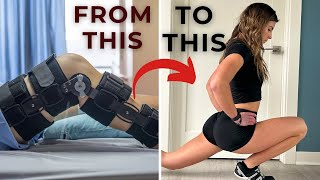
In this video, Victoria S. Dorsano shares her personal experience recovering from ACL reconstruction (performed in 2020) and outlines five practical strategies that helped her reduce chronic knee pain and regain near‑full function. She begins by acknowledging the common frustration of lingering pain after surgery and the fear that the knee may never return to normal. She then details each of the five key approaches: (1) managing inflammation through topical NSAID gels (Voltaren), CBD cream, regular icing (including an icy roller ball), and an anti‑inflammatory IncrediWear knee sleeve that uses germanium to boost circulation; (2) optimizing nutrition with ample protein, fruits, vegetables, omega‑3 fats, and whole‑grain foods to support tissue repair and lower systemic inflammation; (3) strengthening the feet and using barefoot‑style shoes to improve arch engagement and overall lower‑body alignment, referencing a foot‑strengthening program from Exercising Health; (4) continuing a structured post‑physical‑therapy “bridge” program—such as the Knees Over Toes system or a personalized strength‑and‑conditioning plan—to keep knee strength progressing after formal PT ends; and (5) prioritizing recovery and sleep, using a Whoop wearable to monitor sleep quality and active recovery. Throughout, she emphasizes that these tactics are not one‑size‑fits‑all but have been most effective for her, and she encourages viewers to experiment, stay patient, and maintain hope. She also cross‑references her other videos and her ACL education site (aclsecrets.com) for deeper dives on each topic.
Chapters
Have you had ACL surgery in the past few months, or maybe in the past year or two, and you're still experiencing pain even though you feel like you shouldn't be at this point? And maybe you're wondering if your knees are ever going to get back to normal again. Or if you haven't gotten ACL surgery yet, but you're still contemplating if that's the route you want to go, you may be hesitating a little bit because you're not sure if your knees can ever get back to 100%. You've heard people talk about the pain of the recovery process and not feeling quite the same again, and you're worried that that's going to be the case for you too. Unfortunately, these thoughts, feelings, and experiences are all too common, and there are so many people that have gone through ACL reconstruction that have been experiencing pain well after the point that they feel like they should be experiencing pain. Maybe they finished their physical therapy and they're wondering, why am I still feeling this? Why is my knee not where I feel like it should be at this point? And I want to talk a little bit about that. I want to share 5 things that I found to really significantly help mitigate the pain and help make sure that you can get back to 100% after going going through ACL reconstruction surgery, because it is possible to get back to a point where your knee feels 100% again, or at least pretty dang close to it. For those of you guys that don't know and haven't seen some of my other videos on my channel, I had ACL reconstruction in 2020 and went through a very long process of healing from that. But I was able to do a lot of self-experimentation as I was sharing my journey with other people and understanding that, hey, I'm not the only one that's experiencing, um, kind of pain when we feel like we shouldn't be experiencing pain, you know, after a certain point of maybe being done with physical therapy or not feeling like, you know, you're at where you should be at a certain timeline, right? And I started to find which things really started to make an impact and which things didn't. And what I found out is that there were 5 main things that really significantly made a difference in helping to reduce my pain in my knee and help build my knee back to a point where it was near to 100% and pretty much similar to my non-operative knee. So I'm going to share those 5 main things that you can do if you are going through ACL surgery or going through that process, or, you know, 5 things to keep in mind if you haven't gone through ACL surgery yet but you're considering, but you're hesitant because you're not sure if you can get it to 100%. I'm telling you, it is possible, but you have to find these strategies. And not all these may work for everybody, but these are the ones that I found to be the most effective for me. So the number 1 most important thing you can do throughout the ACL reconstruction healing process, and even going past, you know, the first year, pretty much for the rest of your life, is managing the inflammation. Your knee has mechanically changed after surgery, right? They've taken either some of your own tendon graft or ligament graft or tissue or somebody else's and reinserted that and created a mechanical change in the knee. And just given that, your knee is going to have inflammation right from the get-go after surgery, right? But you're also going to be more prone to having inflammation throughout your active life. And that's just because that, that way that your knee mechanically has changed a little bit. So managing inflammation is one of the biggest things that I can recommend for reducing pain and gaining back functionality. Because if you have an inflamed knee, you're not going to be able to really do the exercises that you want to do and actually put the kind of strength work and effort into the knee that you really need to, to build that strength. So managing the inflammation is first and foremost. And there's a few things that I found to be the most effective in that section of managing inflammation. The first thing is using something like a topical anti-inflammatory gel. Now, again, I'm not a medical doctor. This might be something you want to check with your own medical doctor with. This is something that I sought the advice of medical professionals and they said, go ahead, give it a go. And it worked really well. So things like Voltaren, which is a diclofenac sodium gel, that's a topical NSAID that you can put onto the knee. I use that pretty much nightly. And then during the day, I would use a topical CBD cream as well. So CBD also has a lot of anti-inflammatory properties. You just want to make sure that you're getting one that's actually like a legit CBD cream. So you might have to go to dispensary depending on the state that you're in or country if you're watching this not in the US. But both of those topical gels really, really made an impact in terms of reducing the inflammation for me on a day-to-day basis. The other thing that I cannot stress enough is icing. And I know you've probably heard that from your surgeon and your PT, and you're probably like, oh, Victoria, I don't want to ice my knee anymore. I get it. I super whiny about it too, like was not having it, but it made such an impact. And I'm not only saying ice for, you know, the duration of that time right after surgery, but it is important to ice after you've had a really hard workout that you've pushed your limits to your knee, even multiple years after surgery. Like I said, that mechanical change that you had in your knee doesn't just go away, like that's going to be there. So you're going to constantly have some inflammation that's going to be more prone to happening in that knee versus the other one. So don't be shy on icing it if you've particularly tough workout. Don't be shy about getting something like this, which is my icy roller ball, which I'll put the link down below if you're interested, which fits so nicely right in the spots of the knee that you need. And you don't have to do the whole thing on the knee, which is always great when you don't have to have a huge ice pack on your knee. But don't shy away from that either if you feel like your knee is particularly inflamed. So I cannot stress that enough. Icing, super, super important to help reduce that inflammation. So the third thing that I can recommend in the managing inflammation section of things is getting an anti-inflammatory knee sleeve. Not just any knee sleeve, but particularly an anti-inflammatory knee sleeve. So the one that I recommend time and time again and that I literally lived in for the first year, I think, after my ACL surgery, and I still put on from time to time if I'm feeling like my knee is kind of overloaded or if I worked it too hard in a workout or if it's just a little achy, is an IncrediWear knee sleeve. I absolutely love these things. I made a full video review on it already. So if you want to learn more about it, you can learn more about it there. So the unique thing about the IncrediWear knee sleeve that makes it anti-inflammatory is that it has this semiconductor metalloid substance that is woven into the fabric called germanium. And germanium, when used in combination with the transdermal effect and our own body's infrared heat, can actually create this micro electromagnetic field which can increase circulation and help to reduce inflammation in the area that it's applied to, which is super cool. I can geek out on the science of that all day. I think it's fascinating, but you won't believe it till you try it. And every person that's tried it so far that I've recommended, they're like, oh my gosh, when I put this thing on, it just kind of instantly takes the pain away. It's pretty amazing how it reduces inflammation and could just reduce pain pretty, pretty immediately. So check out my full video review on it if you want to, but that is something I recommend to anybody that has gotten ACL surgery or had any knee pain or aches and pains in general. All right, so the next thing that I found that really, really helped to reduce knee pain and help my knee get back to 100% was focusing on nutrition. I think this isn't really talked about that much. I know surgeons typically don't talk about this that much, but your nutrition is really important and can really impact how, you know, quickly or slowly your knee ends up healing from surgery. I actually have a full video I've already done on nutrition for injury recovery that's going to cover over a lot of what I'm going to talk about now in more detail, but But just to give an overview, it's super, super important to actually focus on a few things in your nutrition as you are making your way through the ACL healing process and beyond. You want to make sure that you're getting plenty of protein. Your body is creating new tissue and it needs the building blocks to do that, and protein is essential for doing that. You're also going to want to eat an array of fruits and vegetables that's going to help you get all the different micronutrients you need to help reduce inflammation, get a bunch of antioxidants from that, which is going to really help. And of course, you're going to want some healthy fats, some omega-3s, um, and then some whole grain sources. So really, you just want to try to focus on healthy proteins and whole foods as much as possible. Now, you don't have to go crazy and do like a Whole30 kind of diet style, but as much as you can get whole food sources and really prioritize getting a nice source of lean protein, some healthy fats, um, fruits and veggies, and some whole grains, and just kind of stick to the basics, it's really going to help your body get the essential building blocks to reduce that inflammation and to help continuously, uh, provide the foundation for what your body needs to form new tissue and to really heal up well. And again, I go over a lot more specifics in my other video on this. So if you want to check that out more in depth, that'll be linked down below. And I'll put a link somewhere up here in the video too. The third thing that I started to prioritize that really made a significant difference in helping my knee to reduce the pain, especially in the late stage of ACL healing too, was strengthening my feet. And this was something that I didn't really anticipate as being something that would help so much. But I started to get into the barefoot shoe space probably like a year after my ACL surgery, and I was still having some knee pain and, and really wasn't sure why. But I started to prioritize my foot health and to make sure I was having shoes that actually allowed my toes to spread out and grip the ground and engage my arches. And I started to really learn how important the foundation, which is our feet, is for the rest of our body and how that really primes the rest of our body to have good posture to load our joints appropriately and all that stuff. So focusing on foot strengthening is so crucial and has really helped me out. There's a great program I'll link down below. It's really inexpensive. It's from Exercising Health. It's a different company, so not my company, but I recommend it. I love this program, and it takes you through all the different foot strengthening exercises you can do very easily at home and help build that foundation so you can make sure that you're setting the proper foundation for your knees to heal and to take some load off the knees and really appropriately utilize feet. And if you're interested in barefoot shoes, I've also made another video on barefoot shoes and how much that's changed my life and how I am only wearing barefoot shoes pretty much from now on. So the fourth thing that has been really, really helpful to help reduce my knee pain and keep kind of knee pain at bay for even these late stages of healing, since I'm about 2 years out of surgery, has been to find an appropriate post-physical therapy program to do. So I've talked about this, I think, in some prior videos. I have an ACL course that I talk way more in depth on this topic, on. But it is so important to not finish your physical therapy at the end of your physical therapy. You should really continue on your, your physical therapy journey after you've been discharged. And what I mean is it doesn't stop at 6 months or whenever you get discharged. Usually you get discharged from physical therapy at about the 6-month mark, typically sometimes even earlier at the 4 to 6 month. You still have a lot of healing to do and a lot more that you should be doing after that point. And it's so important that you find something called a bridge program if you're an athlete that can take you and be able to take you into that late-stage ACL physical training portion, or find a strength and conditioning coach, or find a program that you can follow like the Knees Over Toes program that I've been doing that can really help to bridge that gap between when physical therapy ends and where you actually need to be for your strength and conditioning for your sport. That is so important, and working on your knees does not stop once you've been discharged from physical therapy. So that has been probably one of the most crucial things is making sure that you continuously strengthen your knees knee after physical therapy. And again, if you're interested in learning more about this, I talk way more in depth on particularly finding the right bridge program for you in my ACL course. It's called aclsecrets.com. That's where you can find it. But it is so, so, so important to prioritize that portion of things— finding exercises you can do after you've finished PT. And like I said, this is a lifelong journey and something you're going to continuously need to work on to make sure the knee pain doesn't come back and that you are building that knee from the ground up. So I digress. The fifth and last thing that has been absolutely crucial for me to reduce knee pain and make sure my knee gets back to 100% has been focusing on recovery. You guys know if you've watched some of my videos, I've talked about my Whoop. I made a video on the Whoop, and that's the tool that I've been using to really prioritize my recovery. But I found when I started to really focus on my sleep and my sleep quality and having solid recovery time and doing active recovery too, that it really helped with my knee pain and my knee healing, and it helped to kind of get rid of a lot of those aches and pains I was experiencing later on in the ACL healing process. So prioritizing sleep has been so important, and the Whoop just made it really easy for me to be able to track that and understand what, what are contributing factors to me having really good sleep and what are contributing factors to me not having not so good sleep. So highly recommend it. And again, if you want to check more on this, I have that separate video on my Whoop training and, and how I've used it for recovery and all that good stuff. Well guys, those are the 5 main strategies that I found to be the most helpful to reduce my knee pain after ACL surgery and get me back to 100%. And like I said, if you are worried, if you were in that stage where you are just worried that you're not going to get there, that you're still experiencing that pain, just know that I've been there, that so many other people have been there, and then if you work and find things that work for you, try some of these things that but ultimately find what works for you and stick to it and really nurture that practice for yourself, and you will get back to where you want to be. It just takes time and patience and some effort. So do not lose faith, because that is the biggest killer of dreams, is just losing hope and faith. And you just have to kind of stay strong throughout that process. So happy healing, folks! And as always, if you can go ahead and give this video a thumbs up and subscribe to my channel, I would greatly, greatly appreciate it. And again, if you're interested in learning more about how to expedite your ACL healing process, definitely check out my other website, aclsecrets.com. There's tons of information there for you in that course. And that's pretty much it. Until next time, guys. Bye!