My Inspiring 1.5-Year Journey to Returning to Sports After ACL Surgery
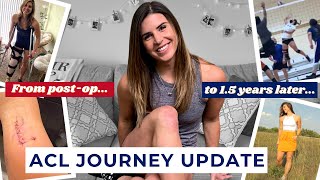
In this 20‑minute vlog, Victoria S. Dorsano recounts her personal ACL reconstruction journey from the initial tear in February 2020 through 20 months of recovery. She explains how COVID delayed her bone‑patellar‑tendon‑bone (BPTB) graft surgery, describes two early complications—a non‑displaced patella fracture and Hoffa’s fat‑pad inflammation—then details a low‑back issue that arose from compensatory loading. Dorsano walks through her rehab milestones, including range‑of‑motion work, strength restoration, and the decision to wait until 12 months post‑op before returning to volleyball at 15 months. She shares mental‑health insights about returning with humility, the importance of bracing, icing, and listening to the body, and provides a candid functional assessment (near‑full ROM, minor kneecap tenderness, calf weakness, crackling noises). The video ends with practical advice for other athletes, a summary of activities she can now perform, and contact information for further questions.
Chapters
What's up everyone, Victoria S. Dorsano here, and today I'm going to do another ACL video and share a little bit about my journey and where I'm at 20 months since my ACL reconstruction surgery. Before we dive in though, if you can give this video a thumbs up and subscribe to my channel, I'd really appreciate it. For those of you guys that are new to my channel and haven't seen my other ACL videos, I'll just give a little bit of a timeline of everything ACL-related that I've gone through in the past year and a half. So in February of 2020, I tore my ACL playing volleyball on traumatic impact. Somebody jumped into my knee across from the net, and my ACL tore midair. I do want to share more of these kind of healing hiccups, that I'll call them, um, that I experienced throughout the timeline, uh, up until the point of where I'm at now at 20 months since the surgery. I originally had surgery scheduled for a month or so after the tear, but that that was right when COVID was happening for the first time, so all elective surgeries got canceled. So I had to wait about 3 months until May of 2020 to get my ACL reconstruction surgery. I did a bone patellar tendon bone graft on my own knee, my right knee, the same knee that I got the ACL reconstruction on. And I'm actually going to do another video shortly about that period in which I was actually deciding if I was going to get ACL surgery or not, because I wasn't sure at first if that was the best option for me. But after weighing the sides of things, I decided it was going to be the best option. About at day 14 post-op, I actually think it was June 1st, I broke my patella in half. It was a non-displaced break, so I didn't have to get surgery, luckily, but I did have to lock my leg straight in that ACL brace for an extra amount of time. Breaking the patella like I did is a small complication of getting that bone patellar tendon bone graft. It happens in very, very rare cases, but mine was one of those cases that it broke while I was doing physical therapy. So once that kneecap healed up, it was back to smooth sailing with my ACL rehab protocol. I'll say another kind of healing hiccup that hit me was like 5 months post-op, and I actually got married at this point in time, and my husband and I were going on our honeymoon, and we had a trip planned to go to North Carolina and do a lot of hiking. And I had gotten clearance from both my surgeon and my physical therapist to do some hiking, but with caution. I had a sport ACL brace, so it's not the really big long one, it's actually a shorter one that you can use when you return to sport. So they cleared to get that a little sooner so I could be safe and wear that when I was hiking. So my husband and I went hiking and we went along the Appalachian Trail. I think we did a hike that was about 12 or 15 miles. So a pretty long hike and it was definitely a lot of climbing. And there were some times that my knee would buckle a little bit, but thankfully I had that Sport Brace on and it stopped me from fully buckling back. So it protected my knee really, really well. Once I got back from the honeymoon, so like 5 and a half to 6 months since my surgery, I started to experience this really strange pain in my knee. I remember laying down and my knee was all swollen, mostly laterally on the side, but around the top too, right on the top of the, the knee capsule joint, like right where the patella is at the top. And it was pretty painful when I stood back up on it. Laying down, completely fine, but I remember when I stood up and I tried to stand with full extension and really kick my knee back, it was like this really intense pinching sensation. And after doing a lot of research and talking to several professionals, both surgeons, non-surgeons, athletic trainers, physical therapists, other knee specialists, we kind of determined that it was something called Hoffa's fat pad syndrome, which I had no idea that there's a fat pad in the knee. And mine was actually pretty inflamed. And it's actually another complication of having the ACL surgery because they stick a scope scope right through, um, that fat pad. So there sometimes can be some inflammation and scarring, um, that are residual from having that scope right through the fat pad. And I think the combination of me having the broken kneecap that also healed and kind of— my kneecap's not like fully the same shape as my normal knee, um, my non-surgical knee, because obviously it had to form an extra layer of bone. So we kind of hypothesized that my knee tracking wasn't super great. The cap tracking wasn't like probably going as smoothly as it should and was kind of maybe crunching down on part of the fat pad and pinching it. So in creating some inflammation, and therefore when I straightened my leg and stood on it, it was pinching the fat pad. And the fat pad has a lot of nerves. It's one of the most innervated parts of the knees. So yeah, that would explain all the pain I was having. However, I was still able to do things like squatting and some lunging carefully. But this fat pad, you know, I really had to take it easy and kind of lay off some of the progressions in my physical therapy. And make sure I was icing it and just take it a step back again and make sure I'm not putting too much impact or load into the knee. And then we move on to the next hiccup that I experienced in these past 20 months. And this is some low back pain. And again, this is something that can be common, you know, after knee replacements or any kind of knee or joint surgeries on one side of the body because, you know, we're compensating for such a long time. If any of you guys have gone through ACL surgery, you know that you're putting a lot of extra stress on your non-operative leg, the leg that didn't go through surgery, because it's having to carry you a lot. You're, you're crutching around, but you're also kind of limping, and your hips can be a little off sometimes because you're putting more stress on one side of the body than the other. You're having all sorts of different compensation sometimes. So that's why it's really important to make sure that you're doing some of these progressive loading exercises with a physical therapist present or trained athletic trainer, because there's certain things that they can catch that you won't necessarily see in terms of those compensations. So, um, for me it was just a matter of doing a leg press one day, a single leg leg press with my right leg, the leg that went through surgery. And I remember my back just feeling kind of stiff and sore after that. And then I went home and it was really, really stiff and sore. And it's kind of been a thing ever since. Um, I think I put a little bit too much pressure into my low back because maybe my leg wasn't ready for that load again after taking some time off from having the fat pad issue in my knee. But I want to get a little bit back into the timeline because for those of you that are athletes like myself, I want to give you guys some hope that you can return to sport and things start to feel normal again. My husband and I made a deal that I wouldn't start playing volleyball until my 1-year mark, until 12 months since surgery. I know they say you can usually do it a little bit sooner, and I was cleared to do it sooner. However, with an abundance of caution. We just wanted to make sure this wasn't going to be something that we had to go through again. So at the 15-month mark, I started playing volleyball again, and it was so much fun, you guys. And I want to say to all you athletes out there, it is possible. Even with all these hiccups that I had throughout my healing journey, it is possible to come back stronger and play better and still be as competitive of a player as you were before you had your ACL reconstruction. That first day I played, yeah, skill-wise I was a little bit rusty, but I will say I was jumping really high. I was able to get some solid blocks in on the net. I was able to hit really well, and I was super, super, super happy with the way I played and how my knee functioned throughout the time of playing. I really didn't feel too much soreness or, you know, fatigue in the knee or any kind of like weird feelings. It felt very normal. I did keep my ACL sport brace on, that shorter brace I was telling you about because I just wanted to be safe. Again, it's better safe than sorry. And I think it also helped people kind of make sure not to run into me too, because that was how it happened in the first place, was somebody running into me on the volleyball court. So I think it also was kind of like a guard, like don't hit the injured girl with the knee brace. I think the most important thing about returning to sport from a mental standpoint is acknowledging that you're going to have to return with a very humble heart. There's going to be certain technique things that are just not going to be fresh and crispy for you when you go back to playing your sport. Like for me, my hand contact on the ball, on the volleyball was not good. It was, I was hitting really well, I was jumping really high, but hand contact, I was kind of like whiffing it pretty hard. My passing platform, not super crispy, not super great, but was I getting the ball up to the target? Yes, I was doing okay. So I kind of had to walk into it acknowledging that like before I walk into this volleyball court, this may be not my best game and that's okay. And, you know, giving myself that grace to just accept that this might not be my best game of play and then that's okay. And as an athlete, you are there to get better and practice and continuously, you know, take that as a challenge to, you know, work on. If you notice, like, again, my passing platform, not so great. Okay, let's work on it. Let's get it better. Now I know what I need to work on. So I just want to mention that because you do need to walk in with a humble heart and acknowledge that you might not be as, you know, great technique-wise or as sharp as you'd like to be, but you'll get there. But strength and power-wise, man, that rehab really did my body well, and I felt really, really strong, like physically strong, going on to the volleyball court. As far as after the sport, I don't think I had too much like knee stiffness or tenderness. I was pretty impressed that it wasn't, you know, achy or anything like that. I did make sure to ice it it after going back to play because again, I didn't want to risk having inflammation or anything that was going to bother it the next day. So I did make sure to ice it as soon as I got home and really treat it well. So I just want to give a little bit of range of motion updates about where I'm at now. Full flexion, full extension, like zero issues with being able to move it around. I never really had too much of an issue with my range of motion other than when I had the Hoffa's fat pad inflammation going on. Aside from that, I really had pretty good flexion pretty soon after surgery and really tried actively to get that range of motion the best I could and was very, very on the ball with passively moving my knee after surgery and trying to make sure that stiffness would not be something that was gonna be going on with my range of motion. But I will say this, that my range of motion before surgery in, my knees and my joints in general is pretty good. I'm a double-jointed person, or, you know, for the proper terminology, I have very lax joints. My, my, my tissues are very, very stretchy, probably to a bad point. Again, I have like very stretchy joints. My shoulders can pop out very easily. So I think that's something to take into consideration, that I had really good, if not like hypermobile knees before the ACL reconstruction. So I think that also factored into how my range of motion was really good after the surgery as well. As far as where I'm at with how my knee feels on a day-to-day basis, I'd say it's good. Most days I forget that that was a knee I had surgery on, minus the fact that it is very crackly. It makes a lot of noises without pain, but it literally sounds like somebody is like popping bubbles. It's really gross to me, and a lot of people, like my husband, when I do it, he's like, oh, it's not a good sound. Um, but again, it doesn't really hurt. It doesn't really like limit my strength at all. Um, I think it's a very normal thing. I've talked to a lot of people that have gone through ACL surgeries, and for years and years and years after, they have that cracky, cracky kind of noise or crackling that's going on. But that is something that I do have. I'll say, like, as far as the ACL and inside the joint, it feels great. I don't feel any limitations on that side of things. As far as the kneecap goes, and this is where it's hard for me to differentiate all the time because I'm not sure what's like a normal ACL thing versus what's a thing that I'm, I'm having to experience because I broke my kneecap in half. It's hard to tell. I do have some like tenderness on the kneecap when I try to do anything like single leg loading where I have a high degree of flexion into the knee and I'm putting a lot of frontal, frontal pressure into that kneecap. I will start to feel some tenderness on the kneecap. It's hard for me to differentiate if it's the site where the graft was taken out or if it's the site where my kneecap broke in half because they're really close to each other. So I don't really know. I'd say on a pain scale it's like 1 out of 10 or a 0.5 out of 10 when I'm doing anything where I'm putting it into really full bends like that, but it's very minimal. As far as my strength on my leg, I'd say my strength is pretty much back to normal in terms of my quads. They're pretty much equaled out. I'd say my hamstrings are the same. I do have a lot of calf weakness on that operative leg, on my right leg, because that calf got torn pretty bad. So it's like a baby calf now. It's like very tiny in comparison to my other one. So that's where I'll say like most of my weaknesses is in that calf on the right side, but that's because again a separate issue, not because of the ACL surgery. The quad fully back to normal, full strength. Glute, hamstring, full strength, happy about that. And as far as like where I'm at mentally with this whole ACL recovery at month 20, um, you know, close to the 2-year mark now, I'll say I'm good. I'm good. But having to experience these other things like the kneecap breaking and Hoffa's fat pad inflammation, and now having my low back— I'd say my low back issues, um, from having so much compensation going on, you know, and recovering throughout this whole process. That's probably the most irritating right now, and it kind of feels like a never-ending string of like minor issues in comparison to the ACL, but nonetheless issues. So it's a little frustrating, I'm not gonna lie. And there's times where I wonder, am I ever gonna feel like fully 100% because I'll say maybe 95, 96% in terms of like how my whole body is functioning overall, because the knee affects so much in our bodies, right? You can't just look at the knee and be like, the knee and I'm 100%. No. If I was just rating the knee, I'd say I'm probably at like 99% with just a little of that frontal kneecap pain. But because of the weakness in the knee and having to heal through that and compensate so much and what caused caused that low back pain and all those things, I'd say it brings me back down to a 95%. But I'm happy with that. Like, if that's the best it gets for me, that's okay. I'm okay with that, um, because I can adjust what, you know, my daily activities are. I can still play my sport. I just have to, you know, be a little bit careful about the movements that I do. And honestly, again, going through these other injuries. Like, I really think that it's forcing me to look at my body and my compensations and how I move in a very different way, and helping me to really build up proactively a lot of the weak spots in my body. So I'm thankful for it. It does hurt, but I'm thankful for it. Um, but I'm grateful to be on the other side of this, and I hope this just gives you some light at the end of the tunnel that you know, you can return to your sport, um, you can feel close to 100%, and you know, you'll get there. And to share a little bit about the activities that I'm able to do, pretty much everything. The only things I haven't done yet because I haven't been able to find anybody to play with me is like tennis. I'd really like to play tennis and see how my knee does there. I probably will still wear my ACL sport brace because it's a new activity that I haven't done yet. And again, just being, being cautious, that's all. Um, I've biked, I've hiked. I went on a hiking trip again, um, a few months ago, so maybe at like month 15 or 16, and hiked about 20 miles, I think it was. It was a long, long hike in Colorado, and my knee felt great. I had no issues afterwards. Um, what else? And that was through like some pretty icy terrain. I've played volleyball, I've played basketball, I've done ice skating. I've pretty much like done all the things that I want to do activity-wise, and I'm really, really, um, again, happy that I'm here on this side of things. And I know you guys will get there too. So I hope this just provided you again some insight as to what's down the road for you. And if you have any questions, of course, drop those questions down below. Reach out to me. If you follow me on Instagram, it's @victoria_s. Dorsano. You can message me there. And connect with me there. But really excited that you guys watched this video, and I hope it provided some insights. And please make sure to subscribe to my channel and give this video a thumbs up. I'll be doing more videos on my ACL journey, some things that I did along the way, some different things that I'm doing now and will continue to do moving forward to keep my body functioning and feeling well after ACL surgery down the road. So I'd love to share those with you. Just be sure to subscribe. And until then, I will see you guys later. Bye!
More from Victoria






3 things you should do to make sure you get the most out of your fish oil #legion
