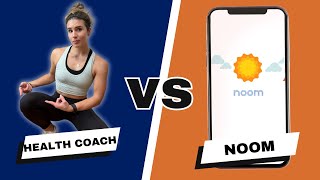
In this video Victoria S. Dorsano compares the Noom weight‑loss app to working with a professional health coach. She first explains what Noom is—a calorie‑counting, daily‑weigh‑in app that provides basic behavior‑change education. She then outlines three major ways a health coach differs from Noom: (1) Noom’s calorie targets are generated by an algorithm without professional review, which can ignore an individual’s set‑point range, metabolism, and realistic goal weight; (2) Noom encourages indefinite food tracking and daily weigh‑ins, which can turn food into a cold numeric exercise and cause psychological distress, whereas a coach may use short‑term tracking and limit weigh‑ins to weekly or less to avoid obsession; (3) Noom does not account for the nuanced, personal lifestyle factors (work schedule, family responsibilities, stress, sleep, etc.) that a coach can integrate into a customized plan. Dorsano argues that for busy professionals or people with complex lives, the personalized, holistic approach of a health coach is more sustainable and effective. She concludes by inviting viewers to apply for her coaching services and encourages likes and subscriptions.
Chapters
What's up everyone, Victoria S. Dorsano here, and today I want to share with you guys 3 differences of what it's like to work with a professional health coach versus something like Noom. And if you don't know what Noom is, we're gonna get into that in a second. But before we do, if you can give this video a thumbs up and subscribe to my channel, I would greatly appreciate it. I'm sure you've probably seen some of the Noom ads already on social media or circulating on Google or wherever you might be browsing the web. But if you're not familiar with Noom at all, here's what it's about. It's basically a weight loss app that encourages you to count your calories, do weigh-ins, and also provides you a little bit of education along the way in terms of behavior change. So what happens is when you sign up, you enter in your current weight, your activity level, any kind of chronic diseases, your motivation level to lose weight, any previous diets that you've done before, and just kind of your general background information about like where are you at now, that sort of thing. Then you enter in your goal weight and the pace that you'd like to go at in terms of losing weight. And then from there they give you a calorie target to reach. So here's where we run into difference number 1 between Noom and a professional health coach. The calorie target provided by Noom is not reviewed by a professional. It's produced by an algorithm, and this can be really dangerous because there's no discussion around set point range, like where your body tends to like to be weight-wise, um, even a goal weight range rather than a goal set point, because our bodies do fluctuate day to day depending on water balance, salt intake, all those things. So just having an algorithm spit out something to you that might not necessarily even be realistic for your body frame, your set point range, where your metabolism is at, all those things. And there's really no discussion around what your lifestyle is going to have to look like to get to that goal weight that you've set. And that's a problem too, because you might have a goal weight in mind that A, might not be sustainable or realistic to your body and the way that it's structured and what your lifestyle needs are currently. And there's really no discussion around what your lifestyle might have to adapt to look like in order to reach that goal weight that you've set into the app. And without the understanding of, you know, let's say you set a goal weight that's much lower than what a professional would recommend, you're gonna have to restrict your calories to a certain point that's not necessarily gonna be healthy. And that's kind of what Noom does. So if I go into the app and I set my goal weight to something that's, you know, significantly less than what I'm at now, it's not even going to have a discussion with me about if that's healthy, number one, because if I enter a weight that's like, let's say, 30 pounds less than I am now, or 40 pounds less than I am now, that's not going to be healthy for me at all. And it's going to recommend a really, really low calorie intake, which isn't going to provide me the daily energy needs I need to, to feed my organs and keep my body functioning and even just keep up with my basal metabolic rate, which will eventually have adjust down to keep up with the low food intake. So it can be problematic when this isn't reviewed by a professional, much more professional that will take the time to understand the basics of how your body functions and what actually is a healthy goal range for your weight loss journey. So as you move through the NuMap, then it basically encourages you to track all of your food, and it uses a, a stoplight system like red foods yellow foods and green foods, which I don't necessarily agree with, but I'm not going to get into in this video because it's going to take me too long to explain that. But it has you track all your foods in there and then weigh in daily. And this is where we run into difference number 2. When working with a professional health coach, you may incorporate some food tracking in the beginning for a few days to maybe even a few weeks, depending on your background knowledge with food tracking and if you've done it in the past. If you're somebody who has done extensive food tracking in the past through through various apps like MyFitnessPal or Lose It or any of those things, then you have a pretty solid knowledge base to pull from where you know, you know, how much protein might be in this or how many calories might be in this. Sometimes, not always the case, but rarely do I ever recommend doing food tracking for the entire duration of ever. And that's kind of what Noom is a proponent of. It's having you use this app indefinitely to track food, which can really start to put food in this category of like numbers and something that's cold and calculated versus something that's nourishment for the body. And it can start to distort that relationship that you have with food over time, which is why that's not something I recommend doing in the long run. But Noom does. So that's a big difference, uh, between working with a professional health coach like myself versus an app like Noom. And the other aspect of this is the daily weigh-ins. Now, as a health coach myself, I I never recommend daily weigh-ins because it can start to discourage a lot of clients sometimes because our weight can fluctuate as much as 5 pounds within a day due to water in our body or even a bowel movement, you know, that we haven't had that day. But usually it's just the water fluctuations in our body from, you know, increased or decreased sodium intake. Hormones can, you know, affect the amount of water that your body's holding on a given day. There's so many different variables, humidity, all that stuff. So There's a lot of different things that can affect how your body's holding on to water. Even eating carbohydrates will do that. Uh, so that's why a lot of people, if they have like a slice of pizza the night before and they step on the scale the next day, they'll realize like, wow, my weight bounced up a little bit. It's not because you immediately gained weight from the pizza, it's that your body's holding on to extra water because of the carbs in the pizza. That's all. But that's why daily weigh-ins can psychologically be a deterrent to somebody's progress, or at least feeling like you're successful in the program. Because if you're constantly seeing the scale go up and down and up and down, up and down, it can feel really like kind of chaotic in that journey. So I never recommend doing daily weigh-ins, weekly at most, because then you can get a true look at progress over time without getting obsessive about the scale. And lastly, difference number 3 is that Noom doesn't necessarily take into account all these really individual lifestyle factors, you know, especially if you're a working professional that's a mom that has a bunch of mouths to feed at home and you're making food for the kids and you have to make yourself a separate meal, but you've already worked a full day. What can you throw together really quickly? Is it okay to have some of these more nutrient-dense foods? And Noom's gonna categorize them as a red food. Like it gets really messy if you're not talking to somebody and really working through solutions that are gonna be unique to you and your environment and your personal stressors and your sleep hygiene and everything that goes into health. And especially with weight loss, there's so many different factors that are variables in that, that working with a professional health coach, you can really hone in on each of those variables and start to make decisions and choices based on those and adapt your lifestyle accordingly. And because it's not just about what you're eating and the food you're tracking and how you're weighing in and the exercise you're doing— those are two factors, but there's there's so many more to account for that you don't necessarily get to touch base with in Noom, but that you would get to work on if you're working with a health coach. And here's the other thing about that too, that if you have dysregulated boundaries around your work life and work keeps seeping into your personal life and you're not having time to go to the grocery store, have time to do any of the things or prepare the meals or, or eat the right things that Noom's telling you to eat, you're not going to be able to follow suit with it, right? So that's where, again, having that personalized touch of working with a professional health coach can really be beneficial because you're getting somebody to help you maybe look at that work-life balance, look at where some adjustments can be made, maybe some, some aspects that can be worked on to increase efficiency in your work life so that you do have that time reserved left for going to the grocery store and built into your schedule to do that and to cook those meals or to make healthy choices when you're going out and you have those energy reserves. Because if you're just topping on calorie tracking and weight tracking and trying to fit in exercise onto already a packed lifestyle system, or maybe even like a fractured system, a system that's not working for you and it's creating extra stress, it's just not going to work. So sometimes you have to go down to the basic foundation of like lifestyle stuff before you add in the component of food tracking and the stuff that Noom does. So that's where a benefit of working with a professional health coach can really come in, is when we can take a look at that personalized foundation that works for you. So those are the 3 differences I wanted to point out because Noom is everywhere and it may work for some people, but I think there's a lot of cases where, you know, a lot of us that have more complicated lifestyles or busy working professionals, we need more of that personalized touch and somebody that's really gonna understand and get onto the ground level with, with you and really look at everything that's going on and start to categorize and organize those pieces so that the whole picture is organized to your goal of weight loss or decreasing stress or whatever it might be. In this particular video, we're categorizing this as weight loss, right, because we're comparing it to Noom, which is a weight loss app, but it can be so many other things. I hope that provided some clarity around some of the differences that you can expect when you are working with a professional health coach versus using something like Noom, and Noom might be right for you. But there are a lot of cases where somebody's going to need more personalization and some understanding of your unique lifestyle and your unique personality to make those adaptations for you so that everything is designed specifically for you. And that's where working with a health coach like myself comes into play. And if you're interested in considering working with a professional health coach like myself, go down to the description down below. I have a link where you can fill out an application for coaching. We can hop on a call, get to know each other, and see if that might be something that's up your alley. So I hope you guys found this video educational, informational, and you learned something from it. And if you haven't already, please give this video a thumbs up and hit that subscribe button so you can stay up to date with all the awesome content I've been putting out lately. And until then, I will see you guys later. Bye.