Red Light Therapy Changed Everything - My Honest Results
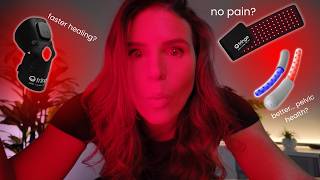
Victoria S. Dorsano reviews the Fringe red-light therapy wrap after 4-6 weeks of daily use. She saw a 75% reduction in calf pain, muscle soreness dropped from three days to 1.5 days, and joint inflammation decreased. The device costs around $230 and runs 20-minute sessions.
Chapters
Welcome to the channel. Did you know that a technology originally developed by NASA has now become one of the new wellness trends that is touted by professional athletes, celebrities, and other wellness folks alike? Well, you better believe it. Red light therapy promises everything from faster recovery to reduced pain to better sleep to even better skin. But in an industry flooded with expensive gimmicks and random cure-alls, is this just another one of them, or is there genuine science behind the glow? Today I'll be talking a little bit about this fringe red light therapy wrap in particular and my experience with using it for the past month or so. In the end, I have some fairly surprising results to share that I think you'll find interesting. So stick along with me in this video to find if red light therapy deserves a spot in your recovery routine or if your money would be better spent elsewhere. But before we dive in, don't forget to hit that like button and subscribe. Red light therapy has definitely exploded in popularity over the past few years, from everyone in professional sports teams to celebrities swearing by its benefits. But its history actually dates back to the 1960s. When a Hungarian physician accidentally discovered some interesting effects while experimenting with low-power lasers. In 1967, Dr. András Mester at Semmelweis University was testing if laser radiation might cause cancer in mice. He shaved the hair off their backs and exposed one group to this low-powered ruby-colored laser and then waited for the results. So not only did these mice not end up developing cancer, but they actually ended up growing their hair back faster than the untreated group. Dr. Mester ended up calling this laser biostimulation, and it became the basis for what we now know as photobiomodulation, or red light therapy. Since those early accidental findings, research has expanded greatly in the area of red light therapy. Over 5,000 peer-reviewed studies have investigated its effects, revealing that certain wavelengths of red and near-infrared lights can actually penetrate the skin and have beneficial effects at a cellular level. But with any promising therapy, understanding the actual science behind it is crucial, especially with so many different products that flood the wellness market, making all these sorts of wellness claims each and every day. So what does the research actually tell us about how red light therapy works? Let's dive into the science of these glowing red panels. Red light therapy, also referred to sometimes as photobiomodulation or low-level light therapy, uses specific red and near-infrared wavelengths to stimulate cellular processes in the body. The key wavelengths that researchers have found most effective are around 660 nanometers for red light and 850 nanometers for near-infrared light. These aren't random numbers. These are specifically chosen because they can penetrate through the skin at different depths. So here's what happens when this light hits your cells. Inside our cells are mitochondria. They are those powerhouses that generate energy. These mitochondria actually contain an enzyme called cytochrome c oxidase that absorb red and near-infrared light. And when this happens, it triggers a series of reactions that do the following. It increases ATP production, which ATP is like the energy currency of our body. It creates low levels of reactive oxygen species that act as signaling molecules. It releases nitric oxide, which improves blood flow, and overall it reduces inflammation and oxidative stress. But here's something actually really interesting from the research papers is that there's this biphasic dose response, which is a little light therapy can be good, a little more can be better, but too much can actually be worse. This is why the intensity of the light measured in milliwatts per square centimeter matters just as much as the wavelength. The sweet spot for intensity tends to be somewhere around 20 to 40 milliwatts per centimeter squared, which actually mimics the natural intensity of sunlight. And guess what? That is exactly the intensity that the Fringe Light Wrap delivers. First off, I want to go through a little bit of the specs, and then I will go into my personal experience with using this wrap. So if you want to skip to that portion, by all means feel free to, but I'm going to go over a little of the specs of this particular device because I find it interesting how they aligned their specs and the amount of light delivered to align optimally with what research supports. So when you get your Fringe Wrap, it comes in this beautiful box. I will say the packaging was really well made. The whole experience of unboxing it felt very luxurious. It kind of reminds me of when you're unboxing like an iPhone or MacBook. So you end up getting the wrap itself, the adjustable Velcro strap, a USB-C charging cord with the adapter, and a user guide. So this is a 60-watt wrap with 120 medical-grade LED lights. Each light actually contains 3 LED chips, giving you 360 LED chips for really uniform coverage. Like I said, the wavelength distribution is also very, very important. It uses both the 660-nanometer red light and the 850-nanometer near-infrared light in a 1:2 ratio. This means for every 1 red light chip, there are 2 near-infrared infrared chips. This is a very intentional design because near-infrared actually penetrates deeper into the tissues than red light does, which allows the near-infrared to work into the muscles and the joint tissues while the red light can address more surface areas on the skin and slightly superficial tissues underneath. The light intensity, which I mentioned before, is very, very important in a red light device, falls in that like 20 to 40 milliwatts per centimeter squared range. So if you guys remember me talking about that biphasic dose response, this is where this comes into play, and this is why it's so important. The intensity in their device falls right in that therapeutic range. The wrap itself is made of water-resistant neoprene that's flexible enough to contour to different body parts. I've used it on my knee, shoulder, back, thigh, ankle. I've laid it over my face. Honestly, probably most body parts I've put it on. Not like that, but you know what I mean. The one I have measures around 16 by 8 inches, so it fits on most areas that you need it to fit on. They do have an even larger wrap that you can get that is much longer and can cover more surface area if that's something you're interested in. It has a built-in rechargeable battery that allows you about 3 to 4 uses before you to recharge it, and each charge takes about 3-ish hours for it to get back to full power. There's also a really, really simple control panel on the device to change the brightness if you want it at half brightness or full brightness, and a built-in 20-minute timer, which again is shown to be the optimal time for treatment on any given body part. Basically how it works is you hit this power button here, hit that on, hold, turns on, and then there's this other setting here to decrease the brightness 50% to 100%, 50%, 100%. So that's pretty much that. It's very bright. I do not look at it directly. It is very strong. So I don't know if it probably won't come off on camera how bright this thing is, but like I can't look at it directly. It will blind me. But the key is really having it right next to the surface of your skin. So you don't want to put it over clothing. You want to have those LED chips as close to the skin as possible. To allow for the greatest penetration of that red light and near-infrared light. And this one's for the gals out there watching this. It is amazing for cramps, like incredible. For optimal results, Fringe does recommend using this device daily on the problem areas that you want to address. I've certainly found it to work best when I use it consistently, but it's not a hassle to use consistently, which is nice because you basically just strap it on, you can walk around with it, turn it on, and because of the automatic timer on it. It shuts off when it hits 20 minutes and you're good to go. I've used it to prep my muscles before a workout. I've used it right after a workout to help speed up recovery. I've used it when I've been feeling extra sore. I've been using it when I feel like I've been having some like joint tenderness, joint issues, or even nerve pain. It's just been a godsend. They also have different types of devices aside from wraps too. So they do have the face masks, they do have light panels, they do have this really cool looking like vest that you can wear for shoulder and neck pain and some other cool like modalities with red light and infrared light therapy in them. So I think, you know, there's plenty of different options to choose from that will fit, you know, your needs and like your body part that you want to use it most optimally for. So I want to dive in and share a little bit of my personal experience talking about this Fringe Wrap in particular that I've been using for the past like 4 to 6 weeks-ish at this point. I've had some pretty great results. I'm not going to lie. I wasn't anticipating that because Again, like I said, I'd used some red light therapy devices in the past, didn't really feel any difference. Mind you, it was like the face mask, so I was anticipating more of like a skin benefit, and I don't think it was really like up to standard with the right intensity and wavelengths and all the things that it should be. So that being said, this was a totally different experience. Um, I had been experiencing some nerve pain in my calves and shins due to the saphenous nerve being irritated. It's not fun. And every time I would play volleyball on hard court, I was almost not able to walk afterwards for 20 to 30 minutes because of this nerve irritation happening. It was so painful. I had been going to PT for months, probably the better part of 4 months, and wasn't really able to get much progress on that. So, you know, when this opportunity came along to try this out, I was like, you know what, I'm going to wrap this on my shin, see how this feels, along with trying it on my knee, my quads, and shoulders and things that I'm using a lot when I'm strength training and playing volleyball to just recover faster. So the first thing I noticed, I will say, is after about a week of consistent use with it on my calves, my nerve pain was like drastically improved. Like I'm talking like 75% improved to the point where I was just getting little twinges here and there occasionally when playing volleyball, but nothing nearly close to what I was experiencing before. That was number one, what I noticed. Number two was when I was noticing in larger muscle groups that I was using for like big strength workouts and lots of volleyball. And putting that on after my workout, I felt like I was not getting nearly as sore as I normally would. Like it would normally take me about like 3 days to kind of flush out all the soreness. This was only taking me like a day and a half. So I feel like it was just helping me get not as sore and process through the soreness a little bit faster. And then lastly, I will say from like a joint standpoint, for my knee, like having some achiness and inflammation if I've pushed myself too hard, it seemed to really help that as well. But I'd say like the most marked improvement was definitely with the nerve pain that I was having. That was pretty incredible. I'm not going to lie. Overall, though, I was pretty floored about my results. Like, I was not anticipating that in the least bit. I mean, if you are somebody that is considering a different recovery modality and want something to help expedite healing and get through some sore muscles a little bit faster and, you know, especially if you're having nerve pain, at least from my point of view and my perspective, it seemed to really, really help. And I haven't even gone into the skin benefits, but apparently it's really great for like wound healing. So I could see this being a great device for if you have gone through ACL surgery recently. Like, I wish I had this sooner because it would have helped heal that tissue a lot faster, number one, like the skin tissue, the scar tissue, and help heal that wound from, from the surgical incision. But I think it would have helped a lot with decreasing inflammation a lot sooner in the game. It's also worth noting that this device from Fringe is FDA registered specifically for pain relief and blood circulation, meaning increased blood flow. So I do think in particular this brand Fringe has done a great job in following like the qualifying markers for this to be considered a therapeutic device that delivers the appropriate dose of like red light and infrared light and the specific correct wavelengths and intensity for it to really be beneficial. So overview, just a quick pros and cons list because I know some people might have skipped to this side just to get a quick gist of Summary of what I've just said in my personal experience as well as the specs. Pros: science-backed specifications. I think Fringe has done a great job in following the science, the research, and making sure that its device is built up to those standards. Number 2, the versatile design with their wraps, whether it be this one or their XL wrap. It's built flexible enough and with a long enough strap that you can really utilize it for multiple body parts. 3, the convenience of the timer is amazing. You just turn it on, don't really think about it, it turns off at the appropriate time of 20 minutes for the best dose response, and you're good to go. 4, has a pretty good coverage area. Even the smaller wrap that I have, 16 by 8 inches, it covers enough of your body and different body parts where it's going to be beneficial. Number 5, the safety features. It emits zero EMFs at its contact distance and has minimal light flicker. And 6, quality construction. It's built very durably. You can tell, especially with that water-resistant neoprene. It's built to last. Okay, so let's talk about some of the cons. Number 1, at around $230 for size wrap that I have, it's a little bit of an investment. While it's definitely cheaper than getting professional treatments over time, it's still a decent cost upfront, but totally worth it in my opinion. Con number 2 is the charging time versus the use time. The 3 to 3.5 hour charge window needed to get about 3 to 4 uses means you just have to plan a little bit in advance to make sure that you are getting it charged and ready for when you want to use it. Number 3, as much as I wish that there was a full body suit version of this, there's not. So if you want to cover multiple areas of your body, you're gonna have to, you know, move it around. And again, with only 3 to 4 uses per 3 to 3.5 hour charge, you're only going to be able to get like 3 to 4 body parts in before you have to charge it again. So that's a little bit of a bummer. So who would the Fringe red light therapy wrap be best suited for? In my experience, I definitely think this would be great for athletes and fitness enthusiasts. If you're regularly pushing your body and need to recover faster in between sessions to perform better, this is going to be definitely something that can give you that edge in recovery. Number 2, people with chronic conditions that cause pain. If you have chronic joint pain or arthritis arthritis or recurring muscle issues, then this can definitely bring some significant relief. Number 3, those recovering from injuries. Like I said, I wish I had had this sooner when I was going through my ACL recovery process. I think this can be a great tool for increased wound healing speed and for, um, decreasing inflammation when you are going through post-operative care, but not even post-operative, like just injury in general. I think this can be great for that. And number 4, busy professionals that are just looking for efficient recovery may not have time to make it to a bunch of PT sessions. Throughout the week. While physical therapy can ultimately be a great tool in the toolbox, some folks just don't have the time. And while yes, they should probably consider making the time, this can be an alternative for some instant relief. So is it worth the investment? I think it absolutely is. Again, for the time and energy that I personally spent in physical therapy and trying to resolve these nerve issues on my own and, you know, just all the other things that I put my body through, I think this red light therapy wrap is 100% worth it, and I am considering getting many more. So huge fan. So there you have it. There's a little bit about the history of red light therapy and its benefits and the science behind it, along with my review of using the Fringe red light therapy wrap. Unlike other wellness products out there, this one actually seems to have the science that backs up its claims, and I personally noticed a difference in my own recovery. So if you're interested in trying it out, I've left the links down below in the description, and the company has also provided added a special discount code for my viewers, so you can use code DORSANO10 for an extra 10% off. So I'm curious, have you tried red light therapy before, or do you have questions on how to make it work for your specific situation? Drop a comment down below, I'd love to hear from you. And guys, as always, if you found this review helpful, please give this video a thumbs up, subscribe to the channel. I greatly appreciate it. As always, thanks for watching, and I'll see you guys in the next one. Bye!
More from Victoria






3 things you should do to make sure you get the most out of your fish oil #legion
