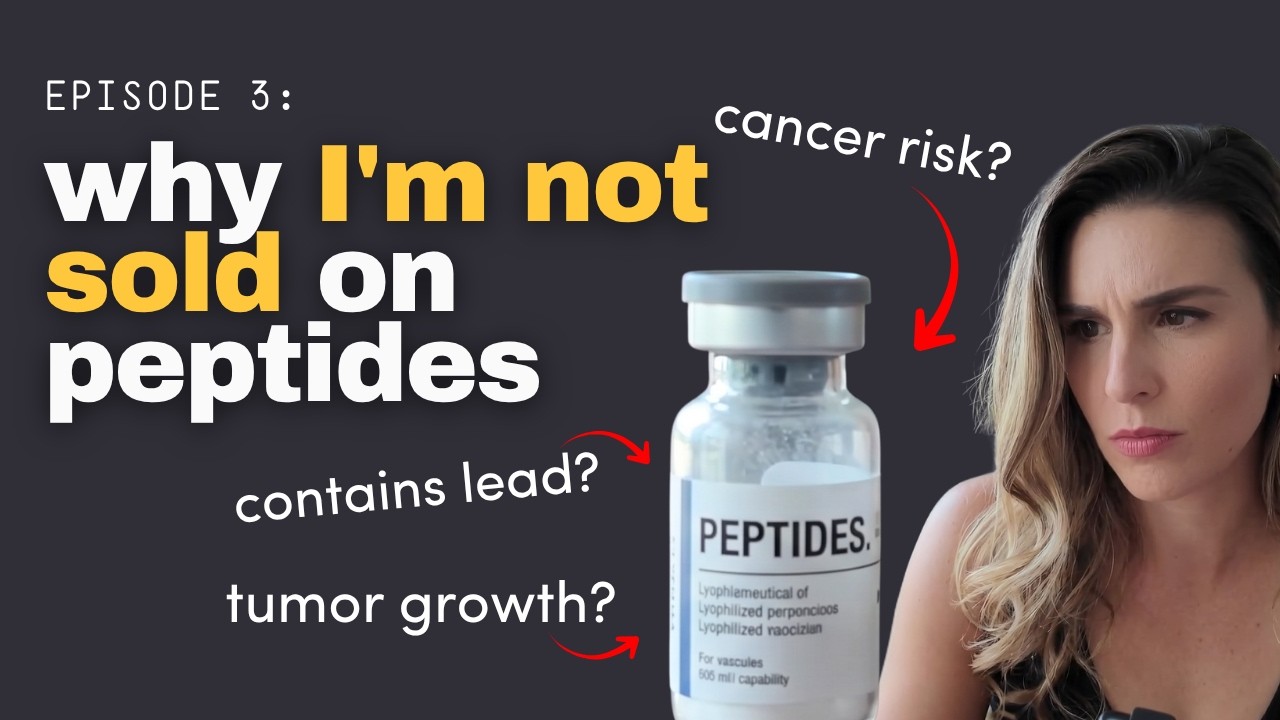
In this third episode of a four‑part series, health‑coach Victoria S. Dorsano investigates the risks of using gray‑market, non‑FDA‑approved peptides such as BPC‑157, TB‑500, ipamorelin, and growth‑hormone‑inducing peptides. She begins by recounting a personal experiment where a vial purchased online, advertised as containing ipamorelin, was found by an independent lab to contain no peptide at all but instead toxic heavy metals (arsenic and lead). She then outlines three main arguments against personal use: (1) the scientific evidence base is extremely limited—human studies involve tiny, uncontrolled samples and are dominated by a single research group, with no independent replication; (2) there are plausible safety concerns, especially cancer‑related risks due to angiogenesis mechanisms, as well as potential immune reactions and contamination with endotoxins or heavy metals; (3) the supply chain is unreliable—over 40% of tested research peptides are mislabeled, certificates of analysis are often self‑issued, and purity does not guarantee safety. Dorsano also highlights the financial incentives driving influencers and vendors to promote these products, noting commission structures up to 30%. She concludes that she will develop a personal decision‑making framework—balancing pros, cons, and risk‑reward—to be presented in the final episode, and encourages viewers to subscribe for the conclusion.
Chapters
So I recently watched a video from The Guardian and I watched this journalist order peptides online and actually take them to a laboratory to get tested. So I'm going to send these and we'll see if they are what they claim to be. And the lab results turned up that there were no peptides in that vial. Absolutely none. Wow. There is zero ipomeren in it. 0% detected. But you know what was in the vial? Arsenic and lead. Welcome back to episode 3 in my series of Should I Be Taking Peptides, where I'm personally exploring the pros and cons of me personally taking gray market peptides and whether they're actually right for me or not. Like I mentioned, this is episode 3 in a 4-part series. So if you haven't seen the previous 2 videos, definitely check those out and make sure you subscribe and hit the notification bell to tune in for the 4th video where I will be revealing my final decision if gray market peptides are something that I'm willing to try myself. Quick but important disclaimer I want to to add about this video that this is a personal exploration for educational purposes only. By no means is this medical information for you to use. I am a health coach and not your doctor, simply my own personal exploration of the topic and making that decision for myself. Now, if you're new here, again, quick context of what peptides are. They are just short-chain amino acids, and some of them are genuinely incredible FDA-approved medicines like insulin, which is a peptide, or Ozempic and Wegovy, which we all know are also peptides. But this category of peptides is not what I'm talking about. I'm talking about the gray market, non-FDA approved peptides. Things like BPC-157, TB-500, retatrutide, ipamorelin, you know, all those ones that all the longevity and biohackers on the internet have been talking about. And also the ones that people are buying online in vials that say for research purposes only and not for human consumption and continuing to inject themselves with it. Sketchy. But if you listen to my last video, also tempting. And I want to be fair from the jump, I don't think that people who are doing this are stupid. I know a lot of very, very intelligent, incredibly, you know, well-studied people in my field and in my circle that are currently taking these peptides. There are real cases where the pros outweigh the cons for each individual person that I know, and the mechanisms behind them are biologically plausible, and a few of the early results are genuinely intriguing. So if you want to hear about some of these arguments for peptides, check out episode 2 in the series. But in this video, I'm particularly going to build my case against taking these peptides and why that might not be a good idea for myself. Argument number one here is that there really isn't proof that these work in humans, or at least there's not strong proof or enough proof. Again, take BPC-157, which is kind of like the flagship peptide for healing injuries. The headline selling point for this one is that there was a human study where about 87% of knee pain patients got relief from it. Sounds pretty compelling, right? Until you really take a look at it. The study was comprised of 16 people. There was no control group or no placebo. And when you zoom out to the entire human evidence base for BPC-157, that's around 30 people. For something that the internet treats like a miracle molecule, there's not much really there proving that it works from a science perspective, that is. Of course, there's anecdotal stories and those matter, but science is science. But even beyond that, when people say in particular there's a lot of research on BPC-157, unfortunately about 80% of those studies came from one single research study group, and no independent researchers outside of that group have been able to replicate those studies. Now, going back to one of the arguments I made in the previous video, episode 2, where I argued the case for using peptides, a lot of people will say, hey, nobody's gonna pay for these studies or fund these studies because, you know, you can't patent naturally occurring peptides like BPC-157. You're not able to do that. So if you can't do that, you're not gonna make money off of it. So if there's no money incentive, Who's going to pay for this research? And yeah, that's true. Things like BPC-157, its sequence has been public since the '90s, so there's no real patent to own on that molecule itself. But just because you can't patent the molecule does not mean that you can't make money off of the compound itself. To be precise, peptides are absolutely patentable. Take Ozempic, for example. It is a GLP-1 drug that has been structurally engineered into Ozempic essentially, and can be patented. Things like BPC-157, on the other hand, the knowledge about the structure is publicly accessible and has not been structurally engineered in a way where it can be patented. But not being able to patent the molecule and not being able to make money off of it are two separate things. A company can still patent a specific formulation or a delivery method or a specific use, or just tweak the chemical structure in a slightly new updated version. So while the incentive to study BPC-157 is weaker, it's not completely out of the picture. So there is money to be made on researching and proving the effectiveness of these other peptides. It just hasn't been done yet. My second argument here is that there are real risks to utilizing gray market unregulated peptides. The big one I can think of, and a lot of other medical professionals on the internet agree with, is cancer. For example, the reason why BPC-157 heals so effectively is that it initiates a process called angiogenesis. Essentially, it's helping your body grow new blood vessels to damaged tissue, which sounds great, but the problem with growing a new blood supply to tissue is that is exactly how tumors are fed and how they continue to proliferate and spread. And the receptor that BPC-157 works through is the one that's dysregulated in about 50% of cancer cases. But I wanna be fair here because BPC-157 has very limited human data, so there's no direct study proving this correlation or associating this correlation to be true. This is just a flagged mechanistic risk across the medical community. But like I said, even scientists and doctors have been saying if you have any sort of cancer history or familial cancer history or risk of cancer, stay away from that compound. But not to single out BPC-157, I want to talk about some of these other peptides too, especially the growth hormone peptides, you know, the ones that are sold for solid recovery and anti-aging and the things that, you know, push up things like IGF-1 and of course upregulate your own growth hormone production. Yes, these growth hormone-inducing peptides might be helping you put on a little bit muscle and recover a little bit faster, but there's no proven longevity benefit, and there's still a risk of tumor acceleration. And beyond those cancer risks, we haven't even talked about the possible impurities in some of these peptides. And unfortunately, some of the impurities in these peptides can teach your immune system to attack the peptide itself, or in rare cases, your own healthy proteins that might look similar to the peptide molecule. And another layer of that, if you compete at any serious competitions, things like BPC-157 and TB-500 are banned, particularly by World Anti-Doping Agencies. Now I'm an athlete myself, but I'm not competing at that level where I'm getting drug tested. So that's not necessarily a risk for me, but still worth mentioning. Now, the third argument I wanna make here for the case against me taking gray market peptides is that you can't really trust what the bottle says it is, nor can you really trust the messenger selling it to you. An independent testing lab reported that in 2024, 43% of research peptides that people sent in to be tested did not show up to be what was on the actual label of the bottle. 43%. That's nearly a coin flip. And fewer than 5% of the peptides being sold out there in the gray market are actually getting independently tested at all. Not to mention the certificate of analysis that usually people tout around as being a benefit to why you should go with their peptide company is usually produced by the same vendor that's selling them to you. So basically you're grading their homework with their own answer key. What? And another thing to note is that purity does not mean safety. A vial can test 99% pure, including the right peptide and the right formulation, and still be loaded with things that a purity test wouldn't necessarily catch. Things like bacterial endotoxins that can spike a fever, heavy metals like lead and arsenic and mercury. There's really no version of carefully tested that resolves unregulated. So that's the part about the label of the bottle. Now what about the messenger? If these types of peptides are so unproven and so risky, then why is everybody so confident about pushing them to their audience or their clients or their patients? And a lot of the times, unfortunately, it's right there in the link in their bio. An influencer raves about peptides, drops their discount code, and can earn anywhere from 5 to 30%. And I can confidently say as somebody who has gotten plenty of emails and DMs from peptide companies making this offer, it usually skews to the higher end of that scale. Like these are generous offers. So there is a very huge financial incentive for people to tout the benefits of peptides and to hype them up and to be very pro-peptide. So some concluding thoughts I wanna bring to the table here, because the whole purpose of this series is to at the end come to a decision whether these Gray market peptides are something that I want to, you know, take myself and inject myself and utilize to help my body recover faster, you know, finally get rid of some of these nagging injuries. But you might be asking at this point in the video and in the series, Victoria, you just laid out an entire argument against taking these and why this would probably not be a good idea, not for you and probably not for anybody. So after that, would you still even consider taking them yourself? Well, to be honest, I need to sift through it a little bit more and probably come up with a designated criteria for me to go through and think through on both sides of the equation, the pros and the cons, and understand my personal risk-reward equation. And that's what I'm gonna be doing in episode 4. And this equation hopefully is gonna be something that can help translate for your personal situation, not only for just peptides, but for any new wellness fad or health You know, optimized thing that's coming out on the internet. So while I take some time formulating that video and coming to my final decision and sharing that with you guys, please make sure to take some time, like this video, subscribe to the channel, hit that notification bell so you know when the next episode comes out so you can follow along and understand what my final decision is. And thanks again for watching guys. Hope this was helpful and I will catch you guys in the next one. Bye.