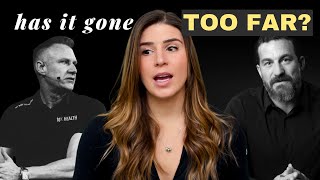
Victoria S. Dorsano argues that health optimization culture focuses on minor tweaks like supplements and ice baths while ignoring the 95% of health that comes from sleep, nutrition, stress, and relationships. Most optimization claims rest on animal studies and limited data, and excessive testing like full-body MRIs creates anxiety over incidental findings that don't matter.
Chapters
Does anyone else feel like they're in a podcast echo chamber with all these different health optimization experts sharing their unique viewpoint on how to perfectly optimize a certain body system and sharing compelling research about how to do that? But then somehow each of these experts seem to at some point contradict the other expert. It's a lot, and I just feel like my feeds have been getting dumped with all this health optimization content. Now, while some of it I think can be helpful, I think a lot of it can actually be dangerous. And I want to get into why. But first, what is it about health optimization that has become so alluring for so many people? And I know I can speak for myself as somebody who used to follow Dave Asprey back in his very early days where he was just talking about buttered coffee. And I think what it is for me was this acknowledgement of our broken medical system and wanting there to be an alternative way for me to take control of my own health and find something to really get a competitive edge of being able to perform perform at my highest level consistently, whether that's mentally or physically. A lot of us have been let down by the medical system. We've seen our parents, our grandparents, our loved ones be hurt at the cost of a really shoddy system. And I'm not faulting the doctors or the science or the research that is the foundation of the system. I'm faulting the system itself. And then secondly, we live in a world that expects a lot of us these days. With the addition of social media and enhanced communication methods and AI, we're expected to output even more these days as far as what we do in society, what we do in our jobs, all that. So I think there's this growing pressure to be able to fine-tune all these systems and really be able to reach our full potential and deliver this high capacity of work consistently. And now more than ever, with these health experts having such accessibility to podcast platforms and being able to publish books easily and being able to develop supplement lines and certain genetic testing, it's become much more accessible for the consumer to learn about their human physiology and to be able to tune into certain metrics and biomarkers and pathways. And it sounds cool, it sounds cool to be able to do this, test things from home, and be able to treat your body as like its own laboratory. But here's the thing, even if Dave Asprey, who again is the founder of like biohacking and the soul optimization movement, says that the goal of biohacking is really to gain full control of our biology. It's not possible to do that. We can never gain full control over the way our body functions. We cannot perfectly measure every single input and output and tweak certain systems in certain ways to get the exact desired outcomes that we hope, because like with anything in life, there's always a facet of our biology that is completely out of our control. One of the biggest problems I see with this health optimization movement that has emerged from biohacking is that I feel like a lot of the times the data that is used to support these claims about optimization is shown in kind of a theoretical standpoint, or data is being extrapolated from an animal study or a mouse study and then applied to how it would work in theory in a human body. And when we boil science down to a mechanistic viewpoint in trying to just understand a certain pathway, how this one thing we ingest affects a certain pathway, then we are negating the entire other couple thousand pathways that also could affect that one pathway when that's initiated. The human body is pretty fine-tuned and is built to have a system of checks and balances. So I think a lot of the times this optimization viewpoint is too simplistic when we're considering the way that the human body functions, because what works in small controlled trials may not apply to public health outcomes. And not only just public health outcomes, but real-world implementation. I just feel like optimizing these smaller biomarkers and physiological pathways is very narrow-minded and narrow-focused and kind of cuts out the bigger picture. Because let's be honest, most of us are not doing the basics well enough to say that optimizing our systems is really going to make that much of an impact. If you're not fully nailing down the larger foundations of health, like eating well, sleeping well, drinking enough water, avoiding or limiting alcohol and smoking, building strong relationships, limiting your mental stress, those are all things that can make significant health impacts as far as the outcomes go. If you tweak some of those and you make sure that you're hitting all those foundations very solidly. And this brings me into this larger point of, I think health optimization really makes people focus on majoring in the minors. And I've talked about the concept of majoring in the minors in some of my other videos, but really what it means is when we focus on the small, small things, like the 5% that's gonna make a very minute difference, instead of focusing on the 95% that's gonna make a huge impact in our health. And I think a lot of people use that 5% as an easy way out. Instead of focusing on the 95, hoping that they can optimize their systems by taking a certain series of supplements or by following a certain ice bath protocol instead of really working on their sleep hygiene or really prioritizing daily movement. Now, if you are somebody who is already hitting all those foundations very solidly and feels very good about that, yeah, play in the health optimization space. But the majority of people are not there. And that's where I feel like health optimization and this whole culture behind it can be really dangerous for the public health. Because a lot of people will hear that and think, that's the thing I need to be doing. I need to be doing this expensive genetic testing. I need to pay $500 to get this genetic profile done to know exactly what kind of methylated vitamins I need. When in reality, they really just need to sleep more. They really just need to eat better first. And then maybe you can do that if you want, but most likely you're gonna be feeling a lot better if you focus on those foundations first. All right. So beyond that, another huge issue I see with health optimization is that it promotes this excessive testing and excessive screening. For example, the full body MRI. Now sure, are there going to be people who do this full body MRI and they catch something serious and are able to mitigate that before it turns into something full-blown for them? Yes, absolutely. But that is a very, very rare case across many. And when you consider the many people who go in and have these benign incidental findings where there's a white smudge on the MRI And then from there, doctors go and investigate. They start doing more testing, which then racks up the medical bills and then causes more anxiety and stress for that person just to find that there's nothing wrong in the end. And that's why there are certain screening guidelines and testing guidelines that exist already, because usually anything beyond that is gonna do more harm to more people than good, not to mention strain the medical community, which is already very strained. So what's the best way to move forward from here? Really, it goes back to some of those basics that I talked about, focusing on those foundations of health. I know it's not sexy. I know it's not something that I can sell to you in a bottle or a $500, you know, test that you can do at home. It really comes back to focusing on those basics. Start there. Then you can reach out to some of these optimization experts, try some of these techniques, see how that goes. But just as I talk about how important it is to be a patient advocate for yourself in the medical system, you You also need to understand that you have to be a consumer advocate for yourself in the wellness industry, because there are definitely a lot of snake oil salesmen out there trying to sell you very expensive treatments that are going to make very, very limited impact on your health, if at all. So no need to be cynical, but always have a critical thinking hat on and be a little skeptical when you are hearing about a new optimization technique. All right, you guys, I hope you enjoyed this video. I'd love to hear your perspective on health optimization, what you think. About the whole health optimization culture, different health gurus and health experts in this field. Just keep it nice and respectful, okay? And again, if you like this video, please don't forget to give it a thumbs up and subscribe to my channel. As always, I appreciate you guys, and I will see you guys next time. Bye!