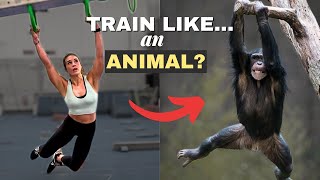
Victoria S. Dorsano compares captive chimpanzees' strength training to humans' sedentary decline, which has tanked grip strength and bone density. Resistance training boosts BDNF, improves memory, and cuts dementia risk. She outlines a twice-weekly protocol covering push, pull, legs, and carries.
Chapters
There's an animal out there that shares 98% of our DNA and is required by law to engage in daily strength training activities to ensure optimal health. Wanna guess what it is? That's right, our closest animal relatives, the chimpanzees, are legally required to have strength-based enrichment to prevent depression and illness. Yet somehow we've convinced ourselves, the human primate, that we don't need the same. We've essentially become captive humans in our own artificial environment. The average office worker now spends about 11 hours of their day sitting at the desk, while our primate cousins are required to lift and move and climb to stay healthy. For 300,000 years, humans were the ultimate generalist athlete. Our ancestors' bones were 50% denser than ours. Their grip strength would put modern athletes to shame. And it's not because they were going to the gym or lifting giant boulders for the sake of it. It's because their survival demanded it. Since 1985 alone, our grip strength has decreased by 20%. Not to mention, our bone density is getting worse and worse with each generation, and our skeletal muscle is just vanishing, with the average person losing about 3 to 8% of their muscle mass per decade after the age of 30. But here's the fascinating part. While we've been getting weaker, our primate cousins have been teaching us something extraordinary about movement. In 1960, Jane Goodall made a revolutionary observation. Wild chimpanzees don't just move to get from point A to point B. They move to think, to feel, and to solve problems. Their daily physical activity was intrinsically linked to their cognitive development. And this is why modern zoos are required to provide something called enrichment, which is basically— think of it as strength training and active play for animals in captivity so that they don't fall chronically ill, get depressed, and lose their ability to develop as naturally as they normally would in the wild. Without strength-based enrichment in captivity, these animals start to suffer a lot of the similar issues that we start to see in our modern-day world plaguing humans: depression, obesity, chronic illness, and even metabolic disorders. Now, of course, if you watched any of my other videos, you know I'm all about nuance. So I'm not saying that physical movement and strength training is the cure-all to all of our modern ailments, but it certainly is something that is a factor, just like our nutrition and our social health and other things that go into just being a healthy human. But there's no denying that how much the lack of strength training and physical movement in our daily lives has been affecting our health. Without intervention of strength training, we lose about 1% of our bone mass every single year after the age of 40. Beyond that, our insulin sensitivity drops by 30% if we're not challenging our muscles in new and engaging ways, which decreased insulin sensitivity means a higher risk for developing diabetes and other metabolic conditions. And perhaps the most shocking statistic is that adults that don't regularly engage in strength training have a 46% higher chance of an early death. But just like how strength training enrichment with captive zoo animals, and especially chimpanzees, helps them improve their cognitive and mental health, the absence of that in our lives leads to the opposite— decline in cognitive development. But if we're able to incorporate strength training regularly, there's some really interesting things that happen in the brain. A groundbreaking study from Harvard actually shows that regular strength training increases something called BDNF in the brain, or brain-derived neurotrophic factor, which is essentially just a protein that enhances our cognitive function. And it's affectionately been nicknamed like Miracle-Gro for the brain. And beyond that, adults who maintain their strength training regimens score 19% higher on memory tests and have on average a 30% lower risk for developing dementia. But here's the cool thing: I'm not saying that you have to go out and become a bodybuilder and lift weights every single day of your life. Research actually shows that just a little bit of resistance training incorporated weekly can go a long way. Even just 2 30-minute strength training sessions per week can make a huge difference. Even beginners can see measurable differences in their health and well-being outcomes within 8 to 12 weeks. So if you don't already have a strength training routine, don't sweat it. Here's what you need to do. In theory, we want to focus on a couple of core movements: a pushing movement— so this would be something like a push-up that's modified to your level— a pulling movement, even starting with like simple resistance band rows, a squat or a hip hinge movement like a deadlift, and a carrying movement similar to carrying heavy bags of groceries. So here's how you realistically can put this together in like a twice-a-week format. So first, you're going to pick your standard push exercise, which is going to be like a push-up for 3 sets of 8 to 12, or a dumbbell bench press for 3 sets 8 to 12. Next, you want to choose your pull exercise. So that can be dumbbell rows, again 3 sets, 8 to 12. Another one would be like pull-ups or chin-ups. You can do 3 sets of however many of those you can get in. Then you'll want to choose your leg movement, whether that's a hip hinge or squat. So you can do something like goblet squats for 3 sets of 10 to 15, or Bulgarian split squats for 3 sets of 8 to 12 each leg. Or you can even add in a deadlift here for 3 sets of 8 to 12. And the last one, you're going to pick an exercise that's like a core and a carry exercise. So you'd actually technically do both of these. So something like a plank, maybe for 30 to 45 seconds, and a farmer's carry for about 3 sets of 30 yards. And an important note is when these exercises start to feel easy, you're going to want to make sure you progress them to keep challenging your muscles. But the key isn't always intensity. It's, of course, consistency too. Something is always better than nothing. So even if you can't get 2 times in a week, start with just one time in a week. You'll at least be making some progress towards those goals of a healthier you. And of course, although we didn't talk about this in this video, and per se, nutrition is very important, especially when we're talking about strength training. So make sure you're keeping your protein high, you're getting a variety of protein— fruits, veggies, grains, all that good stuff. But you're especially going to want to increase your protein to make sure that you have enough to repair your muscle tissue. In addition to getting lean whole food sources of protein like chicken, fish, legumes, lean sources of red meat, all that good stuff, I'm also a big fan of supplementing with some protein powders and some protein bars if needed throughout the day. It just makes it easier to do sometimes if you have a really busy schedule. One of my favorite companies to get pure and lab-tested supplements is Legion Athletics. I'll be sure to link them down below, and if you're interested in placing an order for some of their amazing protein powders, protein bars, and other supplements, be sure to use code Victoria for 20% off your first order. So in the end, we're really not all that different from our primate cousins after all. Our bodies still crave the same basic movements The same physical challenges, the same strength-based problem solving. I don't know about you guys, but when I am lifting and working out, I do some of my best thinking. The only difference is we have a choice. We are not legally mandated to engage in strength training like captive zoo animals are. We have to choose to give our bodies what they need. So my one piece of advice is don't wait to start. Don't wait for perfect conditions. Start today. Your primate brain will thank you. That's all I got for today, folks. I hope you enjoyed this video. If you did, go ahead and give this video a thumbs up subscribe to the channel. I greatly appreciate each and every one of you that subscribe, so thank you, thank you, thank you, and I will catch you guys on the next one. Bye!