Why I Chose To Get ACL Surgery vs Non-Surgical Treatment (& How I Weighed The Options)
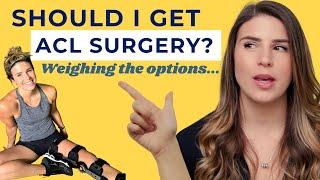
In this video, Victoria S. Dorsano recounts her personal journey after rupturing her ACL in February 2020 and explains how she decided to undergo surgical reconstruction rather than pursue a non‑operative rehabilitation path. She describes discovering the non‑surgical option through a physiatrist, reviewing research on long‑term osteoarthritis risk, and weighing lifestyle demands such as her fitness‑coach job and competitive volleyball. Financial considerations, insurance coverage, and the anticipated rehabilitation timeline (including a later kneecap fracture) are discussed. Dorsano also references emerging studies on spontaneous ACL healing and notes that graft selection is a separate topic. Throughout, she emphasizes that her decision was highly individualized, acknowledges the pros and cons of each approach, and encourages viewers to evaluate their own priorities when faced with a similar choice.
Chapters
What's up everyone, Victoria S. Dorsano here, and today I'm going to share with you guys a little bit about the process of how I decided to get my ACL surgery. But before I dive into that, if you can give this video a thumbs up and subscribe to my channel, I would greatly appreciate it. All right, so if you're not familiar with my ACL videos and my ACL journey in general, I'll go ahead and put the links to all my ACL videos down in the description below as well as link them in this video. I had ACL surgery in February 2020 and had a long recovery process with a variety of complications that happened along the way. And a lot of you guys have commented on these videos and I've gotten so, so many great questions and so many great wonderful comments from you about, you know, the process, what it was like, you guys sharing your stories of your ACL journeys as well. And it's absolutely amazing. But one of the most common questions I keep getting asked is, how did I decide to get ACL surgery? You know, because believe it or not, it's not necessarily, uh, the only route to go when you have an ACL rupture. You have a non-surgical approach, but everybody's case is completely different. So I want to go into a little bit of why I decided to go the route of ACL surgery versus a non-surgical approach and what that was like, and some of the deciding factors that led me to make that ultimate decision of getting the surgery. But before I dive in, I do want to mention that that my journey and my story and my body and all the things that I've experienced in this process are completely different than your case and somebody else's case and somebody else's case. So I want you to make sure that the way that I went through this and decided about getting surgery for myself, um, just take it with a grain of salt and understand that you might have your own approach and your own factors that are going to, you know, mix into your decision. All right. So let's dive in. February of 2020, had my ACL rupture, right? And at that point, um, I actually didn't know. I was pretty certain when I had the injury happen that it was my ACL that ruptured, cuz it's a very, very distinguishable feeling and noise and pain that comes along with it. Um, yes, I'm like cringing thinking about it, but, um, I describe it a lot in my other videos if you wanna see what that experience is like, but I was pretty certain that's what happened. I didn't know, of course, until I got my MRI results back a few weeks later. Um, and once I did get the MRI that confirmed it was a full rupture, I actually didn't even think twice about getting surgery or having that be the option I was going to go for because I didn't know that there were options. I really only had known ACL surgery to be the option. Um, and it wasn't until I saw a physiatrist who's you know, physical rehab specialist, um, that I heard about doing any other option other than surgery. The reason why I saw this physiatrist, who was a DO, a doctor of osteopathic medicine, was because I was having a lot of swelling in my knee and I hadn't been able to get into my surgeon yet to do an eval. Like, we had confirmed through the MRI that there was a rupture, but I wasn't able to go see my surgeon yet at this point. And I was having a lot of swelling, a lot of inflammation in the knee, and I wasn't able to move it really well. So I went to this DO who I'd known and had gone to for other sports injuries. And he had done a knee aspiration and drained some of the blood and the fluid out of the knee just to get the joint down so I can get range of motion back. But he was the one who actually was telling me like, hey, you don't have to get surgery. You can go through, you know, a rehab process and see how it feels. And at the end of the rehab process, if you feel like your knee's unstable, you can go for surgery then at that point. And I was like, whoa, I have no idea. And this was news to me. I had no idea that that was an option, uh, and that people could move around and exist without an ACL. And he was kind of telling me a little bit about the pros and cons of each situation, whether I was going to get the surgery or not get the surgery, and what the outcomes could be for each. But ultimately he's like, you know, you're gonna have to try it out yourself and decide what's best for you. This is a really personal decision. And he's right, it is a very personal decision. So I remember him sending me a few articles about, you know, ACL surgery, the outcomes, um, going a non-operative way and doing physical therapy and rehabilitation of the knee without surgery and what the outcomes were of that. And I think one of the most alarming things that hit me first was when I was reading all the research and the studies on like the instances of knee osteoarthritis after ACL surgery. And that was the first time I was like, whoo, I don't want osteoarthritis. And in a lot of the studies say, you know, within 10 to 20 years of, uh, an athlete getting their ACL reconstruction done, that it's— there's like a likelihood of— don't quote me on this, I want to say 50%, but it's probably not— there's a likelihood of, a strong likelihood of getting osteoarthritis in that knee. And that's scary because I don't want osteoarthritis that early in my life. So that was something where I was like, whoo, I don't really know if that's gonna be the best option now for me. So maybe I should just try doing physical therapy and rehab first and seeing how my knee feels and going from there. So I went that route and just started doing some physical therapy, some rehab, and seeing how my knee was feeling and if it was gonna get stronger, if it was still, you know, gonna be kind of unstable. And my knee instability wasn't terrible to begin with. I actually passed the Lachman's test when I was at the doctor. Like they didn't think my ACL was ruptured because my leg was pretty stable. But I will say on like lateral movement, it was very, I could feel it in my body that it was like shifting. Like my femur felt like it was shifting over the tibia like it shouldn't have. And it just didn't feel right. Like something felt grindy and weird. And there was just some internal pain in the knee still, even weeks after doing physical therapy. So at that point, I wasn't feeling too hopeful that that was gonna be the best approach for me, and then I was gonna get back to where I wanted to be activity-wise and playing my sport of volleyball. And this is where the other factors started to come into play. So I started to consider, okay, so for my job as a health coach, a lot of my work is done remotely, but at the time I was teaching fitness classes and I had a very active, you know, few days a week where I was teaching fitness classes back to back and really moving my body and it was just very demanding of my body to teach these classes. So that played a factor into it because if I wanted to continue doing that, was I going to be able to do that with a ruptured ACL? Would it be better to have surgery and have a stable ACL? Um, even though it is a long rehabilitation process after the surgery. And then volleyball, I mean, my sport of volleyball, I, I've talked about this in other videos. That's just, that's my sport. I love it. And I would hate for that to feel like taken away from me or scared to play it. It's hard because I was talking to, again, the, the DO and asked him like, hey, would I still be able to play like a lower level of volleyball, maybe not super aggressive without getting the ACL surgery? And he basically said, yeah, that's totally fine. You'd totally be enabled. You'd be able to jog. You'd be able to do, you know, most of the things you'd love to do. There's just a chance that you may damage some meniscus or some other ligaments in the knee because your knee could be a little bit less stable. So that was, again, like, I was like, do I, do I wanna play volleyball at like a lesser level and like purposely hold back? And knowing my personality, I'm kind of like an all or nothing type of person when it comes to sports. I'm really not good at holding myself back. Like I'm not good at like being like, oh, I'll give a level 6 effort today. No, if I'm going to play, like, I'm going to play at like level 9 or 10 effort all the time. It's like really hard for me to do that and it doesn't come natural. So in my mind, I was just thinking about it as I don't think I'm going to be able to go on a volleyball court and not give it my all just because that's the personality type that I have. And I don't trust myself to not give, give it my all if I were to play really any sport. So I had to consider that in the mix too. So on top of like, you know, we're having the factors of like arthritis as a con of surgery and then, you know, playing sports, you know, and to my full capacity as a pro of surgery. And there's just like a lot of like mixing factors in there. But ultimately what it came down to is I have an active lifestyle. I want to be able to live my active lifestyle with less worry about damaging other areas of my knee. And I want to be able to be free and capable to try new sports, to be aggressive in the sports that I love, to, you know, not have to worry about damaging other areas of my knee because my knee may be unstable from not having an ACL there anymore. And all those things just came to a head, and I really just decided that going through the ACL reconstruction surgery was going to be the best option for me. Even though I'm not I'm not currently like a professional athlete by any means, you know, or, you know, collegiate athlete. I'm 30 years old, but I still do play sports. You know, it's just for the type of lifestyle that I wanted to live, I really thought that surgery was gonna be the best option for me. And I'm still happy I did go through that with that whole process of surgery. And yes, the rehabilitation process is long. After ACL surgery. They say 6 to 8 months. It's in more realistically about a year at least in terms of getting back to true normal normal of how your knee feels. Sometimes longer, sometimes shorter, but I'd say for me it took about a year. I also broke my kneecap in that process of ACL healing after the surgery, and if you haven't watched that video, again, I will drop that link in the description as well as tag it here into the video. But yeah, I mean, for me it just made sense to get the surgery done because I didn't want to live my life feeling scared that I was going to not be able to perform the way I wanted to perform in my sports or my, you know, job if I was ever going to teach classes again, you know, fitness classes. So that's what it came down to. And the risk of having osteoarthritis to me was something that, you know, I could try to manage through lifestyle factors like eating an anti-inflammatory diet, really making sure I'm continuously doing my physical therapy even well after the year mark of being out of surgery, which I'm, you know, still doing a lot of knee exercises. And I've mentioned on a previous video that I'm doing the Knees Over Toes program to continuously build up that knee strength. So I'm being proactive about it. I'm trying to do my best to not overtax my knee joint to prevent that osteoarthritis, and I'm very happy with how my knee's been performing, you know, since the surgery. I'm really glad I did get it. Yes, there were some complications like my kneecap breaking in half, but all in all, I think it was the right decision to make for me. For other people, it might not be. There's a lot of people who delay their ACL surgery or, you know, push it for a year, 2 years just to see how you know, doing physical therapy and a non-operative approach is going to work. And a lot of people have great success with that too, so that is possible. And there's actually a really cool paper that came out that was showing spontaneous healing of a fully ruptured ACL ligament is possible. They studied— it's a very small sample size, I think there's 14 people, so really not— they need to do it at a much larger scale for it to be like an actual, like thing that can be considered to be an option, that your ACL is going to spontaneously regrow. But I thought that was really interesting too. So there's a lot of healing that can be done in the body, um, that you might, you know, that that non-operative approach might be better. And I totally understand that the cost is a factor too. It was definitely something that weighed into my decision on this. I did have health insurance. I'm self-employed, so I had my own health insurance that I bought It's not the greatest health insurance, but it was able to cover a good amount of the surgical costs. I did have to pay a pretty significant amount out of pocket, and I'm still paying that off in a payment plan. But for me, it was worth it and manageable. And oftentimes a lot of hospitals and surgical centers will work with you on a payment plan for little to no interest so that you can pay off any kind of expense like that. Um, you know, over time. So I'm— even despite the cost of the surgery, I'm still glad I did it. But I totally understand that that's a factor for some people, and some people don't have medical insurance or the ability to, to pay for the surgery, so they'll wait and delay it for multiple years or choose not to get it at all. And that's definitely an option to, to think about too. So all these factors are important to consider. And then there's the whole other question of like, if you are going to get surgery how do you decide on what type of ACL graft do you want to get? And I'll make a separate video about that because that's, you know, its own, its own topic. But I just wanted to go through and highlight just my process in this, my thoughts that were going on at the time, and how I was going through this whole journey and making these decisions, and what were my personal lifestyle factors that, that came into play when considering to get surgery or to not get surgery, and how I ultimately led up to the decision of getting the surgery done. So I hope this helped, just kind of walking through my thought process with me. If you are in that stage of trying to decide if you want to get surgery or not, or delay it, or not get it at all, or whatever that's going to look like for you, I hope just considering some of these factors and just kind of walking through this process of how I went through this helped you and gave you some hope of some options maybe you didn't consider, or, you know, just some hope that you know, there is a right option for you, and it's just a matter of kind of weighing through those options in your life. And if you could like this video and subscribe to my channel, I'd be super appreciative of it. And if you're looking for more ACL content, definitely subscribe to my channel because I'm going to be posting some more videos about my ACL journey, specific things along the way that have worked for me, that haven't worked for me, and, uh, just continuing to update everybody on my current knee progress. All right, so that's all I got for today. Have an awesome one. Bye.
More from Victoria






3 things you should do to make sure you get the most out of your fish oil #legion
